
Carb Loading for Football Explained: Is It Worth It?
This post contains affiliate links. As an Amazon Associate, we earn from qualifying purchases.
Carb loading for football is the strategic increase of your carbohydrate intake in the 24-48 hours before a match to maximize muscle glycogen stores — your primary fuel for high-intensity running. For a match, aim for 6–8 grams of carbohydrate per kilogram of your body weight the day before, a pre-match meal of 1–3 g/kg 3–4 hours prior, and 30–60 grams per hour during play. The goal isn’t to eat a mountain of pasta the night before; it’s to consistently top up your tank when your body can best store and use the fuel.
That glycogen tank empties fast. A 2024 systematic review in PubMed Central confirms muscle glycogen drops drastically by the final whistle and stays low for a full 48 hours afterward. If you only load before the match and ignore the recovery window, you start your next training session or match already in a deficit. The principle of carb loading for football explained is to fill stores before and replenish them after.
What follows is the football-specific playbook for the carb loading for football explained question: the exact gram-per-kilo numbers from the latest research, the meal timing that beats a last-minute binge, and the one recovery rule that most amateur players miss.
Key Takeaways
- Carb loading is not just the night before. The process starts 24-48 hours out with 6–8 g/kg of carbs per day, requiring consistent eating across multiple meals.
- Your pre-match meal is a separate event. Eat 1–3 g/kg of carbs 3-4 hours before kickoff to top off liver glycogen, which fuels your brain and central nervous system.
- Muscle glycogen remains low for 48 hours post-match. Start refueling with 1–1.5 g/kg of carbs within 20 minutes of the final whistle to kickstart recovery for the next session.
- During the match, sip on a carbohydrate-electrolyte drink to take in 30-60 g of carbs per hour. This maintains blood glucose and delays the drop in sprint speed and passing accuracy later in the match.
- Individual tolerance is key. The high end of these ranges can cause gut distress if you haven’t practiced it. Test your pre-match meal and in-game fuel in training first.
What Carb Loading Actually Does (And Doesn’t Do)
Carbohydrates get stored in your muscles and liver as glycogen. Think of it as your body’s premium unleaded fuel for high-intensity efforts. A full tank lets you maintain your top speed, make sharp defensive reactions in the 85th minute, and keep your passing crisp when legs get heavy.
A 2024 systematic review on carbohydrate intake and soccer performance found that following a diet providing 8 g/kg/d of carbs for 3–4 days allowed players to cover 17% more distance at higher speeds during a match compared to a diet providing only 3 g/kg/d.
The common misconception when you compare a carb loading for football explained is that carb loading is about eating a huge bowl of pasta the night before and calling it a day. That’s a recipe for feeling sluggish. The real work is a consistent elevation of your intake over the final 48 hours, paired with a taper in training load. Your body can only store so much glycogen at once, and the process takes time.
It’s also not a magic bullet for a lack of fitness. If your base endurance isn’t there, a full glycogen tank will delay fatigue, but it won’t turn a 5k runner into a marathoner. For football — a sport built on repeated sprints and explosive changes of direction — that tank is what separates players who fade from those who finish strong.
The Core Carb Loading Timeline for Football
Forget the old 6-day depletion protocols. Modern football carb loading is a 2-3 day process centered on the match, with clear daily targets. This isn’t a one-size-fits-all number; it’s a sliding scale based on your size and the work you’re doing.
| Timeline | Carbohydrate Intake (g/kg body weight) | Primary Goal | What Happens If You Skip It |
|---|---|---|---|
| Match Day -2 & -1 | 6–8 g/kg/day | Maximize muscle glycogen storage. | Glycogen stores start sub-optimal. You’ll feel the drop in power and sharpness earlier in the match. |
| Match Day (Pre-Meal) | 1–3 g/kg (3-4 hours before) | Top off liver glycogen, ensure steady blood glucose. | Risk of early mental fatigue, slower reaction time, and that “empty” feeling by halftime. |
| During Match | 30–60 g/hour (via drink/gel) | Maintain blood glucose, spare muscle glycogen. | Noticeable drop in sprint speed and skill execution in the final 20-30 minutes. |
| First 4 Hours Post-Match | 1–1.5 g/kg/hour (start within 20 min) | Rapidly replenish muscle glycogen, kickstart recovery. | Glycogen stores stay depressed for 48+ hours, impairing performance in the next training session or match. |
The numbers here come straight from the 2024 systematic review, which synthesizes decades of football-specific research. Notice the post-match column. That 48-hour recovery window is the part most Sunday league players completely ignore. You can nail the pre-match load, but if you go home and have a beer and a burger, you’ve lost the chance to properly refuel.
Where this goes sideways: Trying to hit 8 g/kg in one massive meal. Your body can’t process it all at once. Spread the load over 4-6 smaller meals and snacks across the day to avoid feeling bloated and to maximize absorption.
How do you hit 6-8 g/kg? For a 75 kg (165 lb) player, that’s 450–600 grams of carbohydrate per day. That sounds like a lot, but it breaks down into manageable portions: a large bowl of oatmeal with banana and honey (75g), a sandwich with a sports drink (100g), a rice-based meal with fruit (120g), and a few carb-rich snacks like pretzels or yogurt.
What and When to Eat: A Practical Game Week Plan
Translating grams per kilo into actual food is the hardest part. Here is a sample plan for a Saturday match. This assumes a 75 kg player aiming for the middle of the ranges.
Thursday & Friday (Load Days): Training should be light or tactical (no grueling fitness sessions). The goal is consistent intake.
- Breakfast: 100g oats made with milk, topped with a banana and 2 tbsp honey. (~120g carbs)
- Mid-Morning Snack: A bagel with jam, plus a 500ml sports drink. (~80g carbs)
- Lunch: A large jacket potato with tuna and sweetcorn, plus an apple. (~100g carbs)
- Afternoon Snack: A 500ml fruit smoothie and a cereal bar. (~60g carbs)
- Dinner: A large portion of chicken and vegetable stir-fry with 1.5 cups (cooked) of white rice. (~120g carbs)
- Evening Snack: Bowl of cereal with milk. (~50g carbs)
Total: ~530g carbs (about 7 g/kg for a 75kg player).
Saturday (Match Day):
- Breakfast (3-4 hours before): This is your pre-match meal. Keep it low in fat and fiber to avoid gut issues. Example: a pre-match meal containing 1–3 g/kg of carbohydrates, such as white toast with a topping and fruit.
- Top-Up (60-90 mins before): A small, easily digestible snack if needed, like a Maurten gel or a slice of toast with honey.
- During Match: Sip on a carbohydrate-electrolyte drink each half. This delivers roughly 30g of carbs per bottle.
- Immediately After (within 20 mins): This is essential. Have a recovery shake or a 500ml chocolate milk ready. It provides carbs and protein to start the repair process.
Common mistake: Choosing high-fiber “healthy” carbs like lentils and whole-grain pasta on load days. The extra fiber can cause bloating and digestive discomfort. Stick to low-fiber, easy-to-digest carbs like white rice, white pasta, potatoes, and white bread during the loading phase.
Your pre-match meal strategy deserves its own focus. The Portuguese Football Federation consensus notes the average pre-match meal in studies is under 1.5 g/kg, lower than their recommended 2-3 g/kg. That gap explains why so many players hit a wall.
Carb Loading for Different Players: Weight, Position, and Gender

The gram-per-kilo formula automatically scales for body weight. A 200 lb (91 kg) player needs more total grams than a 150 lb (68 kg) player. For the 200 lb athlete, 6 g/kg means 546 grams of carbs; 8 g/kg means 728 grams. The meal plan structure is the same, just with larger portions.
Position matters, but the research is still catching up. A 2022 journal article in the Journal of Sports Sciences notes that goalkeepers may have different requirements due to lower overall running distances but higher explosive power demands. For now, outfield players should follow the standard guidelines. If you’re a keeper who also acts as a sweeper and covers a lot of ground, err toward the higher end.
The most important caveat is for youth and female players. The same 2022 article states clearly that carbohydrate periodization “should not be practiced by youth or female players given the negative health and performance outcomes associated with reduced energy availability.” For these groups, the focus should be on consistently meeting daily energy and carbohydrate needs to support growth, health, and performance, not on strategic restriction and loading.
The PMC systematic review on soccer performance adds that female players often underestimate their energy expenditure and don’t consume enough carbs overall. The guidelines should be individualized, but the priority is avoiding a deficit, not engineering a surplus for a single match.
In-Match Fueling and the Critical Recovery Window

Loading sets the stage, but what you do during and immediately after the match determines how you finish and how quickly you bounce back.
During the Match: Aim for 30-60 grams of carbohydrate per hour. The easiest way is through a sports drink. The Gatorade Sports Science Institute football fuel guide and the Portuguese Federation consensus agree: a 6-8% carbohydrate solution is optimal. Drinks stronger than 8% (without specific maltodextrin blends) can delay gastric emptying and cause stomach cramps.
Sip don’t gulp. Take 2-3 big mouthfuls every 15 minutes during natural breaks in play. This steady trickle keeps your blood glucose stable without sloshing in your stomach.
The Golden Recovery Hour: This is the most underrated part of the entire process. That 2024 review is emphatic: muscle glycogen remains low for 48 hours post-match. To interrupt that, you need 1–1.5 g/kg of carbs per hour for the first 4 hours, starting within 20 minutes of the final whistle.
Your first priority after shaking hands is not the protein shake. It’s carbs with a little protein. A chocolate milk, a recovery shake, or even a banana and a sports drink will do. This isn’t about building muscle yet; it’s about refilling the fuel tank while your muscles are most receptive. This practice is a cornerstone of effective post-match recovery.
Has Carb Loading Been Debunked? The Football Reality
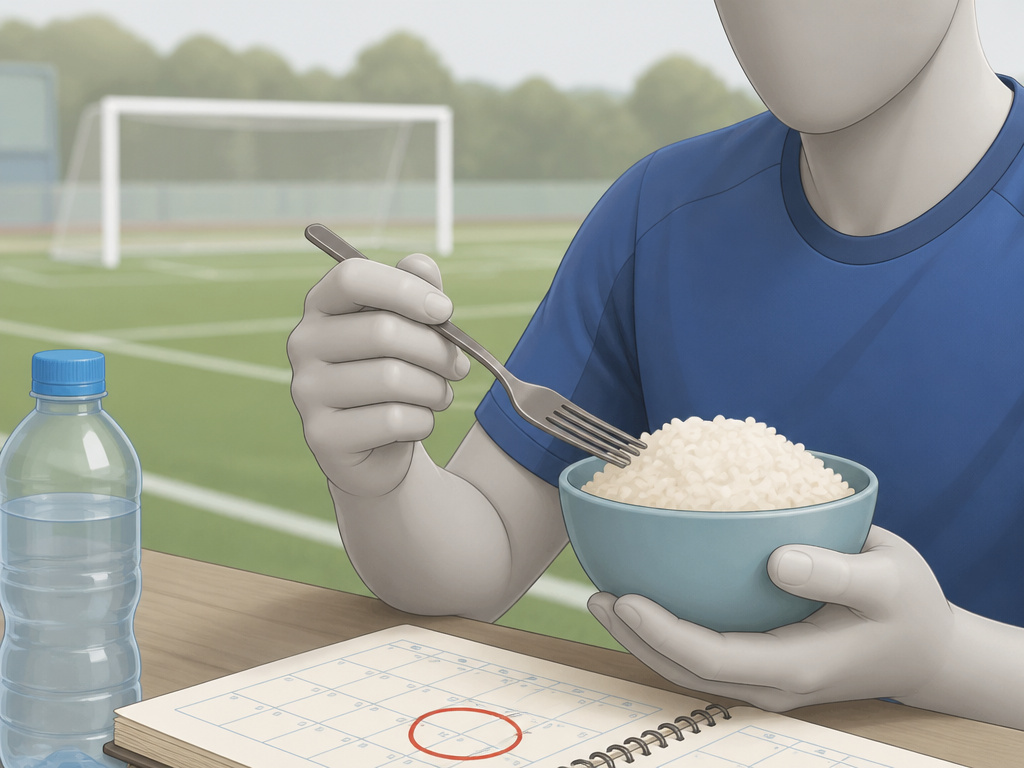
You might read headlines claiming “carb loading is dead.” That advice is usually aimed at endurance athletes in steady-state events or the general public. For football, a 90-minute intermittent high-intensity sport, the evidence is robust and specific.
The confusion comes from applying marathon data to a football match. Yes, the body can use fat as fuel at low intensities. But the top-end speed, the jumps, the tackles, and the repeated sprints that decide games are powered almost exclusively by carbohydrate. When your glycogen runs out, your brain knows it. Your perception of effort skyrockets, your decision-making slows, and your legs simply won’t move as fast.
Studies cited in the team sport performance carbohydrate nutrition review show that carb intake before and during team-sport exercise preserves both physical performance and central nervous system function. It’s not debunked; it’s just been refined. We now know it’s about periodizing your intake across the week — higher on heavy days, lower on light days — not just a one-off binge.
For the amateur player, this means being intentional about your core nutritional strategies in the 48 hours before a big game. It’s not complicated, but it requires planning. Skip the Friday night takeaway and cook some rice.
Frequently Asked Questions
How many carbs does a 200 lb football player need to load?
For a 200 lb (91 kg) player, carb loading the day before a match means consuming 545 to 728 grams of carbohydrate. This uses the standard range of 6–8 grams per kilogram of body weight. Hit this by spreading your intake across 4-6 meals and snacks featuring foods like rice, pasta, potatoes, bread, and fruit.
What is the 4-2-1 rule for athletes?
For football carb loading, the gram-per-kilogram recommendations (6-8 g/kg) from sport-specific research are more accurate and tailored to the high fuel demands of a match.
Can you carb load the morning of a football match?
You cannot fully carb load the morning of a match. The process of synthesizing and storing significant muscle glycogen takes 24-48 hours. What you eat on match morning is your pre-match meal (1-3 g/kg 3-4 hours before). Its job is to top up liver glycogen and ensure stable blood sugar, not to fill your primary muscle fuel tanks.
Is carb loading just for professional footballers?
No. Any player competing in a match lasting 90 minutes or more will benefit from optimizing their glycogen stores. The principles are the same whether you’re in the Premier League or Sunday league. The difference is in the precision and resources; a pro has a chef, but an amateur can still plan their meals around the same timeline and food choices.
What are the best carb-loading foods for football?
The best foods are high in carbohydrates but low in fiber and fat to maximize digestibility and storage. Opt for white rice, white pasta, white bread, potatoes, bananas, fruit juices, sports drinks, honey, jam, and cereal. Save the high-fiber whole grains, beans, and fatty foods for your regular football nutrition guide, not your intensive load days.
Before You Go
The biggest mistake isn’t under-eating carbs; it’s mistiming them. Loading starts two days out, not at dinner the night before. The most important meal might be the one you have in the 20 minutes after the final whistle, when your muscles are screaming for fuel to start the 48-hour repair job.
If you take one thing, let it be this: test your plan. Try your target pre-match meal before a hard training session. Practice drinking your hydration for football strategy in a friendly. Your gut needs training just like your legs do. Find what works for you, stick to it, and you’ll stop being the player who disappears in the last twenty minutes. You’ll be the one others are trying to keep up with.
