
How to Hydrate for a Football Match: The 3-Phase Protocol
This post contains affiliate links. As an Amazon Associate, we earn from qualifying purchases.
To hydrate for a football match, follow a 3-phase protocol based on body weight and sweat rate. Drink 5–7 mL of fluid per kilogram of body mass in the 2–4 hours before kick-off. During the match, aim to limit fluid loss; sources disagree on the exact limit, with UEFA suggesting preventing a deficit >2–3% body mass, while Aspetar and NATA recommend keeping loss to <2%. After the final whistle, drink 1.2 to 1.5 liters for every kilogram of weight lost, as recommended by Aspetar; the Portuguese Football Federation recommends 1.5 L/kg lost. Sports drinks (4–8% carbohydrate) are useful for matches longer than 60 minutes or in the heat.
That 2% weight loss ceiling isn’t a random number. It’s the threshold where the UEFA expert group and the National Athletic Trainers’ Association (NATA) agree performance deficits start, your heart rate climbs, your temperature rises, and your decision-making gets fuzzy. The trick isn’t to drink until you’re sloshing; it’s to limit your fluid deficit to prevent performance loss. Understanding how to hydrate for a football match is key to staying below this threshold.
What follows is the playbook the pros use, stripped of the supplement hype. We’ll walk through the exact amounts for before, during, and after, explain why “drink when thirsty” is bad advice when learning how to hydrate for a football match, and show you how to handle the two biggest variables: morning kick-offs and blistering heat.
Key Takeaways
- Start hydrating the day before an early match; the pre-match window alone isn’t enough to correct a deficit.
- Weigh yourself before and after training to find your personal sweat rate; general guidelines fail both high and low sweaters.
- In warm conditions, your sweat rate can jump to over 1.4 liters per hour; upgrade your drinking plan accordingly or you’ll fade.
- Use a sports drink with 4–8% carbohydrates for matches over 60 minutes to fuel your brain and muscles simultaneously.
- Post-match, drink 1.2–1.5 L for every kg lost; plain water won’t fully rehydrate you without sodium from food or a drink.
The Pre-Match Hydration Window
Forget slamming a litre right before you walk out. Effective pre-match hydration is a slow, deliberate process that starts hours earlier.
The UEFA expert group’s guideline is your anchor: 5–7 mL of fluid per kilogram of body mass in the 2–4 hours before kick-off. The goal is to start the match “euhydrated”, a state where your urine osmolality is under 700 mOsmol/kg or its specific gravity is below 1.020.
The day prior to a match with an early kick-off is a key opportunity to optimize hydration. The standard pre-match window may be insufficient if you start from a deficit.
This is the part most Sunday league players miss. If you have a morning game, your hydration work is done on Friday and Saturday. Rolling out of bed and trying to “cram” fluid in the two hours before doesn’t work; your body just processes it as excess and you’ll be sprinting for the bathroom during warm-ups.
Where this goes sideways: Relying on thirst. Thirst perception typically kicks in at about 2% body mass loss, a level where the Gatorade Sports Science Institute notes performance deficits can occur. By the time you feel thirsty during a match, you’re already playing catch-up.
| Time Before Kick-Off | Action | Rationale |
|---|---|---|
| 24+ Hours (Day Before) | Drink consistently with meals. Monitor urine color (light straw). | Builds fluid reserves, especially critical for early kick-offs. |
| 2–4 Hours | Drink 5–7 mL/kg BM. Have a carb-rich meal. | Allows for fluid absorption and gastric emptying. Top up liver glycogen. |
| 10–20 Minutes | Sip 200–300 mL of water or sports drink. | Final top-up. Provides accessible fluid for the first 15-20 minutes of play. |
What to Drink During the 90 Minutes
Your in-match goal is damage control: prevent dehydration from exceeding that 2% body weight loss limit. This isn’t about matching sweat loss drop-for-drop, that’s often impossible, but about limiting the deficit.
The Portuguese Football Federation measured it: sweat rates range from 1.13 liters per hour in cool conditions (around 5°C) to 1.46 liters per hour in warm conditions (around 27°C). That’s a massive swing. The practical takeaway? You need a plan for the weather.
In cooler conditions it may not be necessary to drink at all. In warm environments, drinking practices should be upgraded to reduce the overall fluid deficit.
So what’s the practical protocol? The NATA recommends taking in 200–300 mL of fluid every 10–20 minutes during activity. That’s a few good gulps every time there’s a stoppage or at the midway point of each half. For a morning match in cool weather, you might only need a few sips at halftime. For an afternoon game in the sun, you should have a bottle ready at the touchline and use every break.
Water vs. Sports Drink: The Sideline Decision
This is where your football nutrition knowledge gets tactical. For matches under 60 minutes, water is fine. For longer or more intense sessions, you need fuel as well as fluid.
- Water: Replaces fluid only. Use it for shorter matches, cooler days, or if you’ve eaten well beforehand.
- Sports Drink (4–8% carbohydrate): Replaces fluid, electrolytes, and provides 20–60 grams of carbohydrate per hour. This is the choice for energy maintenance in matches over 60 minutes, in the heat, or if you’re a player covering high distance.
The carbs aren’t just for your legs. Your brain runs on glucose, and decision-making accuracy nosedives when blood sugar drops. A GSSI football hydration guide confirms that a drink with up to 6% carbohydrate doesn’t slow stomach emptying, so you get the fuel without the gut discomfort.
The Post-Match Rehydration Equation
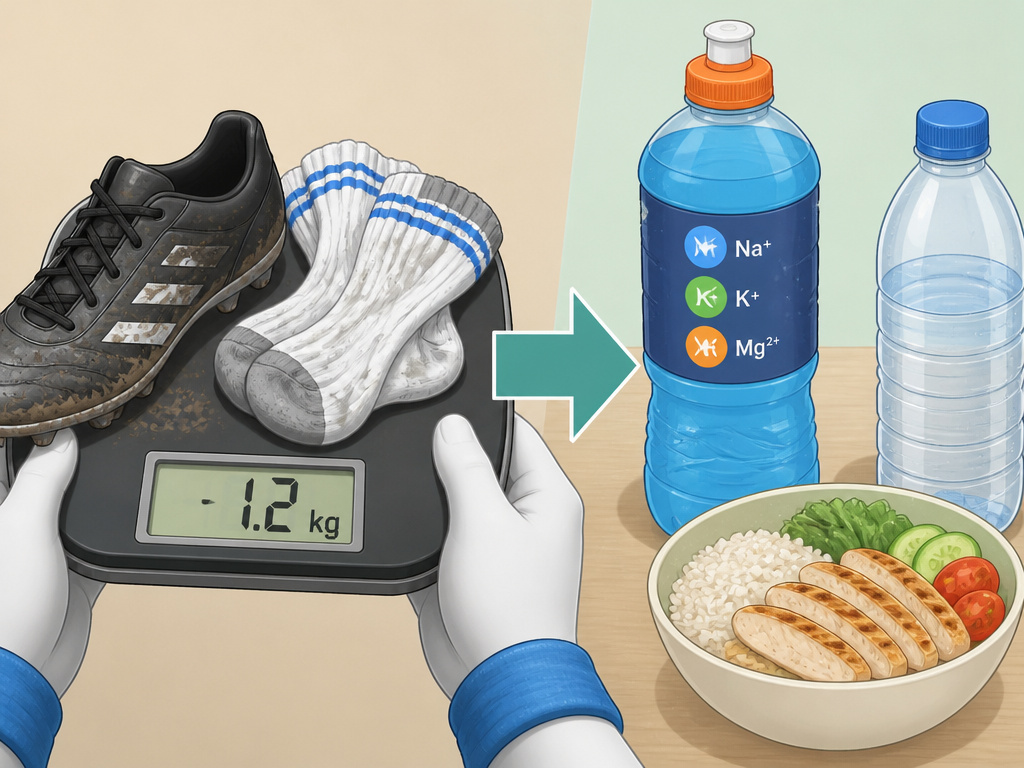
The final whistle isn’t the finish line. How you rehydrate in the next two hours dictates how you feel tomorrow and how you’ll train next week.
The research converges on a simple formula: drink 1.2 to 1.5 liters of fluid for every kilogram of body weight you lost. Weigh yourself in your dry kit before and after the match to get this number.
Common mistake: Chugging a litre of plain water post-match. Without sodium, a lot of that water just passes through as dilute urine.
You need electrolytes to retain the fluid. Sodium is the key one, it stimulates thirst and helps your body hold onto the water. This is why your post-match meal is part of rehydration. A salty snack or a sports drink does the job far better than water alone. An NIH hydration performance review states that rehydrating and refueling should occur within two hours, with sodium to aid retention.
Two Critical Variables Most Guides Miss

Standard advice assumes a 75 kg player in mild weather. Football isn’t played in a lab. These two variables change everything.
1. The Morning Match Timeline
An 11 a.m. Kick-off scrambles the usual schedule. You can’t follow an afternoon routine. Here’s the adjusted timeline:
- The Night Before: This is your main hydration phase. Drink with dinner and have a glass of water before bed.
- Wake-Up: Drink water immediately.
- Breakfast (3 hours before): Have your pre-match meal with plenty of fluid. A bowl of oatmeal with a sports drink works.
- 2 Hours Out: Continue sipping fluid.
- Warm-Up: Sip 200-300 mL in the 20 minutes before kick-off.
The day-before work is essential. If you skip it, you start behind.
2. Your Personal Sweat Rate (And Sodium Loss)
This is the single most important number you can know. Two players on the same team can have wildly different needs.
| Player Profile | Typical Sweat Rate | Key Risk | Hydration Focus | | :— | :— | :— | | High Sweater (e.g., Lineman) | Up to ~3 L/hour (Gatorade Performance Partner) | Not replacing losses, cumulative dehydration over a session. | Aggressive, planned intake during breaks. Must prioritize post-match recovery. | | Low Sweater | <1 L/hour | Over-drinking, risking exertional hyponatremia (low blood sodium). | Smaller, frequent sips. Use a planned intake of smaller, frequent sips rather than relying on thirst. | | “Salty” Sweater | Variable rate, but leaves salt crust on skin. | High sodium loss, impairing fluid retention. | Needs electrolyte drinks during & after, not just water. |
Find your rate: weigh yourself nude before and after a training session. Every kilogram lost equals one liter of sweat. Do this in different conditions.
How does hydration for training compare to match day?

Your approach should differ. For training, especially in cooler conditions, Aspetar notes drinking may not be necessary, while the Gatorade Performance Partner warns dehydration risk remains in cold weather if fluid intake is inadequate. Match day demands a precise, proactive plan for how to hydrate for a football match. The day before an early kick-off is a key opportunity to optimize hydration. Pre-match intake should follow a specific formula over the 2-4 hours prior to kick-off to ensure you start well-hydrated. During a match, the objective is to prevent a fluid deficit exceeding two to three percent of your body mass, as this is where performance deficits in strength, power, and cognition begin. Training hydration can be more flexible, but match day is about executing a proven, individual plan.
FAQ: Football Hydration Myths Busted
What do NFL players drink to stay hydrated?
They follow individualized plans, but the core is the same: water and electrolyte-carbohydrate sports drinks (like Gatorade or branded team drinks) before, during, and after. The difference is scale, with sweat rates up to 3 L/hour, linemen might have personalized bottles with specific sodium concentrations.
What hydrates quicker than water?
Nothing hydrates “quicker.” Water is absorbed rapidly. However, a drink containing sodium and carbohydrates (like a sports drink) can hydrate more effectively after significant sweat loss because the sodium improves fluid retention. For rapid rehydration post-match, a drink with electrolytes beats plain water.
Should I take electrolytes before a football game?
If you’re eating a normal pre-match meal with some salt, you’re likely getting enough. The main benefit of electrolyte drinks pre-match is the carbohydrates they provide for energy. Save the heavy electrolyte focus for during and after the match, when losses are high.
Is it possible to drink too much water?
Yes. Drinking excessive amounts of plain water without replacing sodium lost in sweat can lead to hyponatremia, a dangerous drop in blood sodium levels. This is rare but a real risk for low-sweat athletes who force fluids. This is why knowing your sweat rate and using sports drinks in long sessions is smart.
Before You Go
Hydration isn’t about a single magic drink. It’s a three-act process: load before, maintain during, replace after. The one action to take this week? Weigh yourself before and after your next training session. That number, your personal sweat rate, is more valuable than any branded supplement. It turns generic advice into a winning, personalized strategy. Everything else, from your halftime snacks to your post-match recovery routine, builds from there.
