
How Scoring Works in Football: Every Play Explained
This post contains affiliate links. As an Amazon Associate, we earn from qualifying purchases.
How scoring works in football: a touchdown is worth 6 points, a field goal 3, and a safety 2. After a touchdown the team gets one extra try, worth 1 point if kicked and 2 if played into the end zone like a touchdown. Those plays build nearly every American football score.
That extra try is where the rulebook gets interesting. A blocked kick, a failed two-point play or one odd bounce can add points for either side. The rules also shift depending on whether you’re watching the NFL, college or a high school game.
What follows: the value of each play, the try in detail, a 27-20 game taken apart play by play, how overtime ends a game, and a short detour for anyone who typed this in meaning soccer.
Key Takeaways
- The kick after a touchdown is snapped from the 15-yard line in the NFL.
- Since 2015 the NFL defense can score 2 points on a try by returning a blocked kick or failed two-point play for a touchdown.
- A 1-point safety is real. Oregon got one in the 2013 Fiesta Bowl.
- NFL regular-season overtime is 10 minutes long, and the result is final when the clock runs out.
- High school (NFHS) rules on defensive scoring are disputed in the sources I found, so check your league’s rulebook.
What Is Each Scoring Play Worth in American Football?
A touchdown is the big prize. Carry or catch the ball into the opponent’s end zone and you earn 6 points. A field goal is a kick through the uprights, and a safety is what the defense gets when it ends a play with the offense’s ball dead in the offense’s own end zone.
A try is the single extra play after a touchdown. The NFL snaps the ball from the 15-yard line for a kicked extra point worth 1 point and from the 2-yard line for a two-point conversion worth 2.
| Play | Points | How it happens |
|---|---|---|
| Touchdown | 6 | Ball carried or caught in the end zone |
| Field goal | 3 | Kick through the uprights |
| Safety | 2 | Offense’s ball goes dead in its own end zone |
| Try, kicked | 1 | Kick after a touchdown |
| Try, touchdown-style | 2 | Run or pass into the end zone after a touchdown |
| Defensive return on a try | 2 | Defense scores on a blocked or failed try (NFL, NCAA) |
I checked those values against the NCAA Rule 8 scoring provisions, which an officials’ association mirrors online. They match the table. The same rule has a detail I love: an interception in the end zone is a touchdown, but it is a touchback if the Team B player made no attempt to advance during perceptible time.
Six rows, five numbers, and that’s the whole chart. The trick is knowing the strange cases around it.
The Try After a Touchdown: What Changed in 2015
NFL owners voted 30-2 to move the extra point to the 15-yard line for the 2015 season. Two-point tries stayed at the 2-yard line.
Under the old rule the ball was dead on a failed try. Now the defense gets to play too. Owners also weighed two other plans. The Patriots proposed something similar without defensive scoring, and the Eagles wanted a 15-yard kick with two-point tries from the 1-yard line. Neither was adopted.
The one-point kick
Kicked tries used to feel like a formality. They don’t anymore. The NFL’s 2021 extra-point success rate was 92.4%, the lowest since 1979, according to Axios. The Pro Football Talk article it links to says 92.5 percent, so the number shifts with the date of the count.
Those misses have a side effect. Pro Football Talk’s Michael David Smith notes that kickers’ struggles have led to more two-point attempts.
The two-point conversion
Run or throw it in from the 2-yard line and you get 2 points, which is how scoring works in football on a two-point try. That’s it. Nothing about the play itself is complicated, and the decision to try it is the tricky part.
A team can also change its mind after a penalty. NFL officiating VP Dean Blandino said a team that chose to go for two and drew an offensive penalty could switch to a 1-point kick.
When the defense scores
A blocked kick makes a flat, ugly thud, and in that instant the field flips. If the defense returns a blocked extra point or failed two-point try for a touchdown, it gets 2 points.
College rulings add a few oddities.
Can a Team Score Exactly 1 Point?
Picture the third quarter of the 2013 Fiesta Bowl. Oregon had just scored to lead 31-10, and the extra point was blocked. Then Kansas State carried the ball into its own end zone, and the officials gave Oregon a point.
The sources disagree on the details. SI says Kansas State’s Javonta Boyd blocked the kick, the Wildcats caught the rebound around their own 3, and Chris Harper dodged back into the end zone and was tackled. Close Call Sports, an officiating blog, says Ryan Mueller recovered near the 2-yard line and retreated into the end zone before lateraling to Allen Champan, who recovered it for the safety.
Both agree on the result: a 1-point safety, confirmed by instant replay, making it 32-10. STATS said it was the first such safety in major college football since Texas against Texas A&M in 2004.
Where this goes sideways: Assuming a defender can run a blocked kick backward and score a point for his own team. If the defense carries the ball into its own end zone and the ball goes dead there, the offense gets the point. The mistake costs the defense a point and a chance at 2.
The same logic works in the NFL. Close Call Sports describes the offense fumbling, the defense kicking the ball into its own end zone, and the ball going dead there from the defense’s impetus (the force that sent the ball there). The offense gets 1 point.
Forum threads show how fuzzy this gets. Some officials there say that under NFHS rules the defense can’t score on a try at all. A poster cites casebook play 8.3.3 for a safety against Team B worth one point to A. Close Call Sports adds that a 1-point safety is still possible in NFHS, just not on a kick try. I’d trust the NFHS casebook over any of them.
How Do the NFL, College and High School Handle Tries?
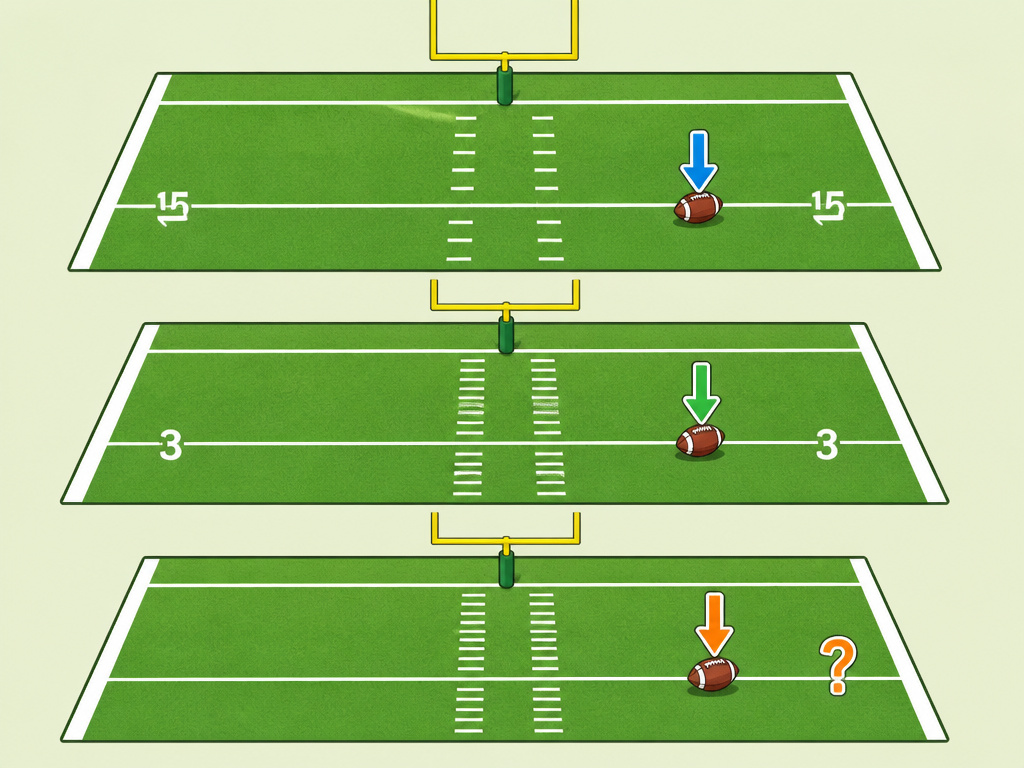
Same sport, three rulebooks. The difference shows up first in the try.
| Level | Try snap spot | Defense can score? |
|---|---|---|
| NFL | 15-yard line (kick), 2-yard line (two-point) | Yes, 2 points since 2015 |
| NCAA | 3-yard line, midway between hashes | Yes, 2 points |
| NFHS (high school) | Not confirmed in my sources | Disputed in forum posts |
The fields differ too. The pro hash marks (the short tick lines that mark where the ball is spotted) sit 70 feet 9 inches apart. College hash marks sit 60 feet apart.
After a try, the NCAA says the team that scored the six-point touchdown kicks off. A team that scored a field goal kicks off as well. Fouls after a try are enforced on that next kickoff.
The NFHS row stays soft on purpose. I only found secondhand forum claims for high school, and they contradict each other.
How Does a Drive Turn Into Points?
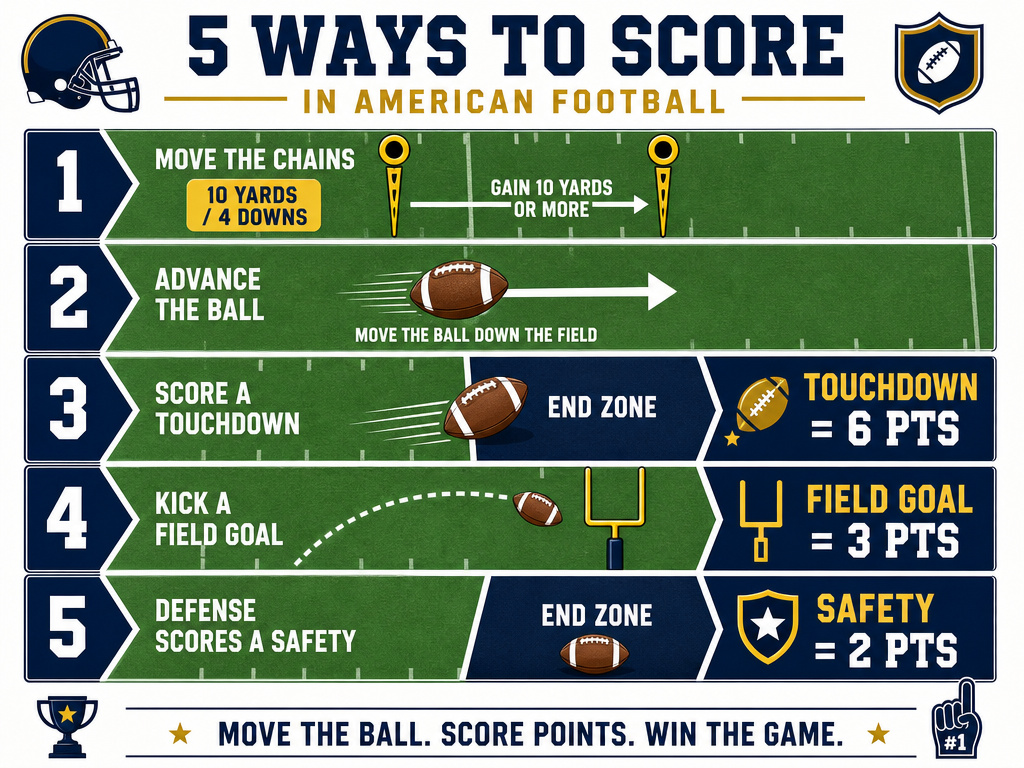
Scoring starts with the ball moving, and that’s a job for the offense: four downs to gain 10 yards. Most scores come from this sequence.
- Gain 10 yards within four downs. Fail, and the other team takes over where you stopped.
- Keep the chain moving until the end zone is in sight. Stall too early and a punt hands the opponent good field position.
- Cross the goal line for a touchdown. That’s 6 points and an immediate try.
- Settle for a field goal when the end zone is out of reach. Miss the kick, and the other side gets the ball at the spot.
- Hold the defense pinned in its own end zone. If the ball goes dead there, a safety follows.
I came to this sport as a soccer-minded fan, so I held a rulebook open on my knee for half of it. The shape clicked once I saw each drive as an argument about space: the offense buys territory, then cashes it in. That’s the only reason I can follow a fourth-and-short call without panicking.
A 27-20 Game, Taken Apart
Here is a made-up final of 27-20. It shows how scoring works in football as a score builds from the plays above.
- Winner: 3 touchdowns (18), 3 kicked extra points (3) and 2 field goals (6). That’s 27 points.
- Loser: 2 touchdowns (12), 2 kicked extra points (2) and 2 field goals (6). That’s 20 points.
Swap one extra point for a two-point conversion and the totals jump by 1. Swap a field goal for a touchdown plus kick and a score goes up by 4. Odd totals like 17 or 23 fall out of those combinations.
Ignore the final score and rebuild it play by play. If the arithmetic doesn’t work, you missed a try, a safety or a defensive return. That’s how I stopped calling games wrong at the pub.
A last strange fact, from NCAA Rule 8: a forfeited game is scored 1-0 for the offended team, unless that team is already ahead. A game can end with one point, but not from play.
How Does Overtime Scoring End a Game?
The football zebras (officiating writers at Football Zebras) walked through the 2025 NFL overtime rules. Regular-season overtime is still 10 minutes, and each team has 2 timeouts. At the five-minute mark, fourth-quarter timing rules apply, and there is a two-minute warning.
What changed is that both teams now get a possession, so a conversion attempt must be tried whenever it could affect the result. It’s skipped only if the scoring team has already won.
- FG then FG: the game continues as standard sudden death.
- FG then TD: the second team wins.
- TD first: the other team gets a possession to tie.
- Safety: the leading team wins, except a 1-point safety on a conversion attempt.
- Opening score, then time expires: if the first team scores and the period ends during the second team’s possession, the first team wins.
The part nobody mentions: The 10 minutes are a hard limit. If the first team scores and the clock dies mid-drive, the second team’s chance disappears, and the result is final regardless of how many possessions happened.
For example, one team kicks a field goal, then the other causes a safety on the return in its own end zone. The final overtime score is 3-2.
College has its own format, and the NCAA publishes an NCAA football overtime rules overview worth checking before a big game. Soccer takes a different road to a winner, namely a penalty shootout after a drawn knockout match.
Kick, Go for Two, or Go for It on Fourth Down?
The rulebook gives you one clear shortcut. Under NCAA Rule 8, a team leading by one or two points doesn’t have to attempt the try if it scores a touchdown on a down where fourth-quarter time runs out. Time is nearly gone, and the extra point can’t change who wins, so why bother?
Penalties change the math too. After a flag on a try, an NFL team can reconsider, as Blandino said. If your two-point play draws an offensive penalty, a 1-point kick may now look safer.
Fourth down is a different gamble. I’m not going to hand you a number for when to go, because I’m weak on the analytics and I’d be guessing. What I see on the sideline is simpler: a team that trusts its kicker tends to take the 3, and a team that trusts its line goes for it.
Does Soccer Scoring Work the Same Way?
No. In soccer a goal is a goal, with no tiers and no extra try. The scoreline simply counts goals.
Points show up one level up. A season’s league tables turn results into points, and when two teams finish level, goal difference can break the tie. Knockout rounds use the aggregate score across two legs, and the away goals rule once decided some of those ties.
New to the sport? The football rules for beginners cover the pitch, the ball and the basics. I’d start there before touching any scoring table, because the points make more sense once you see why the pitch is shaped the way it is.
How have football scoring values changed over time?
The core values of 6 for a touchdown, 3 for a field goal and 2 for a safety have held steady, but the rules around the try after a touchdown keep getting reworked. The biggest recent shift came when NFL owners approved moving the extra point to the 15-yard line for the 2015 season, by a 30-2 vote. Two-point conversions stayed at the 2-yard line. The defense also gained a way to score: if it returns a blocked extra point or a failed two-point try for a touchdown, it earns 2 points. Before that, the ball was dead on a failed try.
The longer kick had an effect. Extra-point success in 2021 was 92.4%, the lowest since 1979, and kickers’ struggles have led to more two-point attempts. Overtime has changed too. Under the 2025 rules, a conversion must be attempted whenever it could affect the result, and the second team gets a possession after an opening touchdown.
Frequently Asked Questions
How does football scoring work for beginners?
Learn six numbers: touchdown 6, field goal 3, safety 2, extra point 1, two-point conversion 2, defensive return on a try 2. Then rebuild a game’s score from its plays. After a few games the combinations start to feel natural.
How do teams score 3 points?
Team scores 3 points with a field goal, a kick through the uprights. Offenses attempt it when the end zone is out of reach but the kicker is in range. A missed attempt gives the ball to the other team at the spot of the kick.
How can a team get exactly 2 points?
Two ways: a safety, when the offense’s ball goes dead in its own end zone, or a two-point conversion after a touchdown. In the NFL, a defensive return on a try is worth 2 as well. The safety is the only one that happens without a touchdown first.
Can the defense score on an extra point?
In the NFL, yes. If the defense returns a blocked extra point or failed two-point try for a touchdown, it gets 2 points. The NFL has allowed this since 2015. High school rules are disputed in my sources, so check the NFHS book.
Can a game end on a safety in overtime?
Yes. A safety in NFL overtime ends the game, and the leading team wins. The one exception is a 1-point safety on a conversion attempt, which doesn’t end the game.
The Bottom Line
Here is the first step for this week: watch one game and keep a tally by play, not by score. Write T6, F3, S2, X1, C2 as they happen. Check the total against the scoreboard at halftime.
One threshold to remember: in college football, a team ahead by one or two points late in the fourth quarter can skip the try. And one concession: everything above leans on NFL and NCAA rules, and my high school sources conflict, so trust your local league’s rulebook there.
I’d rather you learn the shape of a drive than memorise the chart. Once you can see why a team settles for 3, the numbers explain themselves.
