
How to Do a Step Over in Football: The Basic Sequence
This post contains affiliate links. As an Amazon Associate, we earn from qualifying purchases.
*To learn how to do a step over in football, lift your foot over the ball, then use an outside-foot touch to change direction and accelerate.* The move works when the foot motion sells a direction before your body commits. That is the basic step-over turn.
The hook-away touch is where the move becomes a real separation from the defender. It changes the ball’s direction before the next player can reset. That means the foot motion and the first touch need to be practiced as one action. They should not be treated as a dance step followed by a random kick.
What follows: the basic sequence, the perception research behind it, defender-reading cues, drills, and the gear that keeps the touch clean.
Key Takeaways
- Use the outside-foot touch to make the ball leave the feint quickly.
- Train both completion patterns, because coaching sources differ on which foot pushes the ball after the step-over.
- Start with a stationary ball and a command cue before adding dribble pace.
- Use an 8 m marker for the step-over and a 10 m marker for the speed change in cone drills.
- Add the sprint, because the move creates time only when the next action follows.
How to Do a Step Over in Football: The Basic Sequence
The basic step-over has three actions: lift, hook, and sprint. Do them in that order, and the move becomes a way to change the ball’s direction. It stops being a foot circle.
The step-over turn is executed by lifting the foot over the ball. Sources disagree on the final action: the BBC Sport Academy says to hook the ball away with the outside foot and race away, while the Frontiers study and Soccer Coach Weekly describe other patterns. The deception depends on the lead foot moving in front of and across the ball before the direction change. This sequence creates time and space when the defender reacts to the feint.
Before you start: Wet grass reduces traction, so a sharp outside-foot cut puts the ankle at risk. Use a dry pitch or lower speed. A heavy ball catches toes, so use a training ball with predictable weight. A hard surface punishes the planting foot, so train on grass or turf first.
The Right-Foot Version from Soccer Coach Weekly
Soccer Coach Weekly gives a named sequence for a right-foot step-over. Follow it as one drill, then swap sides.
- Move the right foot to the left of the ball. If you skip this, there is no space to circle the ball.
- Feint with the outside of the right foot. If the fake is absent, the defender has no reason to shift.
- Move the right foot over the top from left to right. If this is rushed, the ball still looks like it will stay where it is.
- Plant the right foot to the right of the ball. If the plant foot is too far away, the next touch loses power.
- Spring off the right foot and take the ball left with the outside of the left foot. If there is no spring, the move ends as a pause.
The BBC Sport Academy step over tutorial defines the move as a lift-and-hook action. It says to lift the foot over the top of the ball, hook it away with the outside foot, then race away.
If the touch feels long, a drag-back saves the next action.
Where the Sources Disagree on the Final Touch
Coaching sources do not agree on which foot completes the move. Train both patterns, because the defender’s angle changes the best exit.
| Source | Completion idea | Practice cue | | BBC Sport Academy | Hook ball away with outside foot | Touch, then sprint | | Soccer Coach Weekly | Right foot steps over and plants; left foot takes ball left | Plant outside the step-over foot | | Frontiers study citing Simpson and Hesse | Go across ball with outside foot, feint upper body, cut inside | Sell with body, then cut inside | | We Make Footballers | Inside step-over uses same foot’s outside touch; outside step-over uses opposite foot’s outside touch | Choose the variant before the run |
Easy to miss: The foot circle can be too slow. If the defender doesn’t shift, the outside touch gives them the same lane. The move is dead by the next stride.
A clean outside touch feels like a short brush, not a kick. That feel is the cue that the ball is ready for the sprint.
Why the Step-Over Works Against a Defender
A Frontiers stepover deception study found lower-body information classified skill with an AUC of 0.94 on deceptive trials at t3. That time point (t3, 0 ms) was one of the occlusion points, and the AUC score measures how well the test separated high-skilled from low-skilled players.
The evidence here is narrow. Treat the AUC number as a study result.
The study’s test stimuli used two skilled female football players with a mean of 13.5 years of National-level experience. The high-skilled participants in the study had a mean of 12.3 years of competitive experience, while the low-skilled group had a mean of 5.1 years of recreational experience.
What the Frontiers Study Found
High-skilled players had higher sensitivity, called d’, than low-skilled players across all spatial occlusion conditions. Low-skilled players were more biased toward judging actions as genuine.
The study also found that information from the lower body or upper body was sufficient for differentiating genuine and deceptive actions. Global full-body information was not necessary to support the expert advantage.
That is a real disagreement. The same paper describes Brault et al. (2012) as showing expert players more attuned to centre-of-mass displacement, implying global processing. The study’s own conclusion says local sources carry the expert advantage. I’m not sure the global-processing story is the whole answer.
I treat the step-over as a first-touch problem, not a footwork show. If the touch doesn’t take the ball away from pressure, the move is just a pause.
The same outside-foot idea shows up when you need to beat a defender in a one-on-one run. The step-over is only one way to create that separation.
How Do You Read a Defender Before the Step-Over?
The lead foot tells you more than the defender’s eyes. If their weight is already moving toward your feint, use the outside touch. If they stay square, a body-feint and a shield are safer.
I would rather see a clean first touch than a flashy circle. The step-over earns space when the ball leaves the feet at an angle the defender can’t cover.
When the defender stays close, shield the ball creates a better angle than a step-over. The move is a decision based on the exit lane. A reflex without a lane is just a lost touch.
Do you want the move to beat a defender or just look good?
In a game, the answer is simple.
Beat the defender.
Do not use the step-over when your first touch is already under pressure. The ball will be behind you by the next stride, and the defender will take it without a second decision.
Which Drills Make the Step-Over Reliable?
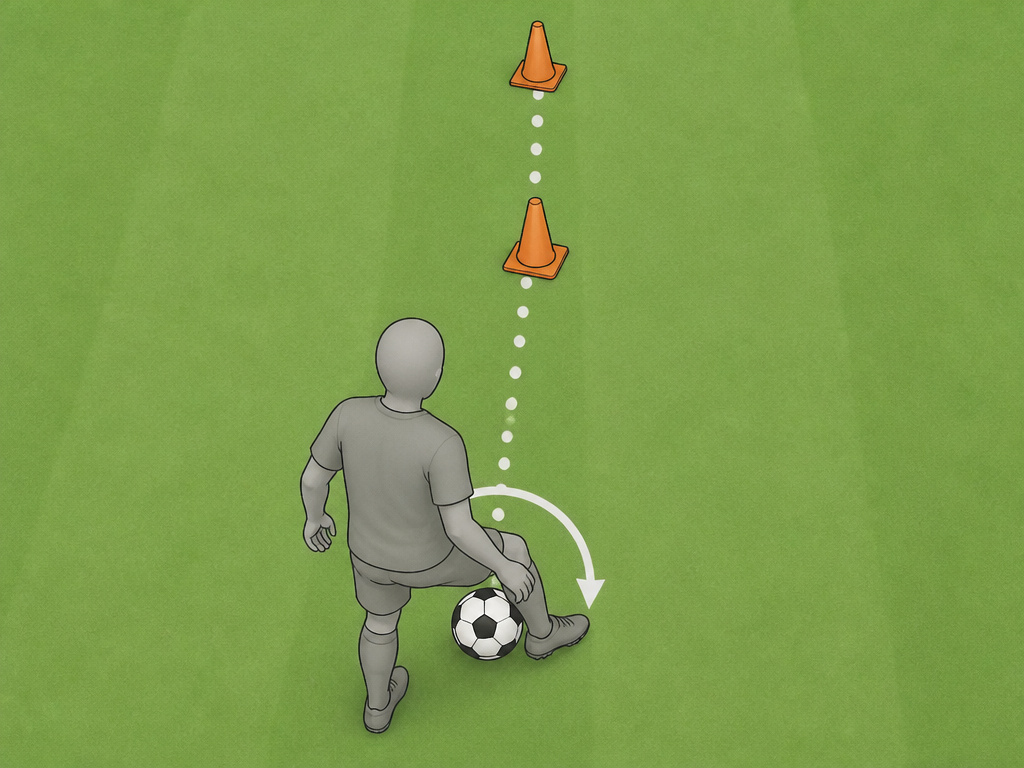
Repetition without direction is useless. Start slow, then add the ball movement that makes the feint matter.
Stationary First, Then Moving
Sportplan uses a stationary ball, “happy feet,” and a whistle or command to step over and return before adding a pass or turn progression. That stage matters. It removes the pressure of chasing a moving ball while learning the foot circle.
We Make Footballers uses a cone about 10 m ahead as a defender and another about 8 m ahead. Perform the step-over at 8 m and change speed at 10 m. That spacing gives a clear timing problem instead of a vague dribble.
- Stationary first: step over the ball at your feet, return to the start, then add a pass.
- Cone spacing: place a step-over marker about 8 m ahead and a defender marker about 10 m ahead.
- Slow-to-fast: walk the approach, then add one touch, then full speed.
- Weak foot: repeat the same sequence with the opposite outside touch.
Add agility training work before you expect speed. The step-over fails when the plant foot can’t push. Simple agility ladder drills train that plant-and-push rhythm.
The drill sounds like two quick taps: ball, boot, then the first step. If the taps become a scrape, the touch is too heavy.
If you skip the stationary stage, the moving touch becomes a guess. You won’t know if the problem is the foot circle or the ball speed.
When Should You Avoid the Step-Over?
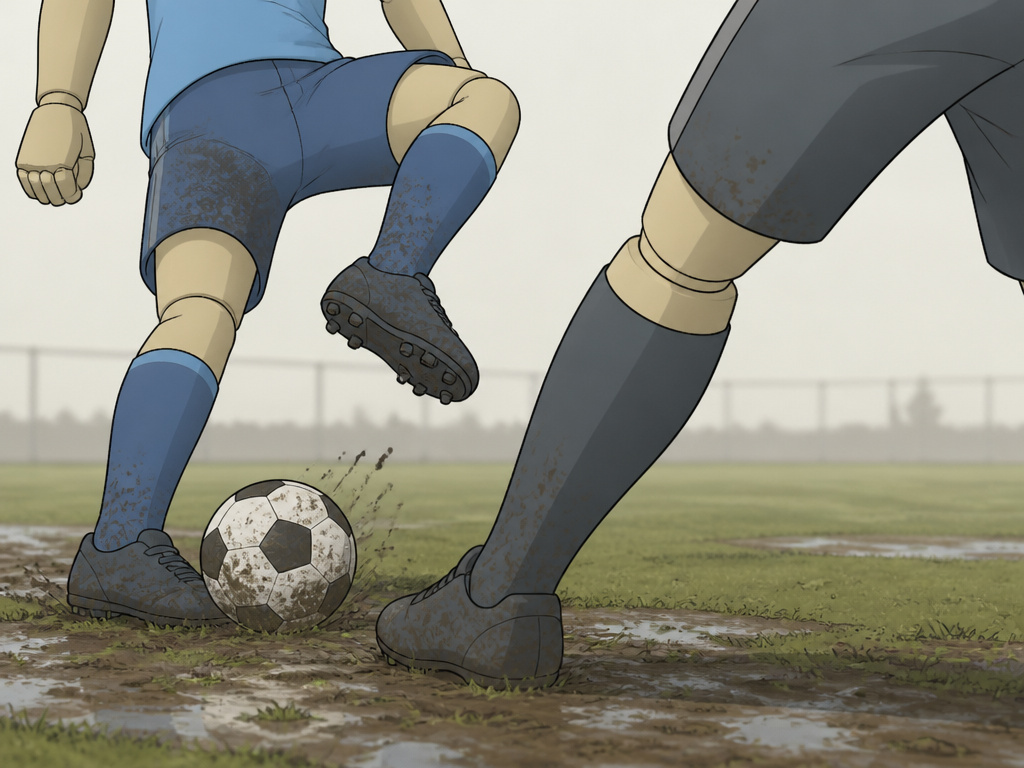
Crowds, hard pressure, and poor touch are where the step-over fails. Use a safer move when the exit lane is not clear.
Near the touchline, a Cruyff turn keeps the ball safer than an outside-foot hook. The turn changes direction without sending the ball into the line.
In a crowd, a nutmeg is a higher-risk option than a simple shield. It needs a gap, and a gap is not always there.
Highlight culture links the step-over with famous attackers such as Ronaldo. Some coaching pages call similar feints scissors or pedalada, but the terms are not always used the same way.
| Symptom | Likely cause | Fix | | Ball rolls away from body | Outside touch too far ahead | Keep touch short | | Defender stays balanced | Foot circle too slow | Add upper-body feint | | Move fails in games | No acceleration after touch | Sprint on next step | | Touch slips | Wet ball or poor surface | Use dry grass and a predictable ball |
Do not use the step-over when the defender’s body blocks your exit lane. The outside touch will push the ball into the next defender within one stride.
Use a safer move. A touch that loses the ball is worse than a simple pass.
Gear That Helps the Move Feel Clean

A worn ball changes the touch. A heavy ball changes the timing. For practice, use a training ball with predictable weight.
The brand matters less than the feel, but a boot that slips on your foot won’t help the outside touch.
The step-over sits inside broader dribbling habits. If the ball is always in the way, the feint won’t save you.
If you want one answer for youth practice: use a Select ball, do the stationary drill, and make the outside touch clean.
The ball comes first.
The boot comes second.
The foot circle comes third.
Frequently Asked Questions
How do you do a step over in football?
Lift your foot over the ball, then hook or push it away with the outside of your foot and accelerate. Keep the first touch short enough that the ball stays in your running lane.
What does a step-over mean?
Coaching sources define it as a feint where the foot moves over the ball before the player changes direction. The exact completion foot varies by source and defender angle.
Why does Messi not do stepovers?
Player can skip the step-over if body-feints and small touches already create space. The move is one option, not a requirement for dribbling.
Are scissors and step-overs the same?
They overlap, but coaches use the terms differently. A step-over describes the foot over the ball; scissors and pedalada describe wider feint patterns in some coaching pages.
How far from a defender should you do it?
Practice drills use a step-over marker about 8 m ahead and a defender marker about 10 m ahead. In games, use the move when the defender is close enough to react but not so close that your touch has no exit lane.
Before You Go
The step-over doesn’t work unless the outside touch creates one clear exit lane. If your touch leaves the ball too far ahead, slow down and return to the stationary drill before adding pace.
Here is the threshold I would use: if you can’t push the ball away with the outside foot and still stay balanced, don’t add speed. A move that costs your balance will cost the ball in a game.
If you want to know how to do a step over in football without losing the ball, start with two markers. Use an 8 m marker for the step-over and a 10 m marker for the speed change. Do ten slow reps, then ten with a pass, then ten at running pace. The move earns its place only when the touch is clean.
Which cue helped you most: the outside touch, the sprint, or the cone spacing?
