
How to Beat a Defender One on One in Football: 3-Step Duel
This post contains affiliate links. As an Amazon Associate, we earn from qualifying purchases.
To learn how to beat a defender one on one in football, dribble at them, fake one way, then burst past with a change of speed and direction.
That timing is the whole duel. A defender recovers when the attacker slows early, and the fake loses its bite.
The guide walks through stance, feints, speed changes, drill sizes, and the next action after the defender is beaten.
Key Takeaways
- Sources disagree on approach speed: Football Reach advises dribbling at speed, while Soccer Coach Weekly advises slowing down as you approach the defender.
- Change speed and direction first. Coach Notes says the burst beats the trick.
- Use 6 games of 2 minutes.
- A named move can help, but it doesn’t win alone. GFTskills says many duels are won by a simple feint.
- Read the front foot. Coach Notes says attack the defender’s front foot.
How to Beat a Defender One on One in Football: The Simple Sequence
The duel starts with movement. I’ve always liked the plainest version: dribble at them, fake one way, then burst into space. I coach the first touch as a choice of direction. A hesitant first touch loses the momentum the duel needs.
A one-on-one duel is won when the defender’s weight is wrong, mid-step, or turned. The attacker uses approach, fake, and burst to create that moment. Ball touches stay close before the change, then the pass into space arrives after the defender commits. The sequence is control, a fake, and a burst, instead of a long routine of tricks.
Before you start: Warm up first. Use flat grass with space all round, never a road or driveway. Defenders stay on their feet. They use no slide tackles and keep the ball on the ground. Under 16, if knees or heels hurt when running, stop and tell an adult. If a head knock is suspected, stop and seek appropriate medical advice.
The 3-Step Duel
Sources disagree on approach speed. For example, Football Reach advises dribbling straight at the defender at speed, while Soccer Coach Weekly advises slowing down as you approach.
- Fake about two big steps away, still moving. A fake that stops the body gives the defender time to shift weight back.
- Push the ball past them and sprint after it. A soft touch leaves the ball in the duel, so the defender can recover.
The ball should sit close enough for a quick change of direction before the burst. Do you keep the ball close enough to change? (the simple version works)
Simple. It works.
How Fast Should You Approach the Defender?
Football Reach says dribble at speed, while Soccer Coach Weekly says slow down as the attacker approaches. The FIFA Talent Coach Programme 1v1 finishing drill asks players to move onto the pass to gain momentum. GFTskills says change speed at about 4 feet from the defender. The sources split, so I treat speed as a tool. A beginner needs control. A final-third runner needs enough speed to reach space.
| Source | Approach advice | Duel effect |
|---|---|---|
| Football Reach | Dribble at speed; don’t slow early | Defender can’t settle |
| Soccer Coach Weekly | Slow down as they approach | Attacker gets time to set the fake |
| GFTskills | Change speed at about 4 feet | The move lands close enough to burst |
| Coach Notes | Slow into fast, then explode | Rhythm creates the moment |
I start a youth session with controlled pace. I add speed once the fake feels natural.
The other side of this duel is one-on-one defending, where the marker tries to stay balanced and wait. Do you have room behind the defender?
Which Drill Area Fits Your Session?
A partner stands in the middle of a 10 x 15 m channel. The Football Reach 1v1 drill sheet gives that size and 2 m gates in the far corners. Soccer Coach Weekly river drill uses a five-yard river across the center. GFTskills gives a 5 x 10 yard or 10 x 10 yard area for tight space, and a 30 yard start for an open shot.
| Drill area | Source size | Best use |
|---|---|---|
| 1v1 channel | 10 m wide and 15 m long, with 2 m gates | straight approach and burst |
| Tight space | 5 x 10 yard or 10 x 10 yard area | close control and bait-and-take |
| Open shot | start 30 yards from goal; defender 5 to 10 yards ahead | final third timing |
| River game | five-yard river across the center | many players, low pressure |
Soccer Coach Weekly also keeps goal zones no larger than five yards square.
Run the 10 x 15 m channel
The Football Reach dose is 6 games of 2 minutes, with 1 minute of rest between. A Heriot Watt University review of pressure training cited by Football Reach found that practicing under pressure helped players do better under pressure.
For the touches behind this, close control drills build the small footwork the drill needs. The channel works because dribbling keeps the ball close enough for a fast change.
On flat grass, a heavy touch skids ahead and leaves a gap you can see. Do you have enough space to burst?
Do You Need a Named Move?
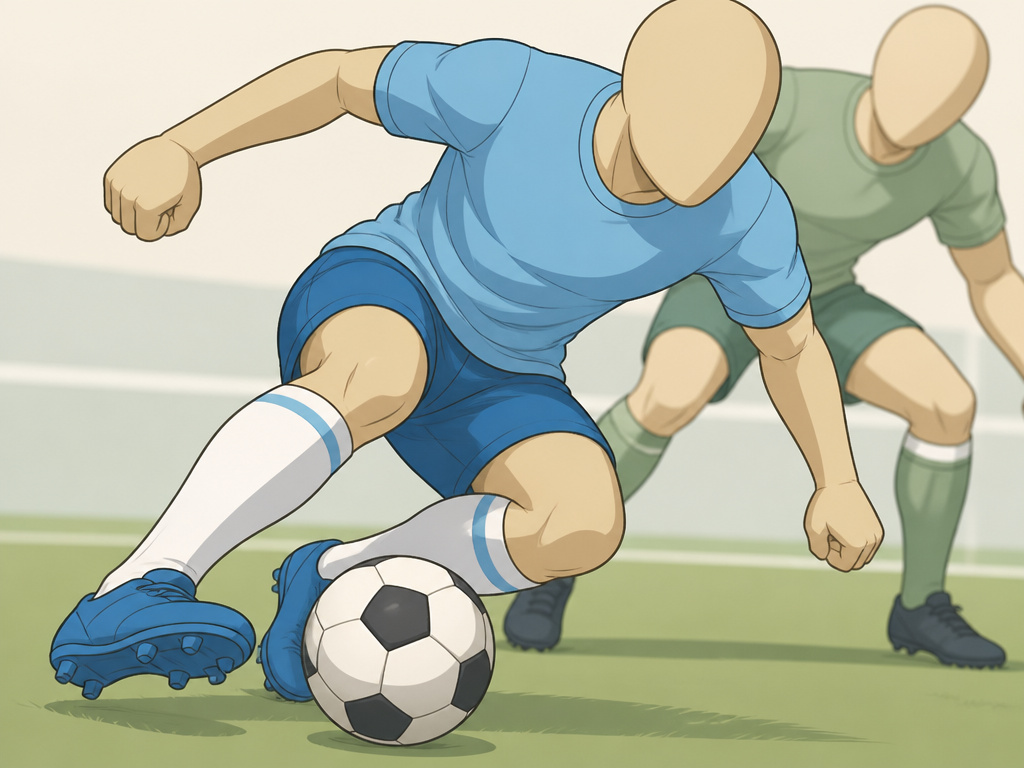
You can win without a step-over. GFTskills says most duels are won by a feint or a change of direction and speed. LevelUp.soccer still teaches named moves, and Coach Notes says change of speed and direction beats the trick. I used to reach for a fancy move too early. The simpler body feint did more work.
- A step-over can sell the fake when the defender is already leaning. If you do it slowly, the defender waits and the move becomes decoration.
- A body feint uses shoulder, eyes, and balance. It can unbalance a defender before the ball moves.
- Use both feet. Practice each move 20 times on each foot, as LevelUp.soccer recommends.
- The scissor and elastico have places in training, but LevelUp.soccer says master fundamentals first. Skip flashy elasticos for beginner practice.
Common mistake: Practising moves without speed. Coach Notes says players who do tricks without speeding up are decorating the ball, instead of attacking.
For gear, use a standard football for practice. See it on Amazon. For boots, choose a pair that fits well.
How Do You Read a Patient Defender?
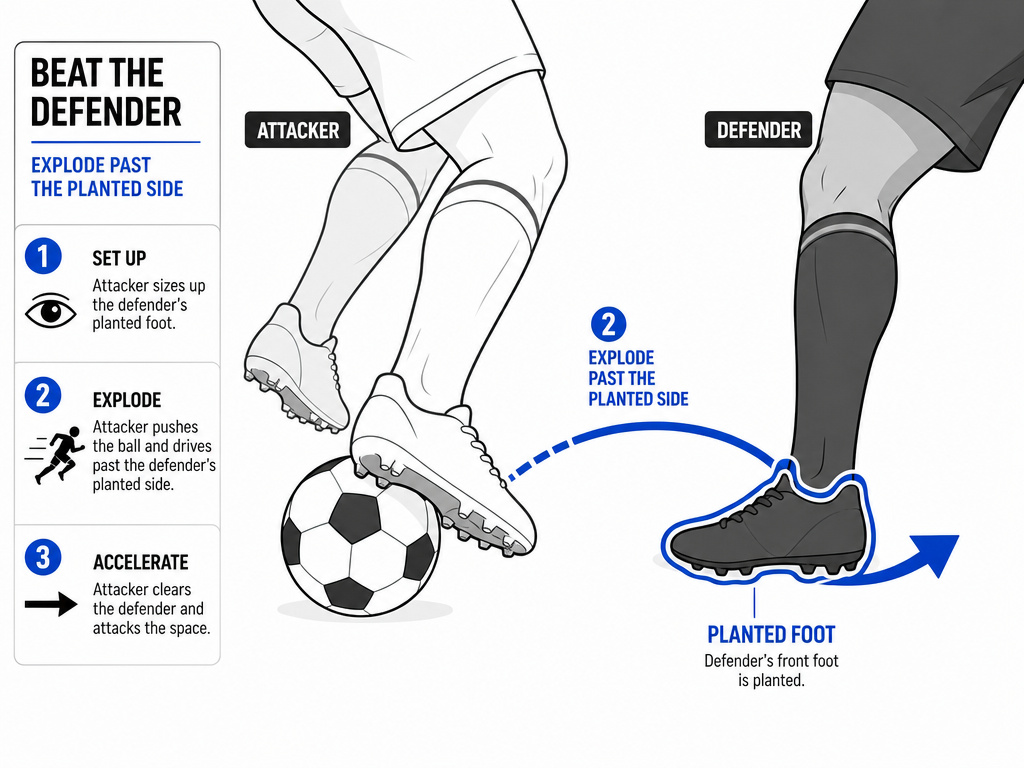
Some defenders wait instead of diving in. This is the duel that frustrates young attackers. The standard advice is to make the defender commit, but a patient marker may not lean on the first fake. Coach Notes says attack the defender’s front foot, because a front-foot turn takes longer than a simple drop.
Reading the front foot
- Watch which foot is forward. Coach Notes says ask the attacker which foot is forward and where the space is.
- If the defender stays balanced, use a real pause, then explode. If the defender stays balanced, use a pause, then explode.
- If the defender still waits, protect the ball and find support. Shielding the ball can buy a second touch.
A patient defender often gives almost no sound or lean; the only tell is the foot that stays planted. Do you have a second option?
What Happens After the Defender Is Beaten?

Pass, shoot, cross, or keep dribbling. Beating the defender only creates a moment.
The next action
The next action decides whether it becomes a goal, a pass, or a lost duel. Once the defender is beaten, the next problem is finishing one-on-one with the keeper.
When a teammate is free, a one-two can beat the defender without a dribble. Quick feet matter after the fake, so improve agility with short change-of-direction work. Do you have a better option?
At U8 to U12, 1v1 skills should dominate your attacking work.
What skill moves should I practice to beat a defender?
You don’t actually need a complex, named move. Most of the time, beating a player is about performing a feint or changing your direction and speed at the right moment. The core skill is creating and exploiting a moment when the defender cannot recover. To practice, work on the fundamental rhythm: approach with control, perform a feint to unbalance the defender, then explode past them. Practice changing direction sharply. For structured repetition, you can practice specific actions like step-overs or scissors, but remember that a simple, well-timed change of pace and direction often beats an elaborate trick.
Should I practice 1v1 with or without a defender?
To be comfortable beating players one-on-one, you need a mix of unopposed and opposed training. Unopposed drills help you master the technical execution of a feint or change of direction. However, a meta-analysis found that practising under pressure is what truly helps performance under pressure in real games. Opposed drills, where a defender is actively trying to stop you, teach you the timing and decision-making needed to unbalance a real opponent. A practice structure that includes both technical repetition on your own and applying those skills against a live defender in a controlled area is effective.
When should I try to beat a defender one-on-one?
The decision starts before you even receive the ball. Time your movement to receive on the move, gaining momentum. When receiving under pressure, orient your first touch away from the oncoming defender to attack the space behind them. This immediate advantage can make the one-on-one duel easier. Assess the situation: do you have room behind the defender to run into? Is your team well-positioned to defend if you lose the ball? In youth football, especially for younger players, one-on-one skills are a primary attacking focus. However, the best attackers know that sometimes the smartest move is a simple pass to a teammate in a better position.
Frequently Asked Questions
How to defend 1v1 in football?
Stay on your feet and wait for the attacker to commit. Football Reach says defenders should use no slide tackles and keep the ball on the ground. Jockeying backwards can help a learner feel the duel without winning every ball.
How to beat a defender in football?
Use a direct approach, a fake, and a burst into space. The simplest change of speed and direction works when the defender’s weight is wrong.
How to win 1 on 1 football?
Make the defender guess. A body feint, a shoulder drop, or a touch into space can create the half second needed to pass the marker.
What if the defender doesn’t commit?
Add a real pause, then explode. If the marker still waits, protect the ball and find a teammate.
How to get past every defender?
You won’t. GFTskills says the best players lose the ball often, and defenders should shut them down most of the time. The goal is one successful duel that changes a game.
The Bottom Line
If you want one answer for how to beat a defender one on one in football, use the plain sequence: dribble at them, fake, then burst.
If the defender won’t commit, stop and play a pass or a one-two. If your knees or heels hurt, stop and tell an adult.
Run 6 games of 2 minutes in a 10 x 15 m channel this week. For adult players, be selective.
The patient defender is the real test. Which defender gives you the most trouble?
