
How to Defend One on One in Football: Step-by-Step
This post contains affiliate links. As an Amazon Associate, we earn from qualifying purchases.
To defend one on one in football, first get into a low, angled stance to force the attacker wide. Close down the space quickly, but decelerate in the last two yards to arrive balanced. From there, stay between the attacker and goal, mirror their movement, and only commit to a tackle when their touch pushes the ball more than a foot ahead of them.
The first touch the attacker takes dictates your next move, not the other way around. This guide explains three layers: the shape that dictates the duel, the approach that keeps you balanced, and the game-specific rules that change based on where you are on the pitch. A core principle is knowing how to defend one on one in football.
What follows is the coaching manual version of that muddy Saturday-morning lesson on how to defend one on one in football, grounded in FIFA and U.S. Soccer coaching resources. It covers the angled stance, the sprint-sit approach, and the specific thresholds, like 25 yards from goal, where retreating stops and standing your ground begins.
Key Takeaways
- Adopt a low, side-on body shape with hips angled 30-45 degrees to force the attacker toward the sideline or their weaker foot.
- Use the “sprint then sit” approach: close 80% of the distance fast, then decelerate hard over the last two yards to arrive balanced.
- Maintain a one-yard cushion between your front foot and the ball while jockeying; this is the sweet spot for reaction.
- The tackle window opens only when the attacker’s touch pushes the ball more than one foot ahead; lunging before then is an invitation to be dribbled.
The Core Shape: Your Angled Body
Forget squaring up. When you face an attacker head-on, chest pointed straight at them, you’ve already given them two equally good options: left or right. However, sources disagree on the ideal stance: FIFA Training Centre advises a low, side-on shape, while Blayze emphasizes getting your body between the attacker and the goal. Your job is to take one away. The FIFA Training Centre, among other sources, advises defenders to adopt a low, side-on body shape to force the opponent wide and away from goal.
A defender who is square to an attacker is a defender who is already reacting. An angled defender is one who is dictating.
This angled stance is a core part of how to defend one on one in football. It involves rotating your hips and shoulders 30 to 45 degrees (per LevelUp.soccer), so your front foot and shoulder are pointed toward the path you want the attacker to take. Your lead foot should be staggered slightly forward, knees bent, weight on the balls of your feet. You’re coiled, not flat-footed.
Which way do you angle? There’s a hierarchy, and it’s not always about the weak foot. First, look for cover, force the attacker toward a supporting teammate. Second, use the sideline; it’s a defender that never gets beat. Third, guide them onto their weaker foot. The body shape you choose in that first second sets the trap for everything that follows.
To Engage or Not to Engage? The First-Second Decision
Here’s where the coaching manuals disagree, and it’s the most important tactical choice you’ll make.
One school, represented by Coaching American Soccer, advocates for aggressive defending. The idea is to disrupt immediately: tackle the opponent just as they receive the ball, interpose yourself between dribbler and ball, or prevent them from turning to face goal. Coaching American Soccer notes that if an attacker receives with their back to goal, the defender may legally pressure, and even contact them, from behind to keep them from turning. Other sources, like FIFA, focus on using a side-on shape to force the attacker wide.
The other school, which includes the FIFA Training Centre and Blayze, preaches controlled engagement and patience. FIFA emphasizes being ‘set and balanced’, while Blayze explicitly lists ‘patience’ as a key element. Their emphasis is on being “set and balanced” when you engage, decelerating with short, controlled steps. The Blayze analysis of Virgil van Dijk highlights this: “Wait for the attacker to make a move of some sort… Don’t go to the ground too soon.”
So which is right? It depends entirely on the pass and your support.
| Scenario | Recommended Action | Source Philosophy |
|---|---|---|
| Attacker receives a poor, bouncing pass in space with no support behind you | Engage aggressively. Win the ball before they control it. | Coaching American Soccer |
| Attacker receives a crisp pass facing you, with teammates tracking back | Delay and control. Adopt your angled stance, slow their progress, and shepherd. | FIFA Training Centre / Blayze |
| Attacker receives with back to goal, 30+ yards out | Apply pressure from behind. Use legal contact to prevent the turn and win the ball. | Coaching American Soccer |
The cue is the quality of the first touch. The defender’s decision about whether to engage with the attacker or stay a short distance from them is key. This initial decision, to pounce or to posture, frames the entire duel. Mastering the art of jockeying is how you execute the patient approach successfully.
The Approach: The Moment Most Players Ruin
You’ve chosen to engage. Now you have to get there. LevelUp.soccer notes you have a window of about 1.5 seconds from the moment the attacker first receives the ball to close down.
This is where the “sprint then sit” cue comes in. Sprint the first 80% of the distance to eat up that space. Then, for the last 20%, you decelerate hard. Over the last two yards, plant your feet, drop your hips, and arrive in your balanced, angled stance. Players who sprint all the way in arrive with momentum they can’t control, one clever touch from the attacker and they’re beaten. Players who arrive balanced force a real, static 1v1, which favors the defender.
The FIFA Training Centre emphasizes that defenders should avoid being unbalanced and on the move as the attacker receives the ball. Good practice is to be set and balanced when engaging, decelerating with short, controlled steps.
That final deceleration is a physical skill. A solo drill to build it: place a cone 10 yards away, sprint at it, and practice decelerating so you plant in your stance just as your front foot reaches the cone. It feels unnatural at first, like slamming on the brakes, but it’s the difference between being a defender and being a spectator.
The Jockey and the Sweet Spot
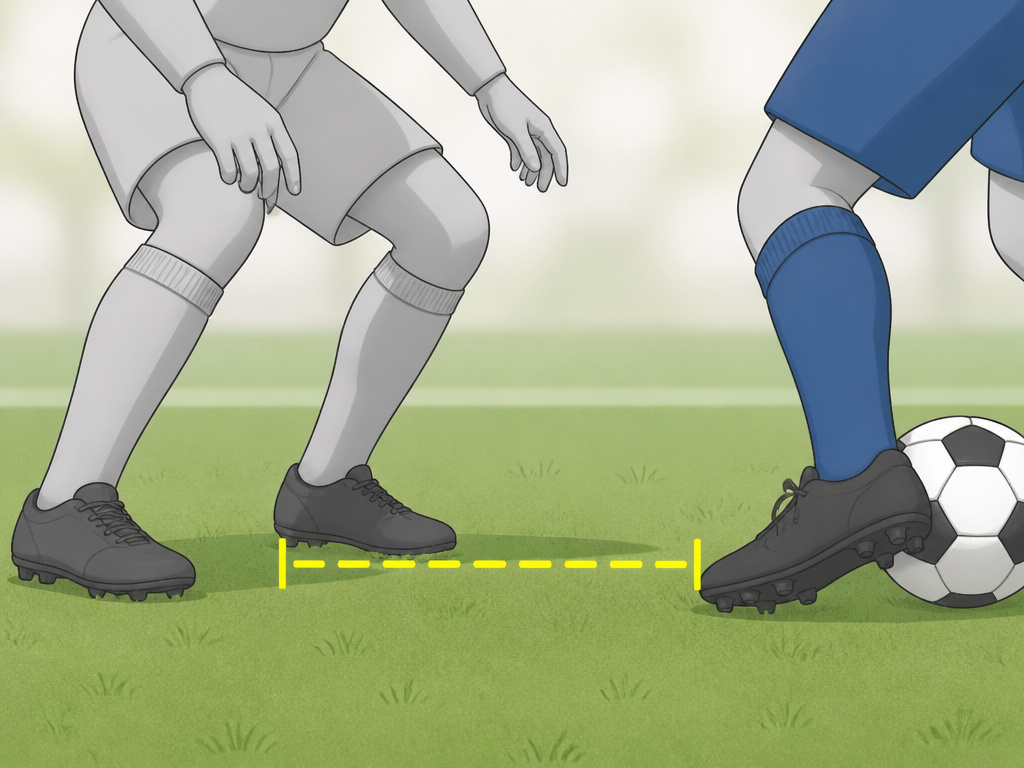
Once you’re balanced and angled in front of the attacker, the jockey begins. Your key tasks are to stay between the attacker and the goal and maintain a balanced, angled stance.
Distance is everything here. Too close, and a quick toe-poke around you wins. Too far, and you’re not defending, just escorting them toward your box. The sweet spot, according to LevelUp.soccer, is roughly one yard between your front foot and the ball. This is close enough to threaten a tackle if they mess up, but far enough to react to any sudden move.
This phase is all about patience and defensive discipline. Your job is to delay, shepherd, and wait for a mistake or for help to arrive. This patient phase of defending never makes the highlight reel but wins points and saves games. It’s also the foundation of defending without fouling, as reckless lunges born from impatience lead to cheap free kicks in dangerous areas.
The Tackle Window: Patience Pays
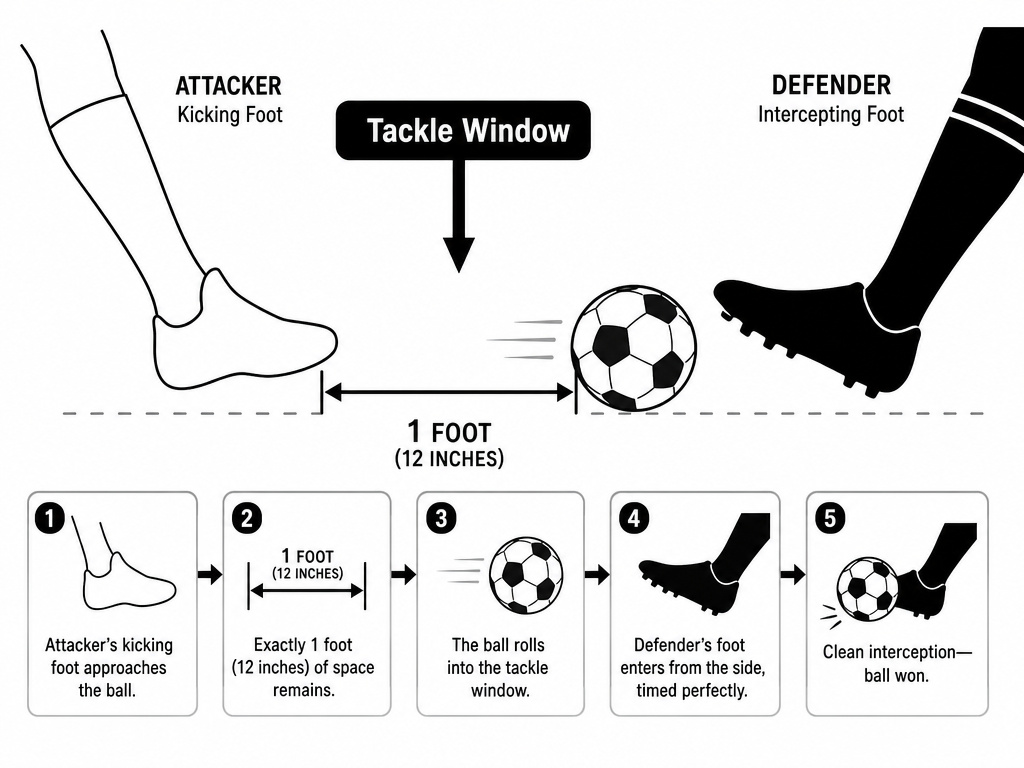
The most satisfying part of defending, winning the ball, is also the most misunderstood. The tackle is an action you perform with the space the attacker gives you.
The “tackle window” opens at one specific moment: when the attacker’s touch pushes the ball more than one foot ahead of them. In that split second, the ball is unprotected. That’s your cue to step in with the inside of your foot and win it cleanly.
Until that window opens, you do nothing but jockey. Most attackers, especially under pressure, will eventually take that heavy touch trying to accelerate past you. Or they’ll look up to spot a pass and let the ball drift. That’s your moment.
Where this goes sideways: Lunging when the ball is still tight to the attacker’s feet. The attacker simply takes one touch around your planted leg, and you’re beaten, often leaving a gaping hole behind you. Wait for the heavy touch.
This requires immense discipline, the kind built through drills like the “1v1 to Goal” exercise. It transforms tackling from a gamble into a calculated, high-percentage play. For the technical execution of that winning challenge, the fundamentals of tackling are a necessary companion skill.
When the Rules Change: Positional Thresholds and Edge Cases
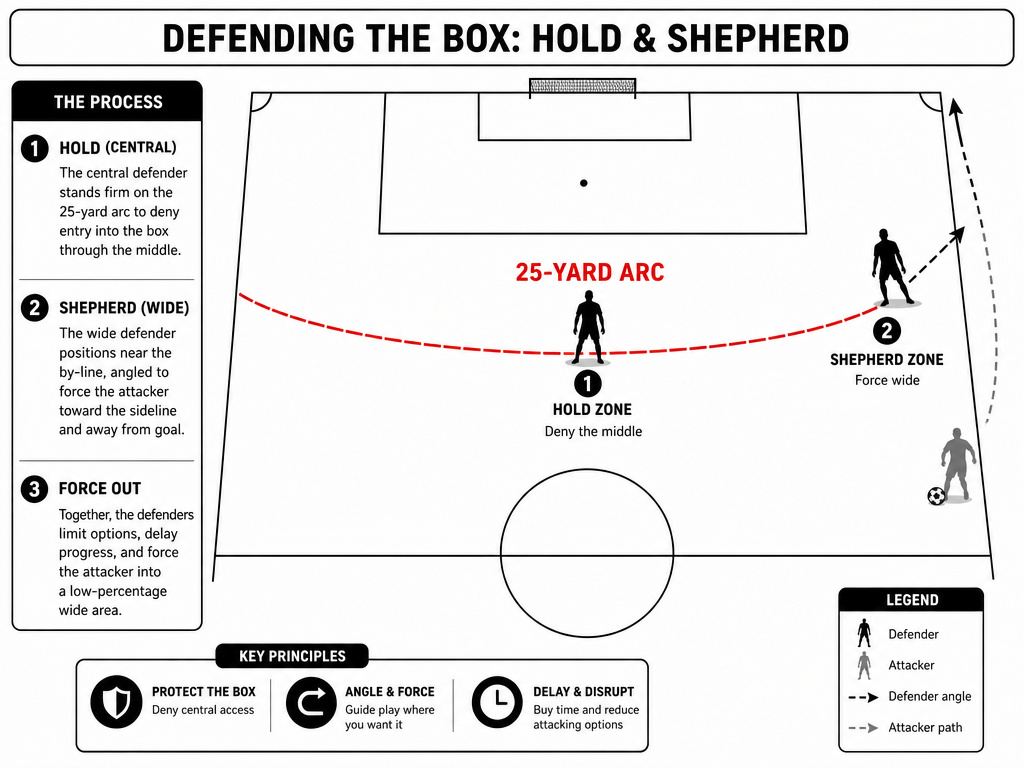
Not all grass is created equal. The principles of jockeying and patience have a hard stop, dictated by your proximity to your own goal.
Coaching American Soccer lays out clear positional thresholds. A defender can only backpedal or give ground so far. For older or advanced players, closer to the by-line, the point to stop retreating is just outside the penalty area. Farther out in the field, it’s usually at 25-yards from the goal.
| Your Position | Action Threshold | Mandatory Action |
|---|---|---|
| Within 25 yards of goal, central areas | Stop retreating at ~25 yards. | Stand your ground, prepare for a tackle. |
| Near the by-line, wide areas | Stop retreating just outside penalty area. | Stand your ground, force attacker wide or out of bounds. |
| Beyond 25 yards, midfield | Continue jockeying and delaying. | Shepherd, wait for help, look to intercept a pass. |
At these thresholds, the calculus flips. Your job is no longer to delay; it’s to stop the advance. You must “stand one’s ground and prepare for a possible tackle.” This is where communication from teammates, yelling “hold him!” or “tackle!”, becomes critical, as your focus is locked on the ball.
Another edge case is when the attacker receives the ball with their back to goal. The standard angled stance is less relevant here. Coaching American Soccer notes the defender may legally apply pressure from behind to prevent the turn. Your focus shifts from guiding direction to denying the pivot, using your body to feel their movement and win the ball before they can face the net, a specialized form of marking a striker.
Drills That Build the Instinct
Knowing the theory is one thing. Feeling the right moment to sit on your hips, or the precise distance for the sweet spot, is another. These drills, sourced from coaching materials, build the muscle memory.
Solo Drills:
- Mirror Shadow: Mark a 5-yard line. Get in your angled stance and slide side-to-side for three sets of 30 seconds, focusing on not crossing your feet. Builds the essential lateral footwork.
- Cone Approach: Place a cone 10 yards away. Sprint at it, and drill the “sprint then sit” deceleration over the last two yards, planting in your stance just beside the cone.
Partner Drills:
- Channel 1v1: Mark a channel 8 yards wide and 15 yards long. The attacker tries to dribble past you to the end line. The narrow space forces you to use your body shape aggressively.
- Funnel Drill: Set up a triangle 12 yards wide at the top, narrowing to 4 yards at the bottom (the “goal”). Start at the goal and practice shepherding the attacker from the wide top down the narrowing sides, using the space to win the ball.
- 1v1 to Goal: The attacker starts 20 yards from a small goal with you 5 yards in front. Add a constraint: you cannot tackle until their second touch. This builds the patience to wait for the true tackle window.
These exercises, repeated, move the skills from your conscious mind to your reflexes. They complement the reading of the game required for anticipating and intercepting a pass, making you a proactive defender rather than a reactive one.
From Isolated Duel to Team Defense
A 1v1 is never truly isolated. The Holliston Soccer coaching manual notes it’s the most common tactical situation, often happening within a crowd of players. Your duel is one piece of the team’s defensive shape.
This is where communication is essential. As Coaching American Soccer states, proper oral communication from teammates to the 1v1 defender is critical. A shout of “delay!” tells you to keep jockeying so the defense can reorganize behind you. A shout of “tackle!” gives you the green light to step in, knowing cover has arrived. You, focused on the ball, are blind to the wider picture; your teammates are your eyes.
And if you do get beaten? The recovery run is your final exam. Don’t stand and watch. Sprint on a curved path to rejoin the attacker from the side of their non-dominant shoulder, aiming to get goal-side again or at least slow their progress. The best defenders are defined not by never getting beat, but by what they do in the three seconds after.
How to watch game film to improve one on one defending
Watching professionals is a powerful tool, but you need to know what to look for. Focus on the defender’s body shape the moment an attacker receives the ball. Are they set and balanced, or are they caught on the move and unbalanced? Look for the low, side-on body shape that forces the attacker toward the sideline or a supporting teammate. Notice the critical decision: does the defender immediately engage to tackle or pressure from behind, or do they stay a short distance away to delay? Pay attention to the ‘sprint then sit’ approach, watching how they close down space quickly but decelerate with short, controlled steps before making a challenge. Listen for verbal cues from teammates, which are often picked up by field mics, directing the defender to either delay or tackle.
Frequently Asked Questions
What are the 5 D’s of defending in football?
The 1v1 duel focuses heavily on the first three.
Should I watch the ball or the attacker’s body?
Watch the hips. The ball can be flicked anywhere with a single touch, but the attacker’s hips have to turn first to generate power or change direction. The hips don’t lie about which way they’re going to go. Keep your eyes around the midfielder, not glued to their dancing feet.
How do I defend against a much faster attacker?
Your angles become even more important. Give yourself a slightly larger cushion in the “sweet spot” to account for their acceleration. Focus intensely on shepherding them toward the sideline or into traffic where their speed is neutralized. Never commit to a tackle you’re not 100% sure of, as a miss against speed is catastrophic.
Is it better to stand up or go to ground for a tackle?
Stay on your feet as long as humanly possible. Going to ground, a slide tackle, is a last resort when you’ve been beaten and need to stop a clear scoring chance, or when you are certain you can win the ball cleanly. As Blayze notes, “Don’t go to the ground too soon.” A standing defender can adjust; a grounded defender is out of the play.
How can I practice 1v1 defending alone?
The solo drills listed above (Mirror Shadow and Cone Approach) are perfect. Focus on footwork, balance, and that rapid transition from movement to a set position.
The Bottom Line
Good one-on-one defending is a quieter, more intelligent game of angles, patience, and controlled aggression. It starts before the attacker even gets the ball, with you reading the pass and deciding to pounce or posture.
The next time you watch a match, don’t follow the ball for a few minutes. Just watch a single central defender. You’ll see the angled stance, the careful approach, the subtle shifts in distance. You’ll see them lose a duel, then make the recovery run. That’s the real work. That’s the defender’s game.
And if you’re a player, start with the solo drills. Get the “sprint then sit” feeling into your legs. Because when that moment comes on a rainy Saturday, you won’t be thinking about 30-degree angles or one-yard cushions. You’ll just be a defender, between an attacker and a goal, ready to win.
