
Body Shape When Defending in Football
This post contains affiliate links. As an Amazon Associate, we earn from qualifying purchases.
Good defending in football is less about the spectacular tackle and more about your body shape before the ball arrives. Get your stance, angle, and distance right, a side-on posture, a low center of gravity, and a patience-first mentality, and the challenge often wins itself. The tackle is the last step in a process you control from the moment you engage.
Most articles teach you the side-on stance and call it a day. But the real conversation starts when you understand why that shape works, the biomechanics of turning hips, the timing of a step, and the way your body composition might steer you toward one defensive style over another. Your build isn’t just a number; it’s a clue to your best role on the pitch, influencing your optimal body shape when defending in football.
What follows breaks down the physical technique, the surprising science behind defender body types, and how to knit individual shape into a team’s defensive fabric. By the end, you’ll know how to stand, when to hold, when to press, and why sometimes the best defensive move is to do nothing at all.
Key Takeaways
- Adopt a side-on, staggered stance with knees bent and weight forward. This position lets you turn and sprint instantly while showing the attacker one direction.
- Jockeying is not about winning the ball, but about delaying the attacker until your team recovers its shape; rushing in turns a 1v1 into a 5v4 break.
- Defenders fall into three distinct physical archetypes: High-mass stoppers (muscle, slower agility), Mobile coverage defenders (lean, faster), and Balanced hybrids, agility and vertical jump power separate them most.
- Your body composition changes throughout a season, with trunk body fat often increasing as play progresses; peak fitness for defending is a moving target.
- Team compactness is less about the entire squad’s shape and more about the tightness of the five defenders closest to the ball, a subtle but critical distinction.
The Foundational Stance: Side-On and Ready
Watch any defender in a professional game the moment an attacker receives the ball. Their first move is a slight crouch, a turn of the shoulders, and a drop of the hips. This is the athletic, side-on stance.
This shape does three jobs at once. First, it lowers your center of gravity, giving you stability so a feint or a shoulder drop won’t knock you off balance. Second, by turning your body side-on, you’re presenting a narrower profile and showing the attacker one clear path, usually toward the touchline or onto their weaker foot. Third, your weight shifts onto the balls of your feet, coiled and ready to explode into a sprint or a tackle the second the attacker’s touch is heavy.
A proper defensive stance positions the feet shoulder-width apart, one foot slightly ahead of the other, knees bent, torso leaning forward, and arms slightly out for balance. The head stays up, tracking the ball and the attacker’s hips, not their feet.
The common coaching cue is to be “on your toes, not your heels.” That’s true, but it’s incomplete. You’re not just on your toes; you’re actively loading the muscles in your legs, like a spring under tension. The sensation you want is readiness, not tension. A tense defender is slow. A ready defender is patient.
This is where jockeying begins. Jockeying is the art of maintaining that loaded, side-on shape while mirroring the attacker’s movements, which is the core of the body shape when defending in football. You’re not trying to win the ball yet. You’re trying to guide the duel, to delay and direct.
The part most people get wrong: They see an attacker receiving the ball and their instinct is to close the distance fast and stick a foot in. That turns a controlled 1v1 into a coin flip. If you miss, you’re beaten, and your team is now a defender short. The first rule of defending one-on-one is to slow the game down in your own head. Your feet follow.
Distance, Angles, and the Trap
Once your stance is set, the next layer is spatial. How close should you be? The old rule of thumb is to be close enough to apply pressure but far enough that a quick turn won’t breeze past you. In reality, the perfect distance is dynamic. It depends on the attacker’s speed, your own speed, and, crucially, where your covering defender is.
If you have a teammate providing solid cover and balance behind you, you can afford to be more aggressive, to step tighter. Your job shifts from pure containment to invitation. You can show the attacker inside, into the traffic, where your covering midfielder is waiting. This is setting a trap with your body shape when defending in football.
If you’re isolated, your priority changes. Your distance might increase slightly, and your stance becomes more about patience. You’re now shepherding, not tackling. The aim is to slow the attacker’s progress, force them to check back or play a safe pass, and allow your teammates time to sprint back and support. This is where clean defending without fouling becomes a high-value skill. A frustrated attacker will often try to force the issue, and that’s when your patience pays off.
Here’s a practical truth they don’t tell you in drills: judging this distance in a match, with the noise and the fatigue, is brutally hard. Your perception narrows. You’ll think you’re a yard closer than you are. The fix is repetition in training under match-like pressure, using small-sided games where a mistake means a goal conceded.
Where this goes sideways: Squaring up to an attacker, facing them head-on with both shoulders parallel to the touchline. This “square” body shape lets them go left or right with equal ease, freezes your own turning motion, and almost guarantees you’ll be beaten by a simple drop of the shoulder. You see it at youth levels constantly. The correction is a deliberate, exaggerated turn of the lead shoulder inward in every defensive drill until the side-on stance is automatic.
Common Mistakes and How to Correct Them
These are the common errors. First, and most common, is the upright stance. Back straight, knees locked, weight on the heels. It looks passive, and it is. From this position, any sudden movement by the attacker leaves you flat-footed. You have to bend your knees, sink your hips, and then push off. That extra half-second is the difference between a block and a shot.
Second is staring at the ball. An attacker’s eyes and feet can lie; their hips usually tell the truth. If you watch only the ball, you’ll be fooled by step-overs and feints. Train your focus to their midsection. The direction of their hips reveals their intended path.
Third is overcommitting on the first touch. This is the eager defender’s curse. You see the attacker’s first touch pop up slightly, and you lunge. A skilled attacker uses that first touch as bait. They expect the lunge and have already planned their second touch to skip past you. Wait. Let them make two or three touches. Your patience forces them to make a decision, and that’s when errors happen.
How to fix them:
| Mistake | Physical Consequence | Correction Drill |
|---|---|---|
| Upright Stance | Slow first step, poor balance | “Mirror drills” – maintain low, side-on shape while mirroring a partner’s shuffles for 30-second bursts. |
| Ball-Watching | Reacts to feints, loses attacker | “Hips drill” – defender shouts “LEFT” or “RIGHT” based only on the attacker’s hip direction, not their feet. |
| Early Lunge | Off-balance, beaten by simple move | “Two-touch rule” – in 1v1s, defender is not allowed to tackle until attacker has taken at least two touches. |
The progression is simple: first, get the static shape right. Then, add movement. Finally, add pressure and consequence. A defender who looks good in a drill but crumbles in a 5v5 scrimmage hasn’t learned the skill; they’ve only learned the choreography.
The 3 Defender Archetypes (and Why It Matters)
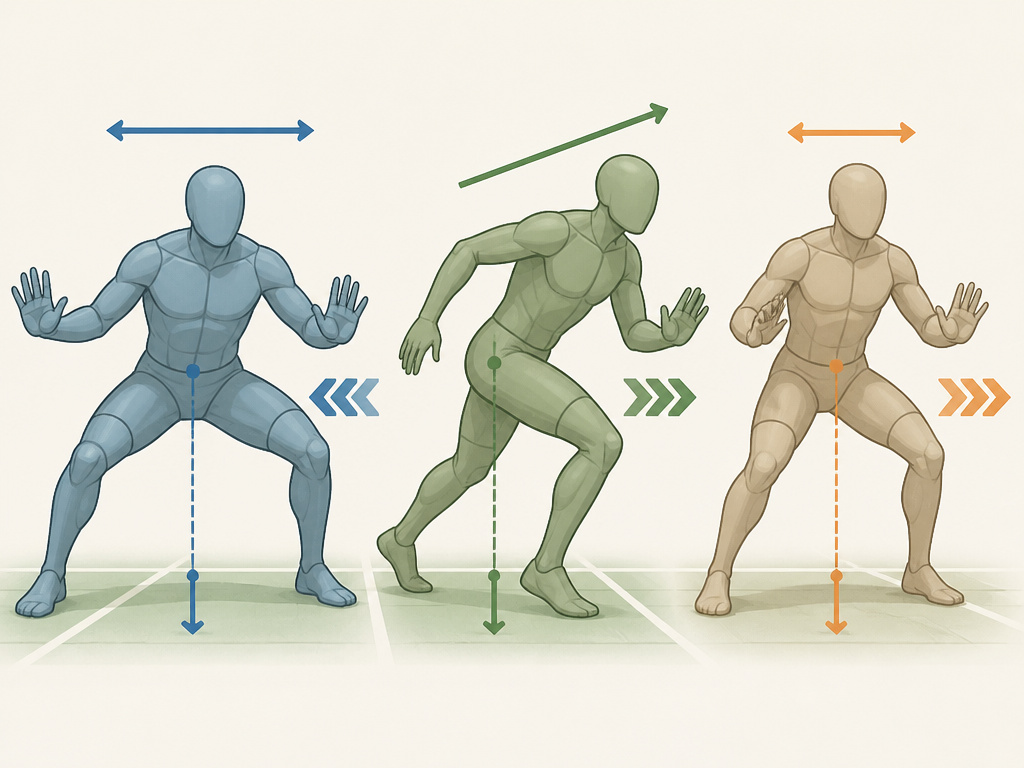
Here’s where the science gets interesting. Defending isn’t just a technique; it’s applied physics. Your body, its size, its composition, its levers, influences what kind of defender you can be most effectively. A study of Nigerian Premier Football League defenders used principal component and cluster analysis to map this out. They found defenders sorted into three clear archetypes, even within the same professional club.
The study analyzed anthropometric and motor-fitness data. The BMC Sports defensive efficiency study identified these clusters:
- Cluster 1: High-mass stoppers. Higher BMI (around 25.7 kg/m²), more muscle mass (41.2 kg average), but slower agility (average 11.0 seconds in an agility test). Think traditional, physical center-backs.
- Cluster 2: Mobile coverage defenders. Leaner builds, faster agility. These are your modern full-backs or covering center-backs who rely on pace and recovery runs.
- Cluster 3: Balanced hybrids. Intermediate values across the board. The versatile defenders who can do a bit of both.
What’s crucial is that agility and vertical jump power showed at least medium effects between the clusters. In plain English: while all defenders need strength, the thing that most distinguishes one type from another is their ability to change direction quickly and explode upwards.
| Archetype | Best For | Physical Limitation | Tactical Niche |
|---|---|---|---|
| High-mass Stopper | Aerial duels, physical containment | Quick changes of direction | Central defense in a deep block |
| Mobile Coverage Defender | Tracking wingers, recovery runs | Physical grappling strength | Wide defense, high-line systems |
| Balanced Hybrid | Versatility, late runs into box | May lack a dominant trait | Full-back in a back three, defensive midfield |
This is about self-awareness for players. If you’re a younger, bigger player who struggles with agility, your training focus might shift. You might work on your positional sense to compensate, mastering the art of shielding the ball to protect a lead. If you’re a lighter, faster player, your game might be about maintaining compactness and using your pace to cover others.
These profiles aren’t static. A professional footballer body composition study tracking players across a training period found “many notable changes” throughout the macrocycle, with all field players gaining trunk body fat as the season wore on. Your peak defending body isn’t a fixed state; it’s a phase in a yearly cycle, with the biggest shifts happening in pre-season and transition periods.
Body Shape for Different Positions and Units
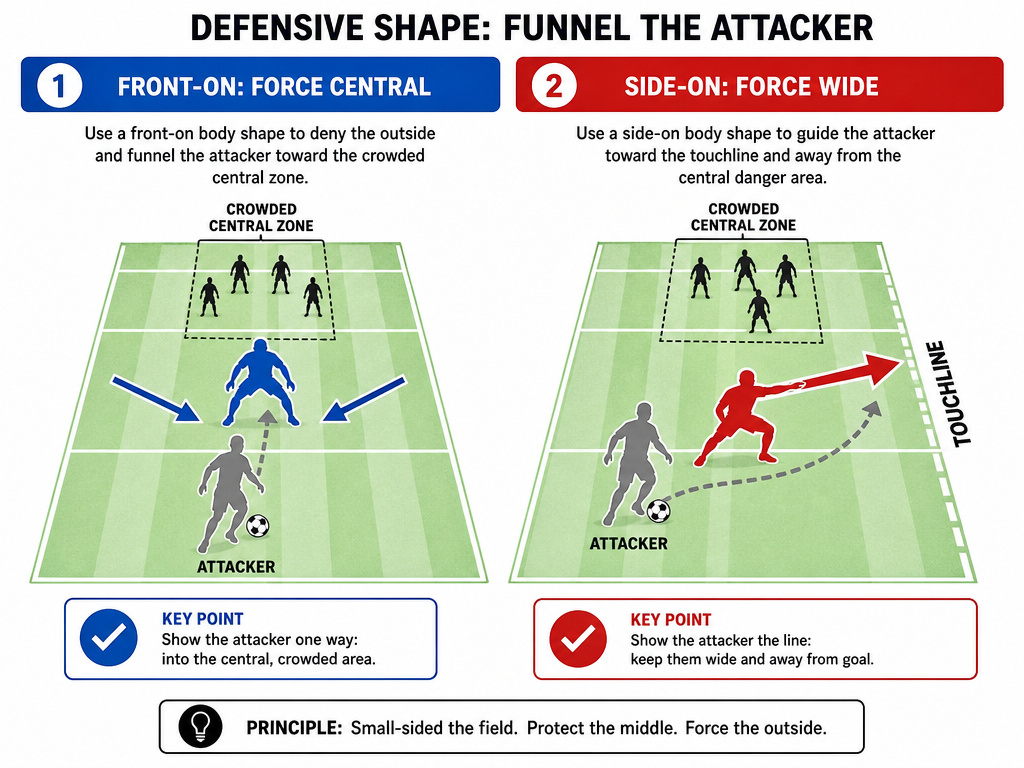
A center-back’s ideal body shape in a 1v1 differs from a full-back’s. A center-back is often funneling an attacker into a crowded central area where help is close. Their stance can be more aggressive, more front-on, because their primary job is to prevent the turn and the shot. They can afford to be a yard closer.
A full-back, especially one isolated against a winger, has different priorities. The touchline is their best friend. Their side-on stance is exaggerated, actively showing the winger down the line, away from the dangerous central areas. Their focus is on footwork and patience, waiting for the winger to look down at the ball or make a predictable cut inside.
When we talk about defensive units, body shape becomes collective. Two center-backs in a pair must coordinate their stances. If one steps up to engage, the other must drop slightly and angle their body to cover the space behind. If both step up in unison, a simple ball over the top splits them. This coordinated movement is the heart of defensive marking.
Common mistake: Two defenders both squaring up to the same attacker, leaving a vertical channel between them for a through ball. One should engage with a side-on stance, the other should provide diagonal cover, their body shape open to see both the ball and the space behind.
This principle scales. The compactness of the five defenders closest to the ball matters far more than the overall team shape. A 2023 German Bundesliga tracking data study found the compactness of the entire defending team showed “almost no differences” between successful and unsuccessful plays. But the subgroup of five nearest defenders was significantly tighter in successful plays. Your individual body shape needs to serve that local density.
Transitioning and Youth Considerations
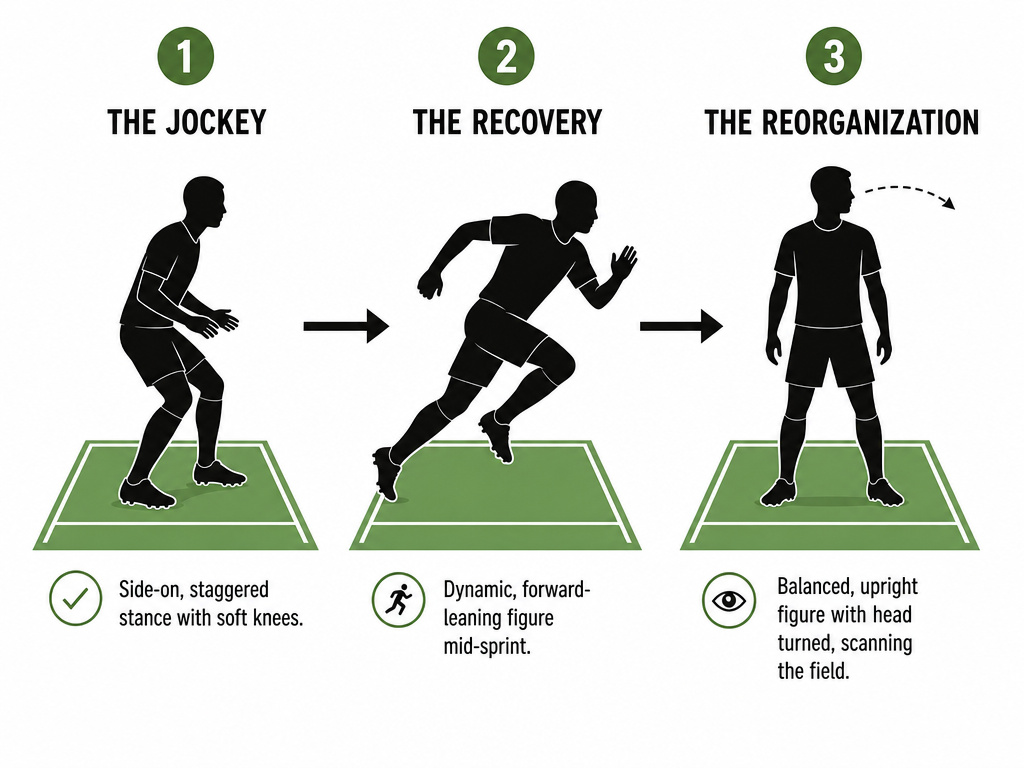
A defender’s work is never static. The moment the ball moves from your side of the pitch to the other, your body shape must transition. You switch from an engaged, side-on jockeying posture to a recovery sprint, then to a scanning mode as you reorganize. The best defenders make this look seamless. Their body is always in a “ready” state, never fully relaxed until the ball is in the opponent’s net.
For youth players, the cues are simpler. Forget the three archetypes. Focus on the three S’s: Side-on, Staggered, and Soft knees. Use clear, visual metaphors: “Be a crab,” “Sit in a chair,” “Make a gate with your legs and only let them go one way.” The Brazilian youth soccer somatotype study reminds us that youth physiques are different, goalkeepers were taller and heavier than defenders in the U-17 sample, and non-midfield positions shared a balanced mesomorph build. Don’t specialize too early; develop all-round athleticism first.
As for the eternal debate about what body type is “best” for a defender, the research disagrees. A study of Spanish professionals classifies defenders as ecto-mesomorphs, while studies of Slovak and Peruvian U-20 players classify them as balanced mesomorphs. The answer probably depends on the league and playing style. The Nigerian study’s “high-mass stopper” might be less effective in a high-pressing, pace-focused European league.
Try this: The next time you watch a match, pick a defender and watch only them for five minutes. Ignore the ball. Watch their feet, their hips, their shoulders. See how they adjust as the ball moves. You’ll start to see the game within the game, the silent, physical chess match that happens long before the tackle.
Frequently Asked Questions
What body type is best for football players?
There’s no single “best” type. Research shows professional defenders cluster into distinct archetypes like high-mass stoppers and mobile coverage defenders. Success depends more on how well a player’s physique, whether ecto-mesomorph or balanced mesomorph, suits their team’s tactical style and their specific role. Agility and explosive power often separate elite performers more than sheer size.
What are the 5 D’s of defending in football?
The 5 D’s are a coaching framework: Delay (jockeying to slow the attack), Deny (blocking passing lanes), Direct (using body shape to channel the attacker), Defend (engaging to win the ball), and Develop (transitioning to attack after possession is won). Body shape is the foundation for the first three.
What position do you put your weakest player in soccer?
You hide a weaker player less by position and more by responsibility. Often, they’re placed in a wide midfield or full-back role with clear, limited duties and plenty of defensive cover nearby. The key is to give them simple instructions and protect them with the team’s overall shape.
Which formation is best for defending?
No formation is inherently superior. A 4-4-2 offers natural width and compactness, a 5-3-2 provides numbers behind the ball, and a 4-3-3 can press high. The best defensive formation is the one that your players understand and can maintain, particularly in the critical compactness of the five defenders nearest to the ball.
The Bottom Line
Good defending starts in the mirror of your own posture. It’s a side-on stance, soft knees, and the patience to wait for a mistake rather than create a crisis. The science tells us our bodies nudge us toward certain roles, but technique is the great equalizer.
The Nigerian study found agility and vertical jump power showed at least medium effects between defender clusters. Whatever your build, train for quick feet and explosive movement. And watch your own team’s next game from a new angle, ignore the ball, follow a defender’s shape. You’ll see the art in the stance.
Now, go find a wall, a partner, or a cone. Practice turning that lead shoulder in. Make it a habit. Because when the game is fast and the pressure is on, your body will remember what your mind might forget.
