
How to Do a Cruyff Turn: Step-by-Step & Historical Context
This post contains affiliate links. As an Amazon Associate, we earn from qualifying purchases.
To do a Cruyff turn, fake a pass or shot, then use the inside of your foot to drag the ball behind your planted leg, pivot your body 180 degrees, and accelerate away. The move is named after Dutch player Johan Cruyff for its first documented use in a competitive match in the 22nd minute of a 1974 World Cup group stage match against Sweden, where he left defender Jan Olsson flat-footed.
That moment in 1974 wasn’t the invention of a new physics. It was the perfect application of a simple principle: use your opponent’s momentum against them. The move works because a defender’s brain is wired to react to the biggest threat, which is usually the ball moving forward. This is the core principle of how to do a Cruyff turn. When you fake that threat, you buy yourself a half-second of hesitation. That’s all you need.
What follows is the full picture of how to do a Cruyff turn, the step-by-step mechanics, the specific 10-minute drill used by academies, the tactical spots on the pitch where it’s gold, and the spots where it’s a genuine risk. We’ll also clear up the common debate about who actually invented it and show you how to build up to it safely, so you don’t end up twisting your ankle on the training pitch.
Key Takeaways
- The Cruyff turn is a 180-degree direction change initiated by faking a pass or shot and dragging the ball behind your standing leg.
- Its most famous use was by Johan Cruyff in the 1974 World Cup, though Pelé executed a similar move in 1960.
- For safety and control, start the move slowly and plant your standing foot on flat ground with a soft knee to avoid ankle injury.
- Practice the turn in a structured 10-minute solo drill 2–4 days a week, progressing from walk-throughs to full-speed repetitions.
- The move is most effective in wide areas or when receiving the ball with your back to goal, but becomes risky in crowded central midfield.
Why the Cruyff Turn Works
Watch any defender in a one-on-one situation. Their eyes lock onto the ball, and their weight shifts toward the direction they think it’s going. The Cruyff turn exploits that programmed response. You sell a story, a driven cross, a shot on goal, and then rewrite the ending.
Johan Cruyff himself put it best: “You play football with your head and you use your feet. So it’s always the situation, what you see, and then react… Use your eyes and fool your opponent.” The move isn’t about fancy footwork. It’s about psychology and timing. You’re not just moving the ball; you’re moving the defender’s expectations.
A successful Cruyff turn creates space not with sheer speed, but by freezing the defender. The fake kick triggers their instinct to block or intercept, committing their momentum forward. Your sudden reverse pull on the ball leaves them wrong-footed and needing a full second to re-set their stance, a lifetime in a dribble.
This is why it has remained a staple for decades. It doesn’t require elasticos or rainbow flicks. It requires a believable sell and a sharp change of direction. Welsh striker Hal Robson-Kanu proved its enduring value at UEFA Euro 2016, using a crisp Cruyff turn in the box to carve out space and score a iconic quarter-final winner against Belgium. The move still works at the highest level because the defender’s basic instincts haven’t changed.
The 5-Step Cruyff Turn Breakdown
We’ll examine the details. Break the move down into separate, slow-motion parts before stitching them together. Rushing the sequence is how you lose the ball or, worse, strain something.
Step 1: Approach and Set-Up
Dribble lightly toward a target, a cone, a shadow defender, the edge of the penalty area. Your head should be up, scanning. This isn’t a move you decide on at the last second; you identify a defender closing you down and choose the turn as your exit.
Step 2: The Sell (The Fake)
This is the entire magic trick. As you take your final touch forward, plant your non-kicking foot firmly beside the ball. Now, swing your kicking leg through as if you’re going to make a firm pass or shot. The swing needs to be convincing. Use your arms and shoulders, wind up your arm across your body. A stiff, tiny leg swing won’t fool anyone.
Step 3: The Drag
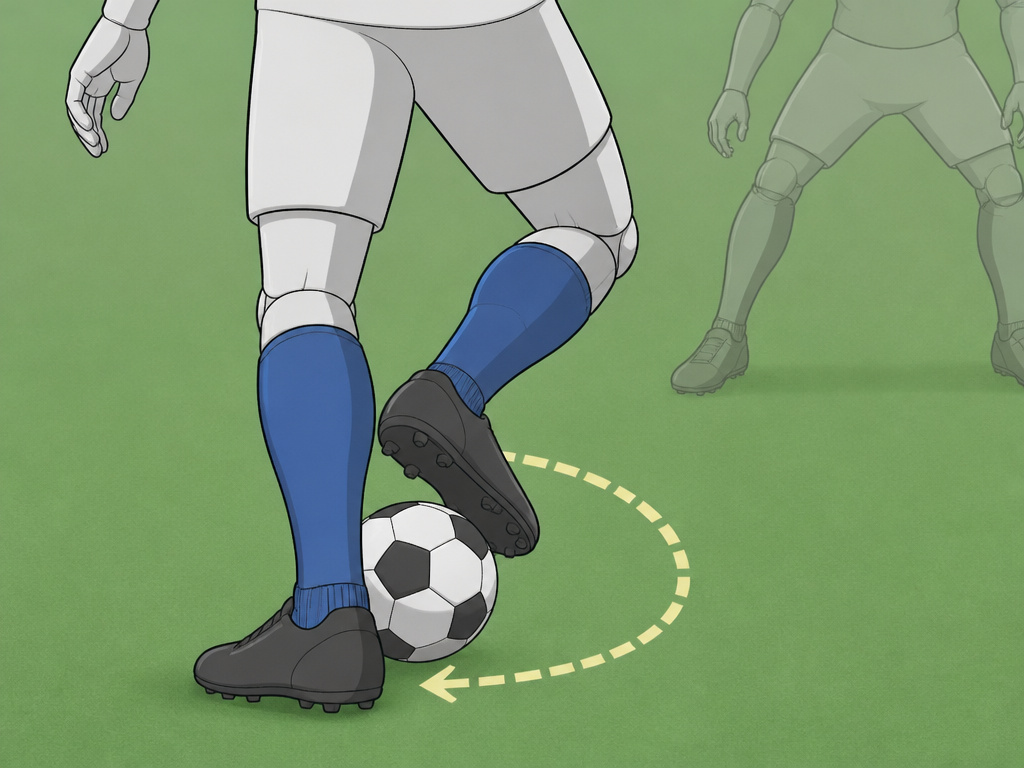
Instead of following through to kick the ball, stop your foot just before contact. Use the inside of that same foot to hook the ball back behind your planted standing leg. Don’t kick it. Think of it as a gentle, controlled pull. The ball should travel only a foot or two.
Step 4: The Pivot
As the ball rolls behind your leg, use that momentum to spin your body 180 degrees. Your shoulders and hips turn together. This is the core of the move described in the BBC Sport Academy skills tutorial: “Turn your shoulders and your hips so that you are back in line with the ball.” If you just drag the ball and don’t turn your upper body, you’ll be facing the wrong way and the defender will easily tackle you.
Step 5: The Escape
You are now facing the opposite direction with the ball at your feet. Your first touch out of the turn must be a positive one, push the ball a few yards into the space you’ve just created and accelerate. The turn is useless if you don’t immediately create distance.
Where this goes sideways: Kicking the ball instead of dragging it. If you make contact with the ball during the fake swing, you’ll simply pass it to the opponent or out of play. The foot stops before contact; the inside of the foot then pulls.
Mastering these steps builds the foundation for all essential one-on-one dribbling skills. It teaches you to manipulate the defender before you even touch the ball.
The 10-Minute Practice Drill (Ages 7–18)
You can’t learn this move by just reading about it. You need reps. A structured drill from coaching resources like Bravara lays out a perfect solo session. It takes 10 minutes and is designed for players aged 7 to 18.
What You Need:
- A soccer ball (Size 3 for age 8 and under, Size 4 for ages 9–12, Size 5 for 13+)
- One cone or marker (a shoe works)
- Open grass or turf about 15 steps (30 feet) long
The Drill Sequence:
- Set your cone at the end of your practice area.
- Dribble toward it with your right foot.
- A step before the cone, plant your left foot and execute the Cruyff turn as described above.
- Walk through the move 5 times slowly. Focus on form, not speed.
- Then, perform 10 full turns at a controlled pace. Count a rep only if the ball stays close after the turn.
- Switch feet and repeat the sequence: 5 walk-throughs, 10 turns with your left foot.
The recommended frequency is 2–4 days a week. This isn’t about marathon sessions; it’s about consistent, focused repetition to build muscle memory.
Safety: Plant your standing foot on flat ground and keep a soft knee as you turn. Start slow so you don’t twist your ankle on the ball.
This kind of repetitive, focused agility training is what translates a skill from the training ground into a game. The drill’s progression from walking to doing mirrors how you should integrate any new dribbling technique.
Cruyff Turn vs. Other Signature Turns
The football world is full of clever turns. How do you know when to use a Cruyff versus, say, a Maradona turn or a La Croqueta? The choice often comes down to the defender’s position and the space available.
| Turn Move | Best For | Key Differentiator | Risk If Misused |
|---|---|---|---|
| Cruyff Turn | Beating a defender closing you down from the front, especially in wide areas. | A 180-degree change of direction using a fake kick. It’s a reaction to pressure. | If the fake isn’t sold, you’re kicking the ball to the defender. Low success rate in crowded central zones. |
| Maradona Turn (360 Spin) | Shielding the ball from a defender tight on your back. | A full 360-degree spin that uses the sole of the foot to roll the ball. It’s a shielding move. | Spinning into a second defender you didn’t see. Requires excellent balance. |
| La Croqueta | Moving laterally past a defender in a tight channel, like the edge of the box. | A quick, lateral shift of the ball between the inside of both feet. It’s a side-step in close quarters. | Can be predictable if telegraphed. The ball is exposed between touches. |
The Cruyff is your go-to when you need to reverse the play completely, making it the answer for how to do a Cruyff turn in the right situation. The others are for navigating tighter, more congested spaces. Understanding this helps you move beyond just having the skill to knowing the right moment to apply it, which is the true heart of close control.
When NOT to Use the Cruyff Turn
Here is the part most people miss. For every highlight reel goal like Robson-Kanu’s, there are a hundred attempts that gift possession to the other team. The turn has specific vulnerabilities.
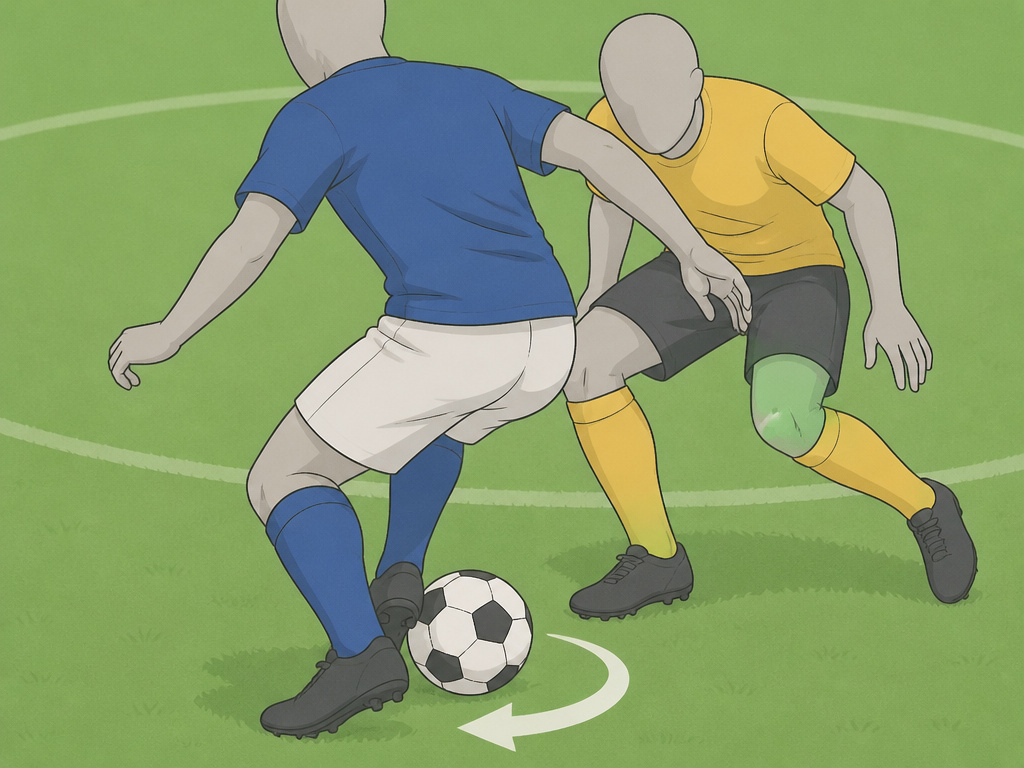
First, never try it in the center of the park when you’re surrounded. The move commits you to a 180-degree pivot. If there’s a second defender lurking behind you, and in midfield, there always is, you’re turning straight into a tackle. The space you think you’re creating disappears.
Second, avoid it when the defender is already side-on or backing off. The fake only works if the defender is actively engaging you, moving forward to close down the passing lane. If they’re jockeying, waiting for you to make a move, your exaggerated fake will look silly and they’ll easily stick a foot in.
Finally, if your first touch is poor, forget the turn. The move requires the ball to be exactly where you need it, just in front of your planted foot. If your controlling touch is too heavy, you’ll have to stretch for the drag, losing balance and power. Work on your fundamental dribbling techniques and first touch before layering in the advanced skill.
A Brief History: Did Cruyff Invent It?
The Wikipedia entry on the Cruyff turn states the move is named after the Dutch maestro for its iconic use in the 1974 World Cup. But it also notes a crucial caveat: “The fact that the feint was named after Cruyff, however, does not mean that Cruyff was the first to perform this move.”
The record shows Brazilian legend Pelé performed the same trick in a match against Juventus back in 1960, fourteen years before Cruyff’s famous moment. So why does Cruyff get the naming rights? Two reasons: stage and style.
The 1974 World Cup was one of the first global tournaments broadcast in color to a massive worldwide audience. Cruyff’s execution was pristine, and the victim, Swedish defender Jan Olsson, was left so utterly bewildered that the moment became an instant legend. Cruyff performed it with a nonchalant, almost arrogant grace that fit his persona as the game’s great thinker. He didn’t just do the move; he presented it. You can see his own charismatic explanation in this BBC Newsround video demonstration.
So no, he probably didn’t invent it. But he perfected its presentation on the biggest possible stage, cementing it in football folklore. It’s a great reminder that in football, timing and theater often matter as much as the invention itself.
Frequently Asked Questions
How do you perform a Cruyff turn?
Fake a pass or shot with a full leg swing, then use the inside of that same foot to drag the ball behind your planted standing leg. As you drag it, pivot your shoulders and hips 180 degrees to face the opposite direction, then accelerate away with the ball.
What is the hardest trick in soccer?
“Hardest” is subjective, but tricks like the rainbow flick or the elastico are often cited due to their complex coordination and low success rate in games. The Cruyff turn is considered one of the more effective and learnable advanced moves because it’s based on a simple mechanical action.
Did Johan Cruyff invent the Cruyff Turn?
Sources disagree on the origin: the common narrative credits Johan Cruyff following its iconic 1974 World Cup use, but historical records show Pelé performed a similar move in 1960.
What tactics did Cruyff use?
Johan Cruyff was the embodiment of “Total Football,” a philosophy where players are versatile and constantly interchanging positions. His tactics emphasized spatial awareness, possession, and pressing. The Cruyff turn was a micro-example of his broader tactical mind: using skill to create space and break defensive lines.
Before You Go
One rule to lock in from all this: if you’re going to practice the Cruyff turn, spend 80% of your time on the first two steps, the approach and the sell. The drag and pivot are almost automatic if the defender bites on the fake. A half-hearted shoulder dip won’t do it. You need to commit to the lie with your whole body.
And remember the origin story. It’s a helpful corrective. The move wasn’t born in a vacuum in 1974; it was a tool that existed and was sharpened by the moment. Your job is to recognize that same moment on your pitch, a defender over-committing, a channel of space behind you, and have the sharpened tool ready. Don’t force it where it doesn’t fit. That’s the difference between a highlight and a turnover.
Now, get a ball, a cone, and give that 10-minute drill a shot. Start slow.
