
How the Scottish Premiership Works: Key Format and Rules
This post contains affiliate links. As an Amazon Associate, we earn from qualifying purchases.
The Scottish Premiership works on a 12-team, 38-game season split into two phases. After each club plays 33 matches (facing every opponent three times), the league splits into a top six and a bottom six. Each club then plays five more matches only against others in their half, deciding the title, European qualification, and relegation. This format, active since the 2000/01 season, prevents a 44-game schedule but creates inherent fixture imbalances.
That 33-match threshold is the hinge everything swings on. Before it, the schedule is locked. After it, the fixture list gets rewritten based on the live league table, which is where the annual debates about fairness, schedules, and who got a better deal really kick off. This is a key part of how the Scottish Premiership works.
What follows is a walk through the calendar, the rules that force tough choices, the financial stakes hidden in the split, and the one playoff that keeps everyone looking over their shoulder until the final whistle.
Key Takeaways
- The league splits after 33 matches, with the top and bottom six then playing five more games only within their half for a 38-game season.
- A perfectly balanced 19 home and 19 away games is not guaranteed; since 2000/01, a 20/18 home/away split has occurred around 50% of the time.
- The team finishing 12th is automatically relegated, while 11th enters a two-legged play-off against a Championship side.
- Fixture reversals, playing an opponent three times at home, have been required every season since the split began, dictated by pre-split home game allocation.
- The split creates a massive mid-season target; finishing in the top six guarantees extra revenue from hosting the league’s biggest clubs post-split.
The 33-Match Threshold and the 38-Game Season
The season begins with a simple, fixed round-robin. Each of the twelve clubs plays every other club three times. In the first 33 matches, each club plays every other club three times, with at least one home and one away game against each opponent.
The Premiership comprises twelve Clubs. Each Premiership club plays 38 matches per season. The split occurs after each club has played 33 matches. In the first 33 matches, each club plays every other club three times, with at least one home and one away game against each opponent.
That’s the predictable part. The fixture list you see in July covers these 33 rounds. Clubs are scheduled to play either 16 or 17 home games in this phase; the SPFL states this scheduling occurs, while BBC Sport notes the number is predetermined based on the previous campaign. This pre-determination is a key factor in the post-split fixture planning.
After that 33rd match, the table is frozen and cut in half. Clubs in positions 1-6 only play each other once more. Clubs in positions 7-12 do the same. That adds five matches per club, bringing the total to 38.
The alternative was a 44-game season where teams play each other four times, which is not how the Scottish Premiership works. The split was the compromise. It keeps the calendar manageable while theoretically ensuring the most meaningful matches happen when the stakes are highest.
The Inevitable Imbalance: Home Games and Fixture Reversals
The ideal outcome is 19 home games and 19 away for every club. The SPFL states it tries to ensure this balance, but admits it is not always possible. The math often works against it.
Since the split’s introduction for the 2000/01 season, a scenario where one club plays 20 home games and another plays 18 has occurred around 50% of the time. For the 2025/26 season, that exact imbalance is confirmed: Falkirk in the top-six will play 20 home games, while Livingston in the bottom-six will play 18.
This happens because of the pre-split home game allocation. If you have 17 home games in the first 33 rounds, you’d nominally get two at home post-split to hit 19. If you had 16, you’d need three at home after the split. But the post-split schedule must also respect other constraints, derby dates, police advice, broadcast selections, and each club must play at least two home games in that final five-match phase. Sometimes, giving a club that third home game to reach 19 is simply impossible without breaking a more important rule.
| Club (2025/26 Example) | Pre-Split Home Games | Post-Split Home Games | Total Home Games | Scenario |
|---|---|---|---|---|
| Falkirk | 17 | 3 | 20 | Top-Six |
| Livingston | 17 | 1 | 18 | Bottom-Six |
| Ideal Balance | 17 | 2 | 19 | N/A |
This leads directly to fixture reversals. A reversal means a club ends up playing a specific opponent three times at home and only once away (or vice versa), breaking the balanced schedule. The SPFL notes these reversals have been required in every season since the split began.
For 2025/26, there are four specific reversals in the top-six involving Falkirk, who will host Rangers and Hibernian for a third time, and travel to Celtic Park and Tynecastle (Hearts) for a third time. The bottom-six has three reversals, including Livingston traveling to Dundee and Dundee United for a third time.
Where this goes sideways: Assuming a perfectly balanced 19/19 home/away season. The predetermined pre-split schedule, working off last year’s table, almost guarantees some clubs will be on the wrong side of the math when the actual top six is revealed.
The SPFL’s fixture compilers work under specific, fixed constraints. Police Scotland will not permit both Old Firm clubs (Celtic and Rangers) to be at home on the same day. City derbies are ruled out on the final day for public safety. Broadcasters pick games that can force a whole round to shift. The compilers aim to avoid reversing fixtures that have a key impact on the title, European races, or relegation, and try to avoid flipping the big city derbies. It’s a juggling act where a perfect solution doesn’t exist.
Promotion, Relegation, and the Playoff That Changes Everything
The split amplifies the stakes at both ends of the table, but the consequences are defined by hard rules.
The club that finishes 12th (last) in the Premiership is automatically relegated, swapping places with the winner of the Scottish Championship.
The drama intensifies for 11th place. That club enters the Premiership/Championship Play-Off Competition. They face the winner of a mini-tournament between the Championship’s 2nd, 3rd, and 4th placed teams over two legs. The winner of that two-legged final earns the right to play in the Premiership the following season.
This means two clubs can be relegated from the Premiership each season. The introduction of this play-off in 2013 added a huge layer of tension. A club sitting comfortably in 10th with a few games to go can suddenly be pulled into a dogfight for survival if results go against them. It makes the bottom-six post-split matches, often involving clubs with little left to play for, suddenly critical for those fighting to avoid 11th place.
This play-off system is a common feature in modern football, designed to maintain excitement. Understanding it is key to grasping the pressure in the Scottish Premiership’s bottom half, where the threat of dropping down to the semi-professional football and lower leagues of the football pyramid is very real.
The Top-Six Prize: More Than Just Pride
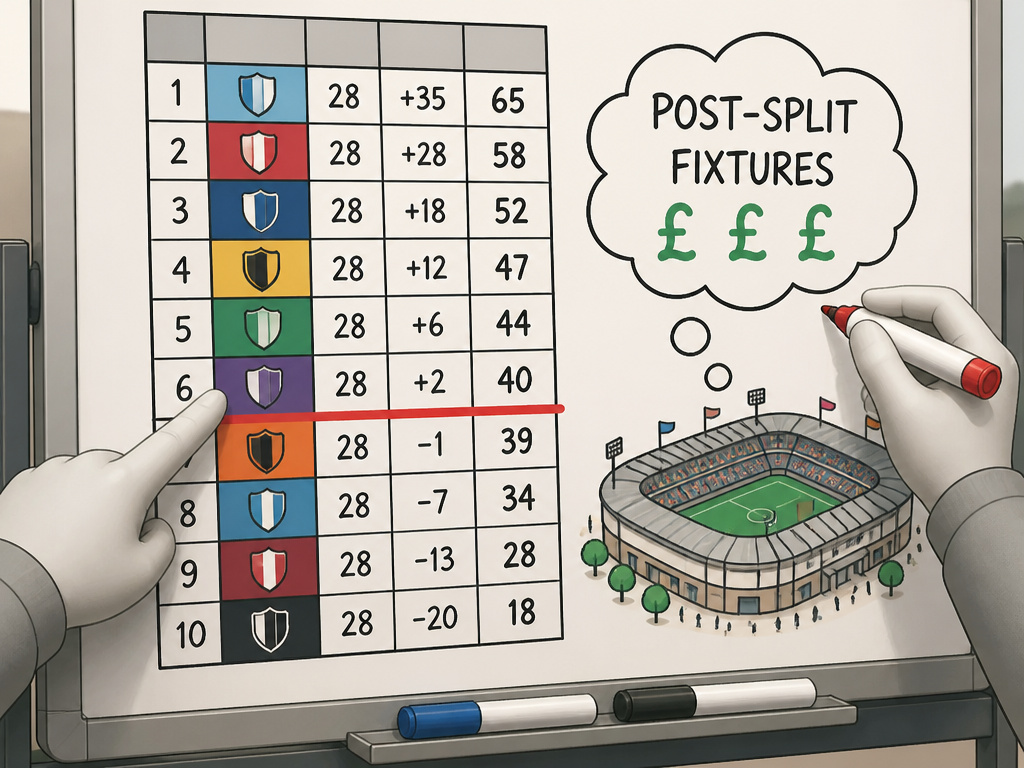
Finishing in the top six is treated as a major objective for clubs outside the traditional giants. It’s not just about European qualification, though that’s the glittering prize, it’s about guaranteed revenue and prestige.
The post-split fixture list for the top six features matches against the league’s best-supported clubs. It guarantees five more matches against the league’s best-supported and most high-profile clubs. For clubs outside the traditional giants, hosting the league’s best-supported clubs post-split can mean significant revenue opportunities.
Missing the top six means a club’s final five matches are against other bottom-half clubs. Your final five matches are against other bottom-half clubs, often with dwindling crowds and less media attention. Finishing in the top six guarantees extra high-profile post-split fixtures, making the battle for that final spot highly competitive.
This dynamic fundamentally shapes club strategy and is a key aspect of how the Scottish Premiership works. The clear mid-season target of a top-six finish can influence club strategy throughout the season. It creates a clear mid-season target that doesn’t exist in a standard 20-team league, making the league table from December onwards a constant source of calculation.
A Season in Practice: The 2025/26 Calendar
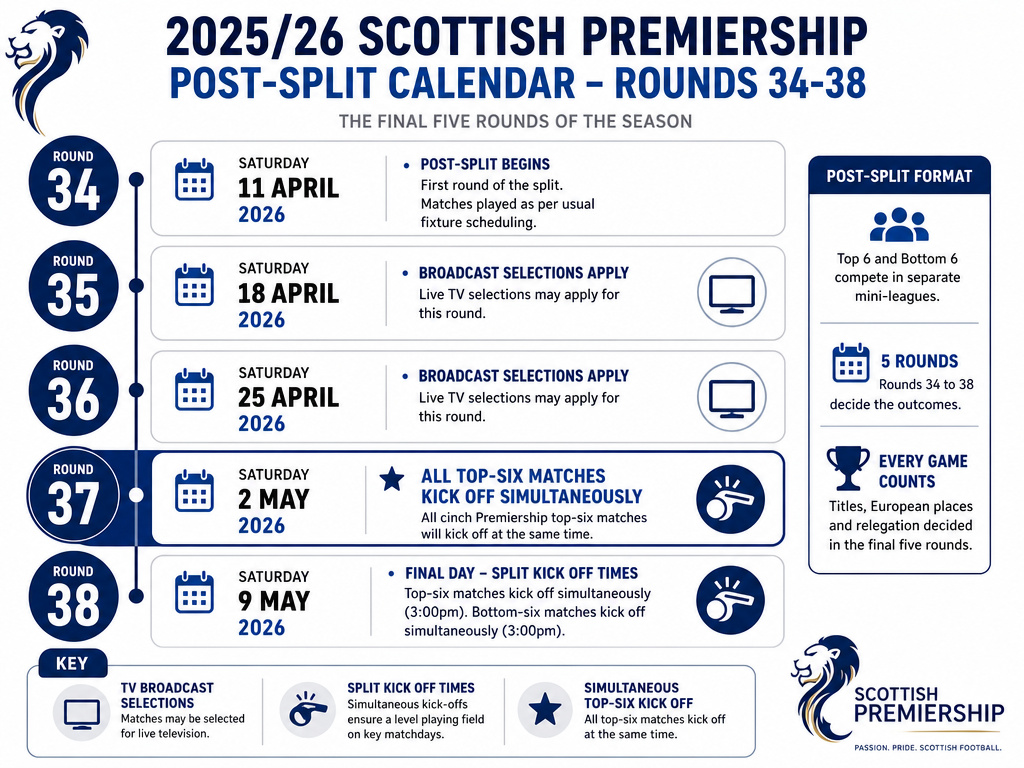
Seeing the dates makes the theory concrete. After the split, the season accelerates towards its conclusion.
- Round 34: Weekend of April 25/26, 2026
- Round 35: Weekend of May 2/3, 2026 (Hearts v Rangers scheduled for Monday, May 4 at 5.30pm for broadcast)
- Round 36: Weekend of May 9/10, 2026
- Round 37: Midweek of May 12/13, 2026 (All top-six matches kick off simultaneously)
- Round 38: Weekend of May 16/17, 2026 (Top-six games on Saturday at 12.30pm, bottom-six on Sunday at 2.00pm)
The scheduling of Round 37 is a telling detail. By having all top-six games kick off at the same time, the SPFL ensures no team has an advantage by knowing another result. This ensures no team has an advantage by knowing another result. For the final day, the split kick-off times also help manage policing and fan movement, especially with the intense Old Firm derby rivalry never far from the planners’ minds.
Sky Sports has confirmed six post-split fixtures for live broadcast for the 2025/26 season. The BBC Sport provides excellent analysis of this fixture decision process, highlighting the competing priorities.
Frequently Asked Questions
Can a team move from the bottom six to the top six after the split?
No. The league table is frozen after 33 matches. The clubs in positions 1-6 are locked into the top-six section for the final five games, and clubs in 7-12 are locked into the bottom-six. This can lead to the odd sight of a team in 7th finishing with more points than the team in 5th, as happened in the 2023-24 season.
Why does the Scottish Premiership have only 12 teams?
The 12-team format was adopted starting with the 2000/01 season. A 10-team league (playing each other four times for 36 games) was seen as too small, while a 12-team league playing each other four times would mean a 44-game season, which was deemed too long. The split format was the chosen compromise to keep the season at 38 games.
How does European qualification work?
European places are awarded based on final league position and Scottish Cup results. Typically, the champions qualify for the UEFA Champions League, with other spots feeding into the UEFA Europa League and UEFA Europa Conference League. The exact allocation changes annually based on Scotland’s UEFA coefficient ranking.
Is the split format used anywhere else?
While other leagues like the Belgian Pro League and the Austrian Bundesliga have used split formats, the Scottish Premiership’s specific model, splitting into two static groups of six after a triple round-robin, is unique in top-flight European football. It’s a defining, and often debated, characteristic of the Scottish game.
What happens if teams are tied on points at the end of the season?
If teams are level on points, the first tiebreaker is goal difference (goals scored minus goals conceded). If goal difference is identical, the next tiebreaker is total goals scored. The full breakdown for determining league position is contained within the SPFL’s official rules and regulations.
Before You Go
The Scottish Premiership’s format is a system of engineered tension. It’s built to maximize drama at the cost of perfect mathematical fairness. That 20/18 home game split isn’t a bug; it’s a feature of the compromise that keeps the season at 38 games.
The real measure of a club’s season often isn’t where they finish, but which side of the split they land on. That’s the single biggest factor for finances, fan engagement, and future planning. Everything in the first 33 games builds towards that divide.
For a deeper look at how clubs move between divisions in systems like this, the principles of promotion and relegation are universal. And if you want the full context, the Wikipedia entry on the Scottish Premiership and the BBC Sport league split explainer are excellent starting points. The format is a defining characteristic of the Scottish game. That’s what makes it worth understanding.
