
Old Firm Derby History Explained: Key Head-to-Head Numbers
This post contains affiliate links. As an Amazon Associate, we earn from qualifying purchases.
The Old Firm derby is the rivalry between Glasgow clubs Celtic and Rangers, a fixture defined by a uniquely close head-to-head record, deep-seated sectarian and political divides, and a commercial partnership first named in a 1904 newspaper cartoon. The term “Old Firm” itself points to the lucrative business relationship the two clubs were seen to share, a perception that would fuel a riot in 1909. One major source tallies 449 competitive fixtures across all competitions as of January 2026, with Rangers holding 172 wins to Celtic’s 171. Another respected source counts only league and major domestic cup matches, arriving at 436 ‘Old Firm derbies’ since 1890, with Rangers having 169 wins to Celtic’s 165.
That 436-match count tells you the first thing you need to know: the balance of power in Glasgow has swung by inches, not miles, for over a century. The numbers are so tight that a single season can tip the all-time record. But those numbers only make sense when you understand the forces that created them, forces that have little to do with football and everything to do with identity, commerce, and, at times, violence. The Old Firm derby history explained reveals the deep roots of this rivalry.
What follows is the story of how a friendly first match in 1888 became the world’s most politically charged derby, a key part of the old firm derby history explained. We’ll break down the cartoon that gave it a name, the riot that nearly broke it, the sectarian fault line that defines it, and the financial crisis in 2012 that made some fans question if it still exists.
Key Takeaways
- The term “Old Firm” first appeared in print in a cartoon in The Scottish Referee on April 16, 1904, depicting a man with a sandwich board reading “Patronise The Old Firm. Rangers, Celtic Ltd.”
- A non-sectarian riot in 1909, sparked by fan anger over a lack of extra time in a cup final replay, led to over 100 injuries and forced the clubs to jointly petition the SFA to abandon the final.
- The rivalry’s sectarian dimension hardened after 1912 when hundreds of Ulster Protestant shipyard workers, employed by Belfast’s Harland and Wolff in Glasgow, adopted Rangers as their club.
- In the 436 competitive Old Firm derbies counted by major sources, Rangers lead by just four wins (169 to 165), a margin so slim it has changed hands within the last decade.
- Following Rangers’ liquidation in 2012, a significant portion of Celtic supporters reject the “Old Firm” label, preferring “Glasgow derby,” while Rangers officially continue to use the old term.
The First Whistle: 1888 and a Cordial Start
The origin story is one of practicality and cooperation, not instant hatred. The origin story is one of practicality and cooperation, not instant hatred. When Celtic was formed in 1888 to support the Irish immigrant community in Glasgow’s East End, they needed a first opponent. Rangers, established 16 years earlier in the city’s south-west, provided one. For a few years, the relationship was reportedly cordial. Clubs would travel to away matches together. This early friendliness is a crucial, often overlooked, layer. It means the poison didn’t come from the football itself.
That timeline alone, five years of Celtic dominance at the start, sets a psychological template. One club playing catch-up from the very beginning creates a different kind of tension than two equals clashing from day one. You can still hear echoes of that foundational dynamic in the banter today.
The 1904 Cartoon & The 1909 Riot
The rivalry’s modern identity was forged in a single decade. Two events, five years apart, gave it a name and a reputation for chaos that still lingers.
The name came first. It wasn’t about friendship or tradition; it was a dig at the perception that the two clubs had a cosy, lucrative duopoly over Scottish football. They were a business partnership, an “old firm” in the commercial sense.
That perception of collusion, a central part of the old firm derby history explained, exploded into violence five years later. On April 17, 1909, a Scottish Cup Final replay between the sides ended 1-1. Fans, believing they were entitled to extra time without paying again, thought the clubs had engineered a draw to force a third, money-spinning replay. A riot ensued.
Where this goes sideways: Assuming the 1909 violence was purely sectarian. Contemporary reports and historians like Celtic’s David Potter note that Rangers “had not yet involved themselves with the extreme Protestant cause” at this stage. The spark was financial anger, not religious hatred.
The fallout was severe. For a moment, the “Firm” acted as one against external authority. It wouldn’t last.
Sectarianism, Shipyards, and a Social Fault Line
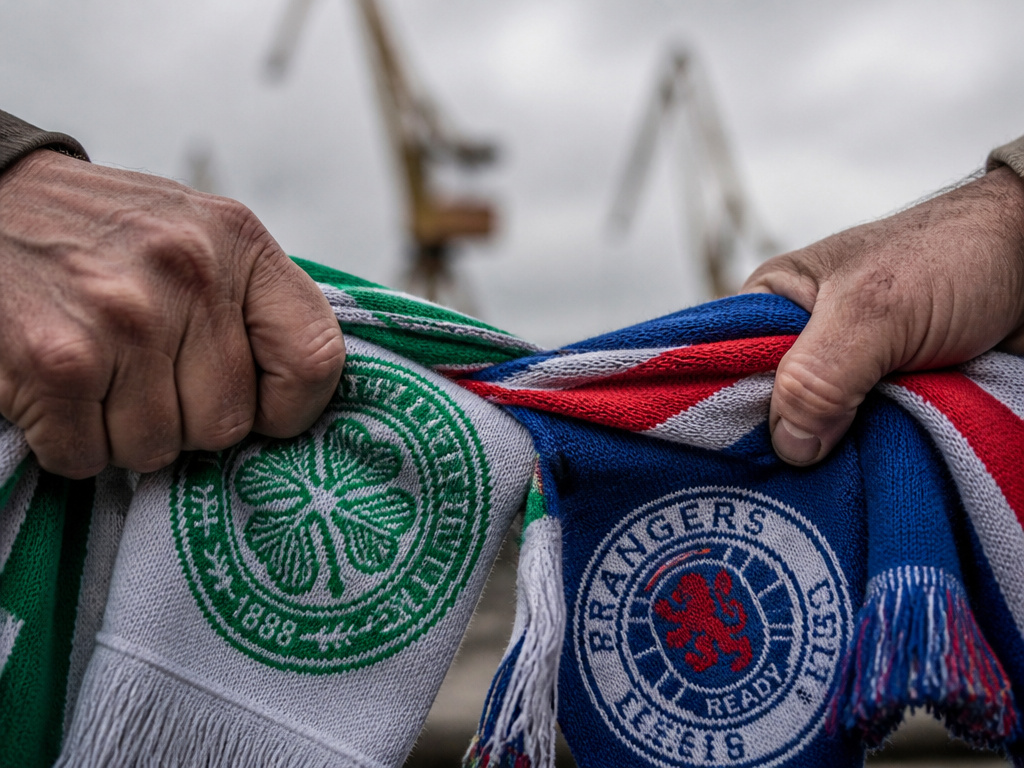
If the early rivalry was about competition and then commerce, the 20th century layered in the identity politics that define it today. This didn’t happen overnight, but one year is pivotal: 1912.
This influx cemented the club’s association with Unionism and Protestantism in a way that was both cultural and demographic. The rivalry was no longer just Glasgow; it was a proxy for the sectarian and political conflicts of Northern Ireland.
| Club | Traditional Fan Identity | Political Symbol | Religious Association |
|---|---|---|---|
| Celtic | Irish-Scots, Catholic | Irish Tricolour, Republicanism | Catholic |
| Rangers | Scots/Ulster-Scots, Protestant | Union Jack, Loyalism | Protestant |
This table is a generalization, not every fan fits these labels, but it captures the symbolic divide. Celtic, founded to support a Catholic immigrant community, had always fielded Protestant players, with legendary Protestant figures like Jock Stein and Kenny Dalglish integral to their history.
The atmosphere this creates is what legends from both sides describe as unmatched. The sound inside the stadium during an Old Firm match has a specific, sustained roar that’s part fury, part fear. You feel it in your chest for hours after you leave.
Head-to-Head: The Numbers That Tell the Story
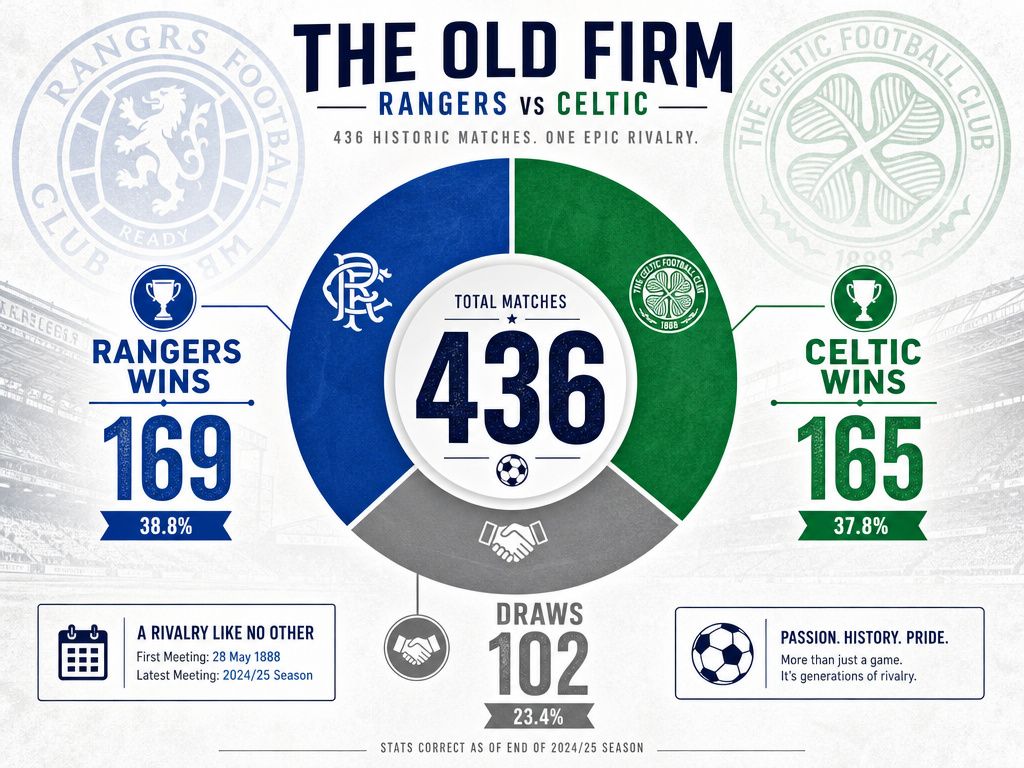
Tactically, the match is its own beast, but the history is written in the ledger. The numbers are astonishingly close, which is why every single derby feels like it could shift the narrative of a century.
| Competition | Matches | Rangers Wins | Celtic Wins | Draws |
|---|---|---|---|---|
| Total (436 Count) | 436 | 169 | 165 | 102 |
The individual records are just as iconic. That’s an entire career defined by one fixture.
Scores like that aren’t just results; they become folklore, used as a taunt for generations.
The managerial records show how eras of dominance are built. These numbers matter because in a rivalry this balanced, a manager who tilts the scale even slightly becomes a legend.
Tragedy, Turmoil, and the “Glasgow Derby”
No history is complete without acknowledging the darkness.
The most recent seismic shift was financial. In 2012, the company that owned Rangers was liquidated. The club was reformed and entered the Scottish league structure in the fourth tier. This event fundamentally altered the rivalry’s terminology for many.
Common mistake: Thinking all fans use “Old Firm” interchangeably.
This is a direct attack on the continuity and history of the rival club, a way of waging war with vocabulary. It also highlights how modern football fan culture uses these historical narratives as weapons. The chants, the banners, the refusal to acknowledge a name, it’s all part of the ongoing battle.
The Modern Matchday: What Has Changed?
The derby today is a different beast from the one in 1909. All-seater stadiums, heavy police presences, and early kick-offs to minimize alcohol-related trouble have sanitised the matchday experience. The sectarian chants, while still present, are less overt than in decades past, partly due to clubs’ own initiatives and legislation like Scotland’s Offensive Behaviour at Football Act (since repealed, but its effect lingers).
The economic reality, however, still echoes that 1904 cartoon. The fixture remains a financial powerhouse, generating revenue that dwarfs any other game in Scottish football. When Rangers were absent from the top flight between 2012 and 2016, broadcasters and sponsors felt the pinch acutely. The commercial “Old Firm” is very much alive, even if the term is contested.
For a neutral, understanding the derby now means recognizing these three layers operating at once: the ferocious sporting contest, the deep historical and social undercurrent, and the multi-million-pound business partnership. It’s why a football derby in Glasgow is never just a game.
Frequently Asked Questions
Why is it called the Old Firm derby?
The most documented origin is a cartoon in the The Scottish Referee newspaper on April 16, 1904. It showed a man with a sandwich board reading “Patronise The Old Firm. Rangers, Celtic Ltd.”, mocking the perception that the two clubs had a lucrative business partnership. Alternative theories, like commentators calling them “two old, firm friends,” lack the same primary-source evidence.
What does WATP mean?
WATP stands for “We Are The People,” a slogan and chant used by a section of Rangers supporters. Its origins are debated but are closely tied to loyalist and Protestant identity in Northern Ireland, reflecting the political dimension of the club’s supporter base.
Who has won more Old Firm derbies?
The all-time record is incredibly close. In the commonly cited tally of 436 competitive meetings in the league and major cups, Rangers have 169 wins to Celtic’s 165, with 102 draws. The lead has swapped hands several times in the last twenty years.
Is it still called the Old Firm?
This is a point of contention. Following Rangers’ financial liquidation in 2012, many Celtic fans and the club itself often use the term “Glasgow derby” instead, arguing the original rivalry died with the old company. Rangers continue to use “Old Firm” officially, so the term persists but is politically charged.
What was the biggest win in an Old Firm derby?
The biggest margin of victory was Celtic’s 7-1 win in the Scottish League Cup final in October 1957. Five-goal margins have been achieved four other times, with 5-0 wins for both sides in the record books.
Before You Go
The Old Firm’s history isn’t a straight line from a friendly in 1888 to sectarian warfare. It’s a story of collaboration turning to commercial partnership, then that partnership being weaponised by identity politics. The 1909 riot wasn’t about religion; it was about fans feeling cheated by the “Firm.” The sectarianism came later, hardened by migration and industry.
That’s what makes it the world’s most intense derby. It’s not just about football, religion, or politics. It’s the terrifying, exhilarating fusion of all three, played out in a stadium where the weight of 436 results hangs in the air. The numbers say the teams are separated by a handful of wins over 134 years. The history says they’re separated by a chasm. Both are true. That’s the paradox, and the power, of the Old Firm.
