
History of the Football Association: The 160-Year Story
This post contains affiliate links. As an Amazon Associate, we earn from qualifying purchases.
The Football Association (FA) was founded on 26 October 1863 at a meeting of eleven clubs at the Freemasons’ Tavern in London. The aim was to create a single, unified code of rules for football, a process finalized six weeks later with the adoption of 14 laws. This body, the world’s first football association, went on to create the FA Cup in 1871, legalise professionalism in 1885, help found the International Football Association Board (IFAB), and, in 1992, launch the Premier League.
That founding date is the anchor, but the real story is in the six frantic meetings that shaped the early history of the football association. They weren’t drafting a perfect game; they were negotiating a peace treaty between rival versions of football, and the fallout shaped everything that came after.
What follows is the chain of problems and solutions: how a meeting in a pub led to a global sport, why the offside law changed three times in sixty years, and how a dispute with Sheffield clubs forced the creation of a permanent rule-making body. This is the 160-year history of the football association, the institution that built the game’s rulebook.
Key Takeaways
- The FA was formed by 11 London clubs on 26 October 1863, with Civil Service FC as the only surviving founding member still playing association football.
- Sources disagree on the number of laws in the final 1863 code: The FA’s first draft in November 1863 numbered 23 laws, while the final agreed code adopted on 8 December 1863 is recorded by some sources as consisting of 14 laws.
- The FA Cup, announced in July 1871, was the catalyst that forced the unification of London and Sheffield rules into a single national code by 1877.
- The International Football Association Board (IFAB) was created in 1886 to guard the laws, requiring a three-quarters majority from the four UK associations to pass changes.
- Rule evolution was driven by problems: the offside law was changed in 1925 (from three defenders to two) specifically to increase goals after a defensive decade.
The Founding Meeting: October 1863
Watch the space, not just the ball. In 1863, the space was a complete mess. Football wasn’t one game; it was a dozen different games, each with its own rules carried over from England’s public schools. The Eton game banned handling. The Rugby game encouraged it, along with ‘hacking’ – kicking an opponent’s shins. University men and cricket clubs wanting a winter game had no idea which version to play.
The move to fix it started with a letter to Bell’s Life newspaper from Ebenezer Cobb Morley of the Barnes club. His call for a governing body led to that first meeting on a Monday evening. Eleven clubs sent delegates. Charterhouse School attended as an observer but didn’t join. The minutes show the immediate goal: “for the purpose of forming an Association with the object of establishing a definite code of rules.”
The technical snippet: The foundational meeting of the Football Association occurred on 26 October 1863 at the Freemasons’ Tavern in London. Eleven clubs were formally minuted as attending, including Barnes, the War Office Club, and Crystal Palace. The sole surviving founding member still playing association football under an unbroken history is Civil Service FC, originally listed as the War Office Club.
The real work began immediately. A second meeting nine days later agreed on nine rules for the Association itself. Then they got to the hard part: the actual laws of the game.
The Six Meetings and the Great Split
They met six times in just over six weeks. It was less a design committee and more a tense negotiation. The first draft in November 1863 contained 23 laws. It was a messy compromise, including handling and hacking to keep the rugby-oriented clubs, like Blackheath, at the table.
The fifth meeting was the breaking point. After hours of debate, the majority voted to exclude hacking from the final code. For Blackheath and a few others, this was a deal-breaker. Their delegate argued that hacking was a “fair and manly” part of the game. When they lost the vote, they walked out.
The part nobody mentions: It wasn’t just Blackheath. A scholarly review of the meeting minutes suggests more clubs than traditionally acknowledged initially favored a hybrid game with rugby elements. The narrative of a single dissenting club simplifies a more complex initial disagreement.
The sixth and final meeting on 8 December 1863 ratified the new code without them. The FA’s first set of Laws of the Game numbered 14, not 23. The schism was complete. From that point, football split into two distinct codes: Rugby Football and Association Football. The FA had its rules, but its authority ended at the door of the Freemasons’ Tavern.
| Meeting | Date (1863) | Key Outcome |
|---|---|---|
| First | 26 October | FA formally instituted by 11 clubs. |
| Second | 9 November | Nine rules for the Association agreed. |
| Third | 17 November | First draft of playing laws debated. |
| Fourth | 24 November | 23-law draft created, includes hacking. |
| Fifth | 1 December | Hacking voted out; rugby clubs secede. |
| Sixth | 8 December | Final 14 Laws of the Game adopted. |
Building the Institution: The FA Cup and Professionalism
With a rulebook but no competition, the FA’s influence was limited. That changed with Charles Alcock, who became secretary in 1870. He remembered the ‘Cock House’ knockout competitions from his school days at Harrow. In July 1871, he proposed “that a Challenge Cup should be established.” The competition, known as the FA Cup, was born with a 29-word announcement.
The Cup changed everything. It was the first national competition, and clubs from outside London, particularly the industrial north, wanted in. But there was a catch: many northern clubs operated under the older Sheffield Rules, which differed from the FA’s code. For years, matches between Sheffield and London sides were played under ‘mixed rules’.
Where this goes sideways: The FA didn’t immediately impose its will. Disputes between the London and Sheffield codes persisted into the late 1870s. The FA Cup’s popularity, however, made a single national rulebook a practical necessity, not just a theoretical one.
This pressure led to the 1877 unification, where several Sheffield Rules, like the corner kick (introduced in 1872), were incorporated into the FA’s laws. The game now had a truly national standard, enforced by the allure of a national trophy.
The Cup’s success created the next crisis: money. Northern clubs, backed by factory owners and drawing big crowds, began compensating their working-class players for lost wages – ‘broken time’ payments. Southern amateur clubs were scandalized. The FA faced a split between its amateur ideals and the game’s commercial reality.
In 1885, after the threat of a breakaway ‘British Football Association,’ the FA formally legalised professionalism. It was a reluctant, pragmatic move to maintain control. The genie was out of the bottle. To organize these new professional clubs, the Football League was formed in 1888—separate from the FA, but under its umbrella. William Pickford, a future FA president, summed up the delicate balance: “The power of the League strengthens the Association and the authority of the Association safeguards the League.”
Guarding the Laws: The IFAB and FIFA
A national rulebook wasn’t enough. As the game spread across Britain, the need for a permanent, neutral rule-making body became clear. On 2 June 1886, the International Football Association Board (IFAB) first met. Its job was to guard the football Laws of the Game.
Its original structure was a UK affair: two representatives from each of the four home associations (England, Scotland, Wales, Ireland). Crucially, any change to the laws required a three-quarters majority – six of the eight votes. This gave the FA a veto but prevented it from acting unilaterally. You can trace the careful, often slow, evolution of the rules directly to this conservative structure.
Meanwhile, the game was spreading globally. FIFA was founded in May 1904 with seven original members. The British associations, proud of their creation, were initially wary of this new international body. The history of FIFA and the FA became intertwined when FIFA joined the IFAB in 1913. The voting structure was rebalanced: FIFA was given four votes, while England, Scotland, Wales, and Ireland retained one each. The 75% majority rule remained, now with FIFA holding half the votes needed to block any change.
| Entity | Founded | Original Role / Composition | Key Voting Power |
|---|---|---|---|
| The Football Association (FA) | 1863 | National governing body for England. | N/A (Founder) |
| International FA Board (IFAB) | 1886 | Guardian of the Laws of the Game. | 2 votes each for ENG, SCO, WAL, IRE (8 total). |
| FIFA | 1904 | International governing body. | Joined IFAB in 1913, given 4 votes. UK associations reduced to 1 vote each. |
Evolution of the Game: Key Rule Changes
The laws weren’t set in stone in 1863. They were a living document, amended by the IFAB to solve specific problems on the pitch. Each major change was a response to how the game was being played – or stifled.
The original offside rule of 1863 required three attacking players between the attacker and the goal line. The FA changed it to the two-player rule in 1866. By the 1920s, defences had adapted, leading to low-scoring games. The IFAB changed the offside rule from three defenders to two in 1925, a direct attempt to increase goals. It worked, sparking a tactical revolution.
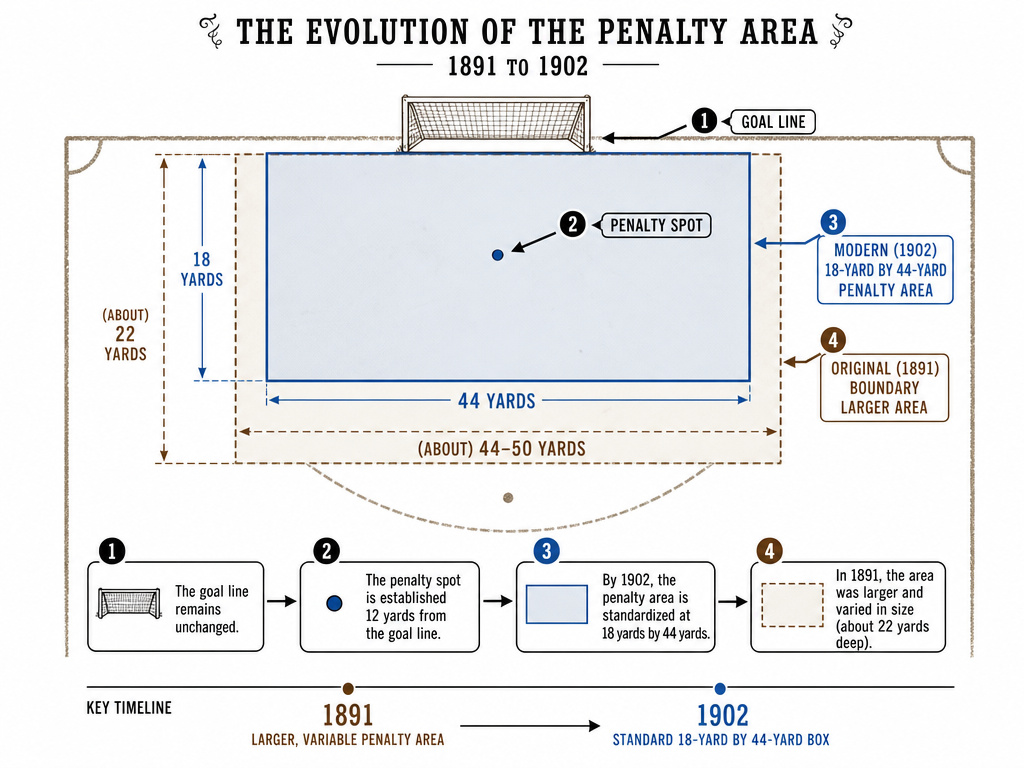
Other changes defined the modern pitch. The penalty kick was introduced in 1891. In 1902, the penalty area was defined as 18 yards from the goal line and 44 yards wide, creating the box and spot we know today. In 1992, the back-pass rule (banning goalkeepers from handling deliberate passes from teammates) was introduced to combat time-wasting and defensive negativity – a classic IFAB ‘for the good of the game’ amendment.
These weren’t random tweaks. The 1920 law banning offside from throw-ins stopped teams using them as an offensive set-piece. The 1990 ruling that a level attacker was onside (“advantage to the attacker”) again sought to favour attack. The history of the offside rule can be read as a continuous tug-of-war between defence and attack, mediated by the IFAB.
The Modern FA: From Lilleshall to the Premier League
The FA’s 20th-century story is one of gradually, and sometimes reluctantly, modernizing. After World War II, it focused on coaching and development. The FA’s National School opened at Lilleshall Hall on 4 September 1984, taking in 25 of England’s best 14-year-olds on a two-year residential course. It was an attempt to create a technical elite, with mixed results.
Governance was a constant struggle. The 1968 Chester Report, a government enquiry, recommended term limits for the FA’s large, aging Council and a greater use of experts. The FA’s defensive response – “It is not expected that a body of this kind can fully understand the ramifications of the complex Football Association” – spoke volumes about its insular culture.
The biggest shift was commercial. In 1992, the FA facilitated the breakaway of the top division to form the Premier League, initially with 22 clubs (reduced to 20 in 1995). This was presented as necessary for the game’s financial health, but it fundamentally redistributed power and wealth away from the Football League and, to an extent, the FA itself. The body that once worried about the corruption of professionalism now presided over a global entertainment empire.
Throughout, its relationship with FIFA and world football has been tense. The British associations left FIFA after World War I, rejoined in 1924, left again after World War II, and only participated in their first World Cup in 1950. The FA even requested the expulsion of the German and Japanese FAs after WWII. This ambivalence towards the global game it helped create is a recurring theme in the FA’s modern history.
Frequently Asked Questions
What was the main reason for creating the Football Association?
The immediate reason was to standardize the rules. Different clubs and schools played by different codes, making organized competition impossible. The deeper reason was to save football from itself – to provide a unified structure that would allow the game to grow beyond ad-hoc matches. The origins of football as an organized sport are inseparable from this need for a common rulebook.
Which clubs founded the FA?
Eleven clubs attended the first meeting on 26 October 1863. They were: Barnes, Civil Service (War Office), Crusaders, Forest of Leytonstone, N.N. (No Names) Club (Kilburn), Crystal Palace, Blackheath, Kensington School, Perceval House (Blackheath), Blackheath Proprietary School, and Surbiton. Only Civil Service FC survives today as an ongoing association football club from that original list.
How did the FA influence football worldwide?
As the first association, its model of governance and its Laws of the Game became the template. The FA Cup was the blueprint for knockout competitions everywhere. By co-founding the IFAB, it helped create the stable, universal rulebook that allowed for international competition. Every national association and global tournament owes a debt to the systems the FA established between 1863 and 1913.
What was the “amateur split”?
From 1906 to 1913, a group of staunchly amateur clubs, disgusted by the FA’s acceptance of professionalism, broke away to form the Amateur Football Association. It was a last stand for the Victorian amateur ideal. The split ended when the FA reintegrated the counties that supported the amateurs, but it highlighted the deep cultural rift that professionalism caused.
How accurate is the common story of the FA’s founding?
It’s broadly correct but oversimplified. The historical development of association football was messier. The idea that Blackheath was the only club wanting rugby rules is contested by some scholars. The process took six meetings of fierce debate, not one moment of inspiration. And the FA’s authority wasn’t accepted nationwide until the FA Cup forced the issue fifteen years later.
The Bottom Line
The Football Association’s history isn’t a straight line of progress. It’s a story of crisis management. It was formed to solve a rules crisis, saved by a cup competition, almost torn apart by a professionalism crisis, and constantly adapting its own laws to a tactical crisis on the pitch.
Its greatest legacy is the framework: the concept of a national governing body, a unified rulebook guarded by a neutral board, and a premier knockout competition. The modern game, for all its global scale and financial power, still operates within that Victorian-era skeleton.
The final piece of context? The FA’s own story is now part of the global development of soccer it helped create. From a meeting of eleven clubs in a London tavern to a sport played by billions, the 160-year chain of problems and solutions is the real history of the Football Association.
