
Origins of Association Football Explained
This post contains affiliate links. As an Amazon Associate, we earn from qualifying purchases.
Modern association football was born not from a wave of public school popularity, but from a failed attempt to unify a fractured game. The Football Association was founded on 26 October 1863 at the Freemasons’ Tavern in London by a dozen clubs playing different rules. Its initial goal was a ‘complete failure’, membership fell from nineteen clubs to just ten by 1867, and it played second fiddle to rugby football for its first decade and a half. The 1863 Laws of the Game, settled on 1 December that year, banned handling the ball, creating the split that defined the sport.
That failure is the part most histories skip. We prefer a simple origin story, but the actual events were more complicated, and the real beginnings of association football are intricate. The FA didn’t emerge as a dominant force. It nearly folded before it began.
What follows is the real timeline: the competing codes, the forgotten Sheffield Rules, and the specific moment the Blackheath club walked out. This account will describe the older games that preceded it, the rule that nearly ended the FA, and the way a basic cup competition rescued it. By the end, you’ll see 1863 not as a beginning, but as a desperate compromise.
Key Takeaways
- The Football Association was founded in 1863 as a compromise between clubs playing different rules, but its first five years were a struggle, with membership halving and talk of dissolution.
- The 1863 Laws of the Game explicitly banned handling the ball and hacking (kicking opponents’ shins), causing the immediate split from rugby football.
- Contrary to popular myth, English public schools were largely absent from the FA’s founding meeting; the driving force was London-based adult clubs like Barnes and Crystal Palace.
- The Sheffield Football Club, founded in 1857, operated under its own “Sheffield Rules” for years, proving a unified code wasn’t immediately inevitable.
- The FA Cup, announced in 1871, and the legalisation of professionalism in 1885 were the twin engines that finally propelled the game to mass popularity.
The FA’s Founding Meeting: A London Pub and a Hasty Retreat
Picture the setting. It’s a Monday evening, 26 October 1863, at the Freemasons’ Tavern in London. The air is thick with pipe smoke and competing ideas. Representatives from a dozen clubs. Barnes, Crystal Palace, War Office, Blackheath, are there. Their goal, as stated, was noble: “forming an Association with the object of establishing a definite code of rules.”
But the nature of that meeting is often misunderstood. A common narrative is that modern football was standardized by English public schools in the 19th century, and the FA was a formal codification of this process. However, a scholarly analysis notes that at the FA’s founding meeting, ‘none of the public schools were represented, with the exception of Charterhouse,’ which refused to join without the others. The minutes tell a different tale. A contemporary account notes that despite heated letters in The Times in the weeks prior, “none of the public schools were represented, with the exception of Charterhouse,” and they refused to join without the others.
The founders were not schoolmasters, but men from adult clubs. Ebenezer Cobb Morley of Barnes FC became the first secretary. Arthur Pember of the N.N. Club (Kilburn) was the first president. This was a bottom-up effort by players who were tired of arguing every time they arranged a match, a key part of the origins of association football explained.
The original 1863 Laws of the Game were ‘settled’ at a meeting on 1 December 1863 and submitted for adoption on 8 December 1863. The laws established a maximum pitch size of 200 yards by 100 yards, defined a goal as the ball passing between posts eight yards apart, and instituted a 10-yard rule at kick-offs.
The critical tension was over handling the ball and the rules that would define the game. The rugby-playing clubs, like Blackheath, saw it as a legitimate part of a manly game. The dribbling clubs saw it as barbaric. At the December meeting, when the new laws that banned handling the ball were settled, a split from rugby football occurred. The schism was instant. From that point, “association football” and rugby football were separate codes.
The Wilderness Years: When Rugby Was King
If you think the FA’s formation sparked a football revolution, think again. For its first decade and a half, the association played “second fiddle to rugby football.”
The numbers are stark. By 1867, FA membership had fallen to just ten clubs, down from nineteen in December 1863. Around 1867, the FA’s own members considered winding it up. They voted to continue, but the optimism was thin.
A survey in 1868 recorded thirty clubs using the FA’s rules, but forty-five playing by Rugby School rules. Rugby was more popular, more widespread. The FA was a niche concern, kept alive by a stubborn few in London and Sheffield.
Why did it struggle? The rules were new and unfamiliar. The ban on handling made the game seem less dynamic to some. But mostly, it lacked a spark, a critical point in the origins of association football explained. There was no central competition, no narrative to pull in spectators or new clubs. It was a governing body without a kingdom to govern. That changed with one simple idea in 1871.
The Spark That Lit the Fire: The FA Cup and Professionalism
The FA’s salvation came not from a change in the laws, but from the creation of a story. On 20 July 1871, at the office of The Sportsman newspaper, the FA announced the birth of the Football Association Challenge Cup.
That competition, the FA Cup, changed everything. It gave clubs a reason to adopt the FA’s rules. It created national heroes, giant-killings, and a shared calendar. Suddenly, the abstract “association” had a tangible prize. Clubs in the industrial north of England, in particular, embraced it.
This popularity created a new problem: amateurism. Northern clubs began compensating players. Southern clubs, steeped in amateur ideals, were outraged.
Where this goes sideways: Clinging to strict amateurism. By 1885, the pressure was unsustainable. The FA formally legalised professionalism, a move that acknowledged the game was now a job for the best players.
This wasn’t a smooth transition. An “amateur split” lasted from 1906 to 1913, with purists forming their own Amateur Football Association. But the genie was out of the bottle. The modern game’s economic engine had been started.
Sheffield Rules vs. FA Laws: The Other Football Code
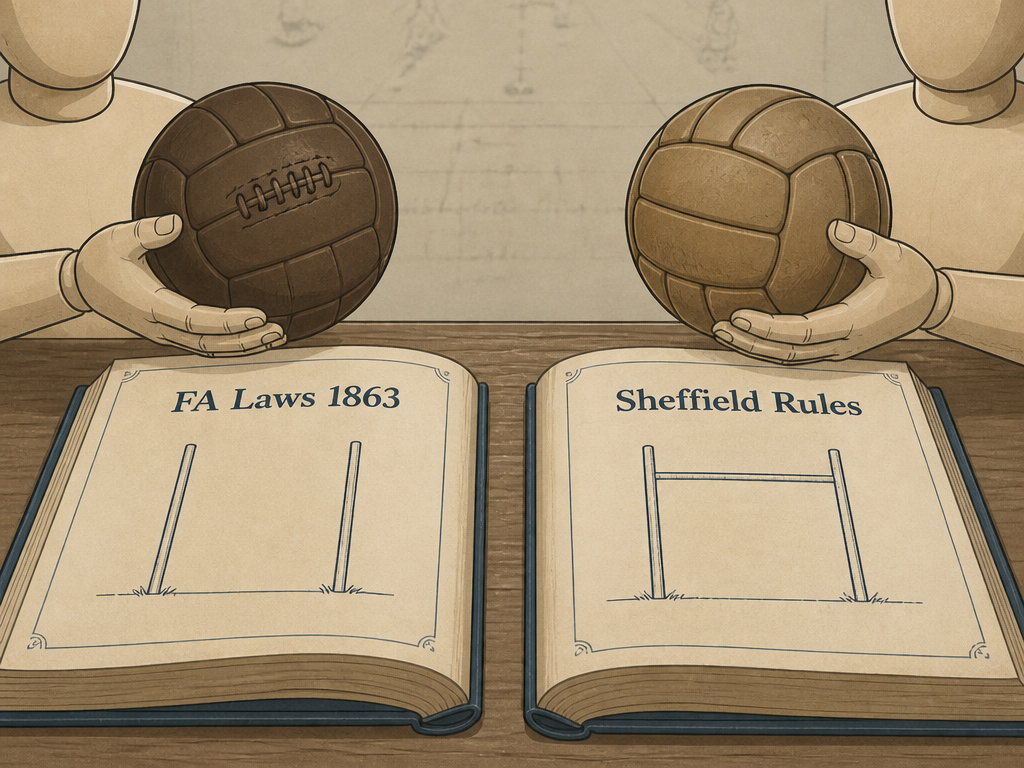
While London debated, Sheffield had already been playing for years. The Sheffield Football Club was formed in 1857, six years before the FA. They played by their own “Sheffield Rules,” which were different, and in some ways, more modern, than the early FA laws.
This is a crucial “what if” in football history. The Sheffield game wasn’t a minor variant; it was a fully-formed alternative. Comparing the two sets of rules shows how the modern game was a hybrid, not a pure FA invention.
| Rule Aspect | Early FA Laws (1863) | Sheffield Rules (c. 1860s) |
|---|---|---|
| Handling | Banned entirely (except for fair catch). | Allowed a player to catch a ball in the air for a free kick. |
| Goal Posts | Two upright posts, 8 yards apart, no crossbar. | Included a crossbar or tape 9 feet high. |
| Offside | A player was offside if ahead of the ball. | No offside rule at all. |
| Kick-ins | A complex “kick-in from goal line” based on who touched it last. | Throw-ins from the touchline, introduced earlier. |
Their early adoption of crossbars and throw-ins show they were innovating independently. The FA didn’t create football from scratch; it eventually absorbed the best ideas from competing codes like Sheffield’s.
Ancient Games and Global Spread: What Came Before and After
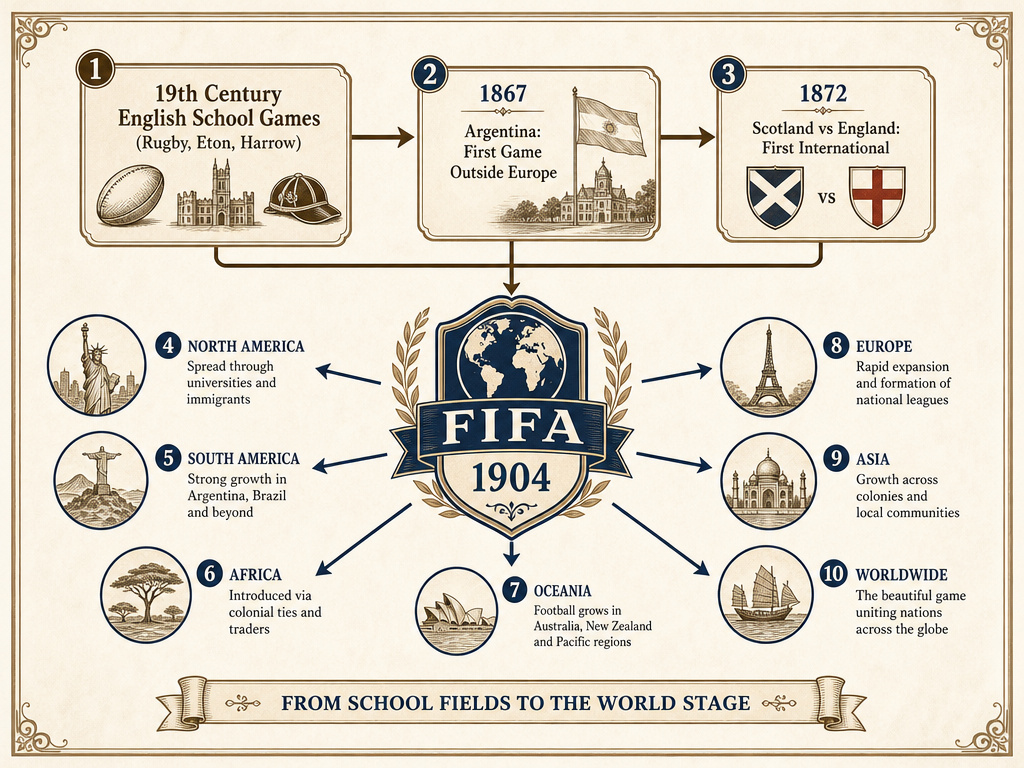
Football-like games have a history that stretches back centuries.
The real precursor was the game that developed in English public schools in the early 1800s. Each school. Rugby, Eton, Harrow, had its own version. When students went to university, they couldn’t play together.
The first game outside Europe was played in Argentina in 1867 by British railway workers. The first international match was Scotland vs. England in 1872, ending 0-0 in front of 4,000 spectators.
The need for an international governing body led to the founding of FIFA (Fédération Internationale de Football Association) in 1904. Today, FIFA includes 211 national associations. The game’s journey from the Freemasons’ Tavern to a global spectacle was complete.
Frequently Asked Questions
Where did association football originate?
Modern association football originated in England in the mid-19th century. While ball games existed worldwide for millennia, the specific codification of the rules we know today happened in London with the formation of The Football Association in 1863. This created a standardized game distinct from rugby.
Why is it called association football?
The name “association football” comes directly from the Football Association (FA). It was the type of football played under the FA’s rules, to distinguish it from other football codes, like Rugby Football. The term was quickly shortened to “soccer” (from “assoc.”) in slang, and later to just “football” in most of the world.
Who started the Football Association?
The Football Association was started by representatives of twelve London and suburban clubs, including Barnes FC, Crystal Palace FC, and the War Office Club. Key individuals included Ebenezer Cobb Morley, who drafted the first laws and served as secretary, and Arthur Pember, the first president. It was a club-led initiative, not a top-down imposition by schools.
What was the first football club in the world?
While several early clubs existed, the world’s oldest documented football club that still exists today is Sheffield Football Club, founded in 1857. They played under their own Sheffield Rules before later adopting the FA’s code. In London, clubs like Crystal Palace (1861) and Barnes (1862) were also pioneers before the FA’s founding.
The Bottom Line
The story of football’s origin isn’t one of inevitable triumph. It’s a story of a bad first draft. The FA’s 1863 meeting was a failure in its primary goal of uniting all football. It sparked a split, not a consensus.
But within that failure were the seeds of everything that followed. By drawing a hard line, no handling, no hacking, it created a distinct, replicable product. The near-collapse before 1870 makes the success of the FA Cup and professionalism seem less like destiny and more like a narrow escape.
The next time you watch a match, remember it almost didn’t happen. The game was saved by a cup competition no one knew they needed and a controversial decision to pay players. History is made by messy compromises, not clean beginnings. Football is no different.
