
Football Position Numbers Explained: Soccer and the NFL
This post contains affiliate links. As an Amazon Associate, we earn from qualifying purchases.
Football position numbers explained simply: in soccer, 1 is the goalkeeper, 9 the striker and 10 the playmaker by custom, and no fixed rule forces any number on any position. In the NFL the numbers are rules. Offensive linemen must wear 50-79, quarterbacks 0-19, and a player lining up out of position has to report to the referee.
That split between custom and rule comes from where each sport started. Soccer numbered shirts in 1928 to label a 2-3-5 shape. American football tied numbers to a harder question: who is allowed to handle the ball.
Ahead: the 1 to 11 map and its history, the country habits that scramble it, what a 17 or a 27 means, the NFL ranges with the spots where my sources disagree, and straight answers on 69 and 77.
Key Takeaways
- Soccer numbers are custom: the 1 to 11 map traces back to the 2-3-5 formation of the 1928 trials, and countries numbered it in their own ways.
- England’s 4-4-2 put its centre-backs in 5 and 6, while Sweden’s put a 9 on the left of midfield.
- From 12 upward, a soccer number tells you almost nothing about position.
- In the NFL, anyone wearing 0-49 can play any position as long as he doesn’t line up on either line, per Fox Sports.
- No. 0 returned to the NFL in 2023, but 00 still isn’t approved, according to Fox Sports.
Football Position Numbers Explained: What 1 to 11 Mean in Soccer
The 1 goes to the starting goalkeeper in nearly every squad, for a plainly literal reason: the keeper is the first player in a line-up. From there the numbers climb up the pitch toward the other goal.
Soccer shirt numbers 1 to 11 began as a map of the 2-3-5 formation used in English football’s 1928 trials: 1 for the goalkeeper, 2 and 3 for the full backs, 4, 5 and 6 for the half backs, and 7 to 11 for the forwards. No fixed rule ties every number to a position today.
That’s the old map. Here’s how I read each shirt when a club still wears it the traditional way, and where the tradition has frayed.
1: The Goalkeeper, Backed by a Rule
The No. 1 shirt typically goes to a goalkeeper. Funnily enough, Chelsea’s keeper wore no number at all in the 1928 trial. English keepers carried that habit on once numbering spread.
Backup keepers took 12 and 22 at some tournaments. Italy did it in 1978, and Argentina did it in 1990.
I’ll say it plainly. Goalkeepers are the most tactically underrated players on the pitch, and the 1 is the one shirt that still tells you what its owner does.
2 to 6: The Back Line and the Holder
The 2 and 3 were the full backs in the 2-3-5. In England’s later 4-4-2, listed right to left, 2 sat at right back and 3 at left back. Today’s full-backs overlap, tuck inside and build play, so the label barely covers the job.
The 5 explains itself once you know the history. Early formations moved the centre half back into defence, and his number went with him. That’s why central defenders wear 5.
If a guide tells you centre-backs wear 4 and 5, treat it as one habit among several. England’s 4-4-2 used 5 and 6.
Then there’s “the 6.” It has become everyday football terminology for the holding midfielder in coaching talk. My sources don’t trace where that started, and in England’s midfield diamond the holder wore 4. Whatever he wears, the midfielder guarding the space between the lines is the player I watch first. Nobody puts him on a poster.
7 to 11: Wide Players, the 8, the 9 and the 10
- 7 and 11 are the wide men. Both were forwards in the 2-3-5, and England’s 4-4-2 kept them on the right and left of midfield.
- The 8 was central midfield in England’s 4-4-2, the runner fans now call box-to-box. In a diamond, the attacking central midfielder took it.
- 9 is the striker, the most advanced player on the pitch.
- 10 is the emblematic shirt. Legends wore it.
A false nine drops off the front line into midfield. So I never trust a 9 on a team sheet until I’ve seen where he stands.
The number 10 role is the one I think gets oversold. Forwards, playmakers, second strikers and attacking midfielders have all worn it. As a fixed position, it has dissolved into several different jobs.
The 2-3-5 Shape Behind the Numbers, 1928 to 1999
On 25 August 1928, Arsenal walked out in numbered shirts for the first time and lost 2-3 to Sheffield Wednesday. Chelsea wore numbers against Swansea Town the same day. The Monday papers called it a success. The FA ordered the experiment abandoned anyway, and nobody seems to know why.
Every argument about shirt numbers leads back to football formations, and this one starts with the 2-3-5. Two full backs, three half backs, five forwards. Numbers went by field location, so the shape and the shirts were one and the same.
The popular story credits Arsenal manager Herbert Chapman with the idea. The Woolwich Arsenal history blog calls that credit unproven guesswork. England wasn’t first, either: the first recorded numbered football shirts date to 1911 in Australia, worn by Sydney Leichhardt and HMS Powerful.
The first US match with numbers followed on 30 March 1924, when Fall River F.C. Played St. Louis Vesper Buick. After 1928, English football took its time:
- 1933: Everton wore 1-11 and Manchester City 12-22 in the FA Cup final.
- 1934: the Football League’s AGM voted numbers down again.
- 5 July 1939: the League Management Committee decided both sides should wear 1 to 11. War wiped out the season before it mattered.
- 31 August 1946: numbered shirts were available to every team in England and Scotland when league football returned.
- 1993 to 1999: the Premier League moved to squad numbers in 1993, added names in 1994, and the Football League made squad numbers mandatory in 1999.
Two of those dates come with arguments attached. Some accounts say one team wore 1-11 and the other 12-22 in 1928. The Woolwich blog’s author found no photos to confirm it, while Wikipedia says the 1928 numbers went by field location.
Wikipedia also dates the League’s requirement to the 1939-40 season, rather than the July 1939 committee decision. Both can be true. I’d just rather show you the seam than paper over it.
When a number seems to make no sense, ask what formation the club played when the habit started. The digit remembers a shape the team abandoned decades ago.
Why England and Sweden Numbered the Same 4-4-2 Differently
A reader who’d followed football for only one season once sent me a sharp breakdown of how a back three shifts when its team has the ball. It surprised me. I stopped assuming newer fans only want the basics, and I started looking harder at how numbers survive a change of shape.
They barely do. A back three breaks the old 2-to-5 logic straight away, because the outside centre-backs and the wing-backs trade jobs depending on who has the ball. (And while I’m here: the back three is not a defensive formation, and calling it one is lazy writing.)
Even a plain 4-4-2 was never numbered one way. Here’s how England and Sweden labelled the same shape, read right to left:
| Position (right to left) | England | Sweden |
|---|---|---|
| Right back | 2 | 2 |
| Centre-backs | 5, 6 | 3, 4 |
| Left back | 3 | 5 |
| Wide midfielders (right, left) | 7, 11 | 7, 9 |
| Central midfielders | 4, 8 | 6, 8 |
| Forwards | 10, 9 | 10, 11 |
Look at Sweden’s left side. A 9 in left midfield would start an argument in any pub I’ve sat in, and an 11 leading the line beside the 10 would finish it.
Other countries scrambled the back line further.
South American domestic football is my thinnest ground. So I’m reporting those habits rather than explaining where they came from.
Squad Numbers: Why a 17 or a 27 Tells You Little
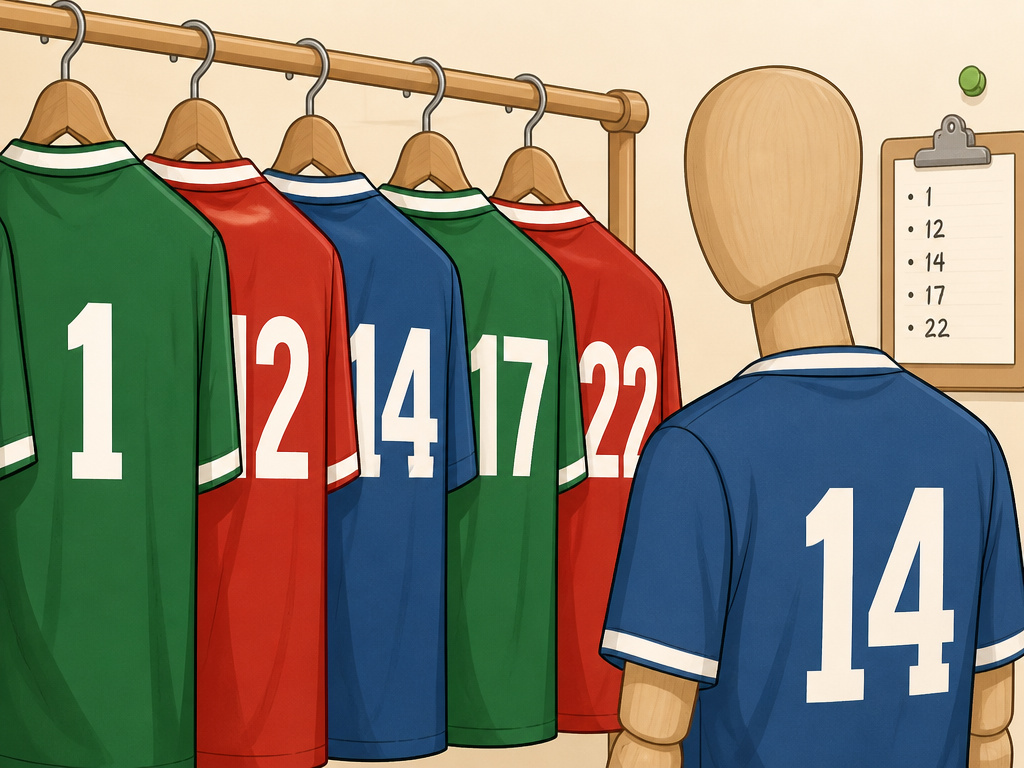
High numbers are a squad list. The shift began at the 1954 World Cup, where each player in a 22-man squad kept one number for the whole tournament. That pushed 12 to 22 onto reserves, with no link to position.
Johan Cruyff made the point for everyone by insisting on 14 for the Netherlands. Ever bought a shirt with a big number and wondered what it meant? Here’s what a number above 11 can signal:
- A backup goalkeeper. Italy in 1978 and Argentina in 1990 gave their keepers 1, 12 and 22.
- An alphabetical slot. The Netherlands numbered purely by surname in 1974, Argentina did it in 1978 and 1986, and Italy in 1978 ran the alphabet within each position group.
- A personal choice, like Cruyff’s 14.
- Nothing at all.
Alphabetical numbering throws up good arguments.
England tried the alphabet too. Charlton Athletic were among ten Football League clubs that adopted squad numbers in 1993-94, handing them out by surname, then went back to 1 to 11 a year later.
So when a number confuses me, I go back to the footage and the positions on the pitch a player actually takes up. Beyond my own eyes, I treat data tools as a second opinion. I can read what those tools show, but I couldn’t build or audit their models, so I treat them as a second opinion.
Believe the pitch over the shirt. If a 4 spends the first ten minutes between the centre-backs, he’s a defender that day, whatever the programme says.
1994: Names Arrive on the Back
Names joined numbers on Premier League shirts in 1994, and I learned the hard way that they need care. I once pressed an iron straight onto a flocked name and number for about 20 seconds, no cloth. The K curled up like a crisp packet.
These days the shirt goes inside out, a thin cotton cloth covers any print, and the iron stays on low.
Polyester is the harder fabric. In my experience, heat that flattens a crease will glaze the surface into a shiny patch. So for polyester shirts I skip the iron and steam-hang them in the bathroom.
Where this goes sideways: pressing a hot iron directly on a flocked number. Mine took about 20 seconds to curl a letter.
From Letters to Zero: How the NFL Built Its Number Ranges
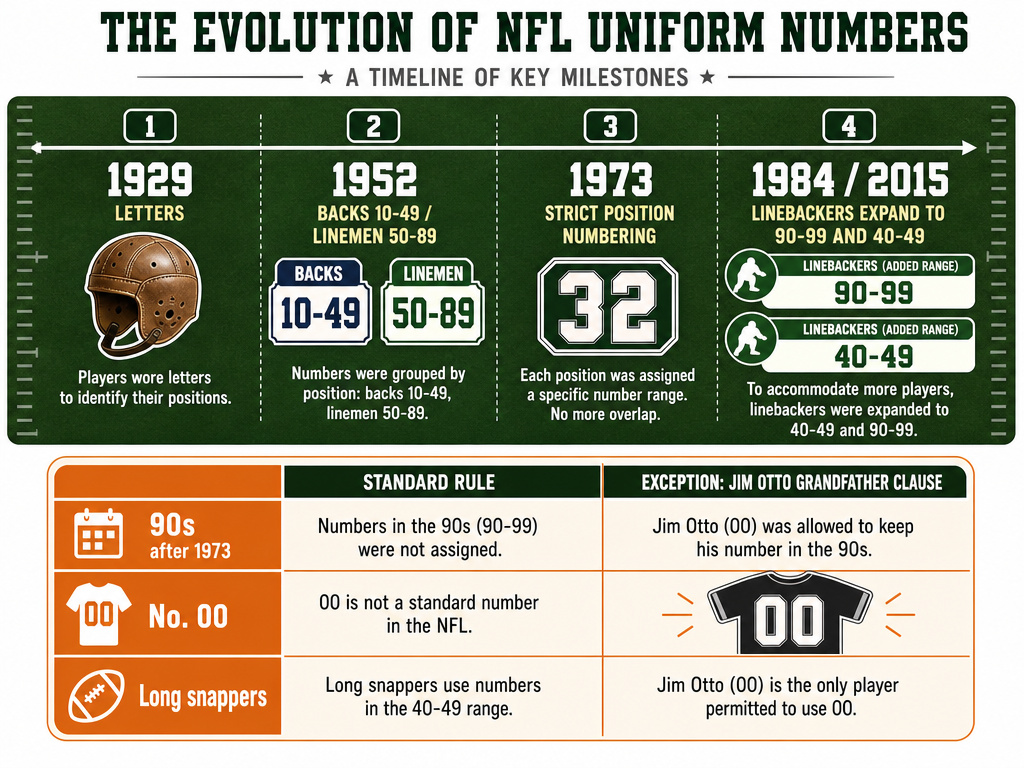
The Orange Tornadoes wore letters instead of numbers in 1929. In those early seasons NFL numbers generally did not go past about 25, with rosters capped at 22, though Red Grange wore 77.
The NFL borrowed college football’s system in 1952: backs 10-49, linemen 50-89. Strict position-based numbering arrived in 1973, after the AFL merger. ESPN notes that only quarterbacks, punters and placeholders got single digits then, and nobody got No. 0.
The AFL had run looser rules. It let wide receivers wear numbers in the teens and 20s, and it allowed 00. Raiders center Jim Otto switched from 50 to 00 and wore it for the rest of his career.
Players already in the league kept their numbers under a grandfather clause. Charlie Joiner wore 18 through the 1986 season, the last player it covered. Julius Adams retired in 1985 wearing 85 as a defensive end, then came back in 1987 wearing 69.
The Wikipedia entry on NFL uniform numbers tracks how the ranges kept stretching after 1973. Linebackers picked up 90-99 in 1984 because more teams played a 3-4 defence, which puts four linebackers on the field and needs more linebacker numbers. Linebackers got 40-49 in 2015.
Not every account lines up, though:
| Point | One account | The other account |
|---|---|---|
| The 90s after 1973 | Fox Sports: defensive linemen wore them | Wikipedia: 90-99 not issued |
| No. 00 today | Fox Sports: the league cleared No. 0 but not 00 | Wikipedia: the AFL allowed 00 (Jim Otto), who kept it after 1973 under the grandfather clause |
| Long snappers | Fox Sports: any number, but it limits other positions | Wikipedia: rulebook silent; in practice 40-59 |
I can’t settle the 1973 question without the old rulebook in hand. So you get both versions.
NFL Jersey Number Ranges by Position Since 2023
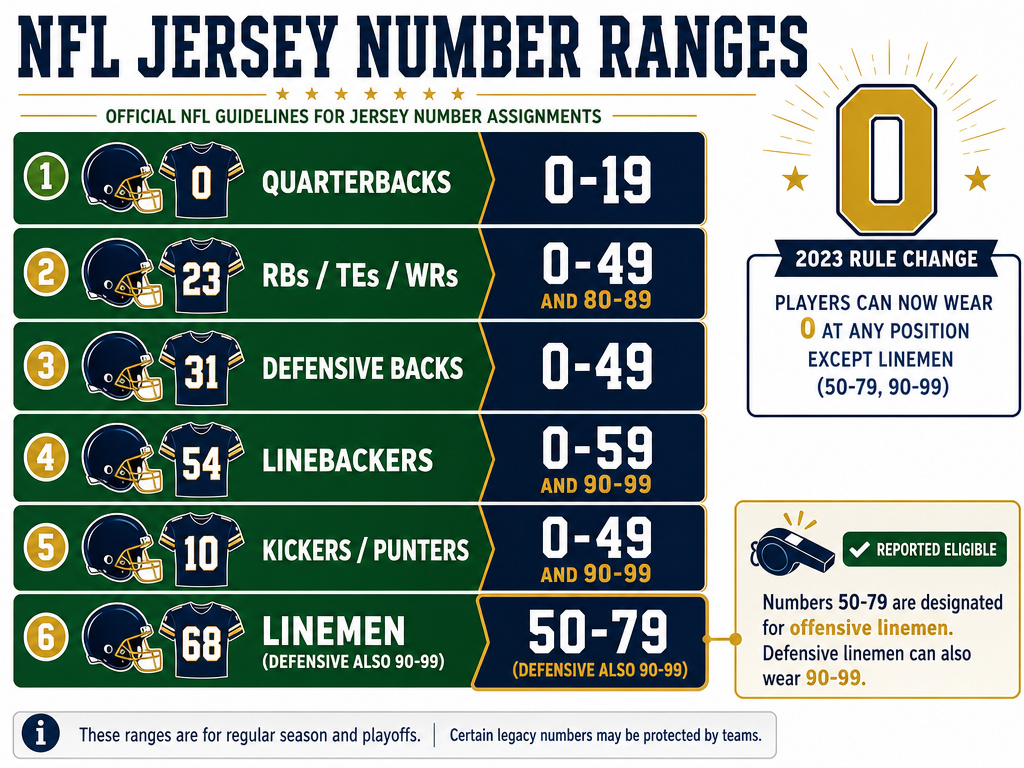
Twenty-two players were set to wear No. 0 in 2023, according to ESPN. Pro Football Reference counts only 19 players who wore 0 or 00 before the 1973 change. One season beat the entire pre-1973 total.
A 2021 rule change came first, giving players more freedom. The 2023 vote then restored No. 0 for everyone except linemen on both sides of the ball. The ranges below follow the Fox Sports NFL jersey numbering history.
| Position group | Allowed numbers |
|---|---|
| Quarterbacks | 0-19 |
| Running backs, tight ends, receivers | 0-49, 80-89 |
| Defensive backs | 0-49 |
| Linebackers | 0-59, 90-99 |
| Kickers and punters | 0-49, 90-99 |
| Offensive / defensive linemen | 50-79 / 50-79 and 90-99 |
The line is where the numbers bite. Offensive linemen in 50-79 can’t handle the ball unless they report as eligible, pick up a fumble, or catch a deflected pass.
When one reports, the referee tells the whole stadium. You hear it over the PA: “Number 61 has reported as an eligible receiver.” The announcement exists so the defence knows who can catch the ball.
A 2015 clarification closed a loophole. Teams can no longer hide ineligible numbers in odd formations, such as a tackle split wide but covered by a receiver, without reporting.
Easy to miss: an offensive lineman in 50-79 who catches a clean pass without reporting first has broken the rule. Only deflected passes and fumbles let him touch the ball unannounced.
Raised on soccer’s anything-goes numbering, I find this oddly reassuring. The shirt is a promise to the officials.
How Do College and High School Numbers Differ From the NFL?
Lower levels loosen everything except the line. At lower levels, the line rule is the main constraint: NCAA requires at least 5 linemen in 50-79 at the snap. The football uniform number position conventions at college and high school all hang on that one rule.
| Level | Line rule | Other limits |
|---|---|---|
| NFL | Ranges for every position group | 0 allowed since 2023; 00 not |
| NCAA | At least 5 linemen in 50-79 at the snap | Max 4 backs |
College adds a kicking exception. In a scrimmage kick formation, it must be obvious a kick is coming, plus either one player 10 or more yards behind the neutral zone, or a holder and kicker 7 or more yards back for a place kick. Then a team can line up without five 50-79 linemen.
The catch is timing. Players become numbering exceptions the moment the snapper takes his position, and once set, they can’t shift to another spot. NCAA approved rulings even show a punt where swapping two players inside a 2×2 group after the snapper set is an illegal formation.
The NFL goes further: outside the offseason, no two teammates share a number.
One honest caveat. My high school details come from secondary sources, not the NFHS rulebook. Officials even argue online over whether NCAA Rule 1-4-2 requires 50-79 linemen or only recommends them. Check your state association’s current book before you hand out shirts to a youth team.
Is 69 Allowed, and What Position Is 77?
Yes, and a lineman. In the NFL, both 69 and 77 sit inside the 50-79 band that offensive linemen wear and defensive linemen share. Julius Adams came back in 1987 wearing 69.
The 77 has a better story. Red Grange wore it as a Bears halfback, something current NFL rules wouldn’t allow.
In soccer, neither number means anything positional. With no fixed rule tying numbers to roles, a 69 or a 77 is whatever squad number the club hands out under its competition’s own rules.
What does each football position do?
In the NFL, the number on the back tells officials and opponents what a player is expected to do. Offensive linemen wear 50-79 and generally cannot handle the ball unless they report as eligible, pick up a fumble, or catch a deflected pass. Their job is blocking, so size, balance and footwork matter most.
Quarterbacks (0-19) run the offense, read defenses and deliver the ball. Running backs, tight ends and receivers (0-49 and 80-89) carry it, catch it and block. Defensive linemen (50-79 and 90-99) rush the passer and stop the run, while linebackers (0-59 and 90-99) do a bit of both and cover space. Defensive backs (0-49) guard receivers.
Kickers and punters (0-49 and 90-99) handle special teams, where accuracy and consistency decide games.
In soccer, shirts hint at roles too. The 1 is typically the goalkeeper, the 9 the striker, and the 10 an emblematic number for forwards, playmakers and attacking midfielders. Treat any label as a starting point, since modern jobs often stretch past it.
Frequently Asked Questions
What do numbers mean in football positions?
In soccer, 1 to 11 started as a map of the 2-3-5 formation, with 1 in goal and the numbers rising toward attack. In the NFL, numbers are rules tied to position groups, and they decide who can legally handle the ball.
What are the 11 positions in football?
In the old 2-3-5 they were a goalkeeper, two full backs, three half backs and five forwards. In England’s 4-4-2 they became a goalkeeper, four defenders, four midfielders and two forwards, numbered 2-5-6-3, 7-4-8-11 and 10-9 from right to left.
Can two players on the same team wear the same number?
Not in the NFL, outside the offseason. College football allows a number to be worn by up to two players on a team, which only works when they’re never on the field together.
Why did the NFL get rid of No. 0?
The 1973 standardization handed single digits only to quarterbacks, punters and placeholders, and gave No. 0 to nobody. It stayed gone until the 2023 vote brought it back for everyone except linemen.
Who wore 00 in the NFL?
Raiders center Jim Otto is the best-known example. He switched from 50 to 00 in the AFL, which allowed double zero, and kept it after 1973 under the grandfather clause.
Before You Go
Here’s the one thing I’d do this week. At your next match, take the team sheet and watch the first ten minutes before you read a single position off it. Wherever a number disagrees with where its owner stands, the pitch wins.
A simple threshold helps. From 12 upward, assume nothing about position until you’ve seen the player move. From 1 to 11, the shirt is a hint about history, and only the 1 comes close to a promise.
American football is the exception to all of that. That’s football position numbers explained as honestly as the sources allow: custom in one sport, law in the other, and at college or high school level the current rulebook beats my summary every time.
So tell me: in the last match you watched, which player’s number lied to you?
