
Football Terminology Glossary: Soccer and American Terms
This post contains affiliate links. As an Amazon Associate, we earn from qualifying purchases.
A football terminology glossary only works if it names its code first. In association football (soccer), terms like corner kick, touchline, and offside come from the IFAB’s Laws of the Game. In American football, terms like down, snap, and line of scrimmage come from the NFL, NCAA, and NFHS rulebooks.
Each of those rulebooks edits its own wording from season to season. A definition copied from an old list can be wrong, and a few entries below show exactly where.
What follows: ten terms that explain most broadcasts, positions and defensive schemes, the quarterback run vocabulary, penalties, special teams, and the soccer terms that went out of date.
Key Takeaways
- A quarterback run has a name for each situation: scramble, sneak, keeper, read option, or draw.
- NFL kickoff touchbacks come out to the 35-yard line since 2025, while high school football makes any free kick into the end zone a touchback.
- Under the 2025/26 Laws, a goalkeeper who holds the ball past eight seconds concedes a corner kick, not the old indirect free kick.
- Hash marks sit in different places at the NFL, college, and high school levels, so name the level before quoting any field measurement.
Which Football Does a Football Terminology Glossary Cover?
Association football and gridiron football share a name and very different vocabularies. The word “football” points to different games depending on where you are standing.
The word football names different games depending on region. Association football, called soccer in the United States, runs under the IFAB’s Laws of the Game. Gridiron football runs under separate rulebooks from the NFL, the NCAA, and NFHS, the body for high school rules. A glossary stays accurate only when every entry names the game described.
For the soccer side, the Laws of the Game are the single rulebook everything else hangs from. The American side has no single book. The NFL, colleges, and high schools each publish their own, and the next table shows how everyday words split.
| Idea | Soccer word | American football word |
|---|---|---|
| Playing surface | Pitch | Field |
| Footwear | Boots (cleats in American English) | Cleats |
| Scoring | Goal | Touchdown or field goal |
| Name of the sport in the US | Soccer | Football |
Cleats shows how messy the split gets. The same shoe has two names in two countries, and both are correct.
Ten Terms to Learn Before Your First Broadcast
Ten terms carry most of a broadcast, split between the two games. Learn these and the commentary stops sounding like code.
- Down: one attempt to move the ball forward in American football. The offense earns a new set of them by gaining enough ground.
- Line of scrimmage: the imaginary line where the ball sits before the snap.
- Snap: the center passing the ball back to start the play.
- Touchdown: the main way to score in American football, by getting the ball into the opponent’s end zone.
- Blitz: extra defenders rushing the quarterback.
- Turnover: the other team gains the ball through a fumble or an interception.
- Corner kick: a soccer restart from the corner after the defending side puts the ball out behind its own goal line.
- Offside: an attacker gets ahead of the defence at the wrong moment.
- Free kick: a soccer restart after a foul.
- Clean sheet: a goalkeeper and defence concede nothing.
Ten words. That’s the whole entry fee.
Positions and Schemes: Why Job Titles Mislead
Watch a quarterback take the snap and the whole field rearranges around the line of scrimmage. Everything in American football vocabulary starts from that line.
Offense: the line and the backfield
The offensive line stands on the line of scrimmage, with the center in the middle snapping the ball. The backfield is the space behind that line, where the quarterback and running backs stand. Eligible receivers are the players allowed to catch a forward pass, and a complete pass means one of them held it.
Defense: fronts, coverage, and the blitz
Defensive ends and tackles stand on the line. Cornerbacks guard the receivers out wide. Names like 4-3 and 3-4 count defensive linemen first and linebackers second, and a nickel package swaps in an extra defensive back.
Coverage comes in two flavors. In man coverage, each defender follows one receiver. In zone coverage, each defender guards an area.
A blitz is like a kitchen sending extra cooks to one station. The order arrives faster, but another station is short-handed. If the quarterback is tackled behind the line of scrimmage, that’s a sack.
I’d rather a new fan follow one player who never touches the ball for a full quarter than memorise a list of job descriptions. Roles shift from team to team, and the off-ball movement tells you where the next chance appears.
Soccer: roles that blur
Soccer has its own job titles, such as goalkeeper, full-back, and winger. The football positions on a pitch blur as fast as an American depth chart does once the ball moves. Coaches describe a team’s shape as a string of numbers counted from defence to attack, which is the idea behind football formations.
What Is It Called When the QB Runs the Ball?
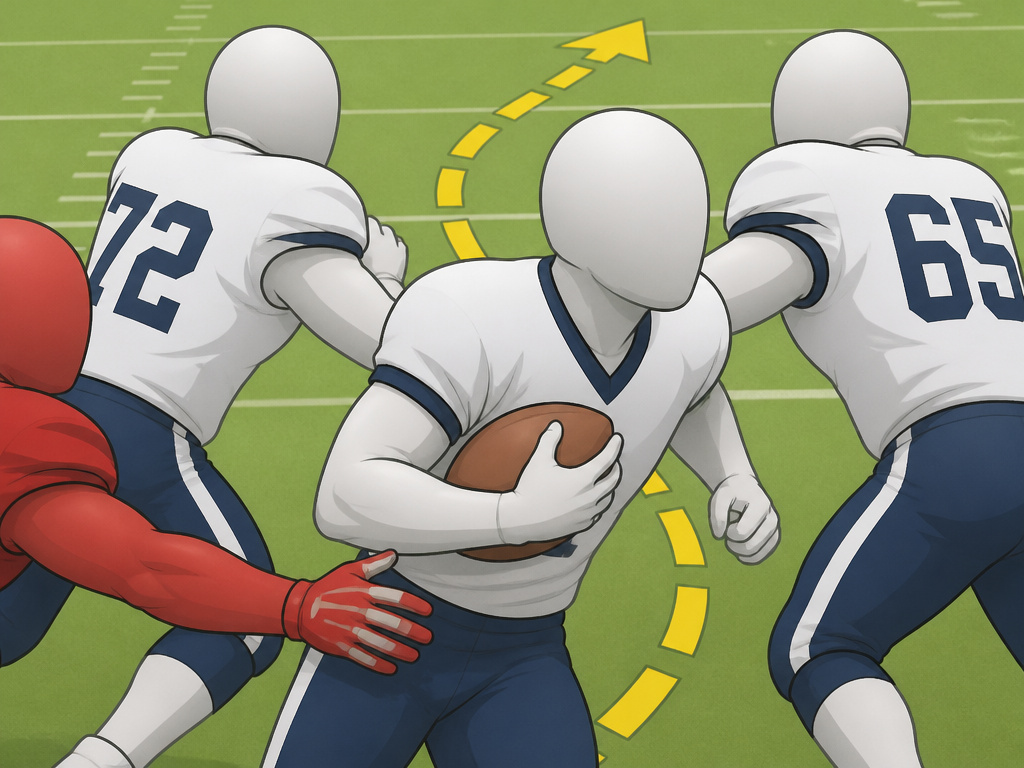
A quarterback run goes by five main names, depending on how the run starts. Each one tells you what the offense planned.
- Scramble: the pocket collapses and the quarterback runs to escape.
- Quarterback sneak: the quarterback takes the snap and drives straight ahead behind the center.
- Keeper: a planned run where the quarterback keeps the ball instead of handing it off.
- Read option: the quarterback watches one defender and decides on the spot whether to hand off or keep.
- Draw: a play that looks like a pass, then turns into a run.
The pocket is the protected space the blockers form around the passer. Leaving it carries a rule risk at the high school level. Under NFHS rules, intentional grounding can be called if the quarterback leaves the pocket and doesn’t throw toward an eligible receiver.
How One Possession Unfolds, Step by Step
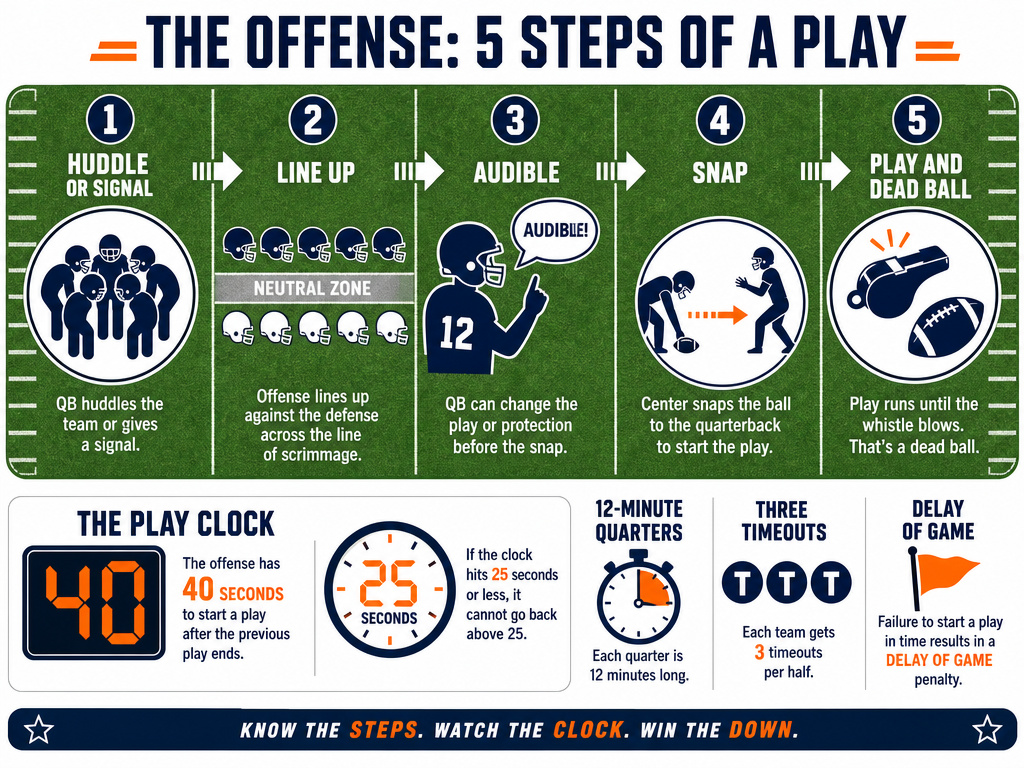
Right, so, here is the order of events on a typical play, with what goes wrong at each step.
- Huddle or signal: the offense hears the play call. Rush it and a player lines up unsure of the assignment.
- Line up: players set along the line of scrimmage. Under NFHS rules, a player lined up in the neutral zone makes the play dead and draws a penalty.
- Audible: the quarterback changes the play at the line. If the defense reads the signal, the change backfires.
- Snap: the center passes the ball back. Moving early draws a flag.
- Play and dead ball: the play runs until the ball is dead, meaning the play is over. Then the next down begins.
The play clock limits how long a team has between plays. NFHS uses a 40-second clock, and a 25-second clock after administrative stoppages like a change of possession, a clock error, or an injury. Miss the clock and the offense gets a delay of game penalty.
NFHS games also use 12-minute quarters and three timeouts per half.
Scoring terms are simpler. A touchdown, a field goal, and an extra point all happen at or near the end zone, the scoring area at each end of the field. A fumble means the ball carrier loses the ball, and an interception means a defender catches the pass. Both are turnovers.
Penalties and Fouls: Flags, Whistles, and Graded Contact
A yellow flag hits the grass in one game and a whistle cuts the air in the other, but both signal an offence. American football calls common fouls by blocking and timing: holding, clipping, delay of game.
High school rules add details worth knowing. NFHS defensive pass interference is 15 yards with no automatic first down, and it can be called whether or not the pass was catchable. Only four penalties give automatic first downs: roughing the passer, kicker, punter, or snapper.
Soccer grades contact. The IFAB glossary defines three levels:
- Careless: a lack of care or attention.
- Reckless: disregard for danger to an opponent.
- Excessive force: more force than necessary.
The same glossary says a holding offence happens only when the contact impedes the opponent’s movement. It also treats violent conduct as excluding cases where the force used is negligible.
“Deliberate” means intended, not a reflex or unintended reaction, which is why a deliberate handball is judged differently from a ball that simply hits an arm. The referee can also let play continue under the advantage rule when stopping it would help the offending side.
The basics of football rules stay stable, but the wording of each definition is what trips up glossaries.
Special Teams and Field Markings: Where the Rulebooks Part Ways
The 2026 NFL rulebook puts the inbounds hash marks 70 feet 9 inches apart for professional football and 60 feet apart for college. Hash marks are the short lines that mark where the ball is spotted between plays. NFHS moved its hash marks from 60 feet to 53 feet 4 inches from each sideline.
The NFL measures the distance between the marks. NFHS measures from each sideline. So the numbers can’t be compared directly. The table gathers the places the three levels disagree.
| Term | NFL / college | High school (NFHS) |
|---|---|---|
| Hash marks | 70 ft 9 in apart (NFL); 60 ft apart (college) | 53 ft 4 in from each sideline |
| Kickoff touchback | NFL: 35-yard line since 2025 (30 in 2024) | Any free kick entering the end zone |
| Three-man wedge on kickoff returns | NCAA banned it in 2010 | No restriction |
| Targeting flag | Not covered here | No automatic ejection |
Where this goes sideways: Quoting a touchback spot without naming the level. A fan who says “the 35” at a high school game is quoting the NFL kickoff rule, and the high school rule treats the same kick as an immediate touchback.
Kickoffs, touchbacks, and the onside kick
For the 2024 season the NFL introduced a “landing zone” from the goal line to the 20-yard line. Only the kicker and the returners move while the ball is in the air. Then owners approved moving the kickoff touchback to the 35-yard line instead of the 30.
The onside kick, a short kick the kicking team tries to recover, is a moving target. In 2025 owners tabled changes for May discussion, and the competition committee had proposed removing the fourth-quarter-only requirement. The 2026 NFL rulebook includes rule 6-1-6, which allows the kicking team to declare an onside kick at any time during the game.
NFHS also counts a missed field goal that reaches the end zone as a touchback, because it treats any free kick that enters the end zone that way.
Field layout words
An end zone is the scoring area at each end of the field. Yard lines mark progress, the sidelines mark the edges, and the red zone is the stretch near the opponent’s end zone. A fair catch allows a punt returner to signal that he won’t run the ball back. Coverage on a kick starts with the first steps downfield.
Massachusetts shows how much levels can differ. When the state moved to NFHS rules, coaches and officials had to study 238 differences with the NCAA game, as the Massachusetts high school football rule changes coverage describes.
Name the rulebook and the season before quoting any rule number or spot. A measurement that was right last year can be wrong this year.
Soccer Terms That Went Out of Date
Eight seconds is the new limit for a goalkeeper holding the ball. The IFAB approved the change at its 139th AGM in Belfast on 1 March 2025 for the 2025/26 Laws, after trials showed a major positive impact.
The referee shows the countdown visually, raising a hand and counting down five seconds on the fingers. If the keeper holds the ball past eight seconds, the opponents get a corner kick. The previous rule gave an indirect free kick after six seconds, and older guides still say that. The FIFA media release lays out both versions.
Other terms have drifted too.
The IFAB glossary calls what many fans say “kicks from the penalty mark” a penalty shoot-out, and lists the old name as previous. It uses “dropped ball”, while most popular glossaries say “drop ball”. It also still defines the away goals rule without noting that UEFA dropped it in 2021.
That last one is easy to miss. A glossary that copies the IFAB wording can carry a rule that many competitions no longer use.
Expect more new words. The IFAB wants more offside trials, and trials of Football Video Support are being extended. It’s a cost-effective system that needs few cameras, and it was tested at several FIFA competitions in 2024.
Slang You’ll Hear in Stands and on Broadcasts
Slang changes faster than any rulebook, so treat these as living words rather than official definitions.
- Nutmeg: passing the ball through an opponent’s legs.
- Worldie: a spectacular goal.
- Gridiron: the American football field, and the game itself.
- Pigskin: the ball.
- Hail Mary: a desperate long pass.
- Pick-six: an interception returned for a touchdown.
Which one will you use first?
Frequently Asked Questions
What are 10 common terms used in football terminology?
Ten that cover both games are down, line of scrimmage, snap, touchdown, blitz, turnover, corner kick, offside, free kick, and clean sheet. The first six come from American football and the last four from soccer. Turnover is used in both.
What are some common football lingo words?
Common slang includes nutmeg, worldie, gridiron, pigskin, Hail Mary, and pick-six. Some are tied to one sport. Others, like turnover, cross over.
What’s it called when the QB runs the ball?
It depends on the situation. A scramble is an improvised run, a sneak is a straight drive behind the center, a keeper is a planned run, a read option is a decision made after watching a defender, and a draw is a run disguised as a pass.
What are some common terms used in football field terminology?
American football uses yard lines, hash marks, end zone, sidelines, and red zone. Soccer says pitch, touchline, goal line, and penalty area. Hash mark placement varies by level, so check the rulebook for the game you’re watching.
Is it drop ball or dropped ball?
The IFAB’s Laws of the Game glossary uses “dropped ball”. Many popular glossaries say “drop ball”, but the official wording is “dropped ball”.
The Bottom Line
Before you quote any rule from any list, including this football terminology glossary, check the code, the level, and the season. A touchback spot, a hash mark measurement, and a goalkeeper’s time limit have all changed or differ by level in the sources above.
This week, pick one match and follow only one player who never touches the ball. You’ll see where the space opens before the pass arrives, and the vocabulary starts to make sense.
One honest limit: this glossary doesn’t cover every level or competition. I haven’t checked the current NCAA book for every entry, so verify college-specific wording before you rely on it.
It always comes back to the basics. Learn the shape of the game first, and the words follow.
