
Football Formations Explained: The Phases of Play
This post contains affiliate links. As an Amazon Associate, we earn from qualifying purchases.
A football formation is an abstract label describing a team’s basic arrangement of players, written as a series of three to five numbers that list the outfield players in each horizontal line from defense to attack. The formation named on the team sheet rarely lasts a full match, as the score, substitutions, and phases of possession cause the shape to shift dynamically.
The numbers give you a starting point, a vocabulary for discussion, but they do not tell you how a team actually plays. A 4-4-2 can sit deep or press high. A 4 3-3 can dominate the ball or defend in a compact 4-5-1 block. The difference is in the spaces between the lines, the aggressiveness of the press, and the full-backs’ starting positions, details the digits alone can’t capture. This is why football formations explained must always go beyond the basic numbers.
What follows is a breakdown of the system: how the numbering works, the trade-offs of common modern shapes, the historical path that got us here, and why professional analysts often disagree on what to call a team’s formation during any given game in a typical football formations explained guide.
Key Takeaways
- Formations are abstract labels, not fixed shapes; they change with possession, the score, and substitutions. A study of the 2022 Men’s World Cup found two industry data providers agreed on the starting formation only 65% of the time.
- The 4-2-3-1 is the most common modern formation in top leagues, but dominance varies: it was strongest in the TFF Super League (46.32% in 2023-24), while 3-4-3 was more prevalent in the Bundesliga and Serie A, and 4-4-2 remained strong in La Liga.
- Read the shape, not just the numbers. A formation diagram shows you the intended starting arrangement, but you must watch the line height, spacing between players, and how the shape morphs in and out of possession to understand a team’s real tactics.
- The evolution from 2-3-5 to 4-2-3-1 was driven by rule changes, defensive innovations, and the rise of the high press. The catalyst for the 4-4-2 to 4-2-3-1 shift in Spain is often credited to Manchester City’s Juanma Lillo, while others credit Brazilian coach Mário Zagallo for pioneering the 4-2-3-1 earlier.
- Modern formations are judged in phases. A team’s in-possession shape is often more attacking and asymmetrical than its out-of-possession block, which is compact and prioritizes cover.
The Numbering System and How to Read a Diagram
Every formation description starts with a simple rule: count the outfield players from the defensive line forward. You ignore the goalkeeper. A 4-4-2 means four defenders, four midfielders, and two forwards. A 4-2-3-1 means four defenders, two holding midfielders, three attacking midfielders, and a single striker.
The classic visual is a pitch diagram with circles or Xs arranged in rows. The top row is the attack, the bottom row the defense. When you see this, you’re looking at a coach’s intended starting structure, a reference point, not a promise. It is useful, as one peer-reviewed survey on formation identification notes, because it gives players and coaches a shared vocabulary for organization central to any football formations explained. But it is an abstraction.
A formation is an abstraction summarizing each team’s spatial arrangement on the pitch over a match using labels, commonly reported using three to five digits denoting the number of outfield players from defense to attack in each horizontal line.
The problem is the diagram is static, but football is motion. Two teams playing a nominal 4-3-3 can look nothing alike. One might push both full-backs high, turning the shape into a 2-3-5 in attack. The other might keep one full-back tucked inside, forming a 3-2 buildup shape. The diagram doesn’t show that. It doesn’t tell you if the wingers will stay wide or cut inside, or if the central midfielders will hold or make runs.
So when you look at a formation graphic, see it as a starting formation, a pre-match intention. The real test is what happens after the whistle.
Common Modern Formations: Trade-offs and League Trends
Today’s game sees a handful of formations dominate. Their popularity shifts by league, by coach, and sometimes by the week.
| Formation | Core Idea | Strengths | Key Weakness | Modern Exponent |
|---|---|---|---|---|
| 4-2-3-1 | A double pivot (two defensive midfielders) shields the back four, freeing three attacking midfielders to support a lone striker. | Versatility and midfield control. Provides defensive security while allowing numbers in the final third. | The single striker can become isolated if the attacking midfielders don’t advance. Wide areas depend heavily on full-backs. | Used by champions across Europe; most common formation in a 2023-24 study of six top leagues. |
| 4-3-3 | Three central midfielders (often one holder, two shuttlers) underpin a front three of wingers and a central forward. | Possession dominance and pressing base. The three-man midfield often creates a numerical advantage for short-passing triangles. | Can be vulnerable on the counter-attack if the wingers stay high and the full-backs push up, leaving space in wide areas. | Pep Guardiola’s Barcelona, Jurgen Klopp’s Liverpool. |
| 4-4-2 | Two banks of four with a striker partnership. The classic “flat” structure prioritizes defensive compactness and direct play. | Defensive solidity and simplicity. Two central midfielders and two strikers provide natural partnerships. Easy to coach and organize. | The two central midfielders can be overrun by a three-man opposition midfield. Often lacks a creative link between midfield and attack. | Diego Simeone’s Atletico Madrid; saw a resurgence in La Liga from 2017/18 to 2020/21. |
| 3-5-2 / 3-4-3 | Three central defenders form the base, with wing-backs providing all the width. The midfield and forward numbers vary. | Security in buildup and control of central channels. The extra center-back offers safe passing angles and covers for wing-backs who push high. | Demands extraordinary stamina from the wing-backs. Can be stretched and exploited in the wide channels if the wing-backs are caught upfield. | Antonio Conte at Chelsea and Inter Milan; common in the Bundesliga (3-4-3 at 26.11% in 2023-24). |
The data shows a clear split in what’s popular where. A 2023-24 study analyzing 2,132 matches (4,038 data points) across six major European leagues found the 4-2-3-1 was the most common overall. But drill down: it was dominant in Turkey’s TFF Super League (46.32%). In Germany’s Bundesliga and Italy’s Serie A, the 3-4-3 was more prevalent (26.11% and 19.92% respectively). Meanwhile, Spain’s La Liga bucked the trend, with the 4-4-2 appearing in 34.60% of matches that season.
League culture, player profiles, and even historical tradition shape these choices. A 4-4-2 might be declared dead, yet it persists in Spain, a league known for technical midfield play. It works because the teams there often pair it with an intense, well-drilled mid-block, the shape is less important than the spacing and triggers.
Why Formations Change: Phases, Scorelines, and Red Cards
The formation listed in the match program is a snapshot of kickoff. It rarely survives the first five minutes of open play.
A study in the journal Frontiers lists the reasons formations change mid-match: the match score, coach instructions, substitutions, tactical switches, match phases (attack, defense, transition), the opponent, injuries, and yellow/red cards. That’s almost everything that can happen in a game. It means the formation is fluid, responding to context every minute.
This leads to the concept of phases of play. Most coaches now plan separate shapes for when their team has the ball and when they don’t.
- In-Possession Shape: This is often more expansive. A 4-3-3 might become a 2-3-5, with one full-back moving into midfield and the wingers staying high. The aim is to create numerical advantages and passing lanes.
- Out-of-Possession Shape: This is compact, designed to deny space. That same 4-3-3 will often collapse into a 4-5-1 or 4-4-2 block, with the wingers dropping level with the midfielders to form two solid banks.
Where this goes sideways: Confusing the team sheet formation with the defensive shape. A team that attacks in a 4-3-3 but defends in a 4-5-1 hasn’t “abandoned” their formation. They are defending the most dangerous spaces, which requires different numbers in different areas of the pitch.
This fluidity is also why identifying a “true” formation is so hard for even professional analysts. That same Frontiers survey pointed out a critical problem: a lack of “ground truth.” When they compared the starting formations logged by two major data companies for the 2022 Men’s World Cup, they matched only 65% of the time. Experts literally could not agree on what to call the shape a team was using.
And then there are the edge cases. Automated systems often fail when a team loses a player to a red card. They are programmed for ten outfield players, not nine. Similarly, a team might use a lopsided shape like a 6-3-1 when desperately defending a lead, which doesn’t fit any standard template.
A Brief History: From 2-3-5 to the Modern Game
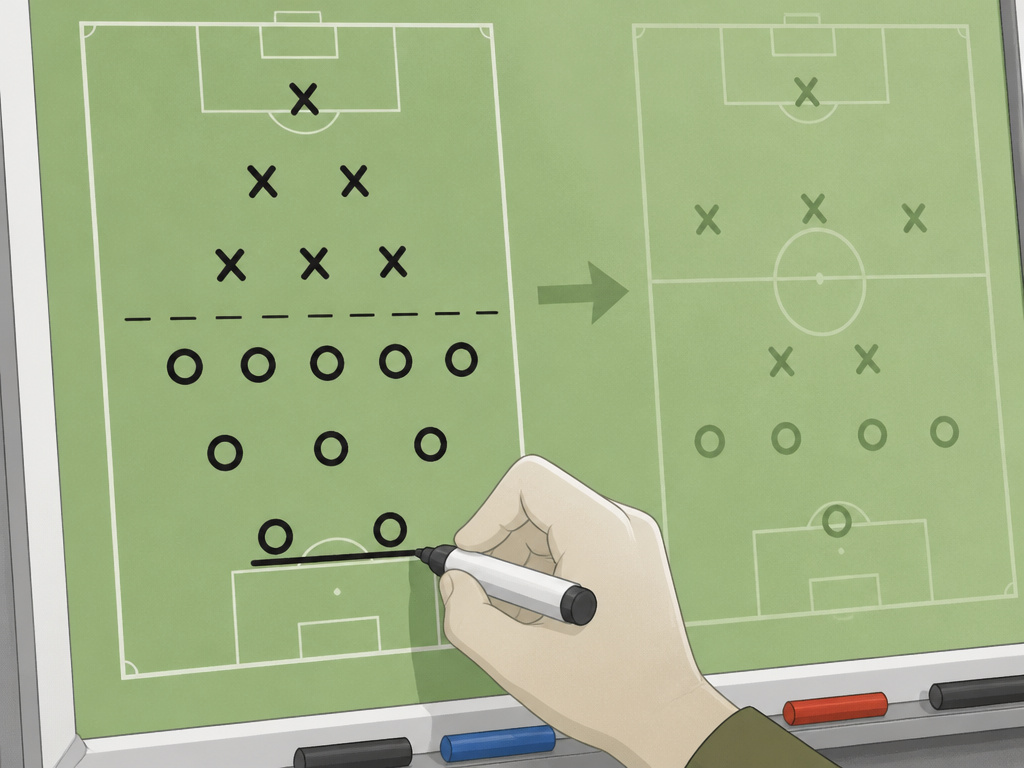
To understand why we play in four-man defenses today, you have to start when we didn’t. For about 50 years of the game’s history, the 2-3-5, the “Pyramid”, was king. Two defenders, three midfielders, and a five-man attack. Football was an attacking pursuit.
The change began with defensive innovations. Herbert Chapman of Arsenal dropped the middle player of the 2-3-5’s three deeper into the backline, creating the ‘centre-half’. Later, the Brazilians dropped another player into the backline to form early 4-2-4 formations. Each change was a response: more attackers meant you needed more defenders to stop them.
Changes to the offside rule are largely blamed for the sweeper’s extinction in the modern game. Changes to the rule in 1925 and 1990 killed off the “sweeper” role and encouraged higher defensive lines. This, paired with the rise of sports science and player physicality in the 21st century, contributed to the renaissance of the high press. Formations that could press effectively, like the 4-2-3-1 and 4-3-3, came to the fore.
Who invented the modern 4-2-3-1? It depends who you ask. The Wikipedia entry on football formations credits Brazilian legend Mário Zagallo, who says his 1970 World Cup-winning team pioneered it. But in Spanish football, the shift from 4-4-2 is often attributed to Juanma Lillo, the influential coach and current Manchester City assistant. Both can be right; tactics evolve in multiple places at once, converging on effective ideas. You can trace the history of tactics through these innovations, each one a reaction to the last dominant trend.
How to See a Formation During a Match
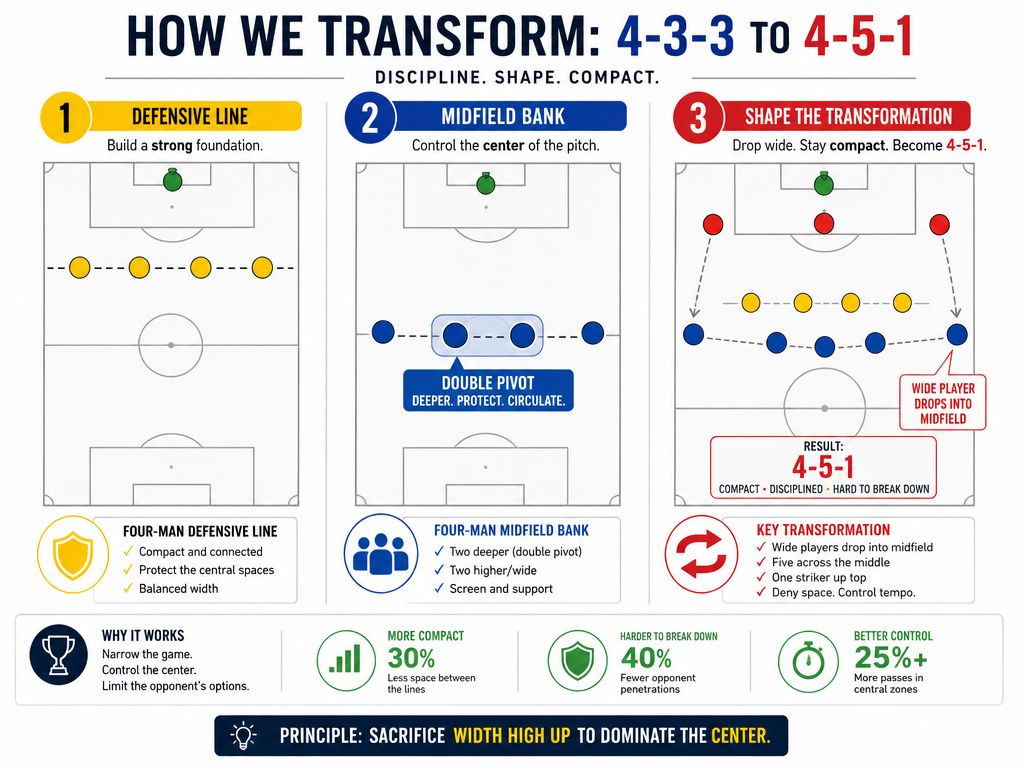
Forget the graphic at the bottom of your TV screen. To really see a formation, watch for three things when the game settles into a pattern:
- Count the Defensive Line. How many players are in the deepest horizontal line when the team is building play from the back? Is it four, with full-backs wide? Is it three, with wing-backs already pushed higher? That’s your first number.
- Identify the Midfield Bank. Identify the next line. Are they all level, or is one player clearly deeper? This tells you if it’s a 4-4-2 (flat) or a 4-2-3-1 (double pivot).
- Watch the Forward Movement. Do the wide players stay forward, or do they drop back when possession is lost? This reveals if a 4-3-3 is actually defending as a 4-5-1.
Do this for both teams, in and out of possession. You’ll start to see the game as a series of shifting shapes, not two static ones clashing. You’ll notice when a team’s width and depth is being exploited, or when a switch in player positions changes the entire structure.
A final piece of advice: be skeptical of the commentator who insists a team has “changed to a 4-4-2” after a substitution. Often, a single player change simply alters the spacing or role within the existing framework. The formation didn’t change; the personnel executing it did. That nuance is where real tactical understanding lives.
What are common offensive formations in football?
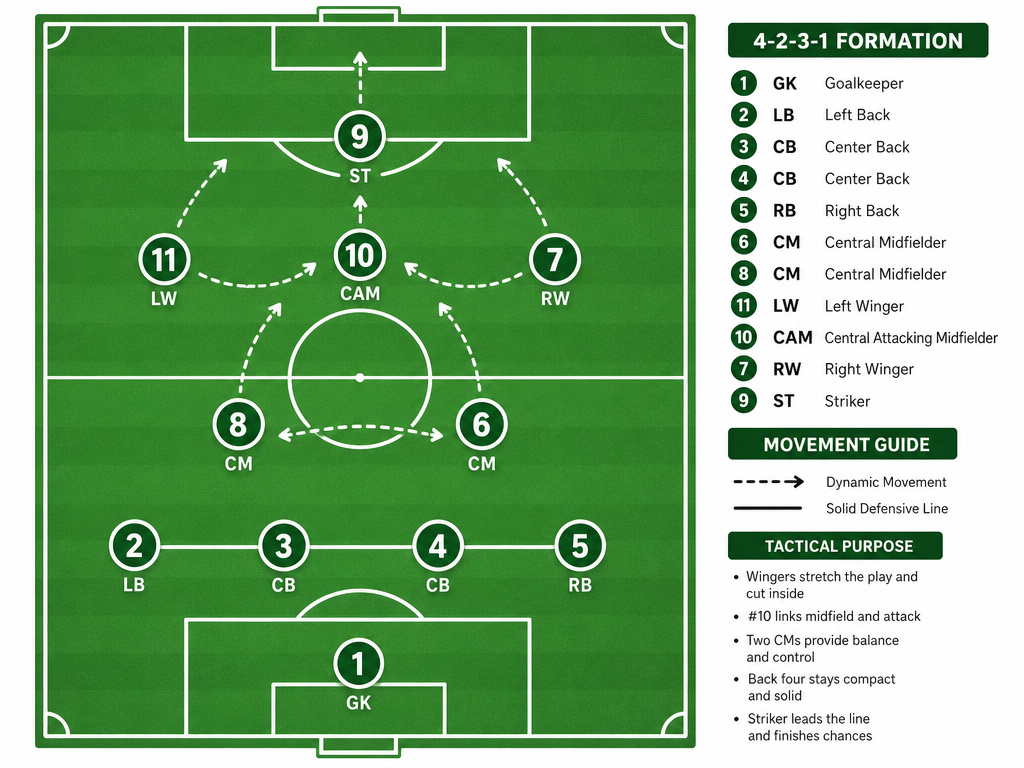
Offensive formations are the starting shapes teams use to organize their attack. They are described by counting outfield players from defense to attack, like 4-4-2 or 4-2-3-1. These shapes are not fixed for the whole game; they can change due to the match score, coach instructions, or the opponent’s tactics. Historically, the game has shifted from older shapes like the 2-3-5 to modern ones. The 4-2-3-1 has been a dominant formation in top European leagues, favored for its balance and suitability for a high press, though the 4-4-2 remains prevalent in leagues like La Liga.
What are common defensive formations in football?
Defensive formations prioritize structure and numbers behind the ball. They are typically named by the number of defenders and midfielders, such as a 4-3 or a 3-4. The first number refers to defenders, the next to midfielders.
What are special teams formations for punts and field goals?
Frequently Asked Questions
Can you explain the different formations in football?
Formations are described by numbers listing outfield players from defense to attack. The most common are the 4-2-3-1 (four defenders, two defensive mids, three attacking mids, one striker), 4-3-3 (four defenders, three midfielders, three forwards), 4-4-2 (two flat banks of four and two strikers), and 3-5-2 (three defenders, five midfielders, two strikers). Each offers different balances of defensive cover, midfield control, and attacking threat.
Why is 4-4-2 not used anymore?
The classic flat 4-4-2 is still used, but less at the very elite level. Its main weakness is the two central midfielders can be numerically overrun by a three-man opposition midfield, conceding control of the center. However, it remains effective for teams that prioritize defensive compactness and direct attacking, as seen in Diego Simeone’s Atletico Madrid and its recent prevalence in Spain’s La Liga.
What are the different types of football formations?
Formations are often grouped by their defensive line: four-at-the-back (e.g., 4-4-2, 4-2-3-1, 4-3-3), three-at-the-back (e.g., 3-5-2, 3-4-3, 5-3-2), and five-at-the-back (a more defensive 5-4-1). Another way is by mindset: possession-based (4-3-3, 4-2-3-1), counter-attacking (4-4-2, 5-3-2), and hybrid systems that change shape with possession.
Why do analysts disagree on a team’s formation?
They disagree because formations are fluid abstractions, not fixed realities. A team’s shape changes with possession, the score, and player movement. Professional data providers studying the same 2022 World Cup match agreed on the starting formation only 65% of the time. Without a single “correct” view, interpretation varies.
The Short Version
Focus less on the three digits at kickoff and more on the spaces between the players during the game. The formation is a coach’s starting idea, but the match is decided by how that idea adapts. Whether a team uses a back three vs back four or a 4-2-3-1 system, the real question is how they use that structure to create advantages and hide weaknesses. Watch for the shifts after a goal or a substitution, that’s when a team’s true tactical plan is revealed.
