
4-2-3-1 Formation Pros and Cons: How to Choose
This post contains affiliate links. As an Amazon Associate, we earn from qualifying purchases.
The 4-2-3-1 formation balances defensive cover and attacking numbers by deploying a back four, two central midfielders (the double pivot), three attacking midfielders, and a lone striker. Its core strengths are control of the half-space, a solid defensive base, and flexibility; its main weaknesses are a potentially isolated striker, vulnerability to overloads in central midfield, and high physical demands on wide defenders and central midfielders.
The tactical effectiveness of the 4-2-3-1 is not just theoretical. It’s the most used formation in top European football for a reason, but a 2026 study also shows it ranked only fourth in average points per match. This guide explains why it’s so popular, what the data says about its success, and where teams using it can be exploited, including a look at the 4-2-3-1 formation pros and cons.
By the last section, you’ll be able to spot the formation on a team sheet, predict its in-possession and out-of-possession shapes, and understand the specific player profiles needed to make it work, or to break it down.
Key Takeaways
- The 4-2-3-1 was the most used formation in top European leagues during the 2023-24 season (29.9% of observations), yet it averaged only 1.41 points per match, ranking it behind formations like the 3-4-3.
- A 2020 study in the Journal of Exercise Science & Fitness found that in a 4-2-3-1, central midfielders covered the most total distance and high-intensity running, while wide defenders covered the most sprint distance. This challenges the common assumption that wingers and forwards are the primary sprint and high-intensity contributors.
- The formation is most vulnerable to midfield overloads, particularly from systems with a central midfield four like a 4-4-2 diamond, which can pin back its double pivot and isolate its attacking midfield trio.
- Its great strength is creating numerical advantages in the half-space through the interplay between the attacking midfielder (number 10) and inverted wingers, forming natural passing triangles that facilitate possession-based play.
- A team’s shape listed as 4-2-3-1 is often just a starting point; it regularly morphs into a 4-4-2 or 4-5-1 defensive block without the ball, making its defensive flexibility a key tactical weapon.
The 4-2-3-1 Under the Microscope: Structure and Evolution
The digits tell you where the players start, not where they end up. A 4-2-3-1 on paper gives you a flat back four, two deeper central midfielders (the double pivot), a line of three attacking midfielders, and a single striker. The real magic, and the real problems, happen when they move.
This formation didn’t appear overnight. It was a natural evolution from the 4-4-2, born from the need to add an extra midfielder to gain control in the centre of the pitch without sacrificing defensive stability. According to a historical analysis in The Guardian, Spanish coach Juanma Lillo is credited with the first self-conscious deployment of the shape at Cultural Leonesa in 1991-92. The idea was to pressure high with four forwards, but it required extremely mobile players. Within a decade in Spain, as noted by Jonathan Wilson in his analysis of the 4-2-3-1’s rise, it had become almost the default, replacing the traditional 4-4-2 formation.
A 2026 study in BMC Sports Science, Medicine and Rehabilitation analyzed formation observations from the 2023-24 season across Europe’s top six leagues. It found the 4-2-3-1 was the most frequently used, appearing 1,211 times and accounting for 29.9% of all observations. This statistical dominance is captured in the peer-reviewed BMC Sports Science tactical trends analysis.
The Premier League saw a downturn in its use after Pep Guardiola’s arrival in 2016-17, as his 4-3-3-centric philosophy emphasised control through a single pivot. Yet, by the 2024-25 season, its usage in England had climbed back to its highest level for a decade. Its persistence speaks to a fundamental trade-off managers are willing to make.
The Core Strengths of the 4-2-3-1
The formation’s popularity is built on three pillars: defensive solidity, midfield control, and attacking flexibility. Examining the 4-2-3-1 formation pros and cons shows it’s a system designed to be good at many things, rather than exceptional at one.
A Staggered Defensive Foundation
The double pivot is the system’s anchor. With two players screening the back four, it’s harder for opponents to penetrate through central channels, especially when the team drops into a mid or low block. This creates what the Premier League’s own analysis calls a “staggered defensive presence.” The shape also naturally morphs into a compact 4-4-2 or 4-5-1 block without the ball, providing clear zonal coverage. This defensive organisation is a core principle of rest defence in football.
Control Through Overloads and Triangles
In possession, the 4-2-3-1 excels at creating numerical advantages. Its greatest strength, according to tactical breakdowns, is overloading the half-space, the channel between the wing and the central lane. The attacking midfielder (the number 10) operates between the opposition’s midfield and defensive lines, while the wingers tuck inside. This interaction with the double pivot and overlapping full-backs creates a web of passing triangles.
The formation lends itself to triangles, making it conducive to a possession-based game. It provides lots of different passing lines and angles to play out from the back.
This structure is perfect for a patient, probing style. It allows a team to dominate the ball in the opponent’s half, constantly recycling possession while waiting for a defensive line to crack. It’s the opposite philosophy of a direct 4-5-1 formation built for swift transitions.
Tactical Flexibility
A 4-2-3-1 is rarely a 4-2-3-1 for 90 minutes. This fluidity is its secret weapon. The same starting shape can effortlessly shift:
- Into a 4-3-3 if one of the double pivot steps higher.
- Into a 4-4-2 if the number 10 pushes up alongside the striker.
- Into a 3-2-5 in attack if one full-back pushes high and a centre-back steps into midfield.
This in-game adaptability means coaches can respond to the flow of a match without making a substitution or a glaring tactical shout. It’s a system that trusts intelligent players to find solutions within a framework.
The Weaknesses and Vulnerabilities
For all its control, the 4-2-3-1 has clear pressure points, a key part of the 4-2-3-1 formation pros and cons. Smart opponents know exactly where to push.
The Isolated Striker
The lone centre-forward can become a frustrated figure. With three attacking midfielders behind, the instinct is often to play to feet in crowded areas, bypassing the striker. If the wingers stay wide and the number 10 drops deep to collect the ball, the striker is left one-on-two against centre-backs. They need exceptional holdup play, constant movement, and the patience to wait for one clear chance a game. Without a strike partner like in a 4-4-2 diamond, their workload is immense.
The Midfield Overload
This is the formation’s kryptonite. The double pivot, while solid, is just two players. A smart opponent playing with a central midfield three, or better, a four, can dominate the zone. The Premier League analysis specifically names the 4-4-2 diamond as a threat, as its four central midfielders can overwhelm the 4-2-3-1’s central three (the two pivots plus the number 10).
| Opponent Formation | Threat to 4-2-3-1 | Why It Works |
|---|---|---|
| 4-4-2 Diamond | High | Four central midfielders vs. Three creates a permanent numerical overload, pinning back the double pivot. |
| 4-3-3 (with a single pivot) | Medium | The single holder plus two advanced eights can outmanoeuvre the double pivot if their movement is clever. |
| 3-5-2 | Variable | The wing-backs can pin back the 4-2-3-1’s wide attackers, while the midfield three battles for central parity. |
When overloaded, the double pivot gets pinned deep, the passing lanes to the number 10 are cut, and the team is forced long to the isolated striker. The game is played in their half, not the opponent’s.
Defensive Exposure on the Flanks
The very triangles that help in attack can cause problems in transition. When the full-backs push high to provide width and the wingers cut inside, enormous space is left in the wide channels. A quick opponent can win the ball and switch play to these exposed areas before the full-backs can recover. This makes the system vulnerable to quick, direct counter-attacking football. The central midfielders, responsible for covering these spaces, simply can’t always get there in time.
Player Demands and Who It Suits

The 4-2-3-1 doesn’t work with just any eleven players. It demands specific, often exhausting, roles. Forget the idea that it’s an easy default.
The Engine Room: Central Midfielders
The two players in the double pivot are the system’s metronome and its brake. One is typically a distributor, comfortable receiving the ball under pressure from the centre-backs. The other is often a ball-winner, covering space and snuffing out counters. Their understanding is essential. A 2020 study in the Journal of Exercise Science & Fitness that analyzed a team using this formation found that central midfielders covered the most total distance and the most high-intensity running. They are never passengers.
The Wide Defenders: Unseen Workhorses
Most broadcast footage misses this. While everyone watches the wingers, it’s the full-backs who often cover the most ground. That same 2020 study found that wide defenders covered the most sprint distance in the 4-2-3-1. They must be athletes: capable of overlapping to provide width one moment, and sprinting 50 yards to recover defensively the next. A tired full-back is the most glaring sign a 4-2-3-1 is about to crack.
The Number 10: The Luxury That Must Work
The attacking midfielder is the system’s spark. Traditionally a “luxury player,” the modern game has stripped away the luxury. They must be a creative force, finding pockets between the lines, but they are also the first line of the press and are expected to drop into a midfield bank of four or five without the ball. A number 10 who doesn’t defend will create a fatal gap between the midfield and attack.
Is This for Amateur or Youth Teams?
Honestly, it’s a mixed bag. At youth levels, focusing on a simpler, more compact shape like a 4-4-2 or 4-3-3 often yields more touches on the ball for each player. The 4-2-3-1’s success hinges on disciplined positioning and high fitness levels, things that are often inconsistent in amateur football. I’ve seen a youth team on a heavy, narrow pitch try to play a fancy 4-2-3-1 and get utterly overrun by a simpler, more compact 4-4-2. The conditions decided the game. For amateur adults, the high physical demands, especially on the full-backs, can be a recipe for second-half collapses if the squad isn’t deep.
Where this goes sideways: Using a 4-2-3-1 with slow, defensively unaware full-backs. By the 60th minute, the channels will be motorways for the opposition’s fastest player, and you’ll concede from a cross your exhausted defender couldn’t block.
How to Beat the 4-2-3-1
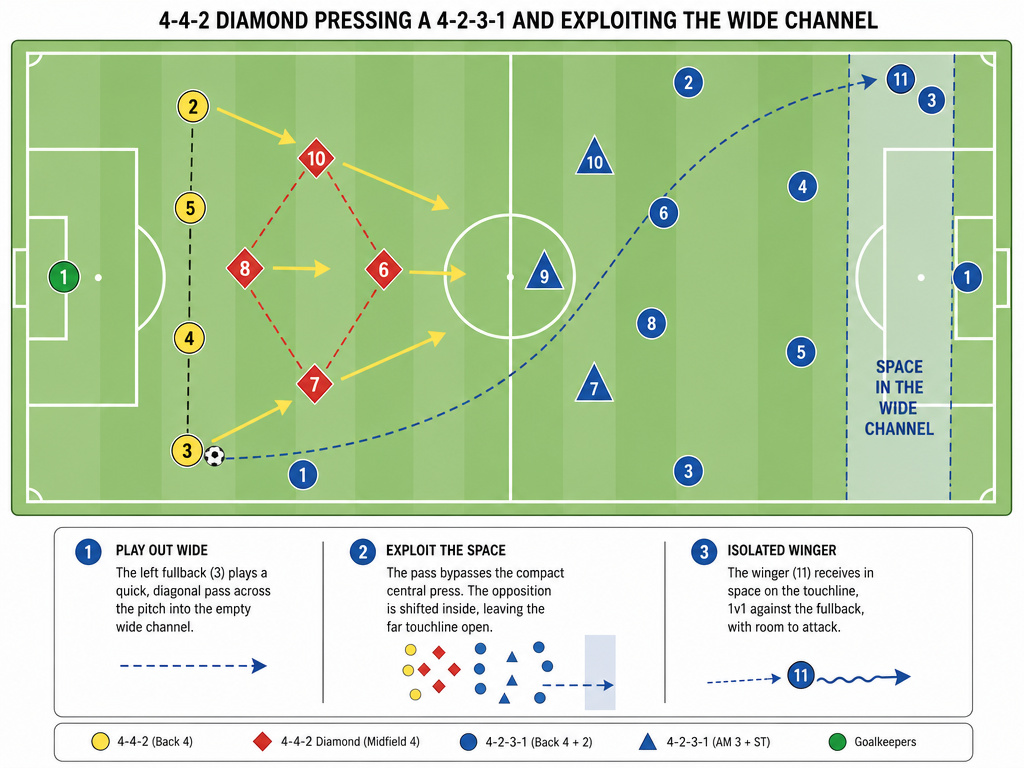
So you’re facing a team that lines up in this shape. Your game plan should focus on two things: overloading the centre and exploiting the space behind the advanced full-backs.
Win the Midfield Battle
The most direct route is to match them with a 4-3-3 and instruct your central midfield three to aggressively man-mark or zone-cover the double pivot and the number 10. Even better, use a formation with a clear numerical advantage in the middle. A 4-4-2 diamond clogs the central corridors, forcing the 4-2-3-1’s creative players wide and into less dangerous areas. Your aim is to separate the double pivot from the back four and the number 10 from the striker.
Exploit the Wide Channels in Transition
Don’t engage in a possession battle with them in their own half. Instead, sit in a compact mid-block, let them have the ball in front of you, and wait for the moment their full-backs commit. The trigger is when the opposing winger cuts inside and their full-back overlaps. Win the ball and immediately switch play to your winger on the opposite side, who should be one-on-one with a backtracking defender. This is the core of effective counter-attacking tactics.
Isolate the Striker
Your two centre-backs should communicate to handle the lone striker. One can engage while the other sweeps. The key is to prevent the striker from linking play by cutting off the passing lanes from the double pivot and number 10. Force the 4-2-3-1 to play around you, not through you. This often leads to harmless crosses from deep areas, which a organised defence should deal with comfortably.
The Data: Does Popularity Equal Success?

This is where the story gets interesting. The 4-2-3-1 is ubiquitous, but is it actually the most successful formation? The numbers suggest a disconnect.
The 2026 BMC study provides the clearest evidence. While the 4-2-3-1 was the most used (29.9% of observations), its average of 1.41 points per match placed it fourth among all formations analyzed. The winner? The 3-4-3 formation, which yielded a significantly higher 1.81 points per match, despite being far less common.
| Formation | Observations (2023-24) | Avg. Points per Match | Key Takeaway |
|---|---|---|---|
| 3-4-3 | Less Common | 1.81 | Highest yield, but fewer teams deploy it successfully. |
| 4-2-3-1 | 1,211 (29.9%) | 1.41 | Most popular, but middle-of-the-pack results. |
| 3-5-2 | Relatively Low | 0.99* | Contextual; team-level analysis showed higher potential. |
Table shows descriptive-level averages; team-level analysis can differ. So why does everyone use it? The answer is probably risk mitigation. The 4-2-3-1 offers a balanced, controllable platform. It minimises glaring weaknesses more than it maximises explosive strengths. Coaches may prefer its reliable structure over the higher-variance, potentially more rewarding 3-4-3. A separate study in the Eurasian Journal of Sport Sciences and Education (EJSSE) analyzing 8,909 matches where both teams used a 4-2-3-1 found the home team held an average advantage of +0.410 points*, it’s a formation that reliably uses home pitch control.
An experimental study published in PLOS ONE comparing the 4-2-3-1 and 3-5-2 in an 11 vs. 11 setup found no difference in metrics like Effective Playing Space or Team Separateness. However, the 3-5-2 exceeded the 4-2-3-1 in Player Length per Width ratio and Pressure Passing Efficiency. This kind of controlled, peer-reviewed soccer formation analysis helps move the discussion beyond anecdote.
How to train a team to use the 4-2-3-1 formation
Implementing the 4-2-3-1 starts with understanding its four distinct lines and the specific physical demands it places on players. Training must focus on the roles of the double pivot and the central attacking midfielder, as they are crucial for linking defense and attack. A study of a team using this system found central midfielders cover the most total distance and high-intensity running, while wide defenders cover the most sprint distance. Drills should emphasize creating triangles to build possession and practicing the transition into a compact 4-4-2 defensive block. Coaches must also prepare for its vulnerability; the central three can be overloaded by a midfield four, such as a 4-4-2 diamond, requiring specific positional work to protect that zone.
Frequently Asked Questions
What are the main pros and cons of the 4-2-3-1?
The main pros are defensive stability from the double pivot, excellent control of the half-space for possession football, and great in-game flexibility. The main cons are a frequently isolated striker, vulnerability to midfield overloads (especially from formations with four central midfielders), and high physical demands that can expose tired full-backs on the counter-attack.
Why is the 4-2-3-1 so popular?
It’s popular because it provides a balanced, safe tactical framework. It covers the pitch well defensively without sacrificing too many attacking numbers. For managers, it’s a logical, controllable system that works with a wide range of player profiles and can be easily adapted during a match, unlike more rigid shapes such as the 4-3-2-1 Christmas tree formation.
What formation can beat a 4-2-3-1?
Formations that overload the central midfield are most effective. The 4-4-2 diamond is a classic counter, using four central midfielders to overwhelm the 4-2-3-1’s three. A well-drilled 4-3-3 can also outmanoeuvre the double pivot, while a 3-5-2 can match it centrally and exploit the space behind its advanced full-backs with wing-backs.
Is the 4-2-3-1 a defensive formation?
Not inherently. While it has a solid defensive base, its primary modern use is for possession-dominant, attacking teams who use the double pivot to build play and the attacking trio to create chances. Its defensive reputation comes from its ability to quickly morph into compact blocks like a 4-5-1, but its intent is often to control the game with the ball. This contrasts with deliberately defensive setups like the 4-1-4-1 formation.
The Bottom Line
The 4-2-3-1 is the workhorse of modern football formations. It won’t always get you the highest points tally, the data shows more adventurous shapes like the 3-4-3 can outperform it. But it will rarely get you caught in a tactical disaster. That’s why it persists.
If you’re coaching a team and considering it, start by asking if you have the players. Do you have two intelligent central midfielders who can handle immense physical loads? Do you have full-backs who are genuine athletes? Do you have a number 10 who works as hard without the ball as with it? If the answer to any of those is no, a simpler guide to football formations might point you toward a shape that better fits your squad.
The final lesson is one all managers learn eventually. The formation on the team sheet is just the opening move. The 4-2-3-1’s real power isn’t in those four digits; it’s in its capacity to become something else when the whistle blows.
