
4-4-2 Formation Pros and Cons: How to Choose
This post contains affiliate links. As an Amazon Associate, we earn from qualifying purchases.
The 4-4-2 formation offers a formidable defensive base and direct attacking threat, but its major weakness is a 2v3 numerical disadvantage in central midfield. Its usage in elite football has plummeted from 44% of Premier League line-ups in 2008-09 to just 7% in 2023-24, yet top coaches like Carlo Ancelotti and Diego Simeone still champion its defensive clarity and compactness.
The real story isn’t that the 4-4-2 is obsolete. It’s that its primary purpose has shifted completely. Analysis such as that in The Athletic suggests that at the highest level, the modern 4-4-2 is primarily a defensive, out-of-possession shape used to funnel play wide and win the ball back, rather than an attacking base formation. Understanding that shift is the key to weighing its true pros and cons, making a discussion of the 4-4-2 formation pros and cons essential.
What follows is a look at the formation’s defensive machinery, its inherent midfield vulnerability, the player profiles it demands, and the practical adjustments that keep it relevant.
Key Takeaways
- According to analysis like that in The Athletic, elite teams now use the 4-4-2 almost exclusively as a defensive base, not an attacking shape, using its natural compactness to protect the center, though it is still broadly described as a balanced formation.
- A major weakness of the 4-4-2 is a 2v3 numerical disadvantage in central midfield against popular systems like the 4-3-3, which sources like Goal.com Nigeria say can lead to possession struggles, though The Athletic notes modern defensive organization can mitigate this.
- Its usage has declined by 40% since 2021/22, and according to Soccer 365, Burnley under Vincent Kompany were the only Premier League side using it as a primary shape in 2023-24.
- To survive, modern iterations rely on staggered forwards (4-4-1-1) and intense, synchronized pressing to trap opponents before they exploit the midfield gap.
- It demands a lost breed of box-to-box midfielders and traditional wingers, which academies no longer prioritize, accelerating its decline.
Why the 4-4-2 Is Still a Defensive Powerhouse
The first thing to understand is that the 4-4-2’s greatest strength is not having more players anywhere. It’s about giving players clear, simple relationships. Carlo Ancelotti said it plainly after a Real Madrid win: “My preferred system is 4-4-2 because I think we defend better… defensively it’s the best system,” though other coaches like Jose Mourinho argue a midfield triangle has an inherent advantage.
He’s talking about compactness. When a team drops into its two banks of four, the distances between the back line and the forward line shrink. Arrigo Sacchi’s legendary AC Milan side, a touchstone for defensive organization, maintained a maximum distance of 25 metres between those lines out of possession. That’s the visual cue: a narrow, impenetrable block.
The 4-4-2 offers a strong defensive presence across the entire pitch, with compactness, balance, and cover easy to establish in a high press, mid-block, or low block. Its two banks of four create a barrier that forces the opposition wide, using the touchline as an extra defender.
This compact shape solves a major problem modern football created. Against a common 4-3-3 build-up with a single defensive midfielder (the “pivot”), a 4-4-2 is perfectly set up to screen. One striker can pick up that pivot, while the other presses the center-backs. The four midfielders behind them can then mark the remaining three opposition midfielders man-for-man, with a spare player to provide cover. It’s a passive-aggressive system, you allow the opponent to have the ball in certain areas, but never in the dangerous ones.
Sean Dyche’s Everton and Diego Simeone’s Atletico Madrid have built identities on this principle. They encourage the opposition to play out wide, then aggressively “lock” them in near the touchline, swarming the receiver in what analysts call a sandwich press. The objective isn’t always to win the ball immediately. It’s to force a rushed pass, a turnover, or a hopeful long ball. From that regained possession, the two strikers provide an instant counter-attacking threat.
The Inherent Midfield Weakness: A 2v3 Battle
For all its defensive virtues, an analysis of the 4-4-2 formation pros and cons reveals it has a fundamental, structural weakness. It fields only two central midfielders. The most popular formations in football today, the 4-3-3 and the 4-2-3-1, field three. This creates a permanent 3v2 overload for the opposition in the most important part of the pitch.
Jose Mourinho explained the tactical consequence years ago. “If I have a triangle in midfield… I will always have an advantage against a pure 4-4-2 where the central midfielders are side by side,” he said. “That’s because I will always have an extra man.” That extra man has time on the ball. He dictates tempo. He finds passing lanes. This is why teams using a 4-4-2 often cede possession and control.
The data bears this out. Leicester City’s miraculous 2015-16 Premier League title win, achieved with a counter-attacking 4-4-2, saw them average just 42.43% possession, the lowest for any champion since records began in 2003-04. They won not by controlling games, but by surviving the midfield battle and being lethally efficient in transition.
Common mistake: Thinking a flat 4-4-2 can out-possess a 4-3-3. The numbers don’t lie. You will be outpassed and outnumbered in the center. Your success hinges on what you do without the ball.
So why doesn’t the 4-3-3 automatically destroy every 4-4-2 today? Modern defensive organization has evolved. As noted in The Athletic’s 4-4-2 analysis, the block is no longer static. It’s dynamic, with pressing, marking, and positioning synchronized to stop the opponent from playing through. The 4-4-2 doesn’t try to win the midfield battle on the ball. It tries to nullify it before the ball arrives.
The Rise and Fall of the Flat Four
The 4-4-2 didn’t start as a defensive tool. It evolved from the gung-ho 4-2-4 formation, pioneered by Russian coach Viktor Maslov in the late 1960s. Maslov’s innovation was to pull both wingers back into midfield, creating a more balanced and overload-proof shape. He led Dynamo Kyiv to three consecutive league titles with it.
For decades, it was the default. For a period, it was very common. Its decline in the Premier League has been stark, dropping from 44% of line-ups in 2008-09 to 7% in 2023-24.
The rise of the 4-2-3-1 and 4-3-3 wasn’t just about fashion. It changed how players were developed. Academies stopped producing the classic box-to-box central midfield pair and the traditional touchline-hugging wingers the 4-4-2 requires. They started nurturing holding midfielders, number 10s, and inverted wingers instead. The player pipeline dried up.
Furthermore, modern in-possession shapes favor systems that start from a 4-3-3 base. Transitioning a 4-4-2 into a common attacking shape like a 3-2-4-1 is clunky. It requires a full-back to tuck inside expertly or a striker to drop into a number 10 role, profiles that aren’t native to the system. As The Tactics Board analysis notes, this inherent limitation pushed it further down the pecking order.
| Era | Dominant Formation | Key Player Profiles | Premier League Usage |
|---|---|---|---|
| 2008-09 Season | 4-4-2 | Box-to-box CMs, traditional wingers, strike partnerships | 44% |
| 2010s-Present | 4-3-3 / 4-2-3-1 | Holding midfielder, No. 10, inverted wingers, lone striker | 7% (2023-24) |
Player Profiles: The Lost Breed
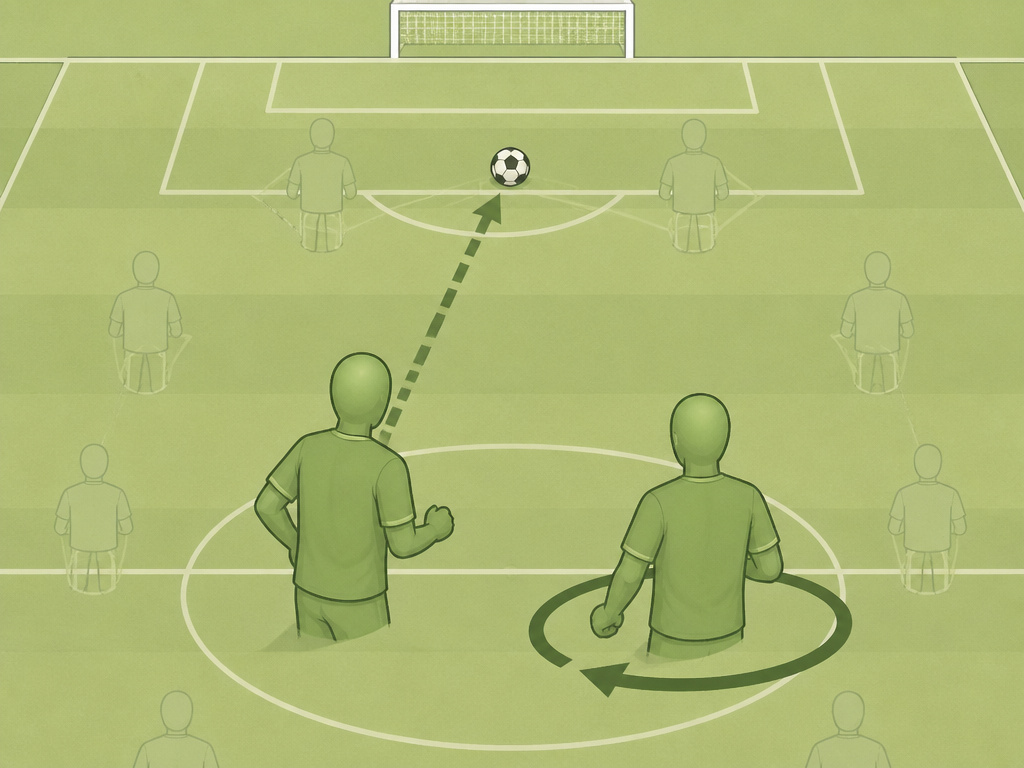
A true, flat 4-4-2 makes specific demands that sound almost nostalgic. Your central midfielders must be engines, able to cover ground for 90 minutes, tackle, and also arrive late in the box. There’s no designated holder or creator; both roles are blended. Your wide midfielders must be hybrids: part winger, part full-back, responsible for providing the team’s only width while also tracking back to defend it.
I learned this the hard way watching youth football. A team with a fancy 4-3-3, full of academy-trained technicians, kept losing the central battle to a simpler, harder-running 4-4-2 side on a heavy, narrow pitch. The conditions and the available players dictated the effective formation, not the other way around. The 4-4-2 rewarded grit and clarity over complexity that day.
The striker partnership is the system’s heartbeat. One often needs to drop and link play, while the other pins the back line. Leicester’s title win worked because Shinji Okazaki constantly dropped to support N’Golo Kanté and Danny Drinkwater, morphing their 4-4-2 into a 4-4-1-1 out of possession. This brings us to the critical modern adjustment.
How Coaches Mitigate the Weakness: The 4-4-1-1 & The Stagger
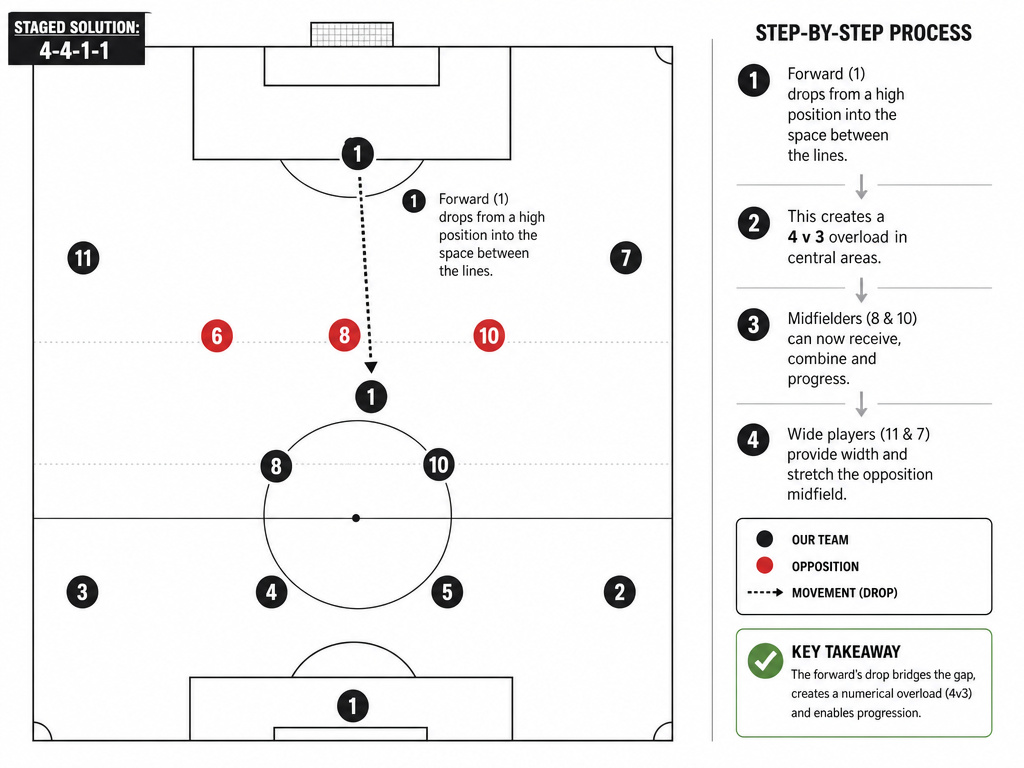
No top coach sends out a rigid, flat 4-4-2 anymore. The solution to the midfield overload is to stagger your players. The most common adaptation is the 4-4-1-1, where one forward (the “1”) drops significantly deeper.
This isn’t a minor tweak. This dropping forward bridges the gap to the midfield two, creating a temporary 3v3 or at least providing a passing outlet to bypass the pressurized central duo. It’s the difference between a numerical defeat and a fighting chance.
| Adjustment | How It Works | Example |
|---|---|---|
| 4-4-1-1 Stagger | One forward drops, creating a link to midfield and denying the opposition’s pivot time. | Leicester City 2015-16 (Okazaki) |
| Asymmetric Wingers | One winger tucks in to form a midfield trio in possession, while the other provides width. | Modern flat 4-4-2 variations |
| Aggressive Sideways Press | The block shifts as a unit to trap opponents wide, using touchline as defender. | Sean Dyche’s Everton |
The other method is intensive coaching of the block’s movement. The four midfielders and the front two must shift laterally in perfect unison, like a well-drilled military unit. The moment the ball goes to an opponent on the flank, the nearest midfielder presses, the far-side midfielder tucks in, and the back four steps up. The goal is to make the field feel small for the player on the ball. This coordinated movement is what analysts mean when they say a modern 4-4-2 is “dynamic.”
4-4-2 vs. 4-3-3: The Direct Comparison
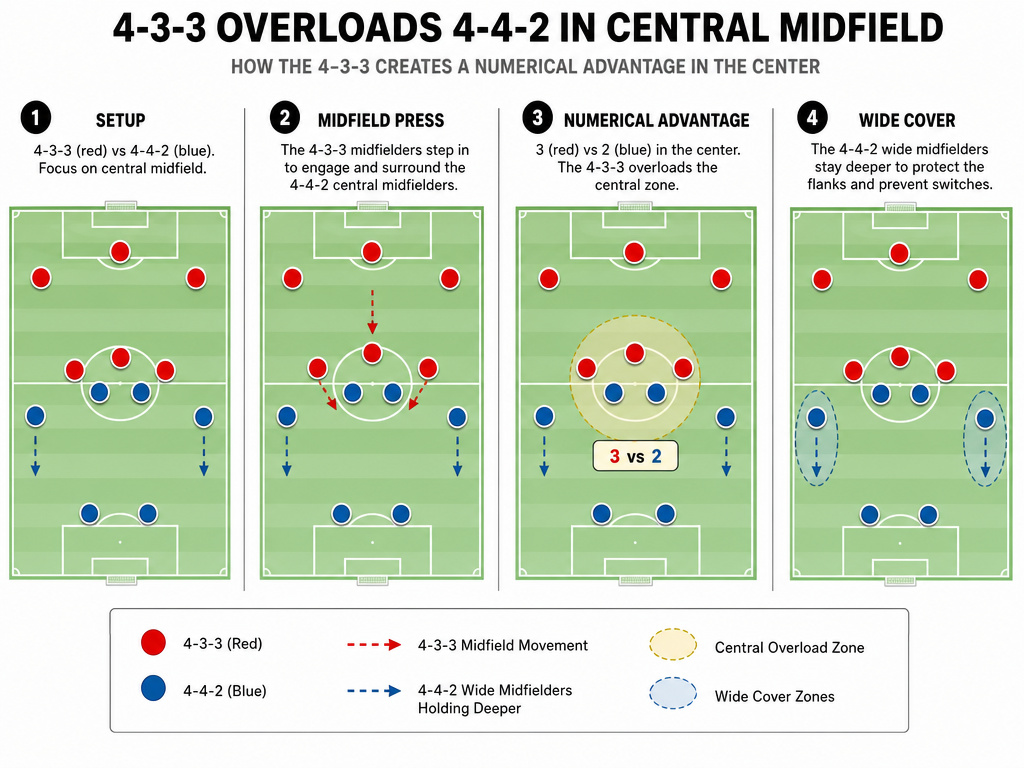
This is the matchup that defines the modern game. The 4-3-3, with its midfield triangle, is designed to dominate the ball. The 4-4-2 is designed to disrupt that domination.
- In Central Midfield: The 4-3-3 has a clear 3v2 advantage. The single pivot can dictate play if not pressed, while the two advanced 8s can overload the 4-4-2’s flat midfield pair. This is the core battleground.
- In Wide Areas: The 4-4-2 often comes out ahead. Its deeper wide midfielders are naturally better positioned to track the 4-3-3’s wingers and support the full-backs. In a 4-3-3 formation, the wingers are attackers first; they don’t always track back with the same discipline.
- In Transition: The 4-4-2’s two strikers provide an instant outlet for counter-attacks, often occupying both opposing center-backs. The 4-3-3’s lone striker can be isolated without support.
The team that wins this duel usually imposes its preferred game state. The 4-3-3 seeks to control central midfield, while the 4-4-2 aims to force play into wide areas. For a detailed look at exploiting a 4-3-3, the specific weak points are between the lines and behind the advanced full-backs.
The Bottom Line
The 4-4-2 is not dead. It’s specialized. It has evolved from an all-purpose system into a specific tool for a specific job: defensive solidity and rapid transition.
Its greatest limitation today isn’t tactical, it’s developmental. Football doesn’t produce many of the pure, traditional players it needs to function at its peak. That’s why you see it most often as a reactive, out-of-possession shape rather than a proactive blueprint.
If you’re considering it, ask one question first: do you have the personnel to execute the defensive plan perfectly, and can you accept sacrificing central possession to do it? If the answer is yes, the 4-4-2 can still be a brutally effective equalizer, a testament to the fact that in football, simplicity and cohesion can still trump sheer technical talent. For a broader look at how it fits among other common formations, the principles of balance and trade-offs remain constant.
Flat 4-4-2 vs Diamond 4-4-2
The classic flat 4-4-2 uses two central midfielders side-by-side. This creates a strong, compact defensive block but can be vulnerable in the middle. Jose Mourinho stated that a midfield triangle from a formation like a 4-3-3 will always have an advantage against this pure flat setup. To counter this, teams often use a diamond variant, with one defensive midfielder, two shuttlers, and an attacking midfielder. This provides a natural presence in the central spaces the flat system can lack. However, the diamond sacrifices the natural width and defensive cover from the flat wide midfielders, placing different demands on the full-backs.
Frequently Asked Questions
Why is the 4-4-2 not used anymore?
Its usage has declined because modern dominant formations like the 4-3-3 and 4-2-3-1 naturally outnumber it in central midfield, leading to a possession disadvantage. Player development has also shifted away from the classic box-to-box midfielders and traditional wingers the system requires. It’s now primarily a specialized defensive shape rather than a default setup.
What are the main weaknesses of the 4-4-2 formation?
The primary weakness is a 2v3 numerical disadvantage in central midfield, making it hard to control possession. It can also be vulnerable to line-breaking passes between its flat defensive lines and sometimes lacks passing options when building attacks from the back compared to a 4-1-4-1 formation.
Did the Russians invent the 4-4-2?
Yes, the core shape is credited to Soviet coach Viktor Maslov in the late 1960s. He adapted the 4-2-4 by pulling both wingers back into midfield, creating a more balanced and defensively secure four-man midfield unit, leading Dynamo Kyiv to three consecutive league titles.
Why is 4-3-3 considered better than 4-4-2?
The 4-3-3 is generally considered better for teams that want to dominate possession and control games through the midfield, thanks to its 3v2 central advantage. The 4-4-2 is often better for teams that prioritize defensive compactness, discipline, and quick counter-attacks. “Better” depends entirely on a team’s players, philosophy, and the specific opponent.
