
Wing Back Role in Football: The Hybrid Position Explained
This post contains affiliate links. As an Amazon Associate, we earn from qualifying purchases.
A wing-back is a hybrid position, part defender and part winger, designed to provide attacking width in formations with three central defenders. The role demands extreme stamina — full-backs covered over 10,000 meters per match in the UEFA Europa League — and carries specific tactical trade-offs between defensive cover and offensive threat.
That 10,000-meter figure is a real, measured average from elite competition, not an abstract goal. When a manager shifts to a back three, the players out wide aren’t just full-backs with a new name. Their job description, the space they patrol, and the physical toll all change, which is why the wing back role in football is so demanding.
This guide unpacks the wing-back role: the exact physical demands proven by match data, the tactical formations that create and exploit it, and the key differences from a traditional full-back that decide which players can actually do the job.
Key Takeaways
- In a back three formation, the wing-back’s primary job is to provide attacking width, turning defensive solidity into offensive overloads.
- The physical demand is brutal: data from the 2021/22 UEFA Europa League shows full-backs averaged 10,036 meters per match.
- A wing-back’s most dangerous run is often the cross-receiving run into the box, a key differentiator from a full-back who stays wider.
- Formations like the 3-5-2 and 5-3-2 maximize wing-backs, but leave them vulnerable to counters if their midfield cover is weak.
- Match training rarely replicates sprint demands for wing-backs; one study found they only hit 64% of match sprint peaks in training.
Wing-Back vs. Full-Back: The Key Distinction
The labels sound similar. The jobs are not. A traditional full-back in a back four shares the flank with a winger. Their first thought is defensive shape. The wing back role in football, in a back three, is the winger. Their first thought is where the space is ahead of them.
Common mistake: Assuming a wing-back is just an attacking full-back. The tactical system changes their entire reference point. A full-back balances a partner; a wing-back is the partner.
The Sevilla FC Innovation Center analysis pinpoints the difference. Wing-backs “tend to make more runs that create danger,” especially breakaway runs, support runs, and cross-receiving runs. The most telling gap? The “arrival to receive crosses.” A wing-back is judged by getting into the box to finish. A full-back is judged by staying wide to create.
This is about geometry, not aggression. In a 4-3-3, the wide forward holds the high line. The full-back supports from behind. In a 3-5-2, there is no high wide forward. That channel belongs entirely to the wing-back. Their starting position is higher, and their defensive duty is simpler: drop into a back five. The trade-off is distance. They own a 60-meter corridor, end to end.
A manager choosing a back three vs back four is designing a machine for width, not just picking defenders. The wing-back is the piston.
What Physical Demands Define a Wing-Back?
Rewind the tape. We know the wing back role in football is demanding, but recent studies put numbers to the pain. The physical profile isn’t a suggestion; it’s a prerequisite.
A 2024 study of UEFA Europa League matches found full-backs covered 10,036 meters of total distance on average. Forwards covered 1,587 meters less. Central backs, often the wing-back’s protective center-halves, sprinted 91 m less than fullbacks and covered 286 m less in high-velocity running than fullbacks.
But distance is only part of the story. The type of running matters more. A 2018 PLOS One study showed that for full-backs, the most common length of a single high-intensity run was 6–10 meters. For central backs, central midfielders, wide midfielders and central forwards, it was 1–5 meters. Wing-backs aren’t just covering ground; they are repeatedly exploding over longer sprints to beat their marker and reach the byline.
Acceleration and deceleration counts are significantly higher in matches than training for all positions (108–166% according to one NIH positional training load study).
The real shock is in training. That same NIH positional training load study found that while center backs and midfielders could match or exceed their match sprint peaks in training, wing-backs only reached 64% of theirs. The game asks them for repeated, maximal efforts that practice drills simply don’t replicate.
| Physical Metric | Wing-Back / Full-Back Demand | Key Implication |
|---|---|---|
| Total Distance | Highest on pitch (~10,000m) | Requires elite aerobic capacity. |
| Sprint Distance | Frequent longer sprints (6-10m) | Needs repeat-sprint ability, not just speed. |
| Training Gap | Largest deficit vs. Match demands (64% of peak) | Practice must include game-realistic, high-intensity drills. |
| High-Velocity Running | Significantly more than center backs | Pure defensive players rarely fit the role. |
This is why simply moving a diligent full-back to wing-back often fails. The engine is different. A player like Achraf Hakimi or Federico Dimarco isn’t just technically gifted; their physiology is built for these specific, punishing surges.
Formations That Unleash (and Isolate) Wing-Backs
The wing-back is a creation of system, not just skill. Certain formations don’t just use them; they necessitate them.
The 3-5-2 is the classic home. Three center backs cover the central channel, freeing two wing-backs to dominate the flanks. The 5-3-2 is another formation that uses wing-backs. Both systems rely on the wing-backs for all the team’s width.
The Sevilla FC analysis looked at win percentages for wing-back systems. The 1-5-4-1 led at 43%. The classic 3-5-2 formation followed at 35.8%. No formation guarantees wins, but these numbers show systems built around wing-backs can be effective.
However, the system also dictates the wing-back’s defensive experience. Here, sources disagree.
Both can be true. In a well-organized 3-5-2, the central midfielder shuffles wide to help. In a disjointed press, the wing-back can be left alone against two players. This is the core tactical risk of any formation using wing-backs: you trade defensive stability for attacking overloads. Opponents looking to counter a back three target these isolation moments.
Where this goes sideways: The wing-back pushes high, the team loses possession, and the opposing winger sprints into 50 yards of open grass. Recovery runs are possible, but they burn fuel needed for the next attack.
Other formations use variants. The 3-4-3 uses wing-backs alongside wide forwards, asking for more combination play than pure crossing. The 5-3-2 formation asks for disciplined defensive positioning first, with attacking runs a secondary feature. Choosing the system decides the job description.
Skills and Attributes: What Makes a Great Wing-Back?
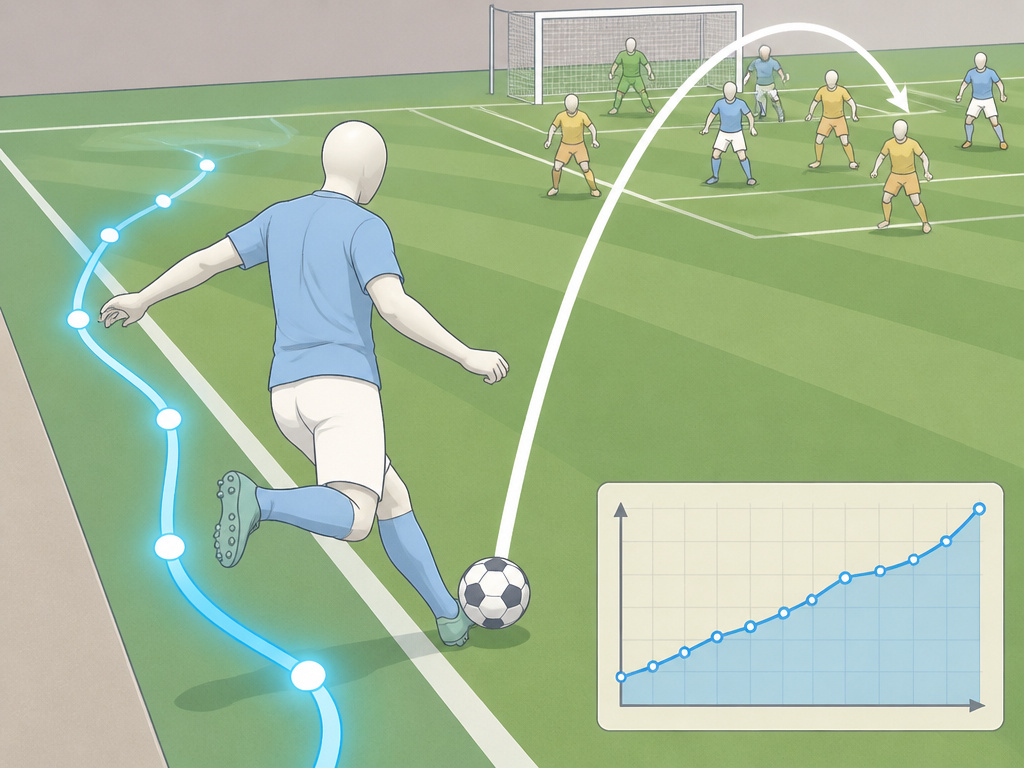
Given the demands, what should a coach look for? Technical skill is just the entry ticket.
Stamina is essential. The GPS doesn’t lie. A player who fades after 70 minutes is a liability. They need the aerobic base to cover the distance and the anaerobic resilience to repeat those 10-meter sprints.
1v1 defensive competency is required, but it’s not the primary skill. A wing-back must be comfortable in a duel, but their main defensive contribution is positional — knowing when to drop and form the back five. A classic center-back’s skillset is often too conservative.
Crossing and final-third decision-making are paramount. Unlike a traditional winger who might cut inside, a wing-back’s key contribution is often the quality of the ball into the box. The Sevilla study highlights the “cross-receiving run” as critical. The best wing-backs, like Denzel Dumfries, have a striker’s instinct for arriving at the back post.
Tactical intelligence might be the most overlooked attribute. They must read the game to know when to stay (protecting against a counter) and when to go (exploiting a overload). A Springer systematic scoping review on positional demands emphasizes that physical outputs are useless without this contextual understanding.
| Attribute | Why It Matters | Poor Fit Indicator |
|---|---|---|
| Repeat-Sprint Ability | Covers the long high-intensity runs (6-10m). | Player fatigues, stops making overlapping runs after 60 mins. |
| Aerobic Capacity | Underpins the 10,000+ meter total distance. | Statistical output declines sharply in second half. |
| Final Ball Quality | Creates chances from wide dominance. | High possession stats with low expected assists (xA). |
| Spatial Awareness | Balances attacking threat with defensive shape. | Team consistently exposed on counter-attacks down their flank. |
Notice “sheer pace” isn’t on the list. Speed helps, but without the endurance to use it repeatedly, it’s a wasted asset. The profile is closer to a box-to-box midfielder than a flyer.
The Evolution and Modern Context
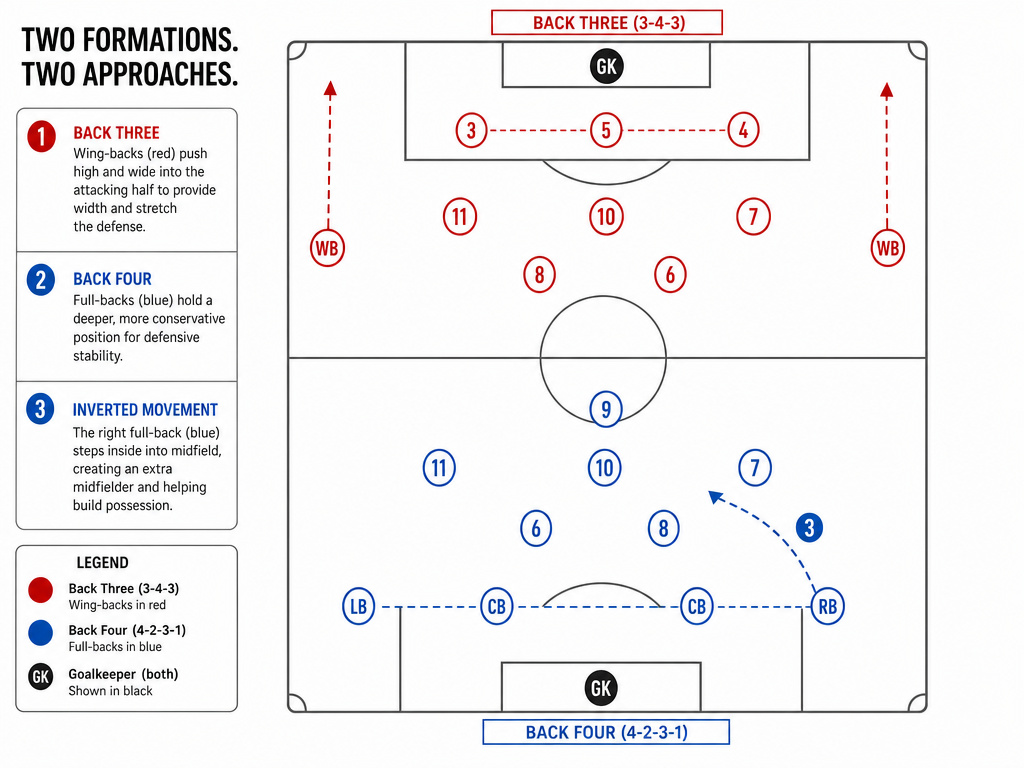
The wing-back is a pragmatic solution to a tactical problem, not a modern invention. Historically, when managers wanted to match an opponent’s midfield without sacrificing defenders, they pushed wide defenders higher. The 1960s Italian catenaccio systems used attacking full-backs like Giacinto Facchetti in ways that previewed the role.
Today, the role has crystallized because of data and physical science. We now know the exact metabolic cost of the job. Coaches can no longer ask a player to “just get up and down.” They must train for it specifically.
The data also reveals subtle evolutions. A 2022 PLOS One study found that in 4-3-3 and 4-2-3-1 formations, all positions except forwards displayed fewer short passes, middle passes and ball-possessions compared to all other formations. This suggests the wing-back’s role in a back four is inherently more conservative and less involved in combination play than in a back three. It’s a different job.
Modern hybrids blur the lines further. The inverted full-back role asks a player to drift inside into midfield, a movement opposite to the wing-back’s wide mission. These roles coexist in top football, demanding players with ever-more specific skill sets.
What does this mean for a player today? Specialization. The era of the generic “defender” is over. A youth player showing the engine and the final ball for the wing-back role should be trained in the specifics of when to stay wide and when to attack the box. Their fitness work must mirror the PMC physical match demands of transitional play, where they are most exposed.
What is a wing back in American football?
In American football, the term ‘wing back’ traditionally refers to an offensive backfield position. This player lines up in the backfield, often just outside or behind a tight end, and is a hybrid of a running back and a receiver. The role is built on versatility, requiring the player to be a direct threat in the running game, a capable pass-catcher out of the backfield or on shorter routes, and a willing blocker in support of other ball carriers. This multi-purpose duty makes the wing back a valuable piece for creating mismatches and offensive unpredictability, forcing the defense to account for multiple potential actions from a single alignment.
Modern wing back formations and examples
In modern soccer, the wing-back is a product of specific formations. Systems with three central defenders, like the 3-4-3 or 3-5-2, create the lane for the role. A 2022 PLOS One study showed that center backs and full backs covered the highest sprinting distances when playing in a formation with only three defenders in the back row (3-4-3, 3-5-2) compared to all other formations. The wing-back becomes the team’s primary wide attacker, making more dangerous runs like overlaps and arrivals for crosses compared to a traditional full-back. Data indicates full-backs already cover over 10,000 meters per match and achieve their highest sprint peaks during games. Formations like the 1-5-4-1 have been shown to yield high win percentages, underlining the tactical value of committing players to these wide, high-energy roles.
Blocking, receiving, and running duties for a wing back
The American football wing back is defined by a triple-threat skill set. Their running duty involves carrying the ball on designed plays like sweeps or counters, using their alignment to quickly attack the edge of the defense. As a receiver, they run routes from the backfield, often serving as a safety valve for the quarterback on check-downs or creating mismatches against linebackers in pass coverage. The blocking duty is equally critical; they must be effective at sealing the edge on running plays for other backs or providing pass protection. This blend of responsibilities requires a unique combination of power, agility, and football intelligence to read and react to defensive schemes.
Frequently Asked Questions
What is the main difference between a wing-back and a full-back?
The system defines them. A full-back operates in a back four, typically with a winger ahead. A wing-back operates in a back three or five, providing the width. The wing-back’s starting position is higher, their attacking responsibility is greater, and their defensive duty is simpler (drop to form a back five).
Are wing-backs and wingers the same thing?
No. A winger is primarily an attacker, judged on goals and assists. A wing-back is a defender-first hybrid, judged on width creation, chance generation, and defensive recovery. A winger might avoid defensive work; a wing-back cannot.
What formations use wing-backs?
The most common are the 3-5-2 and 5-3-2, along with variants like 3-4-3 and 1-5-4-1. Any system with three central defenders and no dedicated wide forwards requires wing-backs to provide attacking width in football.
Is wing-back the most physically demanding position?
Data suggests it is among the most demanding. Full-backs/wing-backs cover the most total distance and engage in more long-duration high-intensity runs than any other position. The gap between match and training sprint demands is also largest for them.
Can a full-back become a wing-back?
Some can, but it’s not automatic. The physical and tactical demands are distinct. A full-back accustomed to shared defensive duties must adapt to being the sole wide attacker and develop the stamina for the increased running load. Many modern full-back variations exist, and wing-back is just one possible destination.
The Bottom Line
The wing-back role is a specific answer to a specific tactical question: how do we control the wide areas without compromising central defence? The answer comes with a receipt written in meters and heartbeats.
If you watch a game using a back three, don’t just watch the wing-back. Watch the space around them. Their success depends on the 60-meter channel they own, the midfield cover that allows them to attack it, and the physiological engine that lets them do it for 90 minutes, not just a cross. That’s what the game is really telling us.
The next time a manager switches to a 3-5-2, you’ll know the move is about unleashing a hybrid, not about adding a defender.
