
5-3-2 Formation Pros and Cons: The Defensive Shield
This post contains affiliate links. As an Amazon Associate, we earn from qualifying purchases.
A 5-3-2 formation offers supreme defensive solidity through a back five and a compact midfield, trading attacking width and sustained possession for a low block that is difficult to break down and a rapid counter-attacking threat.
This structure forces a specific type of game. It’s not just about having more bodies at the back. The distances between your lines shorten, the field squeezes for the other team, and the rhythm of the match shifts away from patient build-up. The real choice is informed by the 5-3-2 formation pros and cons, not a simple paper comparison between a 5-3-2 and a 4-4-2. It’s between committing to a shape that defends as a unit of eight and attacks as a unit of four, and accepting the consequences.
The rest of this guide looks at what that commitment means when you compare a 5-3-2 formation pros and cons, from the precise numbers that prove its compactness to the physical toll it takes. We’ll break down the player roles that make it work, the common pitfalls that break it, and the key tactical battles that decide whether it’s a cagey masterstroke or a passive surrender.
Key Takeaways
- Defending in a 5-3-2 formation reduces team dispersion by -0.69 m and midfield-forward distance by -0.81 m compared to a 4-4-2, making it exceptionally compact.
- The system’s primary weakness is its lack of natural width, making it vulnerable to teams that can attack down the flanks and stretch the back five.
- Success hinges on the athleticism of the wing-backs, who must provide attacking width while recovering defensively, a role that demands elite stamina.
- Opinions on its attacking potential are split: some sources label it exclusively defensive, while others praise its strong transitional threat.
- It is best deployed against technically superior opponents or to protect a lead, but it becomes a major liability if the team falls behind.
The Measurable Defensive Effect
The numbers settle the debate before it starts. A 2024 study involving 69 youth footballers across 72 trials used local positioning data to measure exactly what happens when a team defends in a 5-3-2 versus a 4-4-2. The differences are small but definitive.
Defending in a 5-3-2 reduced team dispersion by -0.69 m, midfield-forward distance by -0.81 m, and defence-forward distance by -1.29 m compared to a 4-4-2. For the attacking team, this meant their team width was reduced by -1.78 m.
These are measurements, not coaching clichés. A team in a 5-3-2 is literally closer together, both horizontally and vertically, than the same players would be in a 4-4-2. This compactness has a domino effect on the opponent. That same study noted attacking teams facing a 5-3-2 showed “less connectivity in the passing network” and found less need to pass back to their goalkeeper. The lanes are simply clogged.
I used to believe the digits in a formation told you how a team played, but a deeper understanding requires weighing the 5-3-2 formation pros and cons. Then I rewatched a match where a nominal 4-4-2 turned into a 4-2-4 in possession, and I realized shape changes with the ball. The 5-3-2 is different. Its value is most concrete when the other team has the ball, and these figures prove the point. You are choosing to shrink the available space.
The consequence is a specific visual and physical feel on the pitch. The defensive and midfield lines move in unison, like a well-tended garden bed where each plant has its space and the gaps between rows are meticulously weeded. An attacker trying to turn between the lines finds themselves surrounded almost instantly. The sound is a chorus of shuffled steps and short, sharp communication, not the long, sweeping passes of a team building from the back.
| Formation | Team Dispersion | Midfield-Forward Distance | Attacking Team Width |
|---|---|---|---|
| Defending 5-3-2 | Reduced by 0.69 m | Reduced by 0.81 m | Reduced by 1.78 m |
| Defending 4-4-2 | Baseline | Baseline | Baseline |
| Tactical Implication | Tighter unit, harder to penetrate | Compact central channels | Forces play into congested areas |
Player Roles and Positioning
A 5-3-2 is made up of five defenders, three midfielders, and two strikers. But those units only tell part of the story. The real mechanics live in the specific jobs within each band, and how they connect.
The Back Five: Three Centre-Backs and Two Wing-Backs
The defensive line isn’t a flat five. You have three centre-backs, typically with a more positionally astute player in the middle acting as a sweeper or organizer. The two outside centre-backs need the pace to cover the channels. Flanking them are the wing-backs, the most physically demanding role on the pitch. They are the engine. In a defensive phase, they drop into the back line, forming a flat five. When possession is won, they must sprint forward to provide the team’s only source of genuine width. Their fitness dictates the entire system’s balance.
The Midfield Three: A Defensive Screen
The three midfielders sit in front of the back five. Usually, one plays as a dedicated defensive midfielder, shielding the centre-backs, while the other two operate as box-to-box players. Their primary job out of possession is to screen the central space, making it impenetrable. They don’t need to be flashy playmakers, but they must be disciplined, positionally intelligent, and relentless in their short, sharp shifts to cover space. When the team wins the ball, at least one of these midfielders must break forward immediately to support the counter-attack.
The Front Two: Isolated but Potent
The two strikers operate in near isolation for long stretches. Their main defensive duty is to form a “screen,” positioning themselves to block passing lanes into the opponent’s midfield without necessarily pressing intensely. This is a crucial distinction. When the ball is won, they become the focal point of the counter-attack, making runs in behind and looking to combine quickly. One often drops slightly to link play, while the other stays on the shoulder of the last defender.
The wing-backs are the engine of the system. Their ability to constantly shift between attacking width and defensive recovery determines the team’s structural balance.
Strengths and Advantages
The strengths of the 5-3-2 are direct results of its structure. They aren’t vague concepts; they are observable, measurable outcomes.
Defensive Solidity and Compactness
This is the formation’s raison d’être. With eight outfield players forming two tight banks of five and three behind the ball, the central axis of the pitch is shut down. The data we saw earlier quantifies this. It becomes a nightmare for teams who rely on playing through the middle or overloading the penalty area. It’s particularly effective against teams that rely heavily on crossing or box overloads, as the back five can match numbers comfortably.
Counter-Attacking Threat
A solid defensive structure is pointless if you can’t score. The 5-3-2 couples its deep block with a constant presence of two strikers high up the pitch. The moment possession is turned over, the team has a ready-made outlet for fast, vertical attacks. The wing-backs and at least one midfielder join the surge, often creating a 4-v-4 or 5-v-4 situation against a stretched defence. This isn’t a hopeful punt; it’s a drilled transition, the primary scoring mechanism for teams using this shape.
Flexibility and Game Management
The 5-3-2 and the 3-5-2 formation are two sides of the same coin, using the same players. In a 5-3-2, the wing-backs are in the defensive line; in a 3-5-2, they push high into midfield. Well-coached teams switch between these shapes as the game requires. This flexibility makes it excellent for managing a result. You can drop into a deep 5-3-2 low block to protect a lead, or push the wing-backs on to chase a game without a wholesale tactical change.
Weaknesses and Drawbacks
For every strength, there is a trade-off. The 5-3-2’s weaknesses are just as pronounced and can be catastrophic if not managed.
Lack of Attacking Width
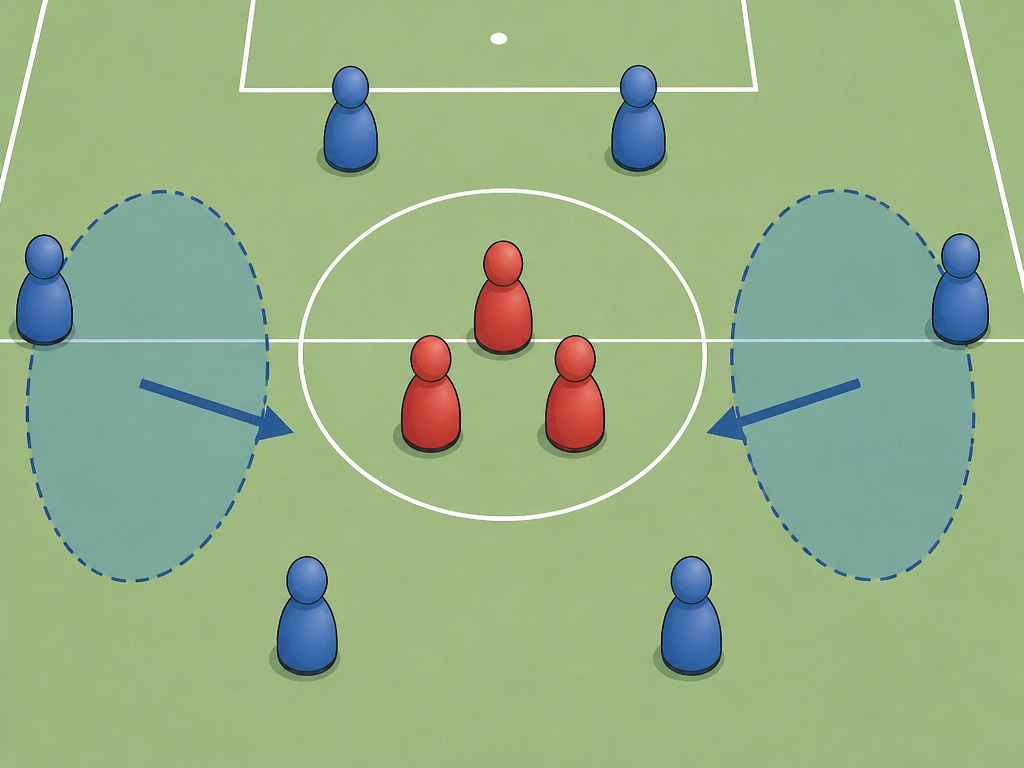
This is the system’s most famous flaw. With only the wing-backs providing width, the attack can become painfully narrow and predictable. If the opposition nullifies the wing-backs—either by pinning them deep or by doubling up on them with their own winger and full-back—the entire attacking plan can grind to a halt. The midfield trio is usually central, leaving huge swathes of space on the flanks for the opposition to exploit.
Physical and Mental Demands
The system is a marathon for specific players. The wing-backs must have elite stamina to constantly sprint up and down the touchline. The midfield three must work to maintain compactness. Over 90 minutes, this leads to fatigue. Gaps appear, players arrive half a second late, and the once-impenetrable block springs leaks. This is why opponents are often advised to be patient and “come on strong late in the game” against a 5-3-2.
Vulnerability When Behind
The 5-3-2 is built to protect. It is not built to chase. If a team using it concedes a goal, they face a monumental problem. Committing more players forward to search for an equalizer inherently breaks the compact defensive shell, leaving them exposed to the very counter-attacks they usually rely on. The formation can feel like a cage, brilliant for keeping a result but suffocating when you need to change it.
Where this goes sideways: Letting the midfield bank sit too deep. This invites constant pressure onto the back five and turns the “second ball” after a clearance into a prime scoring chance for the opposition. The gap between midfield and attack becomes a chasm.
How to Attack and Defend in a 5-3-2
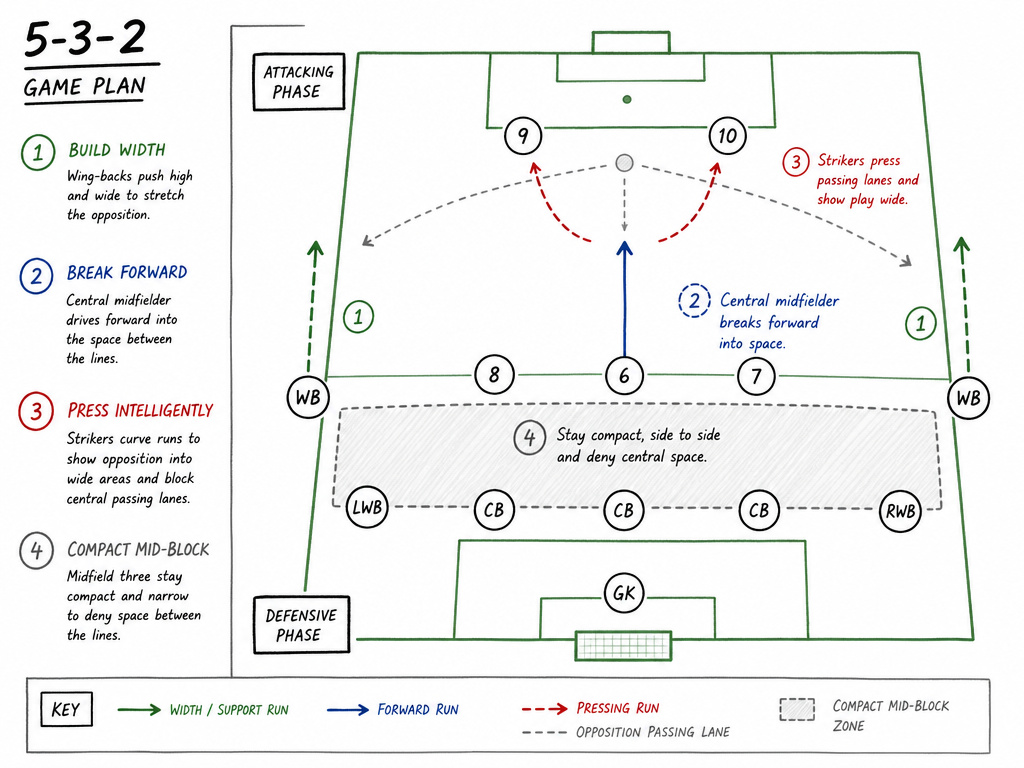
Implementing this formation isn’t just drawing lines on a whiteboard. It requires specific instructions that address its inherent tensions.
Attacking Principles
- Commit Numbers Forward: The two strikers are not enough. At least one midfielder must break forward to support attacks, and the wing-backs must provide the width.
- Play Quickly in Transition: The golden moment is the immediate period after winning the ball. Drill fast, direct passes into the channels for the strikers and overlapping wing-backs.
- Use the Wing-Backs as Outlets: When central play is congested, the ball must be switched quickly to the wing-backs in advanced positions to stretch the play.
Defensive Principles
- Employ an Aggressive Mid-Block: Don’t just drop to the edge of your box. Defend from the middle third, with the midfield three pressing aggressively to force turnovers in dangerous areas.
- Maintain Compactness: The distance between the back five and the midfield three must stay tight. This principle is essential.
- Press from the Front (Selectively): The two strikers should work together to screen passing lanes into the opponent’s midfield, forcing play wide where the 5-3-2 is designed to deal with it.
The 5-3-2 vs. Other Formations
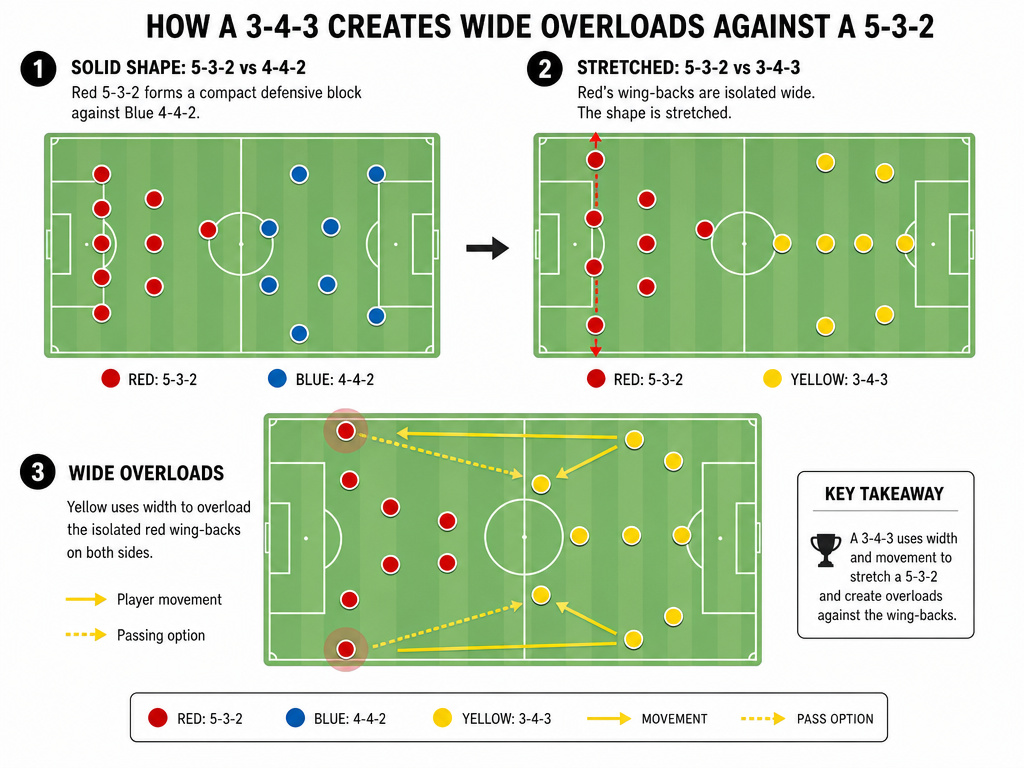
Its effectiveness often depends on the shape it faces. A direct comparison shows where it thrives and where it struggles.
Vs. A 4-4-2 or 4-2-3-1 Formation
The 5-3-2 often dominates these battles. The back five provides numerical cover against opposing strikers, while the three midfielders work to control central areas. It forces these systems, which like to play through central zones, out to the flanks.
Vs. A 3-4-3 Formation or Any System with Width
This is its kryptonite. A formation like a 3-4-3 with genuine wingers and wing-backs can create 2-v-1 overloads against the 5-3-2’s wing-backs. This stretches the back five horizontally, creating space that can be exploited. It’s the ultimate test of the wing-backs’ defensive discipline and stamina.
| Opponent Formation | 5-3-2’s Advantage | 5-3-2’s Vulnerability |
|---|---|---|
| 4-4-2 / 4-2-3-1 | Central overload in defence; forces play wide. | Can be outnumbered in wide areas if wing-backs are pinned. |
| 3-4-3 / 4-3-3 | Solid central cover for crosses into the box. | Severe risk of overloads on the flanks; wing-backs can be isolated. |
| 3-5-2 System | Can match shape directly; becomes a battle of execution. | Lacks the natural width to stretch the opponent’s back three. |
Common Mistakes and How to Avoid Them
Mistake 1: Treating it as a Permanent Low Block
Sitting on the edge of your own box for 90 minutes is a recipe for a 1-0 defeat. The low block should be a phase, not the default. Use an aggressive mid-block to engage the opponent higher up and create turnovers in more dangerous areas.
Mistake 2: Isolating the Strikers
If the midfield trio is too deep or lacks the quality to play forward passes, the two strikers become spectators. One midfielder must have the passing range and vision to find them quickly. Otherwise, the team surrenders possession aimlessly.
Mistake 3: Neglecting Set-Piece Training
With fewer open-play chances, set pieces become a primary scoring avenue. Failing to dedicate serious training time to corners and free-kicks wastes one of the formation’s key offensive weapons.
Mistake 4: Using the Wrong Wing-Back Profile
Putting a natural, attack-minded winger in the wing-back role might give you width, but it will leave your centre-backs exposed. Conversely, a traditional defensive full-back won’t provide the necessary attacking thrust. You need the rare hybrid.
Is the 5-3-2 Right for Your Team?
The answer depends on your players and your goals. It’s a specialist tool, not a universal system.
Ideal Scenarios:
- You are facing a technically superior opponent and need a structured, disciplined shape to frustrate them.
- You have a lead to protect in the latter stages of a match.
- Your squad is blessed with three quality centre-backs and at least two incredibly fit, two-way wing-backs.
- You have two strikers who can play together effectively, with one capable of holding up the ball.
Poor Scenarios:
- You are expected to dominate possession and break down deep-lying opponents.
- Your wing-backs lack the engine for the role.
- You are coaching a youth team where development of individual skills should take precedence over a rigid, result-oriented structure.
- You are a goal down and need to take the initiative.
For most amateur sides, the physical demands are the biggest barrier. It looks organized on the board, but it falls apart in the 75th minute when your wing-back can’t sprint back. Choose it knowing the commitment it requires from specific individuals.
Is the 5-3-2 midfield vulnerable to overloads?
The central midfield trio is the system’s primary tactical risk. With only three players in the center, they can be easily outnumbered by opponents using a four or five-man midfield. This numerical disadvantage makes it crucial to avoid sitting too deep, as it invites pressure and danger from second balls. To beat a 5-3-2, opponents are advised to disrupt play by congesting the midfield. The defensive compactness data shows reduced distances between units, but if the midfield three are bypassed or overwhelmed, the back five can become isolated and stretched.
Frequently Asked Questions
Is the 5-3-2 formation defensive or can it attack?
Sources disagree fundamentally. Some, like Tactico, call it “football’s most explicitly defensive formation” that “surrenders possession.” Others, like Soccer Coach Lab, describe it as a “balanced formation that combines defensive solidity with strong transitional attacking potential.” The truth lies in execution. Its primary mode is defensive, but its attacking output is entirely dependent on the quality of its transitions and the athleticism of its wing-backs.
What’s the difference between a 5-3-2 and a 3-5-2?
They use the same players but represent different phases. The 5-3-2 is the defensive shape, with the wing-backs in the back line. The 3-5-2 is the attacking shape, with the wing-backs pushed high into midfield. Most teams that use one will transition into the other throughout the game. The 5-3-2 is generally more conservative.
How do you beat a 5-3-2 formation?
You attack the wings. Use a formation with true wingers and overlapping full-backs to create 2-v-1 overloads against the isolated wing-backs. Patient possession to draw the block out slightly, followed by quick switches of play, can also exploit the space behind them as they recover. Finally, maintain intensity late in the game to exploit the inevitable fatigue.
Why is the 5-3-2 not common in modern football?
The modern game’s emphasis on possession and high pressing works against the 5-3-2’s core strengths. It is seen as reactive. However, it still has niche use as a tactical surprise or a specific game-management tool, as seen in the 2002 World Cup final with Brazil.
Is the 5-3-2 good for youth football?
Generally, no. At youth levels, the priority should be maximizing touches on the ball and developing individual skills in various positions. The 5-3-2 is a results-oriented, system-first shape that can limit players’ experiential learning and over-emphasize defensive structure over creative development.
The Bottom Line
The 5-3-2 is a statement, not a neutral shape. You are choosing to build a fortress and wait for the right moment to strike. The data proves its compactness, and history shows it can win the biggest games.
But that fortress has a blueprint. You need the right personnel—specifically, those engine-room wing-backs and three composed centre-backs—and you must drill the principles until the compactness is automatic. Get it right, and you have a defensive structure that can nullify any opponent. Get it wrong, and you have a passive, narrow team waiting to be picked apart.
The best tactical choices are honest about their own limits. The 5-3-2 knows its limits better than any other formation. Use it with that clarity, or don’t use it at all.
