
Inverted Full Back Role in Football: How It Works
This post contains affiliate links. As an Amazon Associate, we earn from qualifying purchases.
An inverted full back is a defender who moves into central midfield areas when their team has the ball, aiming to create numerical superiority and improve ball progression, before quickly recovering to a wide defensive position when possession is lost.
To do this, they need a specific skill set that’s far removed from the traditional, touchline-hugging defender of old. The difference isn’t just positioning; it’s a complete change in how a team builds its attack and structures its defense against counters, often built around an inverted full back role in football.
What follows is a breakdown of the mechanism, the hard data showing its rise, the specific defensive trade-offs, and how top coaches from Guardiola to Postecoglou are putting their own spin on the role.
Key Takeaways
- The core tactical aim is creating a midfield overload, giving the team more passing options and control in the center.
- Inverted full-backs receive the ball significantly more in central channels. FIFA data shows an average of 3.8 more times per 30 minutes in possession compared to FIFA World Cup Qatar 2022™.
- The defensive transition is the biggest risk; players must have the game awareness and pace to recover their wide position or the team gets exposed.
- Not every player fits the role; it requires excellent ball control, distribution, and tactical intelligence over pure defensive grit.
- Systems vary wildly, from inverting just one full-back (like Klopp with Alexander-Arnold) to inverting both (like Guardiola’s Manchester City), each creating a different rest-defense shape.
How Does an Inverted Full Back Actually Work?
Forget the idea that it’s just a right-footer playing left-back; that’s a different topic from the inverted full back role in football. An inverted full back starts in a standard back-four defensive line. When their team wins possession, they don’t sprint up the flank. Instead, they step inside, often flanking the defensive midfielder.
Inverted full-backs, as defined by FIFA’s technical analysis, are defenders who position themselves “narrower and higher” than the tournament average when their team is in possession, specifically to “create overloads in the inner and central channels” and disrupt opposition defensive structures.
This movement changes the formation. A 4-3-3 in defense can instantly become a 2-3-2-3 or a 3-2-2-3 in attack. You’re trading width for central density. The wide attacker ahead of them, your winger, now becomes the sole source of width on that side.
Why bother? It solves a pressing problem. If an opponent is man-marking your midfield, a drifting full-back becomes a free player. They also offer a safer, central passing lane out from the back, which is crucial against a high press. Once they receive, their job is to play forward, often distributing to that isolated winger or breaking lines with a pass to an advanced midfielder.
The magic, and the difficulty, of the inverted full back role in football happens the moment the ball is lost.
The Critical Defensive Decision
Possession turns over. Now what? This is the moment that defines an inverted full-back from a liability.
The player has two stark choices, and they have to pick one in a split second. Do they stay central to try and snuff out the counter-attack at its source? Or do they immediately sprint back to their orthodox wide defensive channel? Get it wrong, and the opposition has an acre of space to attack.
Where this goes sideways: A full-back who inverts but lacks the recovery pace or awareness to get back. The team is left with a back three, but the wing is utterly vacant, inviting a quick switch of play and a dangerous cross.
This is why agility and pace are essential for the role. You’re asking a defender to be a midfielder for 30 seconds and then a sprinter for the next five. Kyle Walker’s physical gifts made him ideal for this at Manchester City. Not many players have that engine.
The rest-defense structure, how the team sets up defensively while still in an attacking shape, is also decided by the full-back’s choice. Sources disagree on the exact shape. FourFourTwo describes a 3-2-2-3, 360player/Tactical Breakdown describes a 2-3-2-3 or 2-3-5, and the FIFA Training Centre analysis of Chelsea showed both a 3+2 and a 2+3 rest-defense structure. The FIFA Training Centre’s analysis of Chelsea in 2025 showed both a 3+2 and a 2+3 rest-defense, depending on which midfielder was covering.
The common thread is that the defensive solidity is built on rapid reorganization. The inverted full-back is the trigger for that reorganization.
The Data-Driven Rise of the Role
This isn’t just a theoretical trend cooked up by tactics bloggers. The move towards inversion is being quantified at the highest level.
FIFA’s technical team, analyzing the 2025 Club World Cup, found a “notable shift.” Compared to the 2022 World Cup, inverted full-backs had a 23.1% higher proportion of receptions in inside and central channels. They weren’t just there for decoration; they were actively used. On average, they received the ball 3.8 more times per 30 minutes in possession.
| Metric | Increase vs. FIFA World Cup 2022 | What It Means | |————|————————————–|——————-| | Proportion of receptions in inside/central channels | 23.1% higher | They’re targeted there more often relative to other areas. | | Offers to receive in inside/central channels | 7.7% increase | They’re making more runs into these zones. | | Proportion of offers followed by a reception in these zones | 9.9% increase | Their movement is more effective at losing markers. | | Receptions in inside/central channels | 7.9% rise | They received the ball more often in these zones overall. |
These numbers tell a clear story: teams are deliberately designing plays to get the ball to their full-backs in the heart of the pitch. Both finalists, Chelsea and Paris Saint-Germain, utilised inverted full-backs consistently throughout the tournament.
A reader who’d only followed football for a season once sent me a sharp breakdown of how a back three shifts.
System Variations: One Inverted or Both?
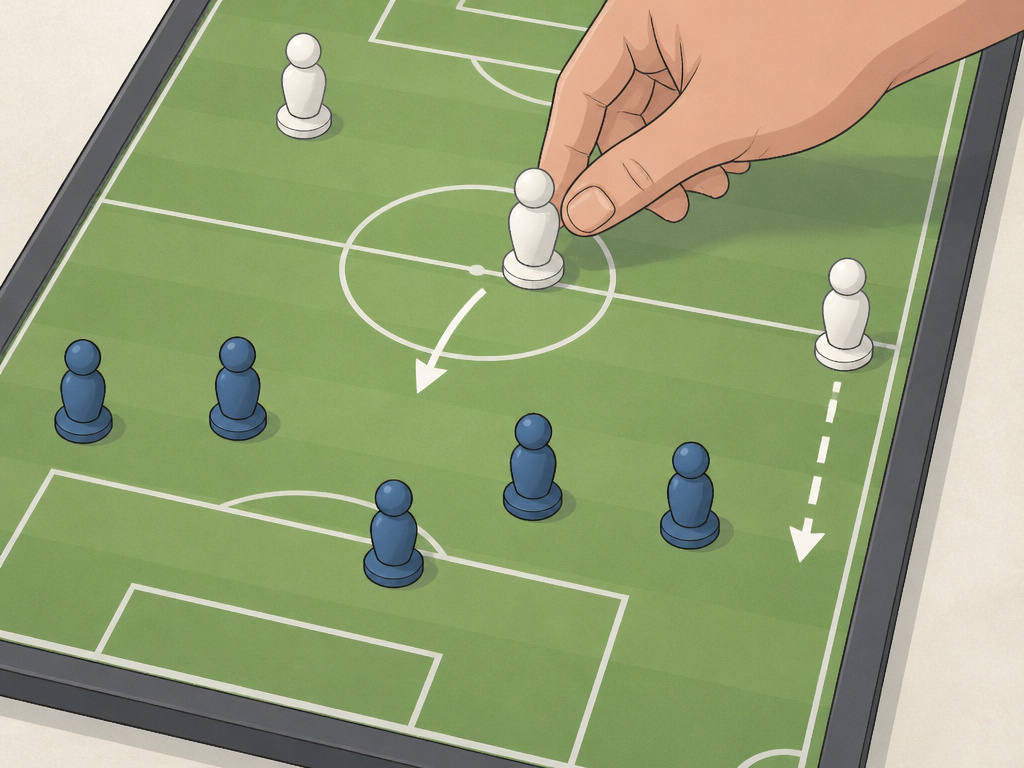
Not all inversions are created equal. Coaches use the tool differently based on their personnel and philosophy. The main split is between single and double inversion.
Single Inversion (One Full-Back)
This is the classic model popularized by Jürgen Klopp at Liverpool. Trent Alexander-Arnold on the right inverts into midfield, where his passing range can be maximized. Andy Robertson on the left stays wider to provide balance. To cover, the right-sided centre-back (often Ibrahima Konaté) pulls wider. It’s a fixed, asymmetrical system. Ange Postecoglou at Tottenham also deployed this with Destiny Udogie, giving the left-back “almost carte blanche to charge forward,” as one analysis put it.
Double Inversion (Both Full-Backs)
This is Pep Guardiola’s territory, aiming for total central control. Both full-backs come inside, flanking the defensive midfielder. This creates a solid three-man pivot for build-up and a very compact midfield block. The trade-off is a complete absence of natural width from the defenders, placing the entire creative burden on the wingers and attacking midfielders.
| System | Primary Architect | Key Feature | Major Risk |
|---|---|---|---|
| Single Inversion | Jürgen Klopp | Asymmetry; one creative hub, one wide outlet. | Overload on the side of the inverting full-back if cover is slow. |
| Double Inversion | Pep Guardiola | Symmetrical central overload and control. | Lack of width can make attacks predictable. |
| Hybrid / Swapping | Chelsea (2025) | Full-back and midfielder swap roles dynamically. | Requires extremely high tactical understanding between players. |
Chelsea (2025) in the FIFA data showed a fascinating hybrid. In one match, left-back Marc Cucurella inverted high as an extra attacking midfielder, while central midfielder Enzo Fernández covered the left-back slot defensively. In another, both full-backs inverted alongside Moses Caicedo, creating a different rest-defense shape. This fluid, player-specific approach is high-risk, requiring players with a high tactical understanding.
Required Skills: Who Can Actually Play This Role?
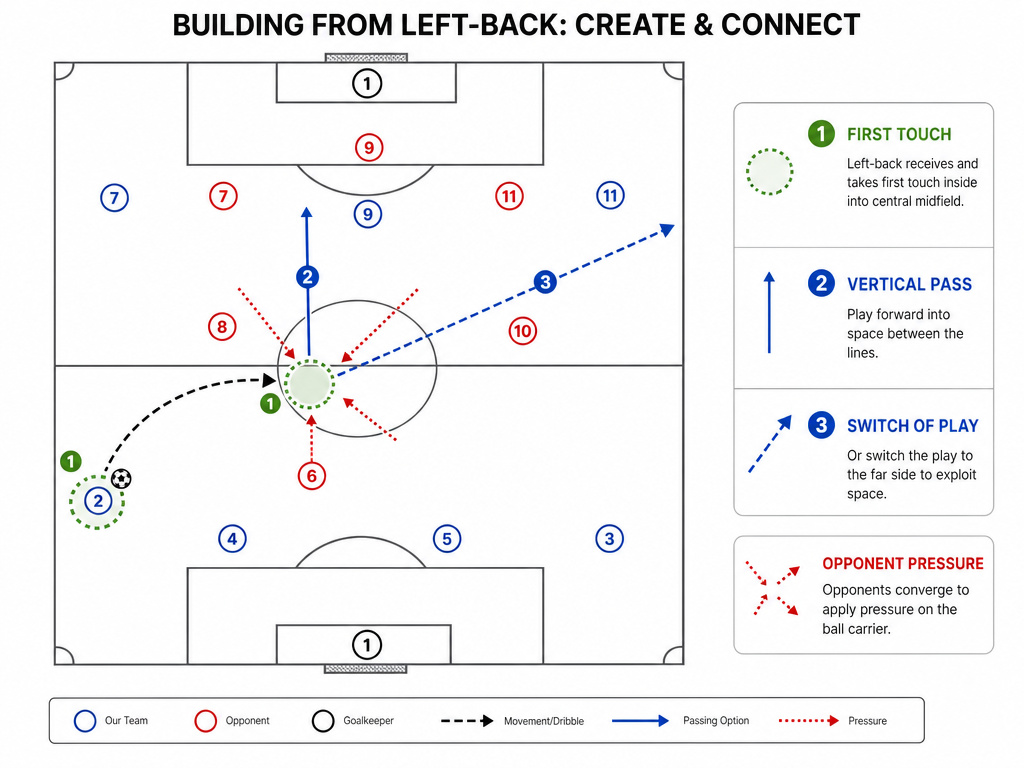
You can’t just take any competent defender and tell them to invert. The job description is unique.
Technical Skills: First and foremost, excellent ball control and distribution. You’re receiving in tight central spaces under pressure. Your first touch must be immaculate, and your passing range needs to include line-breaking vertical passes and switches of play. Philipp Lahm and David Alaba at Bayern Munich were prototypes, defenders with midfielders’ technique.
Physical & Mental Attributes: High game awareness is the cornerstone. You must understand when to go, when to stay, and read the opponent’s press to find space. Great pace is a huge asset for the recovery run, though exceptional positioning can compensate somewhat.
It’s a role that blurs lines, sitting somewhere between a traditional full-back role and a central midfielder. This is why debates about players like Trent Alexander-Arnold “needing to move to midfield” are somewhat missing the point. He already plays there for large portions of the game; the inversion is his midfield role.
Common Misconceptions and Trade-Offs
For all its benefits, the inverted full-back isn’t a magic bullet. Analysis from Analytics FC regarding the 2023 season noted a “generally negative” feeling around the tactic, arguing it could “stifle fluidity.”
Trade-Off 1: Isolating the Winger. By moving inside, the full-back is no longer overlapping or providing close support. This leaves the winger ahead of them in a constant 1v1 battle. If the winger isn’t dominant in those duels, the attack stagnates. The tactical effect can be to isolate the winger in a 1v1 situation.
Trade-2 2: Vulnerability on the Flank. We’ve covered the recovery, but it’s worth reiterating. A quick counter-attack or a smart switch of play to the opposite wing can exploit the space left behind.
Trade-Off 3: It Requires a Specific Player. You cannot force this system. Not every team has the “ruthless, fluid efficiency” of Pep Guardiola’s 2021/22 Manchester City, where players rotated “with the efficiency of a revolving door,” as noted by Analytics FC. Without the right personnel, the inversion just congests the center without the payoff.
Furthermore, it changes the team’s passing distribution. FIFA data shows inverted full-backs had a higher proportion of distributions to wingers, whereas traditional full-backs distributed more to midfielders. Their central positioning seems to be about receiving the ball, not necessarily about being the primary midfield link-up.
How does the inverted full back affect rest defence?
The inverted full back’s positioning is a direct tool for strengthening a team’s rest defence. By moving into central midfield during possession, they create a structural overload that persists when the ball is lost. The FIFA Training Centre analysis noted that Chelsea (2025) at times used both inverted full-backs alongside defensive midfielder Moses Caicedo, creating a 2+3 rest-defense. This central congestion makes it easier to initiate an immediate, man-oriented press to win the ball back high. The system relies on the player’s agility to recover their wide defensive position quickly if the counter-attack bypasses the initial press, ensuring the back line isn’t exposed.
Frequently Asked Questions
Who invented the inverted full back?
While Pep Guardiola popularized it in the modern era, credit for its first elite use generally goes to Johan Cruyff during his time at Barcelona. In his 4-3-3, he instructed one full-back to move centrally into midfield when the ball was on the opposite flank, freeing a midfielder to push forward.
What’s the difference between an inverted full back and a wing-back?
wing-back is primarily an attacking wide player in a back-three or back-five system, with less defensive responsibility. An inverted full-back starts in a back-four, defends in a back-four, and moves centrally in possession. The wing-back’s focus is width; the inverted full-back’s focus is central density.
How is an inverted full back different from an inverted winger?
An inverted winger is a forward who plays on the opposite side of their strong foot (a right-footer on the left wing) to cut inside and shoot. An inverted full-back is a defender who moves into midfield to pass and create. Their starting positions and primary objectives are completely different.
Do both full-backs have to invert?
No. Systems like Klopp’s Liverpool invert only one (Alexander-Arnold), while the other (Robertson) provides width. Guardiola’s Manchester City often inverts both. The choice depends on the coach’s desire for symmetry and the players available.
What formations work best with inverted full-backs?
The 4-3-3 is the most common base, as it smoothly shifts into shapes like the 2-3-2-3. It can also work from a 4-2-3-1, though the presence of a number 10 can clutter the very space the full-back wants to occupy. It’s less effective against a back three, as the central channels are already congested.
Before You Go
The inverted full-back is less a fixed position and more a solution to a specific problem: how to beat the modern high press and gain control of the midfield. Its effectiveness hinges on one volatile moment, the transition after losing the ball.
Implementations like Chelsea’s 2025 variations involved fluid exchanges between positions.
For any team trying it, the question isn’t “should we invert?” It’s “do we have the player who can make the critical defensive decision, and the recovery pace to survive when they get it wrong?” Everything else, the passing networks, the overloads in midfield, the pretty shapes, flows from that.
