
Creatine for Football Players Pros and Cons: How to Choose
This post contains affiliate links. As an Amazon Associate, we earn from qualifying purchases.
Creatine for football players offers a significant boost to high-intensity power and sprint recovery but comes with side effects like water weight gain and potential cramping if hydration is neglected. The core benefit is an improved ability to repeat match-winning sprints and jumps, supported by research showing a large effect on tests like the Wingate Anaerobic Test. The main debate is whether a 20-30g loading phase is necessary or if a consistent 2-3g daily dose is better for footballers.
That loading debate is where most guides get fuzzy. Some studies insist on a week of loading to saturate muscles quickly, while newer football-specific research suggests that slower, steady intake works just as well without the initial water-weight spike. The real answer for a player isn’t in picking one side, it’s in understanding which protocol fits their pre-season schedule versus their in-season maintenance, which is a key part of evaluating creatine for football players pros and cons.
What follows is a breakdown of the evidence, the disagreements, and the practical steps. We’ll look at how creatine actually works in a footballer’s legs, compare the two main dosing strategies, and outline a simple hydration plan to sidestep the most common side effects when you compare a creatine for football players pros and cons. You’ll finish with a clear protocol for your next training block.
Key Takeaways
- Creatine monohydrate supplementation shows a large, significant effect on tests like the Wingate Anaerobic Test (Standardized Mean Difference 2.26), directly supporting repeated high-intensity actions in football.
- The primary side effect is rapid water retention, which can be managed by increasing daily fluid intake and pairing creatine with a carbohydrate source.
- Footballers face a choice between a standard loading phase (20-30g/day for 6-7 days, then 5g/day) and a low-dose approach (0.03g/kg/day, or ~2-3g daily); evidence is split on which is better for trained players.
- Combining creatine with whey protein may offer synergistic benefits for recovery, with one study on semi-professional players showing a significant reduction in muscle damage markers (P=0.035 for CK reduction).
- Long-term safety in football is supported by studies like a 32-week in-season trial with 71 female players showing no adverse biochemical effects, but individuals with pre-existing kidney conditions should consult a doctor first.
The Core Benefits: Power, Recovery, and Injury Risk
Forget the bodybuilder image. For a footballer, creatine’s value is in the 80th-minute sprint to close down a winger or the third powerful jump in a row to win a header. The fuel for those explosive actions is phosphocreatine, a molecule stored in your muscles. When you launch into a sprint, your body burns through its phosphocreatine stores in under 10 seconds. Supplementing increases those stores.
The research backs this up concretely. A systematic review of nine studies found creatine demonstrated a large, significant effect on Wingate Anaerobic Test (WAnT) performance, with a Standardized Mean Difference of 2.26. That’s not a marginal gain, it’s a substantial shift in a test that mirrors the repeated sprint demands of a match.
Creatine supplementation increases intramuscular phosphocreatine stores, providing a readily available phosphate donor to rapidly resynthesize adenosine triphosphate (ATP) during repeated bouts of high-intensity exercise. This biochemical mechanism underpins observed improvements in power output and recovery between sprints.
The benefits extend beyond a single burst. For semi-professional players, the combination of creatine monohydrate and whey protein showed a synergistic effect. The group taking both saw a statistically significant reduction in creatine kinase (CK) levels, a key marker of muscle damage, compared to those taking either supplement alone or a placebo. Less muscle damage means you can train harder more frequently and feel fresher for the weekend’s match.
There’s also a potential protective effect. One NCBI study on cramping reduction involving collegiate football players found that creatine supplementation was associated with reduced cramping and injury incidence. The theory is that better-hydrated muscle cells (a side effect of creatine storage) are more resilient to the strains and heat stress of a full match.
Where this goes sideways: Assuming more is better. Once your muscles are saturated with creatine, which any protocol achieves, taking extra does nothing but pass through your system. The performance window is in maintaining saturation, not in mega-dosing.
The Loading vs. Low-Dose Debate for Footballers
Here’s the first major fork in the road. You’ll find two conflicting protocols, each with studies to back them up. Your choice changes your first two weeks on the supplement.
The traditional method is a loading phase. This protocol, outlined in the MDPI systematic review, calls for 20–30 g per day, split into 3–4 doses, for 6 to 7 days, followed by a maintenance dose of 5 g/day. However, other sources disagree on the necessity of loading phases for soccer players, advising a continuous low-dose intake instead.
The alternative is the low-dose, long-term approach. Research in the Journal of the International Society of Sports Nutrition and elsewhere suggests a dose of 0.03 g/kg/day. For a 75 kg player, a low-dose protocol would be approximately 2.25 grams daily (0.03 g/kg/day). A study on 19 elite youth soccer players used this exact dose for 14 days and still found it “beneficially affected muscle power output.” Another source suggests this dose can be sustained for up to 115 days.
So, which should a footballer follow? The evidence isn’t unanimous, and your decision should hinge on timing and tolerance, which is central to the creatine for football players pros and cons.
| Protocol | Daily Dose (for 75kg player) | Duration | Best For | Key Drawback |
|---|---|---|---|---|
| Loading + Maintenance | 20-30g (loading), then 5g (maintenance) | 6-7 days loading, then ongoing | Players in pre-season wanting rapid saturation for early training gains | Higher likelihood of initial water retention, GI discomfort if doses aren’t split |
| Low-Dose Continuous | ~2-3g (0.03g/kg) | 14+ days, can continue indefinitely | In-season players seeking steady benefits without weight fluctuation | Takes 3-4 weeks to reach full saturation, delaying full ergogenic effect |
A crucial counterpoint comes from a low-dose versus loading study on Division IA collegiate football players. It concluded that “creatine monohydrate in any amount does not have any beneficial ergogenic effects in highly trained collegiate football players” over a 10-week periodized program. This is the core of the disagreement: does elite training alone max out performance, leaving no room for creatine to help?
My take: For most academy and semi-pro players, the low-dose approach is smarter. It avoids the bloated feeling that can disrupt touch and coordination during the loading phase. You trade a slightly slower start for a smoother integration into your existing football nutrition and hydration routine.
Potential Side Effects and How to Mitigate Them
Creatine isn’t magic dust. It pulls water into your muscle cells, and your body has to adjust. The side effects are manageable but unavoidable if you ignore the basics.
The most immediate and universal effect is water weight gain. You can expect water weight gain on the scale within the first week of a loading phase, less with a low-dose start. This isn’t fat, it’s water stored with creatine in the muscles. It can make you feel heavier and slightly sluggish for a week. The fix is proactive hydration. Increase your daily water intake by at least 500ml, and don’t rely on thirst alone. If your pee isn’t a pale straw colour, you’re behind.
Common mistake: Not increasing fluid intake with creatine. The supplement increases intramuscular water draw, which can slightly reduce plasma volume if you don’t drink more. This elevates cramping risk, especially in hot conditions or during a long match.
Some people report gastrointestinal discomfort, bloating, gas, or stomach cramps. This is almost exclusively tied to taking large doses (like a full 5g scoop) on an empty stomach. The simple solution is to split your daily dose and take it with meals or a carbohydrate-rich snack. A banana or a slice of toast works.
Then there’s the perennial kidney concern. The ISSN creatine position stand, which summarizes over 1,000 studies, finds no evidence that creatine supplementation damages healthy kidneys. A specific 32-week in-season study on 71 female football players found no adverse changes in kidney function markers. However, this is a YMYL (Your Money or Your Life) topic. If you have a pre-existing kidney condition, you must consult a doctor before considering any supplement, creatine included.
The mental side is often overlooked. Some players don’t like the initial weight gain, feeling it impacts their agility. Others worry it’s a “shortcut.” That’s why integrating it with your overall player diet plan is key. It’s one tool, not the foundation.
A Footballer’s Practical Dosing and Cycling Guide
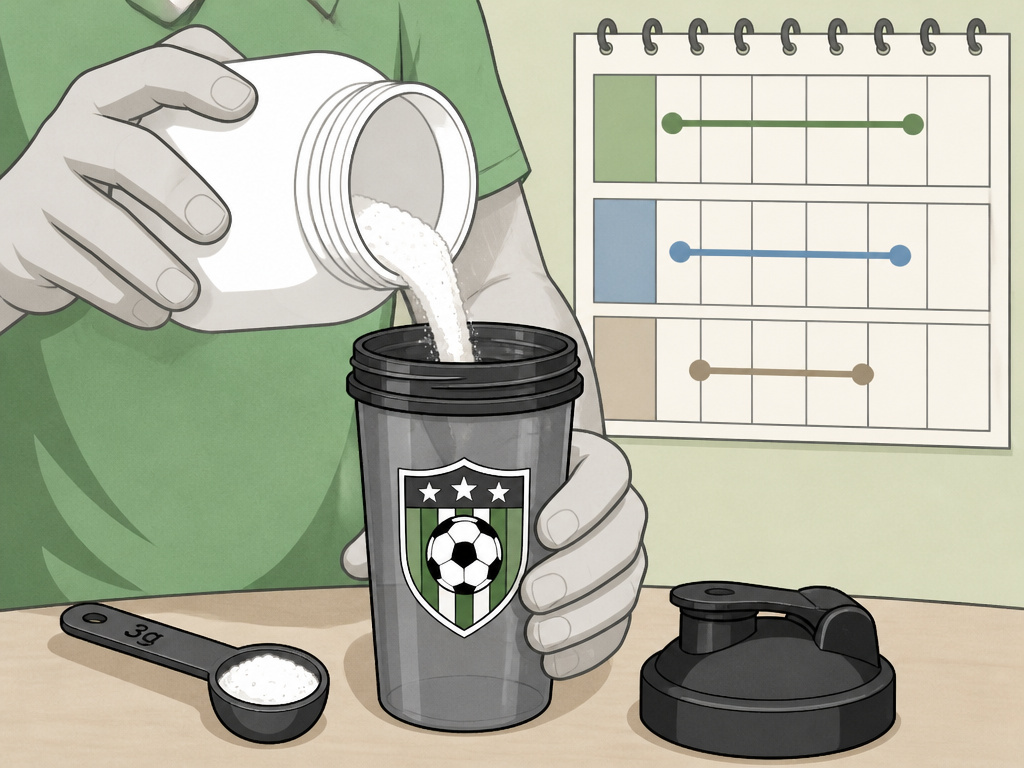
Theory is one thing. Getting it into your shin guards and water bottle is another. We can build a protocol from the ground up, position-aware and season-tied.
First, pick your creatine. Creatine monohydrate is the only form with decades of safety and efficacy data. Fancy blends with HCl or nitrate don’t offer proven advantages for football. A simple, third-party tested creatine monohydrate powder is all you need.
Now, match the protocol to your calendar:
- Pre-Season (6-8 weeks out): This is the time for the loading phase if you want to start saturated. Follow the 20-30g/day (split into 4 doses) for 6-7 days, then drop to 3-5g daily. The initial weight gain happens here, away from competitive matches.
- In-Season: Use the low-dose method. Take 3g (roughly one level teaspoon) every day, with your post-training shake or breakfast. Consistency is everything. Pair it with your post-match nutrition for better uptake.
- Off-Season (Active Rest): You can cycle off. There’s no physiological “addiction,” but benefits wane once muscle stores deplete, about 4-6 weeks after stopping. I recommend a 4-8 week break if you’ve been on it for a full season.
Should you cycle it? The science says no, long-term use is safe. But from a practical standpoint, taking a break during your off-season allows you to reassess your baseline performance and saves money. It also allows you to see how your body feels without it.
Position-Specific Nuance:
- Midfielders & Wing-Backs: You might benefit most. The research on repeated high-intensity actions and recovery aligns perfectly with the engine-room demands of covering ground and making late runs.
- Centre-Backs & Strikers: The power for jumps and holds is useful, but the potential initial water weight might be a slight trade-off for agility. A low-dose start is critical here.
- Goalkeepers: The explosive power for dives and spring is a clear plus. The low-dose protocol is likely ideal to avoid any subtle change in feel or movement perception.
Always take it with a source of carbohydrates (like your post-training shake with maltodextrin or a piece of fruit) and plenty of water. This enhances muscle uptake and minimises stomach upset.
How Creatine Compares to Other Football Supplements
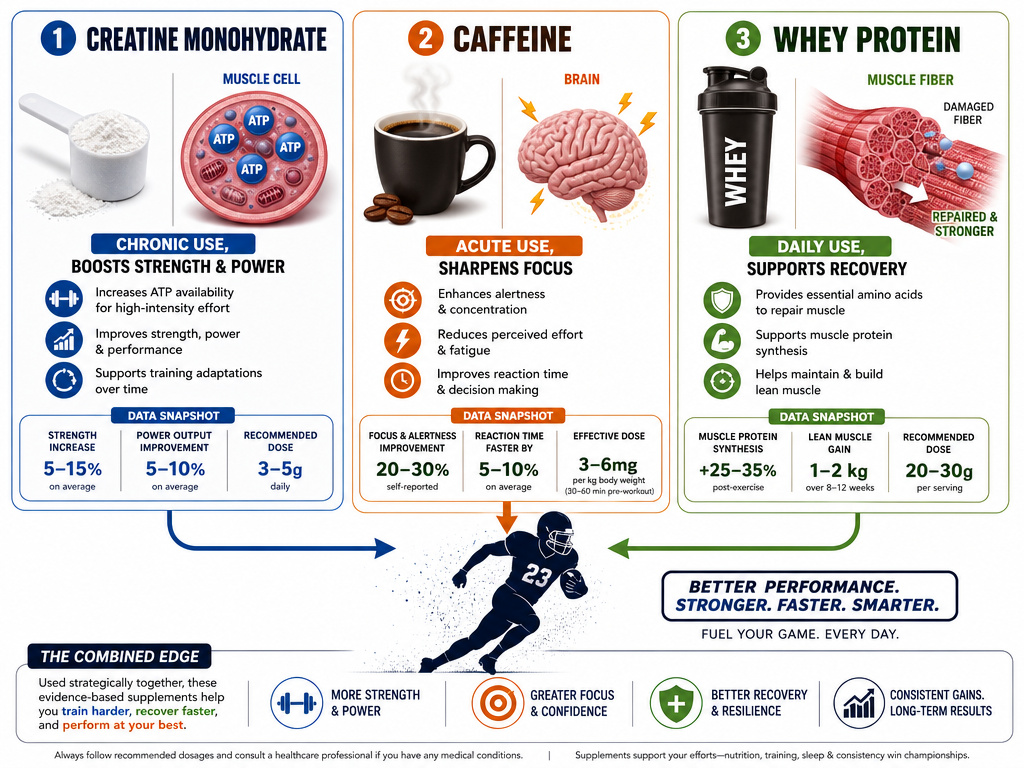
Creatine doesn’t exist in a vacuum. Players are often weighing it against caffeine, beta-alanine, or just whey protein. Here’s how it stacks up.
The most common comparison is with caffeine. Both are ergogenic aids, but they work in opposite ways. Caffeine is a stimulant that acts on the central nervous system, reducing perceived effort and sharpening focus. Its effects are acute, you take it 60 minutes before a match. Creatine is a chronic supplement that changes muscle physiology over weeks. They’re not an either/or; they can be stacked, with caffeine used for match-day and creatine for underlying strength training adaptation. For a deep dive on the other, see our look at caffeine for football.
Whey protein is a nutrient, not a direct performance supplement. It supports muscle repair and synthesis. As the semi-professional football muscle damage study showed, whey and creatine can be synergistic. Use protein for daily recovery needs, and creatine for the performance ceiling.
Then there’s the question of necessity. A diet rich in red meat and fish provides some creatine daily. Supplementing adds another 3-5 grams, pushing total intake to a level that meaningfully boosts muscle stores. For vegetarians or players with lower meat intake, supplementation is almost a dietary essential to reach baseline levels.
The bottom line: Creatine is for boosting your high-intensity energy system. It’s foundational. Caffeine is for sharpening your execution on the day. Protein is for rebuilding. They serve different roles in a complete nutrition guide.
Does creatine help with mental sharpness for footballers?
The research on creatine’s direct impact on brain function in football players is not detailed in the available studies. The focus of the research is primarily on physical performance metrics like power output and muscle recovery. For a footballer considering supplementation, the primary goal remains supporting the high-intensity, repeat-sprint demands of the game. Any potential cognitive benefits would be secondary to the well-documented role in replenishing muscle energy stores for explosive actions.
What foods are natural sources of creatine?
Creatine is found naturally in animal products, particularly in red meat and seafood. For example, a typical serving of steak or salmon contains a small amount of creatine. However, the quantity of creatine obtained through a normal diet is significantly lower than the amounts used in supplementation protocols studied for athletic performance. Footballers following a vegetarian or vegan diet will have negligible dietary creatine intake. While dietary sources contribute to your body’s baseline stores, they are generally insufficient to achieve the elevated muscle creatine levels targeted for ergogenic benefits.
Can creatine cause breathing problems or make asthma worse?
The fact sheet does not contain specific information linking creatine supplementation to respiratory issues like asthma. The long-term safety profile of creatine has been assessed in various athletic populations. For instance, one longitudinal study monitored biochemical safety in female football players over an entire competitive season. If you have a pre-existing respiratory condition, the most practical guidance is to consult with a healthcare professional before starting any new supplement, including creatine, to discuss potential individual risks and interactions.
Frequently Asked Questions
Does creatine cause dehydration or cramping?
It’s the opposite of the myth. Creatine draws water into muscle cells. The dehydration and cramping risk comes if you don’t increase your total fluid intake to account for this shift. A player who starts creatine and drinks the same amount of water is effectively reducing the fluid available for sweat and blood volume. The fix is simple: drink more. Aim to increase your daily fluid intake as a baseline, and more if training in the heat.
Should a 16-year-old footballer take creatine?
The research on younger athletes is positive but limited. The elite youth soccer power study used 19 players aged 17 and found benefits with a low dose. The International Society of Sports Nutrition states it is likely safe for adolescents in appropriate doses. However, the priority for a 16-year-old should be mastering essential diet for players, sleep, and training technique. If a young player and their parents decide to use it after consulting a sports doctor, a very low dose (0.03g/kg/day) is the only protocol to consider.
Why did I gain weight so quickly on creatine?
You gained water, not fat. Each gram of creatine stored in muscle pulls with it several grams of water. This intracellular water weight gain of 1-2 kg is normal, expected, and a sign the supplement is being stored. It usually plateaus after the first week. This is why many footballers prefer the low-dose protocol, it leads to a slower, less noticeable increase.
Can I take creatine with protein?
Yes, and you probably should. Taking creatine with a protein and carbohydrate source (like a post-training shake) can improve its uptake into muscles. Research on semi-professional players specifically found the combination was more effective for reducing muscle damage markers than either supplement alone.
How long does it take to see benefits for football performance?
With a loading phase, you may notice improved recovery between sprint drills in training within the first week. With a low-dose protocol, it takes several weeks to fully saturate muscles and feel the full effect. The benefits aren’t a sudden “boost” but rather a subtle improvement in your ability to maintain power in the final third of a match or a tough training session.
Before You Go
If you take one thing from this, let it be this: creatine is a tool for the repeated sprint. Its value is measured in the last quarter of a game, not the first minute. The 0.03 g/kg daily dose, about a teaspoon, is the smartest starting point for any player in-season. It integrates without disruption.
The loading phase has its place in a structured pre-season, but the potential for bloating and coordination drift makes it a poor choice during competition. Whatever you choose, pair it with a deliberate hydration strategy. Your fluid intake needs to increase from day one.
Finally, see it as part of the machinery, not the engine. No amount of creatine monohydrate will compensate for poor recovery techniques, inconsistent sleep, or a diet low in complex carbohydrates. It works because your training creates the demand. Add it to a solid foundation, track your performance in those final 15 minutes, and let that be your guide.
