
Sweeper Keeper Role in Football: A Side-by-Side Look
This post contains affiliate links. As an Amazon Associate, we earn from qualifying purchases.
The sweeper keeper role in football changes the goalkeeper into an eleventh outfield player, whose primary tasks are defending the space behind a high defensive line and initiating attacking build-up with their feet. This hybrid role demands proficiency in traditional shot-stopping, precise short-passing under pressure, and the speed to sweep up through-balls outside the penalty area.
The 2022 World Cup showed this isn’t theoretical. When the ball was in the middle third, defenses were positioned 7 meters further upfield compared to 2018. The average goalkeeper position was 4 meters higher. That gap changes everything. A keeper who stays on his line in that system leaves a highway of space for a through-ball. One who pushes up becomes part of the defensive structure itself.
What follows is a look at how the role works, the hard numbers behind its rise, and the specific analytical risks that come with it. This is less about a new type of player and more about a different way of solving the same old problems: how to stop goals and how to start attacks.
Key Takeaways
- The core shift is a 4-meter higher average position when the ball was in the middle third compared to 2018, forcing goalkeepers to defend space, not just shots.
- Distribution is now categorized by the FIFA Distribution Framework, which includes “play around and support,” “play through,” “play into,” and “play beyond” the press, not just long kicks.
- A misplaced pass in the defensive third can generate a shot with an extremely high xG value, turning distribution into a calculated gamble.
- Historical origins are contested; Bruce Grobbelaar (1980s) and Edwin van der Sar (1993) are both cited as pioneers for different reasons.
What Exactly Does a Sweeper Keeper Do?
A sweeper keeper has two primary jobs, and only one of them involves using their hands. The first is to act as the last defender, covering the space behind a high defensive line. The second is to act as the first attacker, receiving the ball from center-backs and breaking an opponent’s press with precise passing. This dual role turns the goalkeeper from a reactive shot-stopper into a proactive game-manager.
The physical reality is simple. If your defenders are pushed up to halfway, the distance to your own goal is massive. An attacker who beats the offside trap has a large amount of open grass. A keeper rooted to his line is a spectator. A keeper who is already positioned well outside the penalty area can intercept the pass or close down the angle. That’s the difference between a goal and a non-event. The modern game asks the keeper to solve the problem the high line creates, and the solution inherent in the sweeper keeper role in football is to join the line.
Technical Snippet: The FIFA Goalkeeping Expert Group’s Distribution Framework classifies keeper distribution into specific types. “Play around and support” refers to short passes in the defensive third. “Play through” targets a central area through an opposition press. “Play into” involves clipping balls over the first press line into space between defensive lines 2 and 3. “Play beyond” is a long ball over the opposition’s last line.
The Data-Driven Rise of the Role
You can trace the sweeper keeper’s rise in cold, hard numbers. The most telling stat isn’t about passing accuracy; it’s about positioning. At the 2022 World Cup, FIFA’s analysis showed that when the ball was in the middle third, the average goalkeeper position was 4 meters higher than in 2018. Entire defensive units had shifted 7 meters further upfield. This isn’t a stylistic choice anymore; it’s a systemic shift. A keeper who doesn’t advance in that system becomes a liability.
The involvement metrics are even more striking. Since 2018, the number of times goalkeepers offered to receive the ball increased by 64%. The number of times they actually received it increased by 100%. They are now a designated outlet, a pressure-release valve built into the team’s tactics. This is confirmed by a Bournemouth University goalkeeping review, which notes that international keepers may make 8-14 kicks per match into the opponent’s half as part of their offensive role.
| Tactical Driver | Quantifiable Change | Source |
|---|---|---|
| Defensive Line Height | +7 meters higher in middle third (2022 vs. 2018) | FIFA Training Centre |
| Goalkeeper Position | +4 meters higher in middle third (2022 vs. 2018) | FIFA Training Centre |
| Involvement in Build-Up | Offers to receive ball: +64%; Actual receptions: +100% (since 2018) | FIFA Training Centre |
| Offensive Distribution | 8-14 kicks per match into opponent’s half | Bournemouth University Review |
Sweeper Keeper vs. Traditional Goalkeeper: A Side-by-Side Look
The differences go far beyond a willingness to come off the line. They represent fundamentally different interpretations of the position.
A traditional goalkeeper is a specialist. Their domain is the 18-yard box. Their tools are their hands, their positioning, and their reflexes. Their primary metric is saves made. Distribution is a secondary skill, often a long punt aimed at a target man. Their risk profile is low, unlike the high-risk profile of the sweeper keeper role in football; a mistake usually involves missing a shot, not giving the ball away.
A sweeper keeper is a generalist. Their domain extends to the halfway line. Their tools include their feet, their passing range, and their reading of the game. Their primary metrics might include the average distance of defensive actions from goal. Their risk profile is high. A mistake can be a catastrophic turnover in front of an open net.
Where this goes sideways: A sweeper keeper mistiming a run outside the box. If an opponent chips the ball over them, it’s an empty-net finish from 40 yards. The visual is embarrassing, but the tactical cost, a near-certain goal, is the real punishment.
The Essential Skills Beyond Shot-Stopping
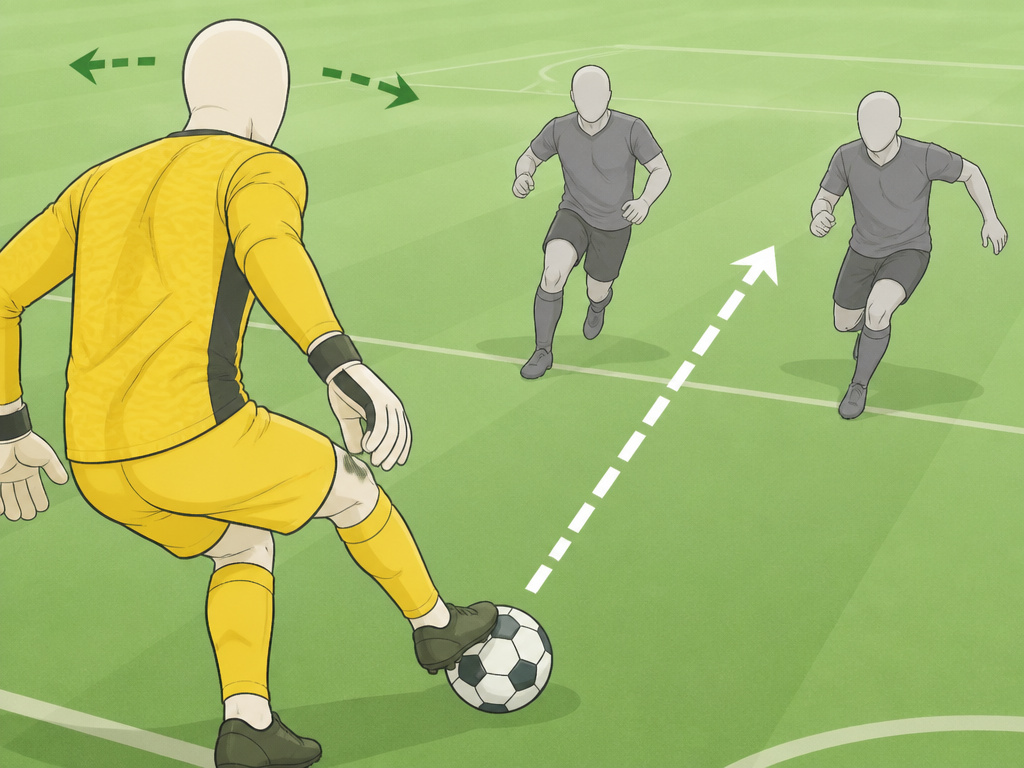
Shot-stopping is the essential baseline. No amount of good passing excuses a keeper who can’t make routine saves. But assuming that foundation is solid, three additional skills separate a true sweeper keeper from a traditional one pretending to play the role.
First is distribution under pressure. This involves scanning the field before receiving the ball, knowing which opponent is pressing, and choosing the right option from the FIFA framework, short to break the press, or long to exploit the space behind it. A keeper’s technical footwork is the engine for this.
Second is anticipation and explosive speed. Reading a through-ball a split-second earlier is the difference between a clean interception and a desperate, sliding tackle that might concede a penalty. Positioning fundamentals for this are about angles and depth, not just shot-stopping.
Third is composure with the ball in dangerous areas. The most pressure a footballer can face is having an opposition striker sprinting at you while you control a pass with your own goal six yards behind. Panic leads to a rushed clearance or a hospital pass. Calmness allows the play to develop. This mental skill is perhaps the hardest to train.
How to Recognize a Modern Sweeper Keeper (The Neuer Test)
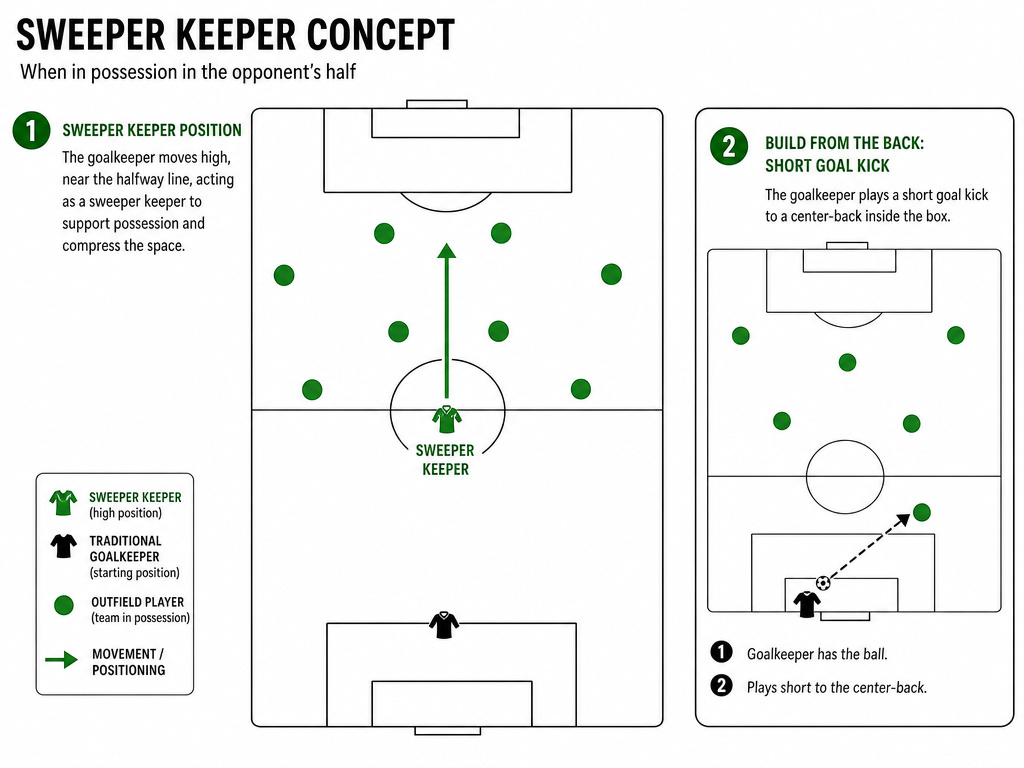
Watch where the goalkeeper stands when their team has sustained possession in the opponent’s half. A traditional keeper might be at the edge of their own box. A sweeper keeper like Manuel Neuer will often be positioned much higher, well outside the penalty area when the team has possession deep in the opponent’s half. This extreme position cuts off long balls instantly and allows the outfield players to press even higher.
Next, watch the goal kicks. Since a 2019 rule change, a goal kick is in play as soon as it’s taken. Modern keepers use this to create a numerical overload, often rolling a short pass to a center-back who has dropped into the penalty area. The old ritual of the long punt to a midfield battle is gone. Now, it’s the first phase of structured build-up play.
Finally, listen. A sweeper keeper is a director. They have the best view on the pitch and must constantly organize the defensive line, shout instructions to step up or drop, and alert teammates to runners they can’t see. Their command of the area expands to include the space well in front of the penalty box.
The Sweeper Keeper Quantified: Risk vs. Reward
Analytics has caught up with the role, and it presents a fascinating problem. How do you value a player whose job is to prevent attacks before they happen and to start attacks from the back? The classic metrics fail here.
Pass completion percentage is misleading. A keeper who only passes five yards to a defender will have a 95% completion rate but adds zero attacking value. More telling is the average distance of defensive actions from goal. A high number indicates a keeper who proactively deals with threats far from his line, the literal definition of sweeping.
But the real analysis is in risk management. Every short pass under pressure carries a tiny chance of a catastrophic error. A heavy touch or a misdirected pass in the defensive third can lead to a shot with an extremely high expected goals (xG) value. Therefore, evaluating a sweeper keeper involves weighing the possession value they create against the xG they concede from errors. As a tactics explainer on the sweeper keeper might frame it, the role is a calculated gamble.
| Analytical Metric | What It Measures | Why It Matters for a Sweeper Keeper |
|---|---|---|
| Avg. Defensive Action Distance | How far from goal the keeper makes saves, interceptions, clearances. | High number = proactive sweeping; low number = reactive, line-bound play. |
| Pass Completion % (Under Pressure) | Accuracy of passes when an opponent is within pressing distance. | Tests composure and technical skill in the most dangerous situations. |
| xG Conceded from Errors | Expected Goals value of shots resulting directly from keeper mistakes. | Quantifies the downside risk of playing out from the back. |
| Progressive Pass Distance | Total distance gained toward opponent’s goal with forward passes. | Measures offensive contribution, not just safety-first distribution. |
Tracing the Roots: Where Did This Role Begin?
Here, the sources disagree, and the disagreement is instructive. One narrative points to the 1992 back-pass law change. Overnight, keepers could no longer pick up deliberate passes from teammates. They had to use their feet. This forced an evolution in skill. In this telling, Edwin van der Sar, starting for Ajax in 1993 under Louis van Gaal’s total football system, became the first genuine sweeper keeper, using his technical ability to be the first line of attack.
Another narrative looks further back. It highlights Bruce Grobbelaar in the 1980s and 1990s, whose unorthodox, rushing style for Liverpool saw him regularly far off his line to clear danger. While perhaps less systematically coached than later examples, his play embodied the sweeper keeper’s proactive spirit.
So who is right? All of them, in a way. Van der Sar represents the systematic adoption of the role as a tactical response to a rule change. Grobbelaar represents the instinctive precursor, a player whose natural style happened to fit a future tactical need. The role’s history isn’t a single point of invention but a convergence of rule changes, tactical evolution, and individual talent. It shares a conceptual lineage with the outfield libero position, a free defender sweeping behind a line, but applies it to the last line of all.
Frequently Asked Questions
Who is considered the best sweeper keeper in football?
Currently, Bayern Munich and Germany’s Manuel Neuer is the archetype. He didn’t invent the role, but his performances, particularly at the 2014 World Cup, defined its modern parameters, extreme positioning, flawless distribution, and seamless integration into a high-pressing system. Others like Manchester City’s Ederson are also elite examples, valued for their specific passing range.
Do teams still play with a sweeper (the defender)?
The outfield sweeper, or libero, is rare in top-level modern football. Most defenses now use a flat back four or a back three with defenders who step into midfield. However, the principles of the sweeper live on in the sweeper keeper. The need for a player to cover space behind a high line hasn’t disappeared; the job has just been reassigned to the last player on the pitch.
Is the sweeper keeper role overhyped?
It can be if the hype ignores the prerequisites. The role is not for every keeper or every team. It requires a specific set of skills beyond shot-stopping and a team built to play with a high line and possession dominance. For a team that sits deep and counters, a traditional shot-stopper is far more effective. The role is a tool, not a universal upgrade.
What’s the biggest risk of using a sweeper keeper?
The most glaring risk is being caught out of position, leading to an easy lobbed goal. The more analytically significant risk is the high-cost error. A traditional keeper’s mistake might concede a corner. A sweeper keeper’s misplaced pass can gift a shot with an xG of 0.8 or higher directly in front of goal. The rewards are higher, but the stakes on every touch are too.
How has the role influenced goalkeeper training?
Training now heavily integrates goalkeepers with outfield players. Drills focus on receiving back-passes with both feet, playing under simulated press from attackers, and making quick decisions to pass through lanes. The isolated “shot-stopping” session is now just one part of a regimen that includes rondos, positional play games, and coordinated pressing patterns.
The Bottom Line
The sweeper keeper is a logical adaptation to football’s tactical arms race. As pressing gets higher and space gets compressed, the goalkeeper becomes the key to creating space. The role demands a complete player, one who can save, pass, read the game, and communicate.
For a young keeper watching, the lesson is to understand that the goalkeeper’s responsibilities are expanding. The foundation will always be the ability to keep the ball out of the net. But the ceiling is now defined by what you do with it once you have it.
The next time you watch a match, don’t just watch the keeper when the shot comes in. Watch them in the 89th minute when their team is winning 1-0 and playing keep-ball in the corner. Are they on the edge of their box, or are they 30 yards out, offering an angle and demanding the ball to kill the game? That’s the difference.
