
Can a Goalkeeper Score a Goal in Football?
This post contains affiliate links. As an Amazon Associate, we earn from qualifying purchases.
A goalkeeper can score a goal in football by kicking or heading the ball into the opponents’ net, including straight from a goal kick. Under IFAB Law 10, a direct throw into the opponents’ goal doesn’t count, and the referee gives a goal kick instead. Guinness recognises Rogerio Ceni as the top-scoring goalkeeper.
That word “direct” carries most of the weight in the law on whether can a goalkeeper score a goal in football. A keeper’s hands are the one part of the body the rulebook won’t let them score with, so the famous keeper goals come off boots and heads: penalties, free kicks, wind-blown clearances and the odd desperate header at a corner.
What follows: the exact wording of Laws 10 and 16, the own-goal quirks that catch fans out, the two wind-assisted distance records, the penalty specialists, the six Premier League keepers who’ve scored, and why nobody can agree on Ceni’s total.
Key Takeaways
- A goal kick can go straight into the opponents’ net and count. If it goes straight into the kicker’s own net, the opponents get a corner instead.
- Throw a caught ball into your own net by accident and the referee awards the goal to the other side.
- Both distance records came from wind-assisted kicks out of the keeper’s own area: Tom King’s 96.01 m and Asmir Begovic’s 91.9 m.
- Ceni’s tally depends on who’s counting: 131 by Wikipedia’s table, 129 by IFFHS.
- A kick scored in a shoot-out is not a goal in the match, because the laws treat the shoot-out as starting after the final whistle.
What Does Law 10 Actually Say About Keepers Scoring?
Law 10.1 sets one test for every goal, whoever scores it. The whole of the ball must cross the goal line, between the posts and under the crossbar.
Under IFAB Law 10.1, a goalkeeper’s goal follows the same test as any other: the whole of the ball must pass over the goal line, between the goalposts and under the crossbar. One exception applies. A goalkeeper’s throw that enters the opponents’ goal directly doesn’t count as a goal, and play restarts with a goal kick.
The full wording sits in IFAB Law 10 on determining the outcome of a match, and it’s shorter than you’d expect. No clause bans the player in gloves from scoring. The law just closes off one route, the hands, and leaves every other route open.
Short version? Feet and head, yes. Direct throw, no.
The goalkeeper rules around handling are where most of the restrictions live. Law 12.3, for example, gives the opponents a corner kick if the keeper holds the ball for more than 8 seconds, with the referee counting the last 5 out loud on a raised hand. Honestly, I think that clause shapes time-wasting more than the penalty-line arguments fans love so much.
The Word “Directly” and the Deflected Throw
Law 10.1 only rules out a throw that goes into the opponents’ goal directly. The wording says nothing about a throw that touches another player on the way. That gap is where the deflection cases sit, and it’s why several ranking pages tell you a throw counts once someone else gets a touch on it.
I’d add one caution. The law text I’m quoting covers the direct throw and nothing more, so for a messy real-world deflection, the referee’s reading of “directly” decides it.
Own Goals: The Throw That Counts, the Goal Kick That Doesn’t
Here’s where the laws get almost mischievous. The IFAB’s own Law 10 FAQ describes a keeper who catches a shot, gets up, and accidentally throws the ball into their own goal. Goal to the opponents.
Yet Law 16 says a goal kick that goes straight into the kicker’s own net is no goal at all. The opponents get a corner. Same keeper, same net, two different answers depending on how the ball went in.
| Situation | Outcome | Law |
|---|---|---|
| Keeper kicks or heads ball into opponents’ net | Goal | Law 10.1 |
| Keeper throws ball directly into opponents’ net | Goal kick, no goal | Law 10.1 |
| Goal kick goes straight into opponents’ net | Goal | Law 16 |
| Goal kick goes straight into kicker’s own net | Corner to opponents | Law 16 |
| Keeper accidentally throws caught ball into own net | Goal to opponents | Law 10 FAQ |
| Keeper touches goal kick again before anyone else | Indirect free kick to opponents | Law 16 |
The 96.01-Metre Goal Kick, and Why Wind Keeps Breaking the Record
96.01 metres (105 yards). That’s the Guinness-verified length of Tom King’s goal for Newport County against Cheltenham Town. He struck it from his own six-yard box, the wind picked it up, and it dropped in just out of reach of the Cheltenham keeper, Joshua Griffiths.
It earned Newport a 1-1 draw. It also ended a record that had stood for seven years.
The previous holder was Asmir Begovic, playing for Stoke City against Southampton on 2 November 2013. His 91.9 m (100.50 yd) kick came 13 seconds into the match, caught a breeze, and sailed over Artur Boruc. You’ll find both goals in the Guinness World Records report on Tom King’s longest goal.
Watch the replays of either goal and you’ll see the tell. The ball keeps climbing past halfway when it should be dropping, then lands with a skid and a high kick off the turf that the far keeper can’t judge. Two records, two following winds.
Law 16 is what makes King’s kind of goal legal. The IFAB Law 16 text on the goal kick says a goal may be scored directly from a goal kick, but only against the opposing team. Nobody else needs to touch it.
So should a keeper aim for goal from a goal kick? I’d say no, and I’ll stand by that. Good goalkeeper distribution finds a teammate. These goals are what happens when distribution meets weather.
Easy to miss: Dawdling over a goal kick while protecting a lead. If the referee judges it deliberate delay, a five-second countdown starts, and if the kick isn’t taken by the end, the opponents get a corner.
The other thing the goal-kick law polices is trickery. If a keeper flicks the ball up at a goal kick for a teammate to head back into their hands, the initiator is cautioned and the opponents get an indirect free kick. Fans assume a keeper can never handle anything from a teammate. The law’s aimed at specific tricks, and it punishes them hard.
I’d also argue the back-pass rule pushed more keepers into playing with their feet than any coaching manual did. Every clean kicker who scores from distance owes that rule something.
Penalties, Free Kicks and the 2-3 That Taught Butt to Run Back
Picture Schalke against Leverkusen on 17 April 2004. Hans-Jorg Butt strokes home a penalty for Leverkusen and turns away to celebrate. He’s still jogging back when Mike Hanke shoots from the halfway line. 2-3.
Bundesliga.com tells the story, and Butt’s own lesson was plain: he had to get back faster, and he stopped celebrating so wildly. Every match leaves a clue. That one left a very big one.
The Hanke goal is the honest cost of a keeper on spot kicks. The goal at your end stands empty for the length of a run-up, a kick and a jog home. A team that wants goalkeepers taking penalty kicks needs someone else to cover that walk back.
I’d only hand a keeper the penalties if a defender’s job is to drop into the six-yard box the moment the ball’s placed on the spot. Butt’s 2-3 shows the gap lasts long enough for a shot from halfway, and a back line that doesn’t plan for it will get punished.
Hans-Jorg Butt’s 26 Bundesliga Penalties
Butt finished with 33 goals. 26 of them were Bundesliga penalties, a record for a single European league, and 3 came in the Champions League, a goalkeeper record in that competition.
Set pieces are the main road for keepers who score a lot, and the reasons are practical:
- The ball is still, so the keeper’s kicking technique matters more than their sprint speed.
- A penalty taker only needs one cool head.
- Free kicks reward a keeper who spends hours on dead-ball practice, which keepers have time for in training while outfield players run drills.
- Open play? Rare.
Chilavert’s Hat-Trick at Velez
On 29 November 1999, Jose Luis Chilavert scored three penalties (45′, 75′ and 82′) as Velez Sarsfield beat Ferro Carril Oeste 6-1. Planet Football describes it as the first goalkeeper hat-trick in professional football.
That era’s keepers deserve a footnote for their shirts, by the way. Late-1990s goalkeeper kits look like nobody supervised the designers: clashing neon, zigzags, patterns like an old screensaver. I’d argue they tell you more about the decade than the outfield shirts do.
Anyway. René Higuita sits on 43 goals and Dimitar Ivankov on 42, the most by a European keeper. My knowledge of the South American game is thinner than my European reading, so I lean on the counts here rather than my own notebooks.
Why Nobody Agrees on Rogerio Ceni’s Total
I check any football story with a neat punchline twice. That habit came after I passed on a too-perfect tale that turned out to be embellished. Goalkeeper goal tallies are where the rule earns its keep.
Take Ceni. The Wikipedia list of goalscoring goalkeepers gives him 131 goals across 1,237 appearances for Sao Paulo between 1993 and 2015, and most press coverage repeats 131. Guinness recognises him as the top-scoring keeper. But IFFHS, which that same Wikipedia page cites in its records section, puts the figure at 129.
It gets messier. Wikipedia’s own split of 59 free kicks and 69 penalties doesn’t add up to 131. Somebody’s arithmetic is off, and I can’t tell you whose.
| Disputed claim | One position | The other position |
|---|---|---|
| Ceni’s career goals | 131 (Wikipedia table, most press) | 129 (IFFHS) |
| Chilavert’s career goals | 67 (Wikipedia, GOAL) | 62 (IFFHS) |
| Chilavert’s 1999 hat-trick the only one | Yes (Offside Rule podcast) | No, a Greek fourth-division keeper did it (GOAL) |
| Chilavert’s River Plate free kick | From the halfway line | From his own half |
Chilavert’s gap comes from what gets counted. Wikipedia and GOAL include 5 goals in the Paraguayan Primera Division on top of the 62 that IFFHS records.
When two serious counts disagree, quote both and name who said what. A single confident number for a goalkeeper’s career tally is a sign someone didn’t check.
I’m weak on data work, and I’ll own that. But this isn’t a data problem. Lower-league records, friendlies and old match reports never got logged the same way, so a gap of two or five goals is the expected outcome.
Can a Goalkeeper Score a Goal in Football When the Team Is Chasing the Game?
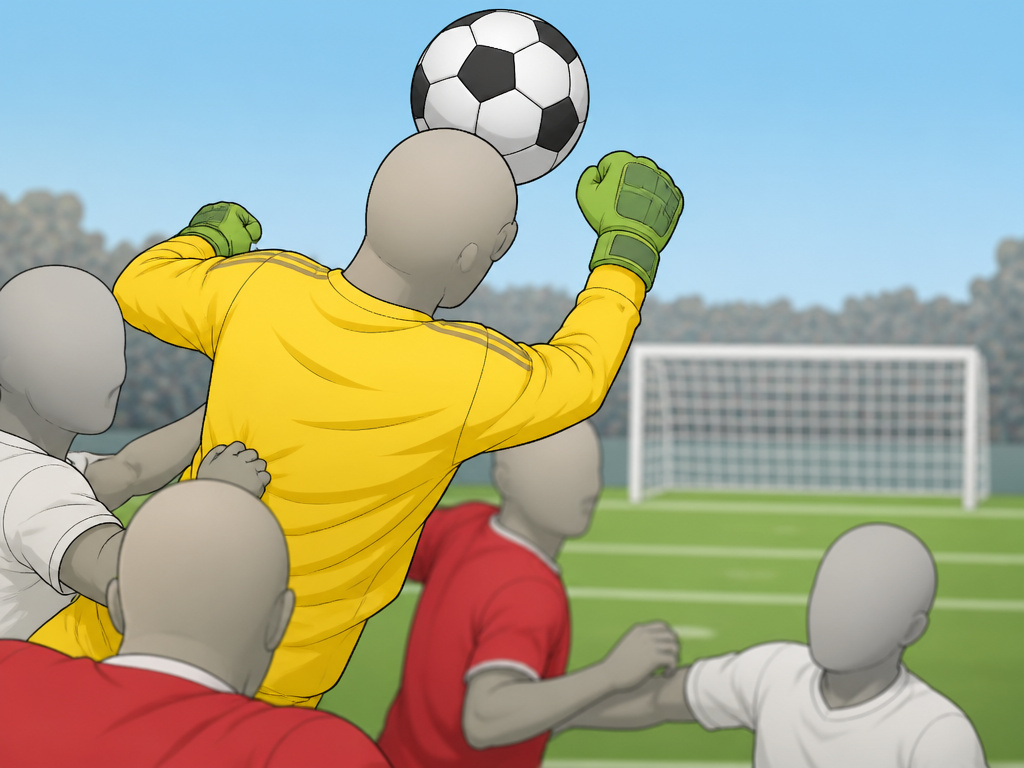
This is the riskiest goal in the sport. A keeper who goes up for a late corner leaves the net empty at the other end. Only the scoreline justifies it.
Alisson at The Hawthorns
On 16 May 2021, Liverpool were level at West Brom deep into stoppage time. Trent Alexander-Arnold swung in a corner in the 95th minute (90+5), and Alisson headed it in for a 2-1 win.
Per Opta and AP, it was the first competitive goal by a Liverpool keeper in the club’s 129-year history. It was also the first Premier League goal by a goalkeeper from a header.
Highlight clips give Alisson all the credit. Fair enough, but the delivery from Trent Alexander-Arnold’s corner mattered too. Strip out the corner taker and the decoy runs and the header never happens.
The Six Premier League Keepers Who’ve Scored
Alisson’s goal made him the sixth keeper on the list of Premier League goalkeepers who have scored.
| Goalkeeper | Goal | Year |
|---|---|---|
| Peter Schmeichel | Aston Villa at Everton | 2001 |
| Brad Friedel | Blackburn at Charlton, 90th minute | 2004 |
| Paul Robinson | Tottenham v Watford | 2007 |
| Tim Howard | Long-range goal | 2012 |
| Asmir Begovic | Stoke v Southampton | 2013 |
| Alisson | Liverpool at West Brom, 90+5 header | 2021 |
Friedel’s line shows the other side. His 90th-minute goal at Charlton came in a 3-2 defeat. Scoring late saves nothing if the shape behind you has already gone.
That’s the joinery argument for me. A team with the keeper up front is a cabinet with the back panel off; it stands, until something leans on it. The role of a goalkeeper still includes the run back, even when the run forward makes the news.
Where this goes sideways: Sending the keeper forward with more than a few minutes left. One cleared corner and a long ball later, the other team is shooting at an empty net, and Butt’s 2-3 shows it can happen in seconds.
Modern keepers playing high up the pitch make these moments look less mad than they used to. A sweeper keeper is used to living well off the line. Going all the way to the opposition box is still a different bet.
Shoot-Out Kicks Don’t Count as Match Goals
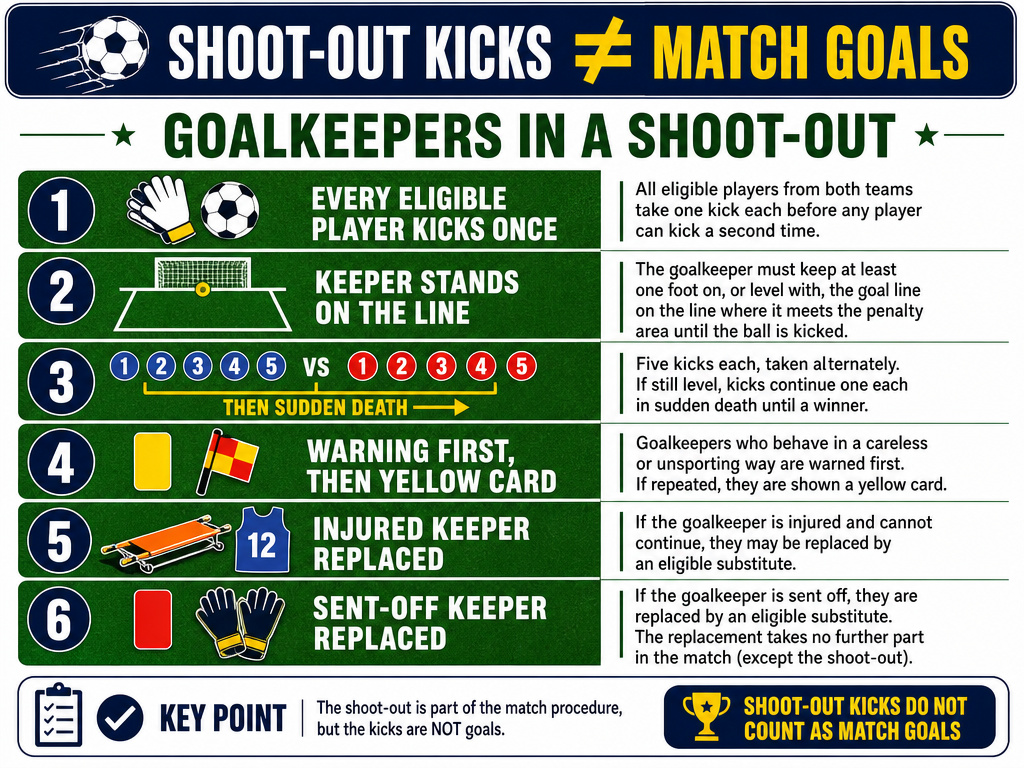
A keeper who buries the winning kick in a shoot-out hasn’t scored a goal in the match. That sounds like pedantry. It’s the law.
The IFAB’s Law 10 FAQ says penalties in a shoot-out are taken after the match has ended and aren’t part of it. Cautions from the match don’t even carry over. So when you read a keeper’s career tally, a shoot-out kick belongs in a different column, and the referee keeps that record separately.
Here’s how the shoot-out laws treat keepers, in the order they come up:
- Every eligible player kicks before anyone kicks twice. A keeper is eligible like anyone else, so in a long shoot-out the keeper’s turn arrives, and skipping them isn’t an option.
- The kicker’s opposing keeper stands on the goal line where it meets the penalty area boundary, outside the penalty area. Wander off that spot and you’re breaking Law 10.
- Both teams take five kicks, alternately, then sudden death if level. A keeper who’d rather not kick only escapes if the shoot-out ends first.
- A keeper who encroaches and causes a retake gets a warning first, then a yellow card for any further offence. Push it twice and you’re in the book.
- An injured keeper can be replaced by an unused substitute, even if the team has used its substitution opportunities. The replaced keeper can’t take a kick, and if they’ve already kicked, the replacement waits until the next round.
- A keeper sent off during the shoot-out must be replaced by an eligible player. Leave the gloves unclaimed and the team can’t continue properly.
Look, the arguments about keepers creeping off the line get far more airtime than they deserve. They decide a handful of matches. The eligibility rules above decide who’s even allowed in the goal.
Frequently Asked Questions
Is it legal for a goalkeeper to score a goal?
Yes. Law 10.1 applies the same test to every goal: the whole ball over the line, between the posts and under the bar. The only route closed to a keeper is a direct throw into the opponents’ goal, which brings a goal kick instead.
What happens if a goalie throws the ball into their own net?
The goal stands for the opponents. The IFAB’s Law 10 FAQ covers exactly this case: a keeper who catches a shot and then accidentally throws it into their own goal concedes. A goal kick that goes straight into the kicker’s own net is different, and gives the opponents a corner.
Has any goalie scored from a header in the Premier League?
Alisson is the one. He headed in a Trent Alexander-Arnold corner at West Brom on 16 May 2021, in the 95th minute, to win 2-1. It was the first Premier League goal by a keeper from a header.
Who has scored the most goals as a goalkeeper?
Guinness recognises Rogerio Ceni as the top-scoring keeper. Wikipedia’s table and most press give him 131 goals, while IFFHS counts 129. Jose Luis Chilavert, Rene Higuita and Hans-Jorg Butt follow on the lists.
Does a goalkeeper’s shoot-out penalty count as a goal?
It counts in the shoot-out, not in the match. Law 10 treats the shoot-out as taking place after the match has ended, so it sits apart from the match result and the keeper’s match goals.
The Bottom Line
So if a mate asks you “can a goalkeeper score a goal in football?”, the answer is yes, with one hand-shaped exception. Kicks and headers count. A direct throw doesn’t.
The part I’d add is a limitation. Every career number here has a source attached, and that’s deliberate. If you’re settling a bet over Ceni or Chilavert, quote both counts and name who holds each, because the people who compile these lists don’t agree yet.
And if you coach a side that’s tempted to send the keeper up early, wait until the clock forces it. Butt learned that lesson when Hanke scored from the halfway line.
Would you rather your keeper take penalties, or keep them on their line and let the outfield players carry that risk?
