
Handball Rule in Football Explained
This post contains affiliate links. As an Amazon Associate, we earn from qualifying purchases.
The handball rule in football explained: a player commits an offence by deliberately touching the ball with the hand or arm, or by making the body unnaturally bigger with an arm position the body’s movement can’t justify. The arm ends at the bottom of the armpit, and not every touch is an offence.
That phrase about the body’s movement is where nearly every handball rule in football explained row starts. The Laws give referees a test and leave the measuring to them. IFAB confirmed in March 2021 that officials should keep using judgment on whether an arm position is justified.
Below: where the arm starts, the four offences, what each one costs in cards, how goalkeepers differ, and the places where the official bodies still disagree with each other.
Key Takeaways
- Contact on the shoulder shouldn’t be penalised under the Premier League’s 2020/21 guidance, which asked officials for clear evidence of contact below the armpit.
- A deliberate handball that denies a goal or obvious chance is a red card anywhere, except for a goalkeeper in their own area.
- In a German study, referees matched UEFA’s verdict on 84.0% of clips, while coaches managed 63.8% and players 67.5%.
- IFAB and UEFA’s Football Board disagree on non-deliberate red cards: IFAB keeps them outside the area, and the Board wanted red only for deliberate touches.
- I found no 2026 IFAB wording on rebounds or close-range deflections, so check the current Laws PDF before quoting this season’s rules.
Where Does the Arm End for Handball?
Law 12 puts the arm boundary at the bottom of the armpit, nicknamed the T-shirt line. The shoulder sits above it.
Under Law 12, the upper boundary of the arm for handball sits in line with the bottom of the armpit. Premier League guidance from 2020/21 required clear evidence that the ball struck the arm below the armpit, and stated that ball-to-shoulder contact should not be penalised. Offside judgments use the same armpit line.
Handball is one corner of Law 12 inside the Laws of the Game, and IFAB’s Law 12 text is the document every other source here leans on.
The Premier League spelled the line out for 2020/21. Under the Premier League’s 2020/21 handball guidance, officials needed clear evidence that the ball hit the arm below the bottom of the armpit and inside a marked red zone.
Offside borrows the same line. IFAB’s 2021 meeting ruled that the Law 12 definition, with the arm ending at the bottom of the armpit, must be used when judging whether a player is in an offside position.
I think it’s the most sensible change of the lot. A line on a shirt beats an argument about where a shoulder turns into an arm.
Four Ways to Commit Handball Under Law 12
Four things get a handball given:
- Deliberate contact, which includes moving the hand or arm towards the ball.
- Making the body unnaturally bigger, where the arm position is not a consequence of, or justifiable by, the player’s body movement.
- Scoring directly from the hand or arm, even by accident, and that includes the goalkeeper.
- Scoring immediately after the ball has touched the player’s own hand or arm.
The second item causes the most arguments. At its March 2021 meeting, IFAB confirmed that not every touch of a hand or arm with the ball is an offence. Referees keep judging whether the position is justified by the player’s movement in that specific situation.
That’s why a swinging arm in a full sprint gets more slack than an arm held out wide at a standing block. The movement explains the position in one case and can’t in the other.
On a frozen replay the difference is easy to spot. An elbow lifted level with the shoulder and an open palm facing the ball looks nothing like an arm tucked against the ribs while the body turns away.
My own read: “justifiable by body movement” is the joint that holds the whole law together, the way a dovetail holds a drawer. Loosen it and every shot into a crowded box becomes a penalty appeal. Tighten it too far and defenders have to play with their arms behind their backs.
The Attacker Rule: When Does an Accidental Touch Still Count?
A striker’s shot cannons off his own forearm. The loose ball runs to a team-mate, who scores. Is the goal good?
Two sources give different answers, and the dates explain why. IFAB’s rule change, effective in the Laws of the Game 2021/22, says accidental handball that leads to a team-mate scoring or having a goal-scoring opportunity is no longer an offence. The Premier League’s guidance, written for 2020/21, said an accidental handball by an attacker is penalised only if a goal or goal-scoring opportunity follows immediately. It treated the ball going to another attacker who scores straight away as an offence. It was not an offence if the ball travelled some distance via a pass or a dribble, or through several passes.
Here’s the bit people skip: the player who touches it and scores himself is still covered by Law 12. Scoring directly from the hand or arm, even by accident, remains an offence.
Where this goes sideways: Applying the 2020/21 Premier League team-mate wording to a match played under the 2021/22 Laws. A goal that IFAB now allows gets chalked off, and the argument runs on long after the restart.
What a Handball Costs: Kicks, Cards and the DOGSO Test
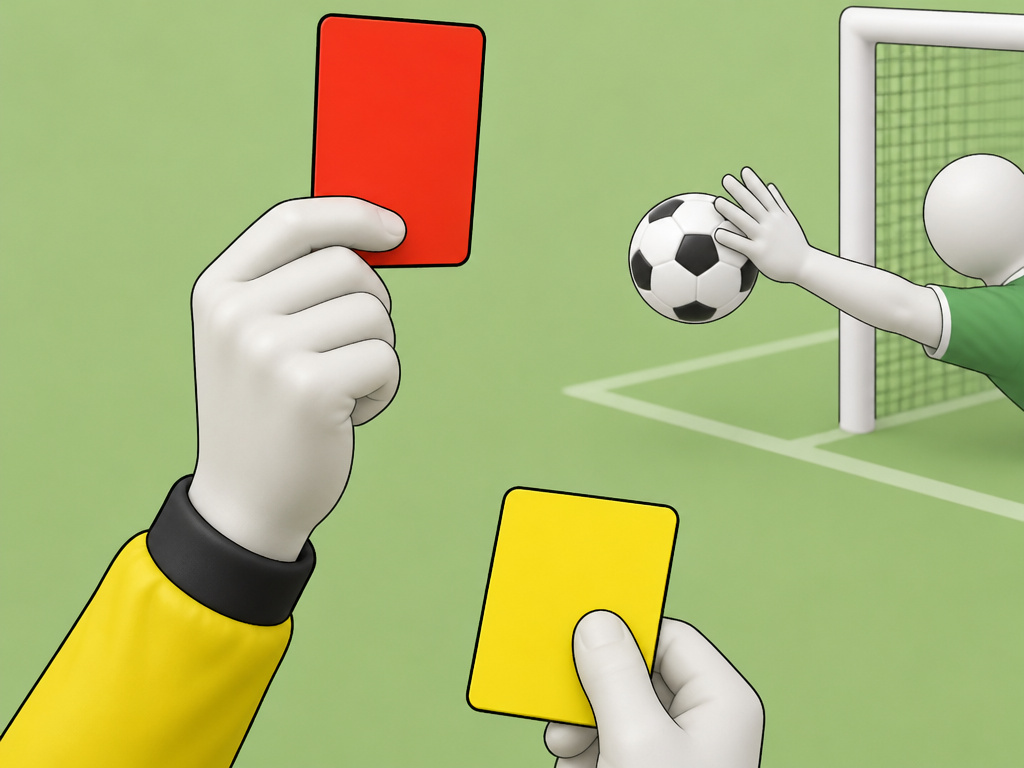
Not every handball earns a card. The basic punishment is a direct free kick, or a penalty kick when the offence happens inside the defender’s own penalty area.
The card depends on what the handball stopped. DOGSO means denying a goal or obvious goal-scoring opportunity, and it’s the dividing line between a yellow and a red.
| Situation | Sanction |
|---|---|
| Deliberate handball denying a goal or obvious chance | Red card, anywhere (not a goalkeeper in own area) |
| Non-deliberate DOGSO handball outside own area | Red card |
| Non-deliberate DOGSO handball, penalty awarded | Yellow card |
| Handling to stop a promising attack | Yellow, unless a penalty is given for a non-deliberate handball |
| Handling to try to score, or a failed attempt to stop a goal | Yellow card |
| Advantage played after DOGSO | Caution; no sanction if the non-offending team scores |
Referees weigh four factors when deciding whether a chance was obvious:
- Distance between the offence and the goal.
- General direction of the play.
- Likelihood of keeping or gaining control of the ball.
- Location and number of defenders and attackers, which is the factor that changes fastest as a move develops.
My view, and it’s only a view: the gap between a yellow for stopping a promising attack and a red for denying an obvious chance gives defenders a decision to make in a split second. The contact is a blink. The card is a checklist.
Goalkeepers and Handball: Hands in the Box, Rules Outside It
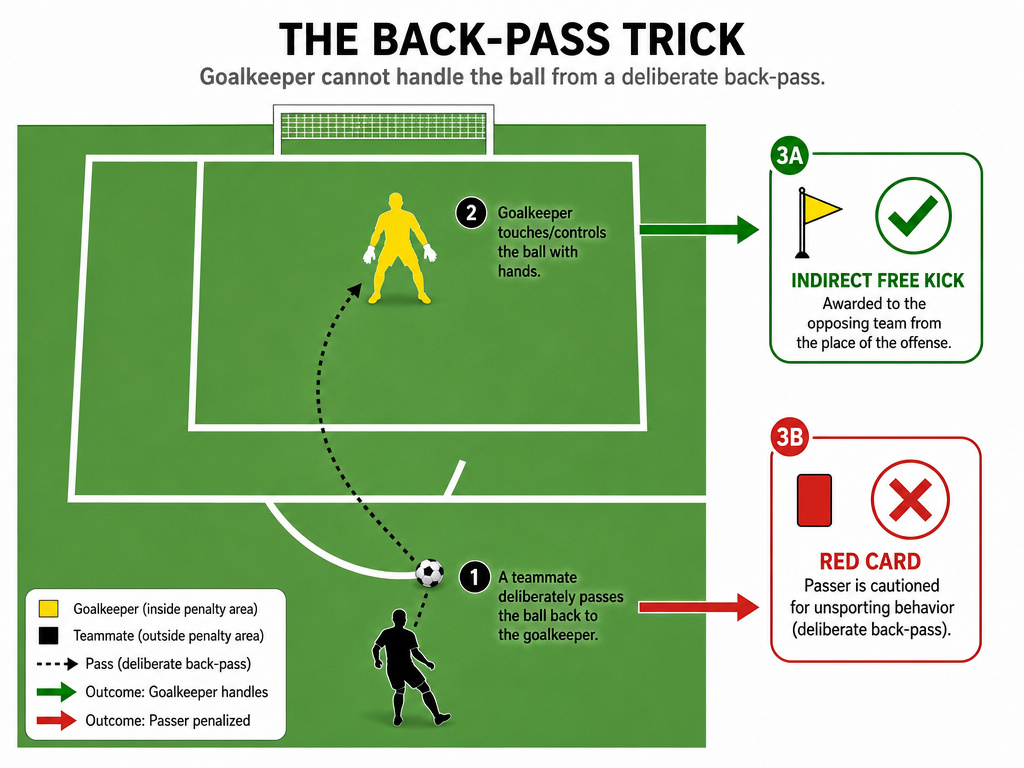
A goalkeeper who deliberately handles the ball to deny a goal or obvious chance inside their own penalty area escapes the red card. Law 12 carves that exception out in so many words.
Illegal handling by a keeper in their own area brings an indirect free kick and no card. That detail comes from the research brief rather than the Law 12 extract I could read, so check the current IFAB text.
Step outside the area and the protection ends. The keeper is judged like any outfield player, and this piece on goalkeeper handling the ball outside the area covers that in detail. A keeper who scores with the hand at the other end is still guilty of an offence.
The goal-kick trick closes another loophole. A deliberate trick to pass the ball to the goalkeeper with the head, chest, knee and so on, to get around the back-pass rule, earns the player who starts it a caution. IFAB’s 2021 meeting extended that to goal kicks. The goalkeeper is cautioned too if responsible for starting the trick. The full list of goalkeeper rules is worth a read before you coach a young keeper.
Why Do Referees, Coaches and Players Read the Handball Rule in Football Differently?
Referees in German men’s professional football matched UEFA’s verdict on 84.0% of the handball clips they were shown. That figure comes from the Bauch et al. PLOS ONE penalty study, where 154 referees judged 30 incidents.
Coaches (31) and players (46) then judged 18 incidents. Their agreement with UEFA was lower: 63.8% for coaches and 67.5% for players. The clip sets differed in size, so treat the comparison as indicative rather than exact.
Strictness is the surprise. UEFA’s baseline was 50% punishable. Referees judged 42.9% punishable, coaches 36.0% and players 33.9%.
The groups also reasoned differently. Referees favoured naturalness, meaning whether the arm position looked natural. Coaches and players emphasised avoidability and impact, meaning whether the defender could have avoided it and whether it mattered. The groups differed significantly in consensus on 11 of the 18 incidents.
So the handball rule in football has a built-in translation problem. Everyone watches the same clip and asks a different question of it. The authors’ conclusion is plain: clearer, more objective criteria, agreed by the key stakeholders, are required to improve consistency and acceptance.
Cucurella and Pieters: How Real Handball Calls Get Argued
Extra time, Euro 2024 quarter-final, Spain 2-1 Germany. Jamal Musiala shoots and Marc Cucurella’s arm gets in the way. Referee Antony Taylor gave no penalty.
UEFA’s Referees Committee later admitted, in a report covered on 24 September, that the decision not to award a penalty was a mistake. Coverage of the Euro 2024 handball penalty controversy shows how a later review and the match-day decision can point in opposite directions. Spain’s win stood regardless.
Chris Foy, a former Premier League referee, analysed a Pieters incident in similar terms. He said Pieters’ arm was clearly extended away from his body, making himself bigger, and that he ran a huge risk. Foy would not have been surprised if a penalty had been awarded. He also stressed that defensive handball judgments always carry a subjective element, and that on the day the officials felt there wasn’t enough evidence to overturn the on-field decision.
The part nobody mentions: A review only changes an on-field call when the evidence is clear. In the Pieters case, officials felt the evidence fell short, so the original decision stood. A borderline arm can survive review even when a former referee says it could have gone either way.
In the stadium, the noise drops while the check runs, then a roar or a groan settles it. Here’s how to judge a replay in the order a referee does:
- Find where the ball struck. If it hit the shoulder, or above the armpit line, stop there. Skip this and you’ll call penalties the Premier League told officials not to give.
- Ask whether the contact was deliberate or the arm made the body bigger. Miss it and a natural running arm gets punished.
- Check whether the touch denied a goal or obvious chance. Skip the DOGSO factors and the card ends up wrong, red where it should be yellow or the reverse.
- Pick the sanction. Deliberate or non-deliberate, inside or outside the area, penalty or not. Get this step wrong and the match turns on a card nobody can defend.
Where IFAB, UEFA and the Premier League Still Disagree
The rule book and the bodies that run Europe’s top competitions aren’t fully aligned. The table shows the main splits, each tied to who holds the position.
| Question | Law 12 / IFAB says | Other body says |
|---|---|---|
| Non-deliberate DOGSO handball | Red outside own area; yellow if penalty | UEFA Football Board: red only for deliberate, intentional touch |
| Handball after a shot at goal | Caution for unsuccessful attempt to stop a goal | UEFA Football Board: not automatic after every shot |
| Ball deflected off own body first | No blanket exemption in the Law 12 text | UEFA Football Board: no offence, especially if not heading to goal |
| Accidental attacker handball | 2021/22: team-mate case no longer an offence | Premier League 2020/21: offence if goal follows immediately |
The UEFA Football Board’s recommendations came from its inaugural meeting in Nyon. They asked UEFA to push IFAB to amend Law 12, and they remain recommendations. The Law 12 text I worked from still carries the red-card wording.
The timeline is short. The armpit line arrived for 2020/21. The team-mate change and the goal-kick trick followed in 2021/22. I found no 2025/26 or 2026 IFAB text on rebounds or close-range deflections, and I’d rather say so than guess.
Common mistake: Quoting a Premier League 2020/21 guidance note as if it were today’s Law. The league’s page predates IFAB’s 2021/22 change, so a rule quoted from it may already have been replaced.
Is it a handball if the ball hits my own body first or comes from close range?
Not every touch of the hand or arm with the ball is an offence, and IFAB members confirmed that at the 2021 annual general meeting. A ball that first strikes a player’s own body before touching the arm is a common grey area. The UEFA Football Board recommended that no handball be called after a deflection off the player’s own body, especially when the ball is not heading towards goal. That is a recommendation, though, and the Law 12 text does not carry a blanket exemption for it, so referees still weigh each case.
The same thinking applies when the ball comes off a teammate or opponent standing very close. A player who has almost no time to react and whose arm is in a natural position for the movement is rarely punished. A player who has pushed the arm out and made the body bigger is far more exposed. Shoulder contact was not penalised in the Premier League’s 2020/21 guidance either.
Is it a handball if my arm is out to break a fall or during a slide?
Usually the referee asks whether the arm position fits the movement. IFAB tells referees to keep using judgment on whether a hand or arm position that makes the body unnaturally bigger is justified by what the player is doing at that moment. A defender sliding in to block a shot or a player going to ground after a challenge often needs an arm on the floor for balance. That support is generally seen as natural, so contact with the ball there tends not to be punished.
The picture changes when the arm is lifted away from the ground, stretched out sideways or raised while the player falls. Then the arm is no longer doing a job for the body, and it looks like extra blocking area. Players can protect themselves by keeping the supporting arm tight to the torso and pointing it towards the turf, not outwards into the path of the ball.
How do referees judge handball when defending inside the penalty area?
Referees look at how far the player was from the ball, how much time they had to react and where the arm was. A shot struck from very close leaves little chance to move, which counts in the defender’s favour. A cross or a shot from distance gives more time, so an arm held away from the body is harder to excuse.
Former Premier League referee Chris Foy said a defender with the arm clearly extended and making himself bigger runs a huge risk, while accepting that these calls are subjective. UEFA’s Referees Committee later admitted that not awarding a penalty for Marc Cucurella’s handball against Germany at Euro 2024 was a mistake. Under Law 12, a non-deliberate handball that denies a goal or obvious goal-scoring opportunity and results in a penalty brings a caution, not a sending-off. Research with German professionals also found referees leaned on how natural the arm position was, while players and coaches focused more on avoidability and impact.
Frequently Asked Questions
What is the exact handball rule in football?
Law 12 sets four offences: deliberate contact, making the body unnaturally bigger, scoring directly from the hand or arm, and scoring immediately after the ball touched the hand or arm. The arm’s upper boundary is the bottom of the armpit. IFAB has confirmed that not every touch is an offence.
Is the shoulder part of the arm for handball?
No. The boundary sits at the bottom of the armpit, and the Premier League’s 2020/21 guidance said incidents where the ball hits the shoulder should not be penalised. Officials needed clear evidence of contact below that line.
Does handball always mean a yellow or red card?
No. The basic punishment is a direct free kick or, inside the area, a penalty. A card follows only in specific cases, such as handling to stop a promising attack (yellow) or deliberate handball that denies a goal or obvious chance (red).
What is the difference between football handball and the sport of handball?
They’re separate sports. Football’s handball is a foul under Law 12, where using the hands is generally prohibited for outfield players. I can’t find a “5 basic rules” or “333 rule” in the Law 12 text I used, and I won’t pretend to explain team handball’s rules here.
Is the handball rule the same in the Premier League, UEFA and FIFA competitions?
All play under IFAB’s Laws, but guidance can differ. The Premier League issued its own 2020/21 interpretation, and UEFA’s Football Board has recommended changes to how its guidelines treat deflections and shots at goal. I couldn’t source anything FIFA-specific.
The Bottom Line
This week, pause the next handball replay and run the checks in order: where the ball hit, whether the arm position fits the movement, whether it denied a goal or obvious chance. Most of the shouting happens before anyone has done step one.
One honest limit: everything here rests on the Law 12 text and guidance quoted in the sources above. I found no 2026 wording on rebounds or close-range deflections, so check the current IFAB PDF before quoting any of it for this season.
If you want a position to argue about, mine is that the “justifiable by body movement” clause is working harder than anything else in the handball rule in football explained here. The data suggests players and coaches already weigh it differently from referees.
Should a non-deliberate handball that denies a clear goal ever be a red card?
