
Pre Contract Agreements in Football Explained
This post contains affiliate links. As an Amazon Associate, we earn from qualifying purchases.
A pre-contract agreement in football is an arrangement where a player, while still under contract with their current club, formally agrees to join a new club on a future date—specifically, once their existing contract expires. According to FIFA’s Regulations on the Status and Transfer of Players, a player is only free to sign such an agreement with another club in the final six months of their current deal, provided their current club receives written notice before negotiations begin. This is how pre contract agreements in football explained are typically defined.
That six-month window is the global baseline set by FIFA, but domestic rules within that period vary, as explained below. The legal reality—backed by FIFA’s Dispute Resolution Chamber and the Court of Arbitration for Sport—is that there’s no special category for “pre-contracts.” If a signed document contains all the essential terms of an employment contract, it is a binding contract, regardless of what the parties call it. This means the moment a player signs, they may be locked in, with serious financial and sporting consequences for backing out. What follows is a walk through the specific rules, the step-by-step process, and the crucial differences between what the industry says and what the law actually does.
Key Takeaways
- The global rule, per FIFA RSTP Article 18.3, allows formal negotiations and signing only in the final six months of a player’s contract for international moves, with written notice to the current club. Domestic rules may differ.
- In England, The FA’s domestic rules are stricter: a player can only speak to other English clubs in the final month of their deal, while the six-month window applies to foreign clubs. Other associations, like the Irish FA, follow the standard FIFA guideline allowing domestic talks in the final six months.
- A signed “pre-contract” is often a legally binding employment contract if it contains essential terms like duration and salary, as ruled by FIFA’s Dispute Resolution Chamber.
- Breaching a binding agreement without just cause triggers joint liability for compensation for the player and the new club, plus potential sporting sanctions.
- For most standard contracts expiring on June 30, the eligibility window for pre-contract agreements opens on January 1 of the same year.
The Core Rule: FIFA Article 18.3 and the 6-Month Window
The entire system is built on one paragraph from FIFA’s rulebook. Article 18.3 of the Regulations on the Status and Transfer of Players (RSTP) states that a player is only free to sign with another club if their current contract has expired or is due to expire within six months. Before any talks start, the interested club must inform the player’s current club in writing. Any breach of this provision is subject to “appropriate sanctions.”
FIFA RSTP Article 18.3: “A club intending to conclude a contract with a professional must inform the player’s current club in writing before entering into negotiations with him. A professional shall only be free to conclude a contract with another club if his contract with his present club has expired or is due to expire within six months. Any breach of this provision shall be subject to appropriate sanctions.”
This is the global baseline. It creates the famous “six-month window.” For contracts expiring on July 1, this window opens on January 1. For players with contracts expiring on July 1, eligibility to sign a pre-contract agreement begins on January 1, a key point in any pre contract agreements in football explained. The rule itself is codified in FIFA’s RSTP Article 18.3, which was influenced by the principles of the landmark 1995 Bosman ruling. The Bosman ruling established players’ rights to freedom of movement and enabled them to agree to join a new club six months before their contract expires.
The written notice is the formal trigger. In practice, a lot of informal soundings happen through agents long before that letter arrives. But for the deal to become official and within the rules, that notification must be sent. It’s the difference between a quiet chat and a formal transfer process.
When the Rules Diverge: Domestic Leagues and Their Own Laws

Here’s where it gets messy. While FIFA’s six-month rule is binding, individual national associations can set stricter rules for transfers within their own borders. This creates a major split between domestic and international moves.
| Football Association | Rule for Last 6 Months of Contract | Rule for Final Month of Contract |
|---|---|---|
| The Football Association (FA) – England | Can only negotiate with clubs in other nations. | Can negotiate with other English clubs. |
| Irish Football Association (IFA) – Northern Ireland | Can negotiate with any club, including domestic rivals. | (No further restriction) |
As the BBC Sport pre-contract rules explainer details, this is why a player in the English Premier League, like Virgil van Dijk, could legally talk to Barcelona in January but couldn’t speak to another Premier League side until June 1. Meanwhile, a player in the Irish Premiership could agree to join a league rival in January. The IFA follows the standard FIFA guideline, while The FA adds an extra layer to protect “sporting integrity” and avoid conflicts of interest mid-season.
This domestic/international split is a major point of confusion in some leagues, central to any pre contract agreements in football explained. For example, it means a Premier League player can be months into negotiations with a foreign club while being off-limits to other English clubs until the final month. In other leagues, like those under the Irish FA, domestic talks are allowed in the final six months.
The Step-by-Step Process of Signing a Pre-Contract
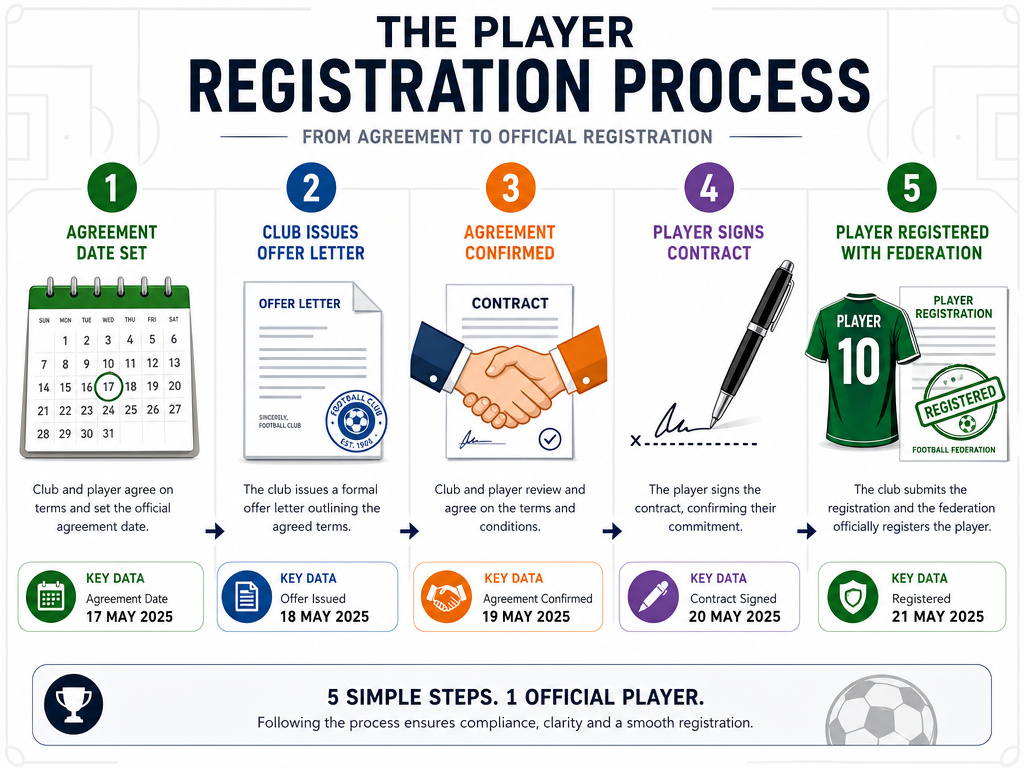
Forget the rumors and back-channel talks. The formal, rule-book process has a clear sequence. Missing a step risks sanctions.
- Window Eligibility Check (T-6 Months): The player’s club confirms the contract expiry date. For contracts expiring on July 1, the window opens January 1.
- Written Notification (Before Negotiation): The interested club sends a formal, written notice to the player’s current club, stating its intent to negotiate. This satisfies the FIFA Article 18.3 requirement.
- Negotiation & Agreement: The player (and their agent) negotiates terms with the new club. This covers salary, contract length, bonuses, and image rights.
- Signing the Agreement: Both parties sign the document. This is the critical legal moment most people misunderstand, which we’ll get to next.
- Registration (Upon Contract Expiry): On the date the old contract expires (e.g., July 1), the new club registers the player with its national association, completing the free transfer.
Where this goes sideways: Clubs or players assuming the signed agreement is just a “gentleman’s agreement” or is conditional on a medical. FIFA’s Article 18.4 explicitly states a contract’s validity cannot be subject to a successful medical or work permit. If you’ve signed, you’re likely bound.
The agent’s role is pivotal here, navigating both the formal rules and the informal market. Their work culminates in the document that gets signed—a document that could be much more powerful than anyone intends.
The Legal Reality: Is a “Pre-Contract” Actually Binding?

This is the most important part of the guide, and the one most football media glosses over. In the eyes of the law, especially FIFA’s judicial bodies, the label “pre-contract” is almost meaningless.
FIFA’s Dispute Resolution Chamber (DRC) jurisprudence does not formally recognize “pre-contracts.” Their position, backed by the Court of Arbitration for Sport (CAS), is straightforward: if a signed document contains all the essential elements of an employment contract (essentialia negotii), it is a binding employment contract. Full stop. These essentials are the parties involved, the contract duration, and the remuneration.
CAS Panel Determination (2008): “The relevant contract was not a ‘pre-contract’ but a definite employment contract because it contained all the essentialia negotii.”
So when a player and a club sign a “pre-contract agreement” with salary, start date, and length specified, they haven’t signed a promise to make a contract later. They’ve signed the actual contract that takes effect on a future date. This isn’t a theoretical point. It’s been tested in court.
In a case cited by legal analysts, a Chinese club signed a “draft employment contract” with a player in 2014, then later refused to honor it. FIFA’s DRC ruled it was a binding contract terminated without cause and ordered the club to pay the player €330,000 in compensation. The label “draft” or “pre-” didn’t protect them.
This creates a potential gap between some industry perceptions and the enforceable position of FIFA’s judicial bodies. While the industry often talks about “agreeing a pre-contract,” FIFA’s DRC and CAS jurisprudence holds that a signed agreement with essential terms is a binding employment contract. This disconnect is where expensive disputes are born.
Famous Cases and What Happens When It Breaks Down
When one side tries to back out of a signed agreement, the consequences are severe and financial. The rules on compensation are explicitly laid out in FIFA’s regulations.
A notable case is that of Scottish midfielder Richard Brittain in 2013. He signed a pre-contract with St Johnstone, then had a change of heart and signed a new deal to stay at Ross County. St Johnstone insisted the agreement was binding and threatened legal action. The dispute was resolved only after Ross County agreed to pay St Johnstone compensation. The dispute was resolved after Ross County agreed to pay St Johnstone compensation.
FIFA’s Article 17 covers the consequences of a breach without “just cause.” The penalties are twofold:
- Compensation: The “innocent party” is entitled to damages. The player and the new club are jointly and severally liable for this payment (Article 17.2). This means either one can be chased for the full amount.
- Sporting Sanctions: There is a presumption that any club signing a player who has breached a contract has “induced” that breach (Article 17.4). This can lead to transfer bans or point deductions.
| Action | Primary Consequence | Additional Risk |
|---|---|---|
| Player breaches signed agreement | Joint liability for financial compensation with new club. | Potential suspension from football. |
| New club induces breach | Joint liability for compensation. | Transfer ban or other sporting sanction. |
| Club refuses to honor signed agreement | Ordered to pay compensation to player for lost wages/opportunity. | Sporting sanction for contractual instability. |
This framework makes a signed pre-contract a serious financial instrument, not just a piece of paper. It’s why big clubs tread very carefully around players who have already signed agreements elsewhere, and why understanding release clauses or buy-back clauses is part of the same contractual literacy.
How This Differs From Other Agreements
It’s easy to lump all “future” deals together. But a pre-contract is structurally different from other common mechanisms.
A pre-contract agreement is a direct employment contract with a delayed start date, used for players whose deals are expiring. No transfer fee is involved.
A loan deal with an option or obligation to buy is a temporary move where a future transfer is possible. The player is already playing for the new club, and a fee is pre-agreed for a later date. The selling club still holds the registration.
A transfer agreement for a future window (like a deal agreed in January for a July move) involves an immediate transfer of registration and payment of a fee. The player’s current contract is terminated early by mutual consent.
The key distinction is the state of the player’s registration and the flow of money. Pre-contracts are about securing a free agent at the lowest cost, which is why they are such a strategic tool for clubs looking to maximize value, as detailed in analyses like the Athletic Premier League pre-contract explainer.
Frequently Asked Questions
What is the Bosman ruling?
The Bosman ruling is a 1995 decision by the European Court of Justice that fundamentally changed football transfers. It established that players could move freely to another club at the end of their contract without a transfer fee. It also created the legal basis for the six-month negotiation window, allowing players to sign pre-contract agreements during that period. You can read a full breakdown of its impact in our guide to the Bosman ruling.
Can a player back out of a signed pre-contract?
Legally, it’s very difficult and expensive. If the document contains all essential terms of an employment contract, it is considered binding by FIFA. Backing out without “just cause” (a very high legal bar) makes the player and any new club jointly liable for financial compensation to the club that was abandoned. The Richard Brittain case is a prime example.
Do all leagues have the same pre-contract rules?
No. While all are bound by FIFA’s six-month window for international transfers, domestic rules vary. England’s FA restricts domestic talks to the final month of a contract. Northern Ireland’s IFA, like many leagues in Europe, allows domestic talks in the full six-month window. Always check the specific rules of the national association.
Are youth players allowed to sign pre-contracts?
The rules are stricter and more complex for minors. FA rules in England state a player under 17 may not enter into a contract of employment except under a scholarship. FIFA’s Article 19 also restricts international transfers of players under 18. Clubs often use unique “pre-contractual” agreements or deeds of undertaking with youth players and their parents to secure future commitments, but these exist in a specialized legal gray area.
Before You Go
The biggest takeaway isn’t about dates or windows. It’s about the paper. In football’s collective imagination, a “pre-contract” is a handshake deal made official. In the eyes of FIFA’s Dispute Resolution Chamber, it’s often the final, binding contract itself. That gap between perception and legal reality is where clubs and players lose millions.
So when you read that a star has “agreed a pre-contract,” understand what likely happened: their agent received formal written notice, negotiated terms that were written into a document, and the player signed it. That signature likely triggered a legally binding employment contract that starts in July, with all the risks and penalties that entails. It’s less a promise and more a delayed-start reality. That’s the part most people miss until a dispute lands on a lawyer’s desk.
