
Free Agents in Football Explained: How to Choose
This post contains affiliate links. As an Amazon Associate, we earn from qualifying purchases.
In football, a free agent is a player not under contract. This status allows them to sign for a new club without a transfer fee. The process is governed by specific rules: a player can sign a pre-contract up to six months before their current deal ends, and they remain registered with their old national association for 30 months after their last match, which still requires an International Transfer Certificate for an international move.
The mechanics of that 30-month rule are where most fans get tripped up. FIFA states a player remains registered with their previous association for 30 months after their last match, while some analyses argue a player ceases to be registered after over 30 months of inactivity. This is a key point in how free agents in football explained are determined.
What follows is a breakdown of the two main systems, global soccer’s FIFA framework and the NFL’s collective bargaining structure, alongside the edge cases, costs, and deadlines that turn the free agents in football explained concept into a complex transaction. You’ll see why a “free” transfer is rarely free, and how a player’s age or a club’s league category can add a hidden price tag.
Key Takeaways
- A player becomes a free agent when their contract expires or is terminated, but they remain tied to their old national association for 30 months for international transfer purposes.
- Training compensation must be paid by the new club for players under 23 moving internationally, calculated via a league-category matrix, making a “free” transfer costly.
- In the NFL, an Unrestricted Free Agent (UFA) has four or more accrued seasons, while a Restricted Free Agent (RFA) has three and a qualifying offer, with exclusive rights reverting to the old club by July 22.
- Registration outside a transfer window is only permitted under FIFA’s two strict exceptions: just-cause termination or a contract that expired before the window closed.
- The Bosman ruling is reflected in rules allowing players to sign a pre-contract with a new club up to six months before their current deal ends (FIFA RSTP), which is when players are also free to negotiate without a transfer fee (Goal.com).
The Two Ways a Player Becomes a Free Agent
A contract runs out. That’s the clean version. A player serves their agreed term, the club doesn’t offer a renewal, and on a set date, they’re free. Think of a veteran player whose contract has naturally expired. The other path is messier: a mutual termination. Player and club agree to cut the cord early, often with a settlement payment. A high-profile mutual termination between a player and club fits here.
The legal status is identical, no contractual ties, but the paperwork trail differs. For a natural expiration, you need proof of the contract’s end date. For a mutual split, you need the signed termination agreement. This documentation is crucial for the next club’s compliance officer when registering the player, especially for an international move where FIFA’s Transfer Matching System (TMS) demands it.
Common mistake: Assuming a mutual termination is always amicable. It’s often a financial negotiation where the player forfeits future wages in exchange for immediate freedom, and the club clears a salary off its books. Get the paperwork wrong, and the new registration gets blocked.
How Free Agency Works in Football (Soccer)
The global rulebook for free agents in football explained is FIFA’s Regulations on the Status and Transfer of Players (RSTP). It treats a free agent not as a completely blank slate, but as a player in administrative limbo. The biggest twist is Article 4: a player stays registered with their previous national association for 30 months after their last official match. This means if they move countries within that period, their new club must request an International Transfer Certificate (ITC) from the old association. It’s a leash you can’t see.
A player remains registered with their previous national association for 30 months after their last official match. This administrative tie affects the documentation required for any international transfer during that period. . FIFA Regulations on the Status and Transfer of Players (RSTP), Article 4
The famous Bosman ruling (explained in our guide to the Bosman ruling) is baked into Article 18.3. A player can sign a pre-contract with a new club up to six months before their current deal ends. This is why you hear about stars “agreeing terms” in January for a summer move. They’re not leaving yet, but their next destination is locked in.
Can a Free Agent Play Immediately After the Transfer Window Closes?
This is where sources directly disagree, and it’s a classic case of league practice versus global regulation. A media report might state a free agent signed in early September can be registered for that season. The FIFA RSTP, and expert analysis from sports law firms, says otherwise.
According to FIFA RSTP Article 6.3, registration outside a transfer window is only allowed under two exceptions:
- The player terminated their contract with justifiable cause (e.g., unpaid wages).
- The contract expired or was terminated before the registration period closed.
If a player’s contract expires after the summer window shuts, the second exception doesn’t apply, as it requires expiry before the window closed. The letter of the global law says they wait until January. Some leagues have a squad registration deadline a week or two after the window, which might allow registration, but not necessarily eligibility if FIFA’s stricter exceptions aren’t met. Clubs sometimes gamble on this gap.
| Scenario | Can they be registered outside the window? (Per FIFA RSTP) | Likely Outcome |
|---|---|---|
| Contract expired June 30, signed September 5 | No (Exception 2 doesn’t apply; expiry was before window closed, but signing is after) | Wait for January window. |
| Contract terminated for unpaid wages in October | Yes (Exception 1 – justifiable cause) | Can be registered and play immediately upon FIFA approval. |
| Mutual termination agreed September 2 | Maybe (If termination date is legally backdated to before Sept 1) | Grey area; depends on documentation and association approval. |
How Free Agency Works in the NFL
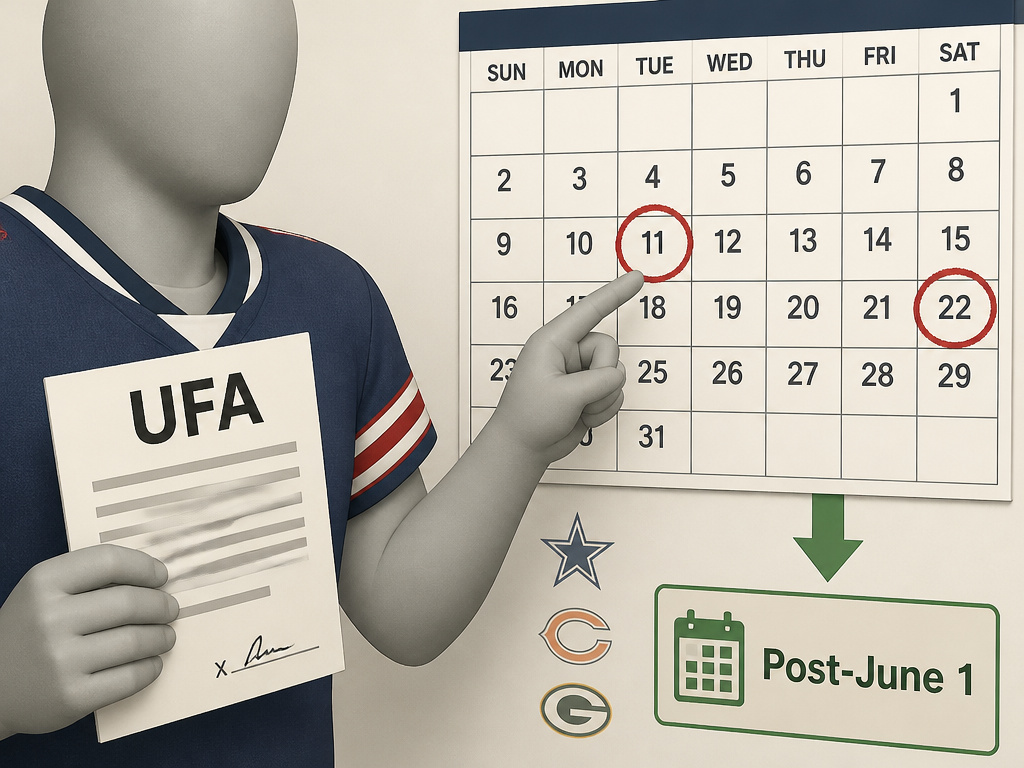
The American system is a creature of the collective bargaining agreement (CBA), not a global governing body. Status is defined by seasons accrued. An Unrestricted Free Agent (UFA) has four or more accrued seasons. They can sign with any team, no strings attached. A Restricted Free Agent (RFA) is defined by the NFL as a player with three accrued seasons who has received a qualifying offer; other sources define it as a player with three accrued seasons whose contract has expired. Other teams can make an offer, but the old club can match it. If they don’t, they might get draft-pick compensation.
The calendar is rigid. The negotiating period opens March 11. For UFAs who received a tender by April 27, exclusive rights revert back to their prior club on July 22. If no deal is done by then, the player can’t sign elsewhere that season. It’s a hard deadline that forces decisions.
A unique procedural edge case is the “post-June 1st” designation for team-cut veterans. It’s not a free agent rule per se, but it directly affects the market. By cutting a player after June 1, a team can spread a large signing bonus cap hit over two years. This often floods the market with experienced players just as teams are finalizing rosters.
The Hidden Costs of a “Free” Transfer
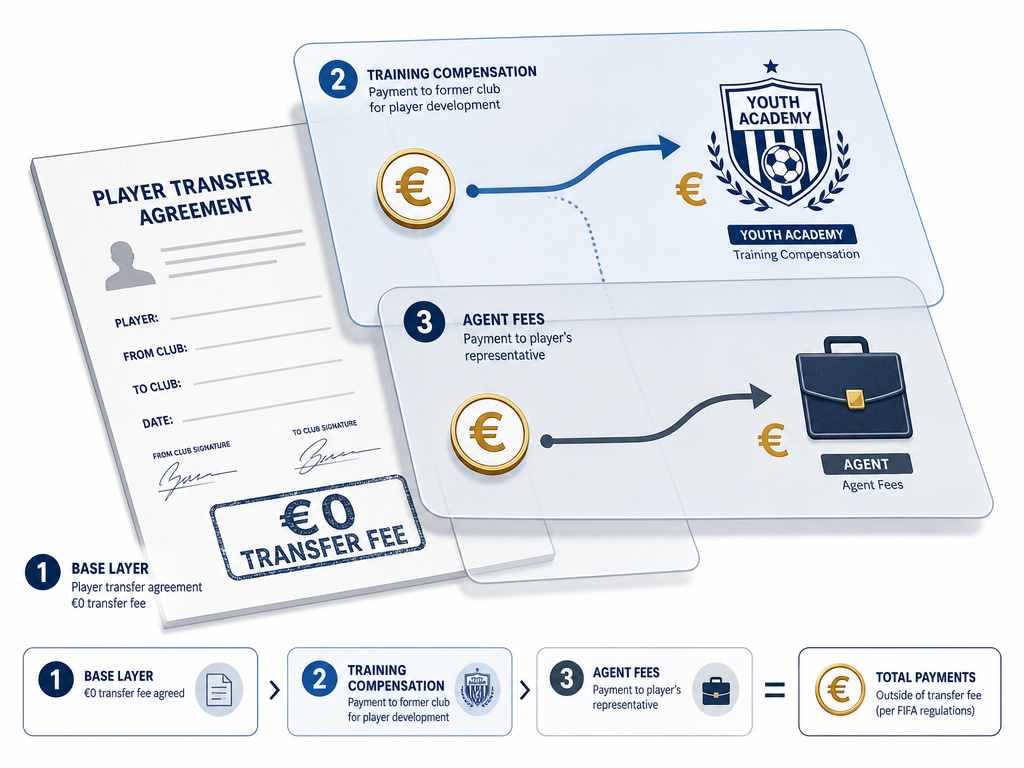
The word “free” only means no transfer fee between clubs. For the new club, the costs simply shift. A major one is training compensation, mandated by FIFA RSTP Article 20. If a player under 23 signs their first professional contract or moves internationally on a free transfer, the new club must pay compensation to every club that trained them between ages 12 and 21.
The amount isn’t random. It’s calculated using a matrix based on the training club’s and the new club’s league categories. Sign a promising 20-year-old from a Belgian club? You’re paying a fee to that Belgian club, and possibly others before them. It’s a system designed to reward youth development, and it makes a “free” signing of a young player a significant investment.
Then there are the player’s own costs. Agent fees are typically the player’s responsibility. However, if the player’s annual salary is under USD 200,000, the club can agree to pay the agent’s fees. For higher earners, that signing bonus you hear about often covers the agent’s cut. Understanding these financial layers is key to grasping the full value of a transfer.
Soccer vs. NFL Free Agency: A Side-by-Side Look
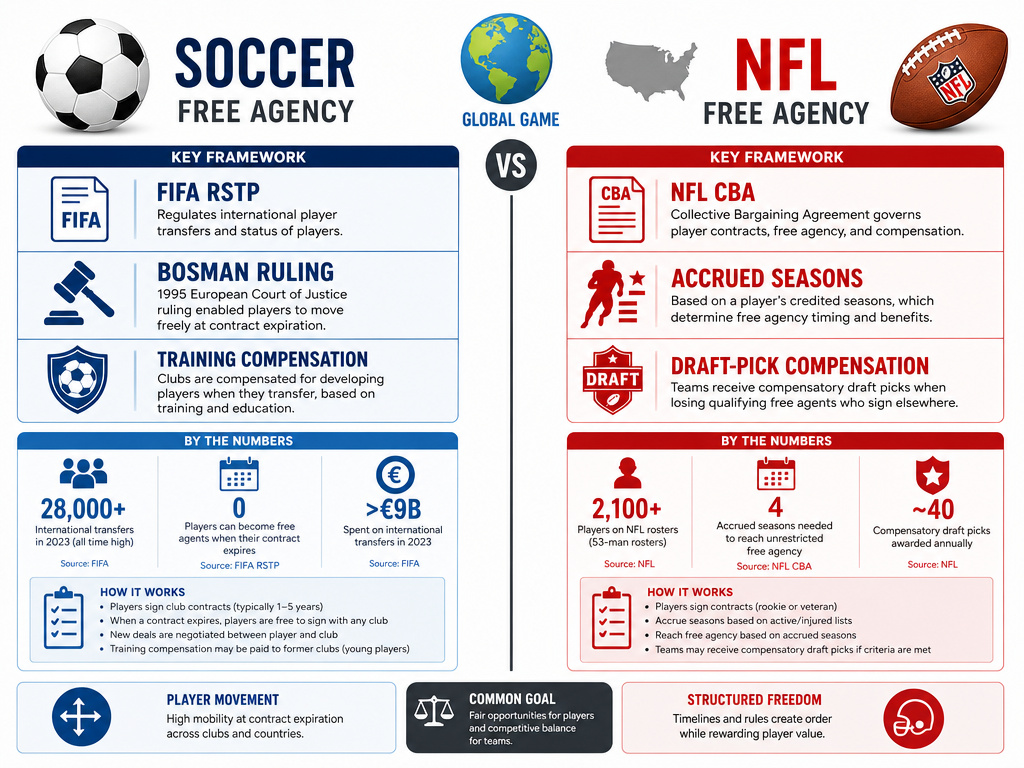
The core idea, a player out of contract, is the same. The execution is worlds apart. Soccer’s system is global, bureaucratic, and full of long-tail administrative rules like the 30-month registration. The NFL’s system is domestic, calendar-driven, and built on the draft-and-compensation model.
| Aspect | Football (Soccer) | NFL (American Football) |
|---|---|---|
| Governing Rules | FIFA RSTP (global) | NFL Collective Bargaining Agreement (domestic) |
| Key Deadline | Transfer window dates (varies by association) | July 22 (exclusive rights revert for tendered UFAs) |
| Player Status | Defined by contract expiry/mutual termination. | Defined by accrued seasons (UFA: 4+, RFA: 3). |
| Compensation to Old Club | Training compensation (for players under 23/international moves). | Draft-pick compensation (for RFAs where offer isn’t matched). |
| Registration Outside Season | Only under two strict FIFA exceptions. | N/A – free agency period is within the league year. |
| Pre-contract Signing | Allowed in final 6 months of contract (Bosman ruling). | Not permitted; tampering rules are strict. |
The NFL model is designed to maintain competitive balance through the draft. Letting a young star walk for nothing is punished with compensatory picks. Soccer’s model is trying to balance club control with player mobility, resulting in complex layers like training compensation. One isn’t better; they’re solutions to different problems in different sporting cultures.
A Free Agent’s Timeline and Process
Here is the process from the player’s perspective. With six months left on your deal, you can legally talk to other clubs about a pre-contract. Your agent starts the conversations. If you move, you’ll need a medical, and your representative will negotiate the player’s salary and bonuses.
Once the old contract ends, you’re a free agent. But if you’re moving abroad, your new club must request your ITC. Remember the 30-month rule? That’s why. The old association has a set period to respond to the ITC request. If they don’t, FIFA can issue a provisional ITC. This is usually smooth, but if there’s a dispute, say, over unpaid bonuses from your old club, it can get stuck.
Finally, registration with the new league. This is where domestic deadlines, like the Premier League’s squad submission date, come in. Miss that, and even with your ITC, you can’t play until the next window. The whole sequence relies on paperwork flowing between clubs, associations, and FIFA’s TMS. One missing document brings it to a halt.
Finding free agent lists or databases
There is no single official public database for free agents in global soccer. Clubs and agents use private networks and scouting software. For fans, the most reliable sources are the squad lists published by leagues after transfer windows close, which highlight players without a club. Sports news websites often compile and update lists of notable free agents, especially around window openings. In systems like the NFL, official lists are more structured and tied to league communications, with clear designations like unrestricted or restricted free agent. The key is to look for reputable sports news aggregators or the official player status announcements from leagues themselves.
Historical context of free agency
The modern concept of free agency in soccer was solidified by the 1995 Bosman ruling, which allowed players to move without a fee at contract’s end. Before this, clubs retained registration rights indefinitely. In American sports like the NFL, free agency was introduced through collective bargaining, creating categories like unrestricted free agents for veterans with four or more seasons and restricted free agents for those with three. These systems shifted power toward players, allowing movement and negotiation. The core principle remains: a player’s right to choose their next employer once their contractual obligations are fulfilled.
Frequently Asked Questions
Do free agents get paid?
Yes, absolutely. They sign a new contract with their new club, which includes a salary, potential signing bonus, and performance incentives. The “free” refers to the lack of a transfer fee between clubs, not the player working for free. In fact, free agents often command higher wages because the buying club has saved millions on a fee.
Is it better to be drafted or a free agent in the NFL?
It depends. A high draft pick gets a larger rookie contract and more job security. An undrafted free agent (UDFA) has no such guarantee but can choose their team situation, potentially landing in a spot with a clearer path to playing time. For established veterans, hitting free agency at the right time is the path to a massive payday, as teams bid for their services without giving up draft picks.
Can a free agent be signed at any time?
In soccer, a contract can be signed anytime. However, being registered to play for a new team is restricted by transfer windows, with the two FIFA exceptions. In the NFL, free agency is confined to specific periods in the league calendar, primarily the opening of the new league year in March.
What is a restricted free agent (RFA)?
In the NFL, an RFA is a player with three accrued seasons whose contract has expired and who has received a qualifying offer from their old club. They can negotiate with other teams, but their old club holds the right to match any offer. If they don’t match, they may receive draft-pick compensation.
What was the Bosman ruling?
The 1995 Bosman ruling was a European Court of Justice decision that fundamentally changed soccer. It established that players could move freely to another club within the EU at the end of their contract without a transfer fee, and it removed limits on the number of EU players a club could field. It’s the legal foundation for modern free agency in European soccer.
Before You Go
The next time you see a headline about a club signing a veteran on a “free,” remember the 30-month rule, the training compensation matrix, and the strict window exceptions. This isn’t just paperwork; it’s the architecture that shapes every move. The difference between a smooth transition and a blocked registration often comes down to a single date on a termination agreement.
For the player, free agency is the greatest source of power, but only if timed perfectly. For the club, it’s a chance to strengthen without a fee, but with hidden costs and administrative risk. The system is built to balance those competing interests, and it usually works, right up until a contract expires one day after a window closes. Then everyone learns the rules the hard way.
