
How Football Player Wages Work: A Guide to Pay Structures
This post contains affiliate links. As an Amazon Associate, we earn from qualifying purchases.
Professional football wages work through a written contract that must specify the currency, amount, due date, and manner of payment for all obligations. The player is then paid that salary, subject to income tax and national insurance, usually monthly. Bonuses, image rights, and expense reimbursements are layered on top, with the entire package increasingly constrained by league financial rules like UEFA’s 70% Squad Cost Ratio.
That contract is the legal spine of the whole system. Everything else, the headline figure, the tax bill, the player’s right to walk away, hangs on the specific clauses written into that document under FIFA’s global regulations and national football association rules. Understanding how football player wages work begins with this foundational agreement.
What follows is a breakdown of the machinery of how football player wages work: the legal definitions that decide who gets taxed, the common bonus structures that inflate reported figures, the global financial caps now in force, and the one number from the 2026 FIFPRO deal that changes the stakes for unpaid wages. By the end, you’ll be able to read any salary story and know exactly what it leaves out.
Key Takeaways
- A player is only a professional under FIFA rules if they have a written contract and are paid more for football than their expenses, not based on a country’s minimum or average wage.
- Reported salaries are almost always gross figures before tax; English media uses weekly amounts, Europe uses annual, and South America often uses monthly net, making direct comparisons misleading.
- Clubs failing to pay salaries now face an 8% interest rate on overdue payments under the 2026 FIFPRO and FIFA agreement, alongside stronger enforcement mechanisms.
- Non-contract players can be reimbursed for travel and kit without becoming taxable employees, but any regular payment or performance bonus triggers full PAYE and National Insurance.
- Major leagues now enforce squad cost caps (e.g., UEFA’s 70%, Premier League’s 85% of revenue) that tie wage spending directly to club income, not owner wealth.
The Professional vs. Amateur Divide (And Why It Matters)
Forget the glamour for a second. The entire payment structure hinges on a single, dry definition from FIFA’s rulebook. A player is a professional only if they have a written contract and are paid more for their football activity than the expenses they effectively incur. Everything else is amateur status.
That definition creates edge cases you wouldn’t expect. A player can be a professional even if they earn “much less than the average salary” in their country. Conversely, someone can be an amateur even if their compensation exceeds the national minimum wage. The test is purely football-specific: does the payment cover more than boots, travel, and kit? If yes, it’s a professional contract. That legal distinction dictates everything about tax, employment rights, and even a player’s ability to move clubs.
A player is a professional only if they have a written contract and are paid more for his footballing activity than the expenses he effectively incurs. All other players are considered to be amateurs.. FIFA Regulations on the Status and Transfer of Players.
The practical difference is stark. A professional’s contract must define the currency, amount, due date, and manner of payment for all financial obligations. If the club unlawfully fails to pay at least two monthly salaries on their due dates, the player has “just cause” to terminate the deal. An amateur, or a “non-contract” player as they’re often called in England, operates in a greyer zone. They can be reimbursed for reasonable travel and necessary kit without being deemed an employee. But the moment they receive a regular round-sum payment or a performance bonus, the tax authorities and The FA reclassify them as an employee. Suddenly, PAYE and National Insurance apply.
Deconstructing the Pay Packet: More Than Just a Salary
The headline figure is a magnet in any discussion of how football player wages work, but it’s rarely the whole story. The core is the basic wage, fixed in the contract. On top of that, clubs stack conditional payments that can massively inflate the total package.
Common Bonus Structures:
- Appearance Fees: Paid per match, sometimes tiered for starting vs. Substitute.
- Performance Bonuses: Goals, assists, clean sheets for defenders and goalkeepers.
- Team Success Bonuses: Payments for winning trophies, achieving promotion, or avoiding relegation.
- Signing-On Fees: A lump sum agreed upon when signing, often paid in instalments over the contract’s life.
- Loyalty Bonuses: Payments triggered by staying at the club for a defined period.
Then there are image rights payments. Clubs pay separately for the right to use a player’s likeness in marketing. This is often routed through a player’s personal company and has its own complex tax implications. Furthermore, agent fees are typically paid by the club, not deducted from the player’s wage, though they are a major cost in any transaction.
The solidarity mechanism is a crucial, often overlooked, element of the transfer economy. When a player is transferred for a fee during the term of their contract, 5% of that fee is set aside. It’s distributed to every club that trained him between the ages of 12 and 23. Each season from 12-15 earns that club 0.25% of the total fee; each season from 16-23 earns 0.5%. This is how a local academy can receive a windfall years after a player has left.
| Payment Component | Paid By | Taxable as Income? | Key Consideration |
|---|---|---|---|
| Basic Salary | Club | Yes (Gross) | Fixed, contractually guaranteed. |
| Performance Bonus | Club | Yes (Gross) | Conditional on metrics (goals, appearances). |
| Signing-On Fee | Club | Yes (Gross) | Often spread over contract length. |
| Image Rights | Club | Yes (Subject to structure) | Frequently paid to a player’s company. |
| Expense Reimbursement | Club | No (if legitimate) | Must be for actual costs (travel, kit). |
| Agent Fee | Club (usually) | No (to player) | A club cost, not a player deduction. |
The Tax Maze: Gross, Net, and Special Regimes
Here is the thing about that massive weekly wage you read about: it’s almost certainly a gross figure, and it’s probably quoted in a way that makes cross-border comparison useless. English media reports gross weekly numbers. Continental Europe uses gross annual figures. South American reports often use monthly net sums. Comparing them directly is a recipe for confusion.
The real take-home pay is what’s left after tax and social contributions. This is where geography is destiny. A European Parliament study bluntly states it is “rather difficult to compare the individual tax burden of a football player on a country-by-country basis.” National systems vary wildly, and special regimes for incoming foreign workers, like Italy’s Regime dei lavoratori impatriati or Spain’s former Beckham Law, can slash the tax bill for new signings. Two players with identical gross salaries in the same league can have drastically different net pay because of their residency status.
Where this goes sideways: Assuming a “£100,000-a-week” salary in England is comparable to a “€6 million-a-year” salary in Italy. Before tax, exchange rates, and residency rules, you’re not comparing like with like.
For non-contract players, the rules are precise. The FA’s guide, based on HMRC policy, states they can be reimbursed for travel to matches and training at approved mileage rates, and for necessary kit like boots, without triggering a tax liability. However, reimbursement for travel to their “normal place of work” (the home ground or training ground) is taxable. The line is fine, and crossing it, by paying a regular flat “appearance” fee, transforms a hobbyist into an employee with full tax obligations overnight.
The New Rules: Wage Caps and Player Protections

For decades, wages were limited only by a club’s ambition (or its owner’s bank account). That changed with UEFA’s Financial Fair Play and has evolved into a new era of direct squad cost controls. The goal is to tether spending to income, promoting sustainability.
UEFA’s current Squad Cost Ratio caps spending on wages, transfers, and agent fees at 70% of a club’s adjusted revenue. This was phased in: 90% in 2023/24, 80% in 2024/25, and 70% from 2025/26. The Premier League has its own version, the Squad Cost Ratio (SCR), set at 85% of football revenue, in force from the start of the 2026/27 season. Brazil’s CBF has also implemented a Financial Sustainability System requiring squad cost to be at or below 70% of the sum of revenue, transfers, and capital injections. These aren’t soft guidelines; breaches lead to significant fines and sporting sanctions, fundamentally reshaping how clubs approach their squad cost management.
Perhaps the most significant recent development for players is the 2026 agreement between FIFPRO and FIFA. It introduces a Global Social Dialogue Platform and, more concretely, stronger enforcement for unpaid wages. Clubs that fail to pay salaries will now face an eight percent interest rate on overdue payments. This formalises a financial penalty that makes delay far more costly for clubs. The agreement also refines “joint liability mechanisms” to guarantee remuneration for the vast majority of players worldwide, a direct response to systemic payment failures in some leagues. This collective bargaining agreement details a major shift in labor standards.
How Wages Shape and Are Shaped by the Transfer Market
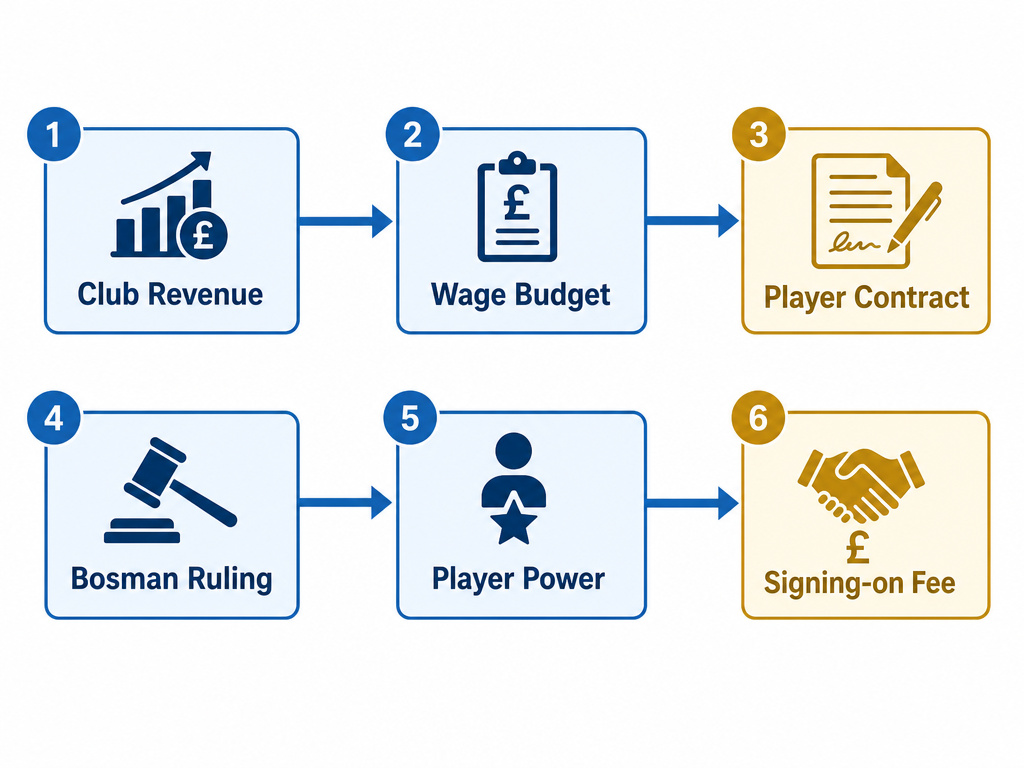
The transfer market and the wage bill are two sides of the same coin, governed by the same Financial Fair Play regulations. The landmark event that supercharged player power was the Bosman ruling in 1995. By allowing players to move for free at the end of their contracts, it shifted bargaining power from clubs to players. The resulting competition for free agents caused wages to spike, as signing-on fees became a tool to attract talent without a transfer fee. Understanding the Bosman ruling’s impact on transfers is essential to understanding modern wage inflation.
When a transfer does involve a fee, that money goes to the selling club. The player does not receive a direct cut. Their benefit comes via the new contract and any signing-on fee negotiated with the buying club. This is why the contract length is a crucial factor in negotiations. A player with two years left has less power than a player entering the final year, who can negotiate a pre-contract agreement with another club six months before expiry. The threat of leaving for free often leads to improved terms, either with the current club or a new one via a pre-contract agreement.
Ultimately, a club’s ability to pay wages is constrained by its sources of revenue: broadcasting deals, commercial partnerships, and matchday income. The squad cost rules explicitly link spending to these revenue streams. This creates a feedback loop: success boosts revenue, which allows for higher wages, which can attract better players to sustain success. The system is designed to prevent clubs from short-circuiting this loop with owner-funded spending sprees, tying the drama on the pitch more closely to the health of the balance sheet.
What are the financial regulations for football clubs?
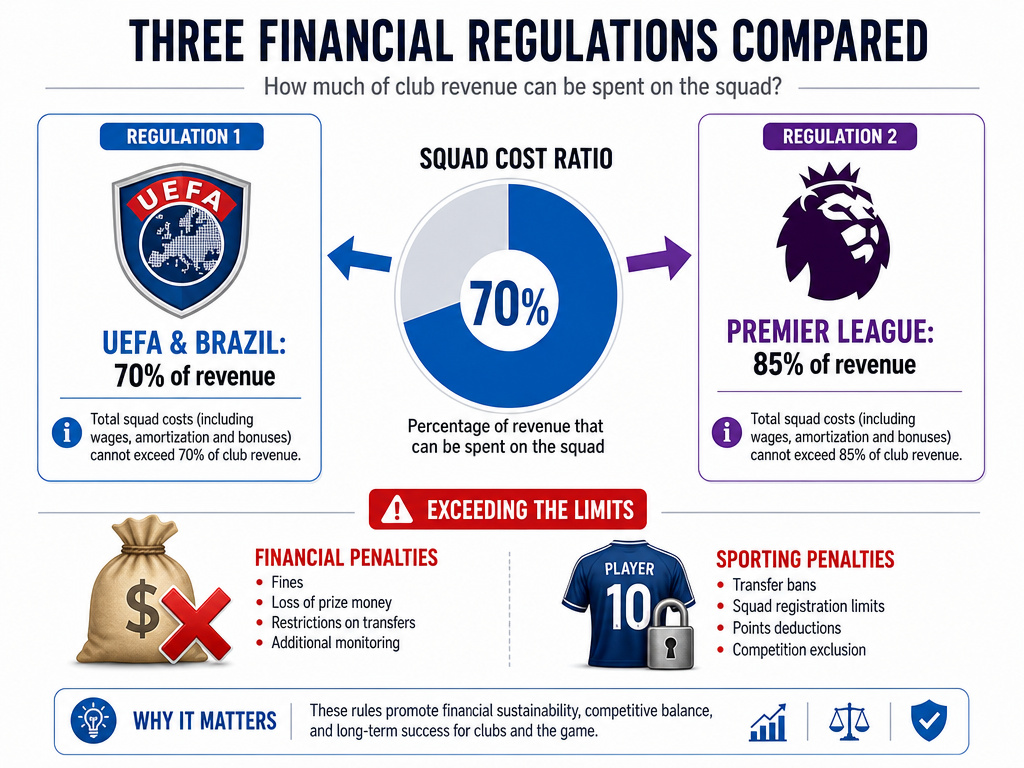
While football has no single league-wide salary cap like the NFL, major competitions enforce squad cost ratios. UEFA’s rule caps total squad spending at 70% of a club’s adjusted revenue. The Premier League’s version sets a limit at 85% of football revenue. Brazil’s system also uses a 70% threshold. These rules are designed to prevent clubs from spending beyond their means. They calculate the cost of the entire playing squad, including wages and transfer fees, against a club’s income. Clubs that exceed these limits face penalties, which can include fines or restrictions on registering new players.
What is guaranteed money in a football contract?
A player’s contract must clearly state the currency, amount, due date, and manner of payment for all financial obligations. This includes the base salary, which is typically guaranteed. However, contracts also include non-guaranteed elements like performance or loyalty bonuses, which are only paid if specific conditions are met. All these payments must be recorded gross in the contract and are subject to standard tax deductions. Crucially, the money must be paid directly to the player, not to a company or agency. If a club fails to pay at least two monthly salaries on time, the player has legal grounds to terminate the contract.
How do rookie and minimum salaries work?
There is no universal minimum wage for footballers. A player’s professional status depends on having a written contract and being paid more than their expenses, not on reaching a specific salary level. A player can be a professional even earning far less than a country’s average wage. For non-contract players, the rules are stricter: they are only considered to be ‘playing for the love of the game’ if they receive no more than reimbursement for reasonable expenses like travel or kit. Any regular payment or performance bonus would trigger employee status and tax obligations for them.
Frequently Asked Questions
Are footballers paid weekly or monthly?
Despite the weekly figures used in British media, players are almost always paid monthly. The contract will specify the exact due date, often at the end of the month. Bonuses might be paid on different schedules, such as quarterly or after season’s end.
Does a player get a percentage of their transfer fee?
No. The transfer fee is paid between clubs. The player’s financial gain comes solely from the terms of their new contract with the buying club, including any signing-on fee. The old club’s club revenue gets the fee, while a slice (5%) is distributed via the solidarity mechanism to their training clubs.
What happens if a club doesn’t pay a player’s wages?
Under FIFA rules, if a club unlawfully fails to pay at least two monthly salaries on time, the player has “just cause” to terminate their contract as a free agent. Under the new 2026 FIFPRO/FIFA agreement, overdue payments also accrue interest at an 8% rate, and players have a more direct route to FIFA for enforcement.
What’s the difference between a “non-contract” and an “amateur” player?
In practice, they are similar. Both are not full professionals under FIFA’s definition. The key in the UK is tax: a non-contract player can receive reimbursed expenses without being a taxable employee. The moment they receive a regular payment or performance bonus, they are reclassified as an employee for tax purposes, with full PAYE and National Insurance due.
Before You Go
The next time you see a staggering wage figure, pause. Ask three questions: Is it gross or net? Is it weekly or annual? And what untold taxes or special residency rules apply? The difference between the headline and the bank transfer can be millions.
The system is evolving from a free-for-all to a regulated ecosystem. The 70% squad cost rules and the 2026 FIFPRO agreement with its 8% penalty aren’t just details; they’re the new guardrails. They mean a club’s player valuation must now account for not just talent, but also the long-term cost of that talent against a fixed revenue ceiling. Wages aren’t just a reward for skill; they’re the central variable in football’s financial stability equation. Getting that equation wrong doesn’t just lose you a player, it can now cost you a place in the league.
