
The Bosman Ruling Explained: What It Changed in Football
This post contains affiliate links. As an Amazon Associate, we earn from qualifying purchases.
The Bosman ruling fundamentally reshaped football by establishing two core rights under EU law. First, an out-of-contract player can move between clubs in different EU member states without a transfer fee. Second, clubs cannot be limited in how many professional players from other EU nations they field. The Bosman ruling explained these changes, decided by the European Court of Justice on 15 December 1995, which shifted power to players and altered the sport’s financial and competitive landscape forever.
This legal earthquake didn’t just create free agency; it rewrote the rules of squad building and player mobility. The story isn’t just about a court date. It’s about a Belgian midfielder’s blocked move, a lengthy legal battle, and a set of dominoes that are still falling today. What follows is the chain of cause and effect—the legal basis, the famous transfers it enabled, and the messy, often unintended consequences that followed.
Key Takeaways
- The ruling, Case C-415/93, struck down two restrictive practices: transfer fees for out-of-contract EU players moving between countries, and nationality-based quotas limiting the number of professional players from other EU Member States a club could field.
- Players can now sign a pre-contract agreement with a new club when their current deal has six months or less remaining, a direct result of the ruling that defines the modern Bosman transfer.
- A 2021 study in the Journal of Sports Economics found the ruling increased national team competitiveness but argued it reduced competition in the Champions League by widening the financial gap. This contrasts with the European Commission’s initial position and some legal commentary, which held that liberalizing the labor market would increase competition.
- The ruling’s principles do not apply universally: fees still exist for players under 24 (FIFA training compensation), and quotas are still allowed for non-EU players.
- Its legacy is a double-edged sword: greater player freedom and higher wages versus increased financial inequality between elite and smaller clubs.
The Case That Started It All: Who Was Jean-Marc Bosman?
In 1990, Jean-Marc Bosman was a Belgian midfielder for RFC Liège. His contract expired, and he agreed to join French club USL Dunkerque. But Dunkerque refused to pay the transfer fee Liège demanded. Under the football association rules of the time, this meant the transfer was blocked, and Bosman was stuck. He was unable to complete his move and remained at Liège under unfavorable terms.
That’s the part most people miss. This wasn’t about a player under contract wanting out. This was about a player whose deal was done, whose obligations were fulfilled, being held hostage by a system that treated him as property. Bosman took his case to court in Belgium, arguing the rules violated European Community law on the free movement of workers. The Belgian court, the Cour d’Appel in Liège, wasn’t sure and asked the European Court of Justice for a definitive interpretation. That reference, made on 1 October 1993, set the stage.
The legal heart of the case was Article 48 of the EEC Treaty (now Article 45 of the Treaty on the Functioning of the European Union), which guarantees the freedom of movement for workers within the European Union. The court had to decide if professional footballers were “workers” under this law, and if the sport’s peculiar transfer and quota rules could be justified.
The ECJ’s answer, delivered on 15 December 1995, was a resounding yes to the first question and a firm no to the second. Footballers were workers, and the rules in question were illegal restrictions on their fundamental EU rights. The system of player transfers would never be the same.
What Did the Bosman Ruling Actually Do?
The court’s judgment had two operative parts, each targeting a specific set of restrictive rules, which the Bosman ruling explained. It’s crucial to separate them, as their impacts were distinct.
First, it abolished transfer fees for out-of-contract players moving between EU nations. Article 48, the court ruled, “precludes the application of rules… Under which a professional footballer… May not, on the expiry of his contract with a club, be employed by a club of another Member State unless the latter club has paid to the former club a transfer, training or development fee.” In plain English: if your contract is up, you can move to another EU club for free. Your old club gets nothing.
Second, it struck down nationality-based quotas for EU players. The same article also “precludes the application of rules… Under which, in matches in competitions which they organize, football clubs may field only a limited number of professional players who are nationals of other Member States.” This directly targeted UEFA’s “3+2” rule, which allowed only three foreign players and two “assimilated” players in European competition matchday squads.
| Restriction Before Bosman (1995) | Legal Status After Bosman Ruling | Immediate Consequence |
|---|---|---|
| Transfer fee required for out-of-contract player moving between EU countries. | Illegal under Article 48 EEC Treaty. | Players gained free agency at contract end. |
| UEFA’s “3+2” limit on foreign EU players in European competitions. | Illegal under Article 48 EEC Treaty. | Clubs could field unlimited EU nationals. |
| Domestic league quotas on EU players (e.g., Italy’s legge stranieri). | Illegal under Article 48 EEC Treaty. | Leagues opened to full EU-wide talent pools. |
The ruling was not retroactive for fees already paid, but its effect was instantaneous for the future. The free agent market was born overnight.
The New Reality: Bosman Transfers and Pre-Contracts
So how does a “Bosman” actually work today? It’s built around the pre-contract agreement.
When a player’s contract has six months or less remaining, they are legally free to negotiate with and sign a binding contract with a new club, to take effect when their current deal expires. This is the modern mechanism of the Bosman ruling. The selling club has no say and receives no fee. For the buying club, it’s a chance to secure a valuable asset for free, often offering a hefty signing bonus and higher wages instead. For the player, this is their strongest bargaining position.
This process, which the Bosman ruling explained, defines the timing and rules of transfer windows. A flurry of pre-contract agreements are typically announced in January, for moves that will happen the following July. It’s a high-stakes game of poker that reshapes squads.
Common mistake: Calling any free transfer a “Bosman.” A true Bosman transfer specifically involves a player moving between clubs in different EU (or EEA) national associations at the end of their contract. A free transfer within the same country, while similar, operates under that nation’s domestic rules, which merely aligned with the Bosman principle.
The first high-profile players to benefit understood the power shift immediately. Edgar Davids moved from Ajax to AC Milan in 1996, and Steve McManaman’s 1999 switch from Liverpool to Real Madrid was dubbed “Britain’s first high-profile Bosman departure.” These moves showed that top talent could now control their destiny and capture their full market value in negotiations, significantly impacting player wages.
The Domino Effect: Intended and Unintended Consequences
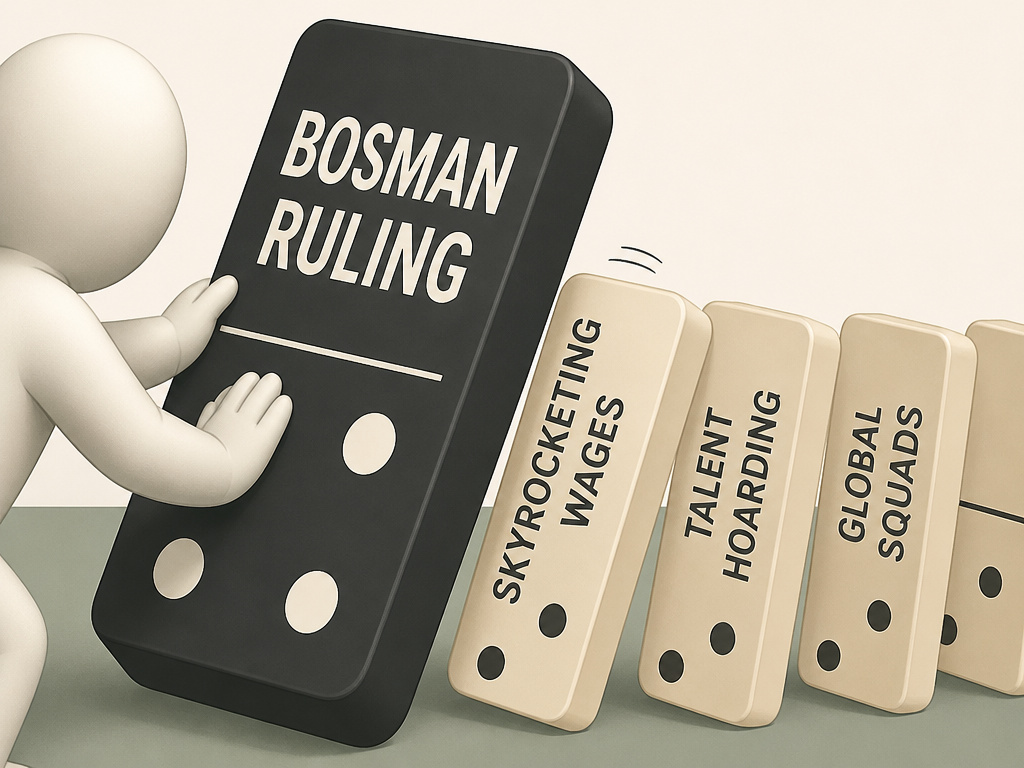
The Bosman ruling didn’t just change a procedure; it altered the ecosystem. The consequences were both liberating and destabilizing.
Player Power & Wages: This is the most direct effect. With the threat of leaving for free, players gained immense bargaining power. Clubs, desperate to retain assets, offered longer contracts and much higher wages to avoid losing them for nothing. The ruling is a key reason player salaries skyrocketed in the late 1990s and 2000s. Agents became more powerful as navigators of this new free-agency landscape.
The Squeeze on Smaller Clubs: For clubs outside the elite, the dynamics changed brutally. Before, a club could develop a talent and be guaranteed a transfer fee when they sold, even at the end of a contract. After Bosman, if you couldn’t tie a youngster to a long-term deal, you risked losing them for nothing. This created a “sell early or lose everything” pressure, funneling talent and money toward richer clubs who could afford the security of long contracts and big wages.
This is where the academic research gets specific. A 2021 study in the Journal of Sports Economics used the ruling as a natural experiment. It concluded that while the Bosman ruling increased national team competitiveness (by giving players more experience in different leagues), it reduced competition in the Champions League. The reason? Top clubs hoarded talent, and smaller clubs sold their best players rather than try to compete with them. This validated UEFA’s own concern; by 2005, UEFA declared it was seeking to repair aspects of the ruling believed to cause the rich-poor gap.
Globalization of Squads: With EU quotas gone, the remaining “foreign” slots in squads were exclusively for non-EU players. This didn’t limit diversity—it redirected it. Clubs filled those slots with talent from South America, Africa, and Asia, genuinely globalizing top-level squads in a way that was impossible under the old “3+2” system.
Where the Bosman Rule Doesn’t Apply: Key Exceptions and Limits
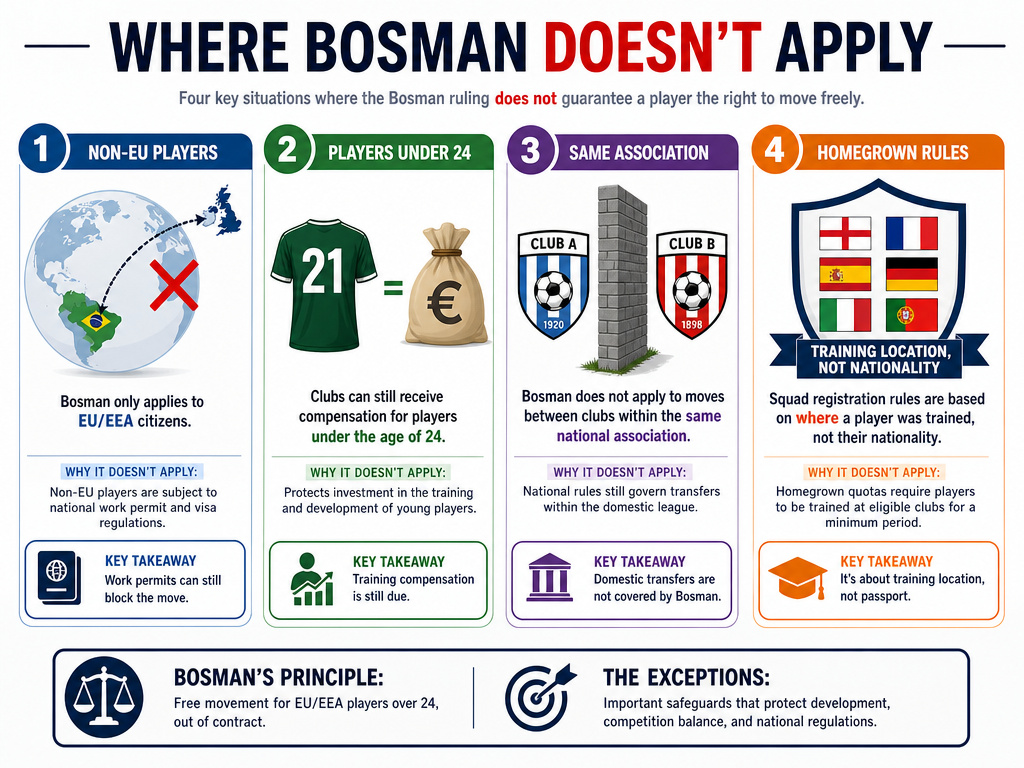
The ruling is powerful, but it’s not a magic wand that made all football transfers free. Several important limits and exceptions create the nuanced system we have today.
Non-EU Players: The Bosman right to free movement applies specifically to workers within the European Union (and later the European Economic Area). A player moving from Brazil to England, or from Japan to Italy, has no automatic Bosman right. Their transfers still require international transfer certificates, work permits, and are often subject to fees. This created a two-tier system.
Players Under 24: The ruling did not abolish fees for very young players. FIFA’s Regulations on the Status and Transfer of Players established a system of “training compensation” for players moving at the end of their contract before the age of 24. This is meant to compensate clubs for their investment in youth development. So a 21-year-old leaving on a free still generates a fee, which is a major point of confusion.
Transfers Within the Same Association: The ECJ ruling explicitly applies to a player moving “from a club within one EU association to a club within another EU association.” The legal force for a move between two English clubs, for example, comes from the English FA aligning its rules with the principle, not from direct ECJ jurisdiction over a domestic transfer.
Homegrown Player Rules: This is a critical evolution. The Bosman ruling banned discrimination based on nationality. It did not ban rules based on training location. UEFA’s subsequent “homegrown player rule”—which requires a minimum number of club-trained and association-trained players in a Champions League squad—has been upheld by the ECJ (e.g., in the Bernard case, 2010) because it applies equally to all nationalities and aims to encourage youth development, not restrict movement.
The Lasting Legacy: A Football Revolution
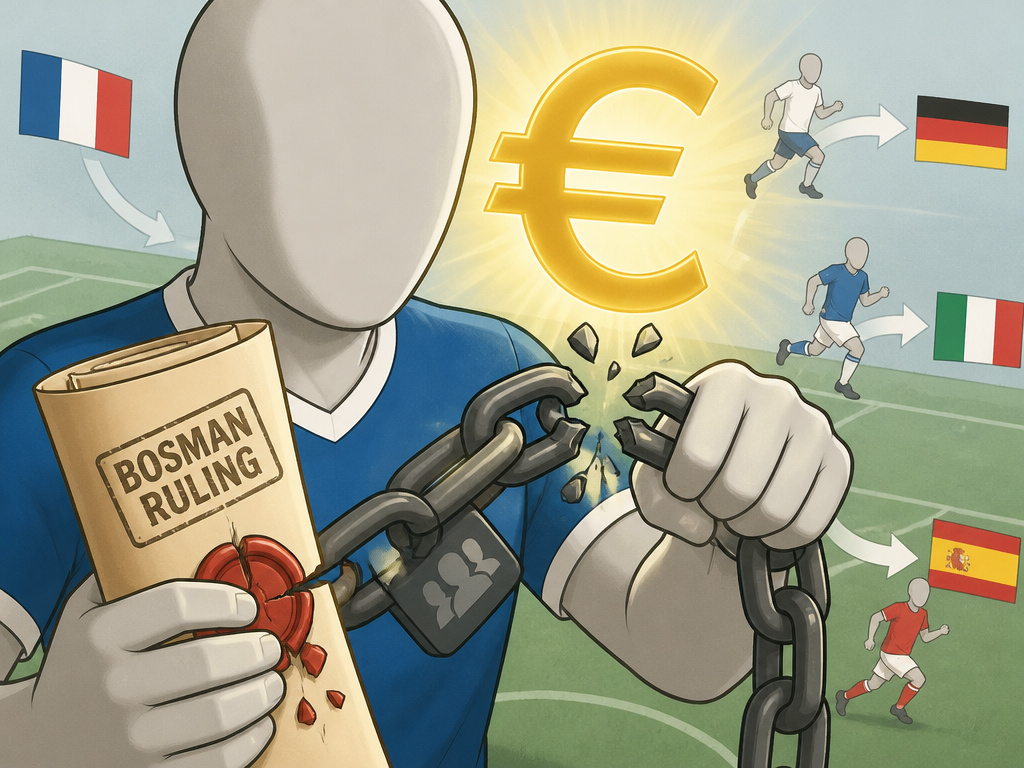
The Bosman ruling was a revolution dressed in legal parchment. It transferred power from institutions to individuals, from clubs to players. It made the sport wealthier and more global, but also more economically stratified.
It also set a precedent. The ruling was distinguished but followed in other sports, like the Lehtonen case in basketball. It influenced later rulings like Kolpak, which extended similar principles to countries with EU association agreements. The entire framework of Financial Fair Play rules and modern regulations governing the transfer system are, in part, attempts to manage the financial forces Bosman unleashed.
The story behind the scoreline is better. It’s not just about free transfers; it’s about a midfielder from Liège who took on the football establishment and won, using the fundamental laws of Europe. He reshaped the career arcs of thousands of players, the business models of every club, and the very composition of the teams we watch. The game before Bosman and the game after are, in many ways, two different sports.
Does the Bosman ruling apply to basketball?
The Bosman ruling’s principles of free movement for workers within the EU apply to all professional sports, including basketball. The European Court of Justice directly considered its application to basketball in a later case involving FIBA’s transfer deadlines. This confirmed that the core legal principles established for football players also protect athletes in other sports from restrictions that violate EU free movement rules. While the specific mechanics of player transfers and quotas can differ between sports federations, the fundamental right of an out-of-contract EU player to move freely to another club within the EU without a transfer fee is protected. This has shaped how European basketball leagues manage player contracts and squad composition.
Frequently Asked Questions
What is a Bosman transfer in simple terms?
Bosman transfer is when a professional footballer moves to a new club in a different EU country for free at the end of their contract. It’s named after Jean-Marc Bosman, whose 1995 court case established this right under EU free movement laws.
Did the Bosman ruling ruin football? It didn’t ruin it, but it fundamentally changed its economics. The ruling increased player freedom and wages but also accelerated financial inequality between rich and poor clubs. A 2021 study argued it made Champions League competition less balanced while improving national teams, a point that is debated among analysts.
Can a club stop a Bosman transfer?
No. Once a player’s contract expires, their club has no legal right to demand a fee or prevent the move to another EU/EEA club. A club’s only option is to attempt to renew the player’s contract before the last six months, when discussions for a future contract can start.
What’s the difference between a Bosman and a free transfer?
All Bosman transfers are free transfers, but not all free transfers are Bosmans. “Bosman” specifically refers to an end-of-contract move between clubs in different EU/EEA nations. A free transfer within the same country (like an English player moving between two Premier League clubs) operates under that nation’s adapted rules.
Are there any transfer fees in a Bosman move?
Typically, no fee is paid between clubs for the player’s registration. However, if the player is under 24, FIFA rules require the new club to pay “training compensation” to the clubs that developed them. Also, players and agents often receive large signing bonuses, effectively redirecting the money that would have been a transfer fee.
