
Transfer Windows in Football Explained: How to Choose
This post contains affiliate links. As an Amazon Associate, we earn from qualifying purchases.
A football transfer window is a registration period set by a national football association when clubs can officially register new players for their competitions. FIFA rules allow a maximum of 16 weeks of registration time per country per year, typically split into a longer summer window (up to 12 weeks) and a shorter winter window (up to 4 weeks). The player’s new association’s window must be open for the registration to be valid.
That distinction between agreeing a deal and registering a player is the whole game. You can negotiate a transfer in a pub in May, but the player can’t pull on the shirt until his new federation’s registration period opens. This system, built on FIFA’s Regulations on the Status and Transfer of Players (RSTP), exists to preserve “contractual stability”, a fancy term for stopping clubs from poaching each other’s players mid-season. The concept of transfer windows in football explained is central to this process.
What follows is a walk through the calendar, the global misalignment, and the very specific cracks in the rules that agents and clubs use to their advantage, a journey that begins with the transfer windows in football explained. By the end, you’ll read transfer gossip with a different eye.
Key Takeaways
- The 16-week annual limit is FIFA’s bedrock rule, with Europe traditionally using 12 weeks in summer and 4 in winter.
- Registration, not negotiation, is what a window controls. Deals can be agreed anytime but only finalized when the buying club’s window is open.
- The FIFA Transfer Matching System (TMS) automatically blocks any international transfer attempted outside the correct registration period.
- Free agents can sign anytime, but sources note they must have become free agents within a transfer window, or, as another source states, been released by their previous club before the end of the transfer window.
- Special emergency registrations are allowed, like when a club has no fit goalkeepers, and loans have their own post-window deadlines.
A Brief History: From March Madness to Modern Windows
The system of two defined windows is younger than the Premier League itself. It was introduced for the 2002/03 season. Before that, in England, players could be traded right up until 31 March, a date chosen because any later was felt to undermine the competition’s integrity. The change came as part of a compromise with the European Commission, aiming to balance a player’s right to move with a club’s right to some squad stability.
This was the final step in a long evolution of player power. The old system gave clubs greater control over player registrations. Windows were introduced as part of a compromise with the European Commission, aiming to balance a player’s right to move with a club’s right to some squad stability. Then A series of legal rulings, including the Bosman ruling in 1995, increased player mobility. Windows were, in part, a reaction to that new freedom, an attempt to reintroduce some order to the chaos.
The Core FIFA Rules: 16 Weeks, Two Windows
FIFA’s framework is simple on the surface. The world governing body says each country should allow transfers for 16 weeks each year. In Europe, a long-standing precedent reserves four of those weeks for a mid-season winter window, though FIFA’s RSTP allows the second period to be 4-8 weeks. That leaves 12 weeks for the summer trading period under the common European model.
National associations decide their exact dates within those limits. The regulations refer to these as “registration periods,” which is the more accurate term. The common phrase “transfer window” is media shorthand.
According to FIFA’s Regulations on the Status and Transfer of Players, there shall be two registration periods per season: a longer one (maximum twelve weeks) in the break between seasons, and a shorter one. The combined total cannot exceed 16 weeks per season.
This is where a key source disagreement pops up. Some summaries, like Wikipedia, state the winter window “may not exceed four weeks.” However, a detailed regulatory analysis citing the FIFA RSTP states the second period must be between 4 and 8 weeks. The 8-week upper limit still respects the 16-week annual cap if the summer window is shortened accordingly.
The rules only govern registrations into an association. A club in a league where the window is closed can still sell a player to a club in a league where the window is still open. The player’s registration is moving to an open window, so the transfer is valid.
| Rule | FIFA Framework | Common European Implementation |
|---|---|---|
| Total Yearly Time | Max 16 weeks per country | 16 weeks |
| Summer Window | Max 12 weeks | ~12 weeks (Jun-Aug/Sep) |
| Winter Window | Max 4-8 weeks | ~4 weeks (January) |
| Governs | Registrations INTO an association | Registrations INTO an association |
Registration vs. Negotiation: What Actually Happens in a Window?
This is the point most casual explanations gloss over, and having the transfer windows in football explained reveals why so much deadline-day drama is theatre.
A transfer involves two parallel processes: the commercial deal and the administrative registration. The window only controls the second part. Clubs can, and do, negotiate fees, agree on personal terms, and even sign contracts months before a window opens. These are often announced as “pre-contract agreements” or deals “subject to registration.”
The registration is the formal act of the player’s new national association (like the English FA) approving him to play for his new club in their competitions. This requires submitting a bundle of documents, and for international moves, it mandates using the FIFA Transfer Matching System (TMS).
The TMS is the digital gatekeeper. If the buying club’s association tries to request an International Transfer Certificate (ITC) outside its approved registration period, the TMS automatically stops the transfer with a validation exception. The system doesn’t care if the deal was agreed in principle last week; if the window isn’t open, the transfer is blocked.
So when you see a “race against time” on deadline day, they’re usually racing to get paperwork into the league and the TMS before the clock hits zero, not to agree on a fee.
Global Calendar Chaos: Why Deadlines Are Never Universal

Europe’s “big five” leagues (England, Spain, Italy, Germany, France) now largely coordinate, often setting a common deadline. For the 2026 summer window, one source reports the Premier League and EFL scheduled a closure at 23:00 BST on 1 September. But that’s just one continent in one year.
Look elsewhere, and the calendars scatter. This is because associations set dates around their own domestic season. The Saudi Pro League window, for instance, has a listed deadline of September 10 on the Saudi federation’s website, while the FIFA calendar shows it open until October 8, a clear discrepancy fans must check yearly. Major League Soccer in the U.S. Has a summer window from July 24 to August 21, right in the middle of its season.
This misalignment creates a secondary market. A Premier League club that misses its September 1 deadline can still sell a player to Turkey or Saudi Arabia if their windows are still open. They just can’t register a replacement until their own next window opens.
| League/Country | Typical Summer Window Dates | Notes |
|---|---|---|
| Premier League (2026) | 15 June – 1 September (23:00 BST) | Aligns with big-five European leagues. |
| Saudi Pro League | Until 10 September (or 8 Oct per FIFA) | Source discrepancy requires annual check. |
| USA (MLS) | 24 July – 21 August | Falls during the MLS season (Feb-Oct). |
| Brazil | 10 July – 2 September | Aligns with their March-December season. |
| Argentina | 7 July – 30 August | Mirrors the Southern Hemisphere calendar. |
Exceptions, Loopholes, and Emergency Measures
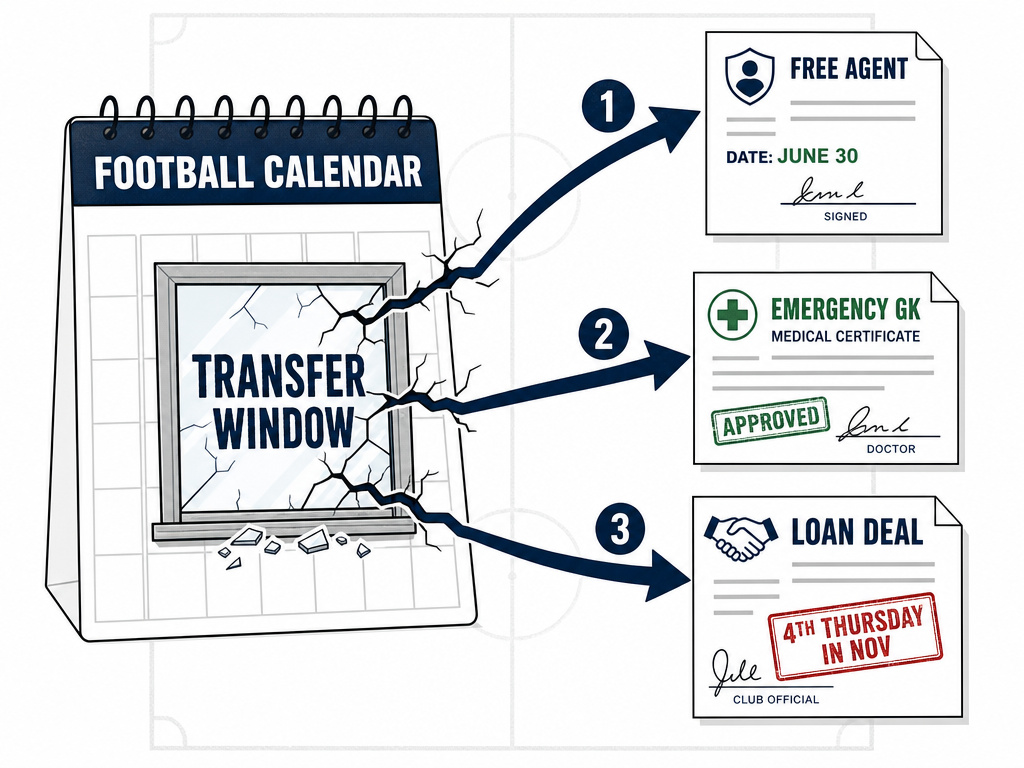
The rules have cracks, and the football industry is built on finding them.
Free Agents are the most famous exception. A player without a club can sign for a new one at any time. But, and this is the critical caveat, they must have become a free agent within a transfer window. If a player’s contract expires on June 30 (after the winter window but before the summer one opens), he’s fine. If a club terminates a player’s contract in October, that player usually cannot register elsewhere until the January window opens. He became a free agent outside a window.
Emergency Registrations are exactly what they sound like. If a club has no fit senior goalkeepers, the league can grant special permission to sign one outside the window. These are rare and tightly controlled.
Loan Rules have their own schedule, particularly in England. Outside the main window, EFL clubs can loan players after a seven-day cooling-off period, with deadlines on the fourth Thursday in November and the fourth Thursday in March. An existing loan can also be made permanent at any time.
Where this goes sideways: Assuming any out-of-contract player is immediately signable. If they weren’t released during a window, they’re in limbo until the next one opens, regardless of their free-agent status.
This created a problem for the Premier League, which had Chelsea and Manchester City in the tournament. To let them use the June window but still keep a summer deadline aligned with Europe (1 September), the league invented a split window. The BBC Sport window dates report confirmed the solution: open 1-10 June, close for five days, then reopen from 16 June to 1 September. This kept them within the 12-week summer limit while accommodating the FIFA exception.
It’s a perfect case study in how global football’s calendar is a negotiated patchwork, not a unified system.
Deadline Day Mechanics and the “Dealsheet”
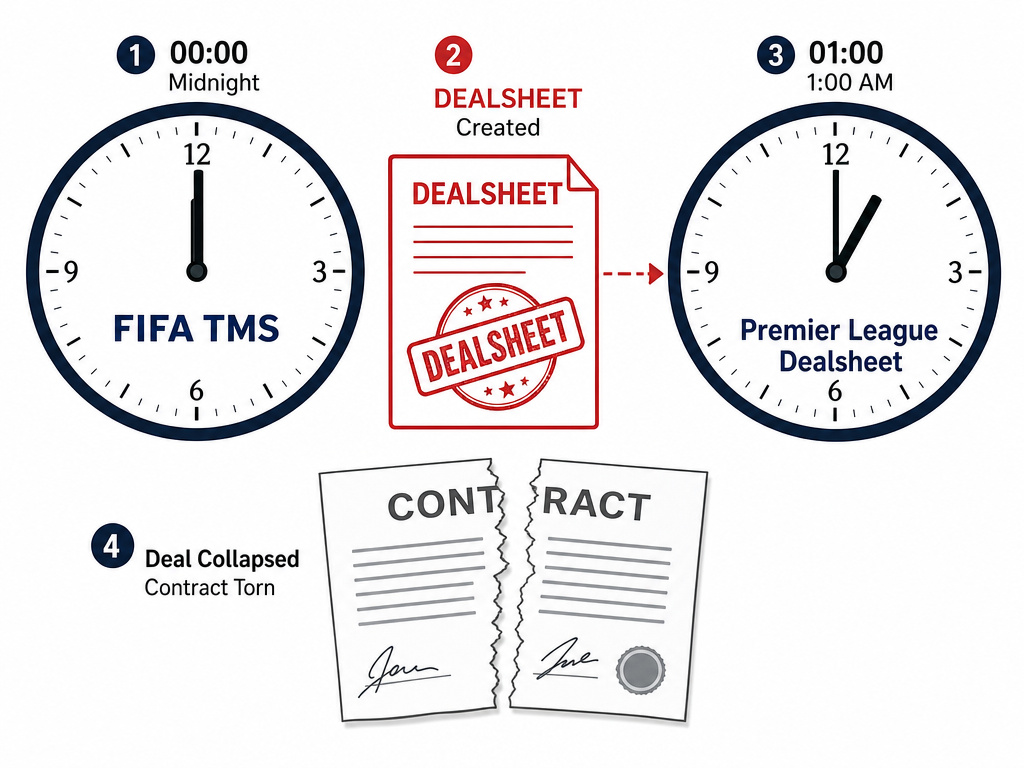
When the clock is ticking, leagues have procedures for last-second deals. In England, if a club submits a dealsheet to the Premier League before the deadline, confirming an agreement is in place, they get a short grace period, often until 01:00, to finalize the domestic paperwork.
However, one source states the FIFA TMS deadline for international transfers is midnight, while league dealsheet extensions may run later. So, a club could complete the Premier League side of a foreign signing by 1 a.m. But see the whole transfer collapse if the TMS submission wasn’t matched by both clubs before its deadline. This technical tug-of-war between league and global system is where many “failed medical” stories are born.
Who receives the transfer fee?
When a player moves for a fee, the money is paid from one club to another. The player themselves does not receive this payment. The selling club uses the fee as income, which can be reinvested in new signings, infrastructure, or other operational costs. The player’s personal financial gain comes from the contract they sign with their new club, which includes salary, bonuses, and potential signing-on fees. This separation ensures the transfer market functions as a trade of contractual rights between clubs, with the player’s consent required for the move but not for the fee itself.
The Bigger Picture: Why Windows (Mostly) Work
For all their complexity, windows achieve their main goal: they concentrate trading activity, which protects competitive balance for most of the season. Before 2002, a team falling apart in November could buy a whole new spine by Christmas. Now, you largely have to solve problems with the squad you have.
They also create a spectacle. Broadcasters’ deadline day coverage, with tickers and reporters stationed at training grounds, is a media event that drives engagement. It turns administration into drama.
But the system has critics. Critics argue the system fails footballers, leaving those released outside a window in professional purgatory. And it undoubtedly benefits rich clubs with deep squads that can withstand injuries.
The transfer window isn’t just a calendar. It’s a financial regulation, a plot device, and a structural constraint that defines how teams are built. Knowing the rules shows you how the game is structured.
Frequently Asked Questions
Why do different countries have transfer windows that open and close on different dates?
Each national football association sets its own specific dates within FIFA’s 16-week annual limit. These dates are often aligned with the start and mid-point of their domestic league seasons. This leads to global misalignment, meaning a club in a league with an open window can only buy from a league with a closed window if that selling club can register a replacement.
Can a club sell a player if its own transfer window is closed?
Yes, a club can sell a player outside its own registration period if the buying club’s association window is open. The transaction is valid because registration, which is the critical act, occurs with the buying federation. However, the selling club would be unable to register a direct replacement until its next window opens.
What happens if a transfer deal is agreed but not registered before the deadline?
If the necessary paperwork is not fully submitted and processed by the league and federation before the window’s official closing time, the transfer collapses for that period. The clubs may attempt to complete the registration during the next window, but they risk the player’s circumstances or agreement terms changing in the interim.
Are there any exceptions for youth or academy player registrations?
Yes, registrations for youth players moving into a club’s academy system often operate under different rules and longer timeframes than senior professional transfers. These are typically governed by specific youth development regulations and may not be confined to the standard senior windows, allowing for more flexible recruitment.
