
Release Clauses in Football Explained
This post contains affiliate links. As an Amazon Associate, we earn from qualifying purchases.
A release clause in football is a pre-agreed sum written into a player’s contract that allows them to unilaterally terminate that contract once it is paid. This mechanism is mandatory for professional footballers in Spain under national law but is a voluntary, often secret, contractual tool in leagues like England’s Premier League.
That legal distinction between a mandatory right and a negotiated option shapes everything from player power to transfer strategy. In Spain, it’s considered a worker’s right for professional footballers; elsewhere, it’s a bargaining chip. This is the core of release clauses in football explained.
What follows is a breakdown of the mechanics, the real-world examples from Haaland to Delap, and the strategic calculus that turns a simple number into a multi-club saga. This section explains the trigger process, the legal differences between leagues, and why the club that pays is not always legally recognized as the buyer.
Key Takeaways
- A release clause is a unilateral termination right for the player, not an offer to buy from the club. Once the clause amount is deposited, the selling club has no legal right to refuse the player’s departure.
- The rules are mandatory in Spain for professional footballers under Royal Decree 1006/1985 but purely contractual in England. This is why every La Liga player has a public clause, while Premier League clauses are often confidential.
- In practice, the buying club provides the funds, but legally, the player must deposit the money to terminate their own contract, a key technicality that underpins the entire system.
- Clauses can be conditional and tiered, like Mohammed Kudus’s different fees for Premier League, European, and Saudi clubs, activating only during a specific 10-day window.
- An excessively high clause that isn’t proportional to the player’s salary can be challenged in Spanish law as creating an unequal contract.
The Core Mechanics: What a Release Clause Actually Is
Forget the idea of a release clause as a fancy price tag. It’s a legal escape hatch for the player, written into their employment contract. The LALIGA Business School defines it precisely: a contractual provision that establishes a financial amount allowing a player to unilaterally terminate their contractual relationship with a club.
The magic word is “unilateral.” It means the player can decide to leave, provided they (or, in reality, their new club) can pay the price. The selling club’s consent is irrelevant once the money hits the account. This flips the script on a normal football transfer, where the selling club can simply say no.
A release clause is not a transfer fee. It is a pre-agreed penalty for contract termination. Under FIFA’s Regulations on the Status and Transfer of Players, compensation for breach of contract (like triggering a clause) is explicitly not considered “transfer compensation.” This legal distinction matters for accounting, Financial Fair Play calculations, and the player’s registration status.
So why do clubs agree to them? For the player, it’s security and control, a guaranteed exit route if a bigger club comes calling. For the selling club, it’s a form of risk management. It sets a clear, often inflated, floor for their asset’s value. They might prefer to negotiate a higher fee, but the clause guarantees they won’t get less.
How Does a Release Clause Actually Work?
The process looks simple from the outside: Club B pays Club A the clause amount, and the player moves. The mechanics beneath are more nuanced, involving legal formalities and strict deadlines.
The Step-by-Step Trigger Process
- Formal Notification & Proof of Funds: The buying club informs the selling club of their intent to trigger the clause. Crucially, they must provide concrete proof they have the full amount available, usually via a bank guarantee. This isn’t a verbal agreement over the phone.
- Deposit to the League/FA: The buying club must provide the full clause amount, following the procedure set by the relevant football authorities. The association confirms receipt of the funds to complete the player’s release.
- Legal Termination & Release: Once the association confirms receipt, the player’s contract with their old club is legally terminated. The association then releases the funds to the selling club and issues the necessary clearance for the player to register with their new team.
- Player Agreement: Once the clause is triggered and the player’s contract is terminated, the player is free to sign with a new club. The clause secures their release first; the new deal is secondary.
Where this goes sideways: A club thinking they’ve “met” a clause by simply offering the amount to the selling club. The 2013 Luis Suarez saga is the textbook case.
Missing any step, especially the formal deposit, means the clause isn’t triggered. The selling club can legally ignore the bid and hold the player to their contract.
League-by-League Rules: Spain vs. England vs. The World
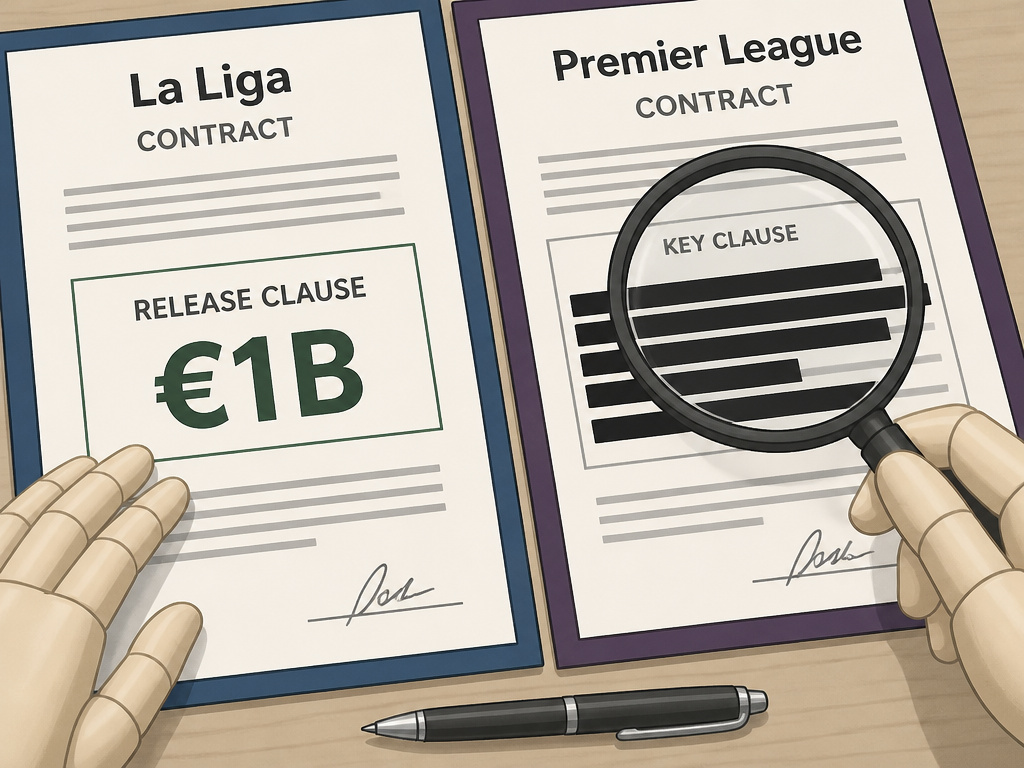
This is where the landscape fractures. The law governing release clauses isn’t international; it’s national, leading to wildly different ecosystems.
| League (Country) | Legal Basis | Mandatory? | Typical Visibility | Key Characteristic |
|---|---|---|---|---|
| La Liga (Spain) | Royal Decree 1006/1985 | Yes, by law | Public (published by La Liga) | Clauses must be “proportional” to salary; extremely high values (€1B for Lamine Yamal) are common as a deterrent. |
| Premier League (England) | General Contract Law | No, purely contractual | Almost always confidential | Wording is king; often include complex conditions (relegation, specific clubs). |
| Serie A (Italy) | Contract Law | No | Mixed (sometimes reported) | Growing in prevalence but not standardized. |
| Bundesliga (Germany) | Contract Law | No | Rare | Uncommon; clubs traditionally resist. |
Spain: A Worker’s Right. The system is built on Spanish labor law. As explained in the ESPN analysis of Spanish release clauses, the basis is Royal Decree 1006 from 1985, which treats footballers like any other worker with the right to resign. The clause is the agreed “compensation” for that resignation. This is why it is mandatory, because every professional footballer’s contract in Spain must include one.
England: A Secret Negotiation. In England, there’s no legal requirement. If a clause exists, it’s a product of hard negotiation and is enforceable under general contract law, but the exact wording dictates everything. As The Sports Lawyer notes, they are often shrouded in secrecy, known only to the player, agent, and club executives. This secrecy itself is a strategic tool.
The difference is visceral, a key point in any release clauses in football explained guide. In Spain, release clause values like Lamine Yamal’s €1 billion are often reported publicly. In England, the details of Erling Haaland’s former €200 million clause only emerged through leaks and reports like those in The Athletic Premier League transfer analysis.
Real-World Examples and Strategic Variations
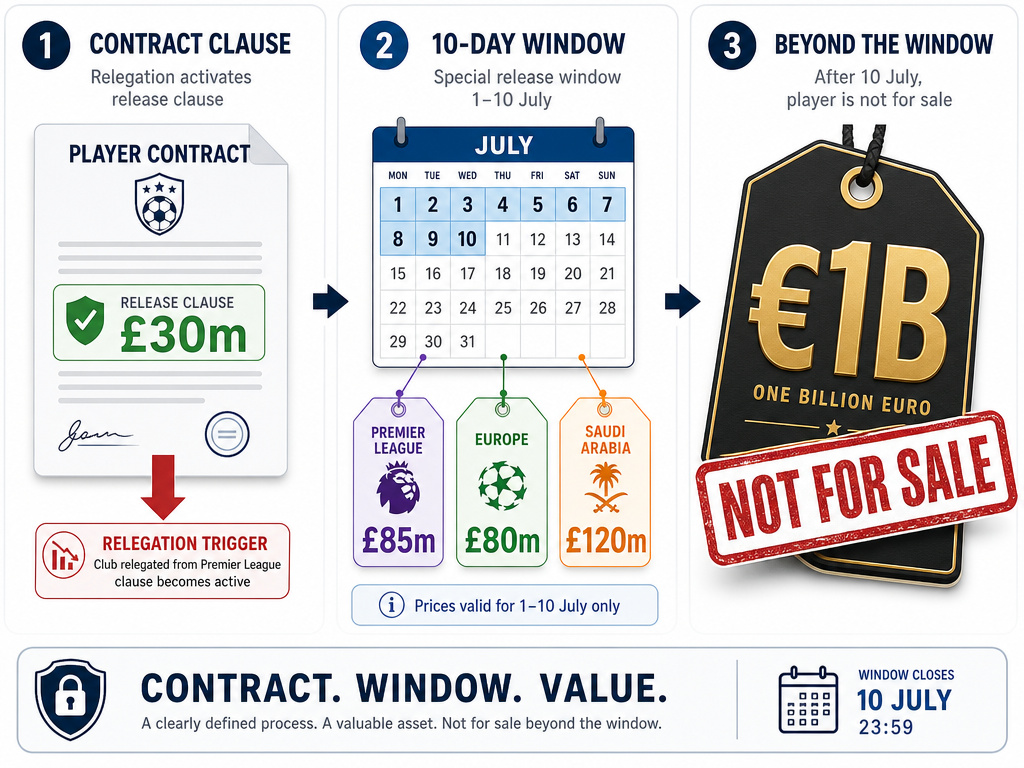
Clauses aren’t just a single number. They are sophisticated tools with built-in conditions and triggers that reflect complex negotiations.
- The Straightforward Escape: Liam Delap’s £30 million clause at Ipswich activated only upon the club’s relegation. It was a classic relegation release clause, a safety net for the player and a clear, if painful, payout for the club. Chelsea triggered it and paid £20 million up front, showing the clause amount can be structured in installments, though the total clause value was £30m.
- The Tiered & Timed Clause: Mohammed Kudus’s contract at West Ham had at least three different values: £85m for Premier League rivals, £80m for European clubs, and £120m for Saudi teams. Crucially, these were only active for the first 10 days of July. This creates a frantic, defined “buying window” for interested clubs.
- The Deterrent Clause: Lamine Yamal’s €1 billion and Erling Haaland’s former €200 million clauses are less about realistic valuation and more about statement-making. They signal “not for sale” while technically honoring the legal requirement in Spain. Spanish lawyer Sanchez-Bote notes that excessively high clauses can be challenged if not proportional to salary, but clubs use them as a powerful deterrent.
These examples show how clauses are tailored, a practical aspect of release clauses in football explained. They can be insurance against relegation, a tool to manage rival bids, or a symbolic fortress wall. Understanding a clause’s conditions is as important as knowing its number.
The Legal Payer vs. The Practical Payer: Who Really Pays?
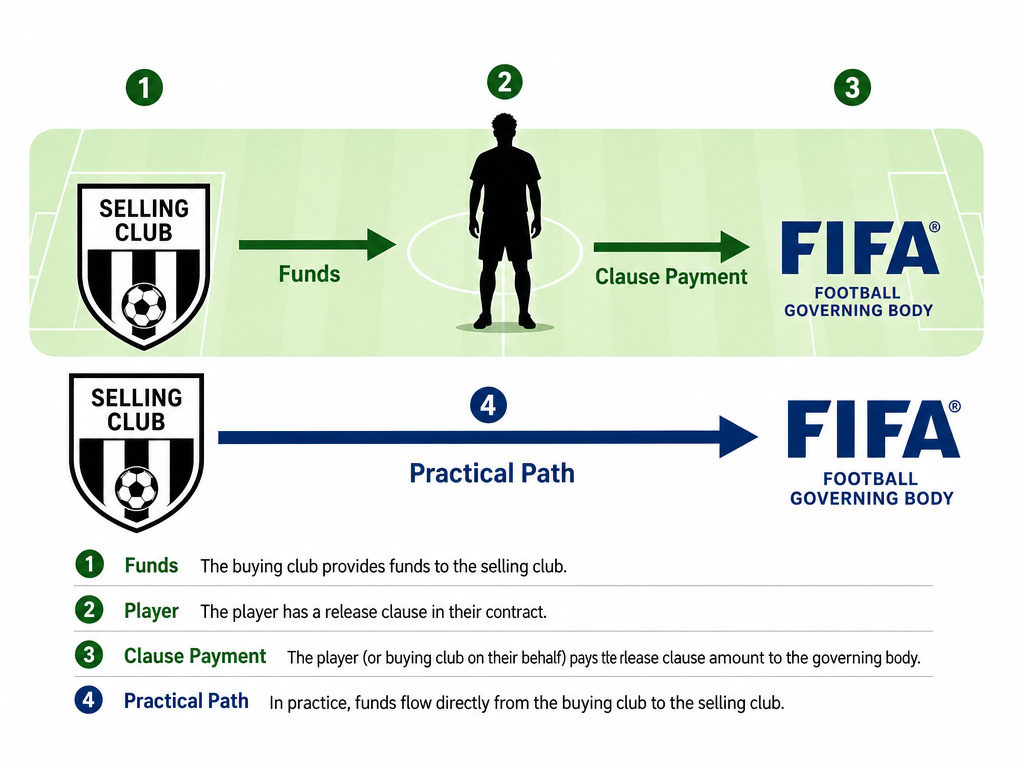
Here’s one of the most misunderstood parts of the process. Legally, the player is the one terminating their own contract. Therefore, under Spanish law, the player is the entity responsible for depositing the clause amount to the football authorities, though in practice the buying club typically provides the funds.
In practice, that almost never happens. The player doesn’t front €100 million. As the same ESPN soccer legal explainer states, the usual thing is that the club wishing to sign the player provides the money to compensate the former club. The new club gives the funds to the player (or directly to the authorities on the player’s behalf), who then uses it to execute their legal right to terminate.
This legal fiction is important. It reinforces that the clause is the player’s right, not an inter-club transaction. It also has implications for things like tax liability in some jurisdictions. The money changes hands between clubs, but the legal pathway runs through the player’s right to resign.
Common Questions and Strategic Implications
Can a Club Reject a Release Clause?
No. If the correct procedure is followed, the full amount is deposited with the governing body, the selling club has no legal grounds to refuse. The player’s contract is terminated automatically. A club can only “reject” a clause if the buying club fails to complete the formal deposit process and instead just makes an offer.
How Do Release Clauses Affect Player Valuation and Transfers?
They create a hard floor. A club might value a player at £50m, but if his clause is £35m, the market price is effectively capped at £35m. Smart agents use lowish clauses as a selling point to attract players: “Sign for us, and you can leave easily for a top club.” Savvy clubs set clauses astronomically high to retain control, as Barcelona does with its young stars.
They also streamline deals. When Chelsea wanted Delap, they didn’t need to negotiate with Ipswich. They just needed to meet the clause’s conditions. This bypasses protracted haggling and can be faster than a standard loan deal with an option.
What’s the Difference Between a Release Clause and a Buy-Back Clause?
They are opposites. A release clause allows the player to depart. A buy-back clause gives the selling club the right to buy the player back from his new club at a pre-set price in the future. One empowers the player, the other protects the original club’s investment.
What is the difference between a release clause and a buyout clause?
In common football parlance, ‘release clause’ and ‘buyout clause’ are often used interchangeably to describe the same mechanism: a set fee that allows a player to leave their club. The key legal function is that it permits a player to unilaterally terminate their contract. The terminology can vary by country, but the core principle remains a contractual financial threshold that, when met, severs the employment tie. The practical effect is identical; the clause grants the player the power to force a move, bypassing the need for their current club to agree to a traditional transfer negotiation.
How are release clause payments structured?
The payment structure for a release clause is dictated by the specific terms of the contract. This is because the clause represents a unilateral termination of contract, and the payment is the compensation owed for that act. In practice, the buying club provides the funds directly, even though legally the obligation to pay rests with the player.
What are the legal aspects and potential disputes around release clauses?
Legality and enforcement vary significantly. In Spain, such clauses are mandatory by law and must be proportional to the player’s salary; excessively high values can be legally challenged. In England, there is no legal requirement, and their enforceability depends entirely on the contract’s wording under general contract law. Disputes can arise over whether a clause is truly ‘automatic’ upon payment or requires additional club cooperation. The specific conditions for activation, such as timing or the identity of the buying club, are also frequent sources of legal scrutiny, making precise contractual language critical to avoid conflicts.
Frequently Asked Questions
What is the biggest release clause in football history?
Currently, it’s Lamine Yamal’s €1 billion clause at Barcelona. These “deterrent clauses” are designed to be almost impossible to trigger, signaling that the player is utterly indispensable to the club’s project.
Is a release clause good or bad for a player?
It’s a double-edged sword. It provides guaranteed mobility and bargaining power, so a player with a low clause has more control over their career. However, it can also limit earning potential. If a player explodes in value but has a low clause, the selling club loses out on a bigger fee, which might sour the relationship and affect the player’s standing. The player also can’t force a bidding war above the clause amount.
Can a release clause expire?
Yes. As with Mohammed Kudus’s clause, they can be active only for specific windows (e.g., the first two weeks of July). They can also expire upon a contract extension or be removed entirely in a new deal, as happened with Erling Haaland’s clauses at Manchester City.
How does a release clause impact other contract terms like a sell-on clause?
It depends on the contract wording. Typically, a sell-on clause applies to future transfer fees. Since a release clause payment is legally a termination fee, not a transfer fee, a standard sell-on clause might not apply. This is a crucial detail for selling clubs to nail down in the original contract.
Before You Go
The real power of a release clause isn’t in the headline number. It’s in the conditions attached to it, the relegation trigger, the 10-day window, the tiered pricing for different leagues. These details are the true product of negotiation, transforming a simple exit fee into a complex strategic instrument.
For a player, the key is balancing security with value. A low clause gets you a move; a high one might keep you stuck. For a club, it’s about protecting an asset without handcuffing it. And for a fan, understanding this mechanism explains why some transfers feel inevitable from the moment a clause is rumored, while others remain pure speculation. It turns the chaotic theatre of the transfer window into a slightly more predictable, if no less dramatic, legal process.
