
How to Referee Youth Football: The 4-Step Path
This post contains affiliate links. As an Amazon Associate, we earn from qualifying purchases.
Refereeing youth football requires matching four core elements: the correct certification for your local league, a pre-game focus on safety over technicalities, an understanding of age-specific rule modifications, and a communication style built for learning, not just enforcement. Your first game is about facilitating play, not proving you know every law.
That last point is where new referees trip. They study the IFAB Laws of the Game, then walk onto a U9 pitch and realize half those laws are softened, modified, or ignored by local policy. A key part of learning how to referee youth football is understanding that your job is to manage a learning environment where the primary goals are safety, fairness, and fun, in that order.
What follows is the four-step framework I wish I’d had: how to get certified, what to actually do before the whistle, how to apply the youth-specific rules that catch everyone off guard, and the scripts that defuse sideline tension before it boils over.
Key Takeaways
- Certification is local. Your first step is finding your national or county football association (like The FA or AYSO) and completing their specific entry-level course.
- Your pre-game inspection is essential. Check that goals are anchored, every player’s shin guards are completely covered by socks, and no jewelry is worn.
- Youth rules modify the standard laws. For U8-U10, many youth leagues adapt the standard laws; for example, the Hampshire FA advises allowing a second attempt at a throw-in, while the EYSA recommends allowing additional tries with no turnover. For injury stoppages, the EYSA uses a dropped ball to the team in possession, which differs from the standard IFAB law.
- Manage sideline behavior with a clear protocol: a private warning, then a public warning, then asking the individual to leave before considering abandonment.
- Your best tool is verbal communication. Inexperienced players won’t understand whistle-and-signal alone, so add a short, clear explanation for every call.
The 4-Step Path to Your First Whistle
You don’t become a referee in a vacuum. The process is dictated by the league you want to work for, and it always starts with a governing body. In England, that’s The Football Association (The FA) and its county branches. In the United States, it could be the American Youth Soccer Organization (AYSO), US Youth Soccer, or a local league like the Eastside Youth Soccer Association (EYSA).
These organizations run entry-level courses that blend online modules with in-person field sessions. The curriculum covers the Laws of the Game, but filtered through the lens of youth football. You’ll learn the hierarchy of rules: the international IFAB laws are the foundation, but your national association, then your local league, can modify them. Passing the course and a background check grants you a certification number and access to a referee assignor.
This is not a theoretical exam on how to referee youth football. The in-person session puts you on a pitch with other trainees, practicing signals, positioning, and game management. The qualification allows you to officiate matches and start earning game fees. For a detailed walkthrough of this initial stage, our guide on the steps to become a certified football referee breaks down the typical timeline and requirements.
The FA’s Hampshire branch explicitly states that for youth matches, “assistant referees are not required.” This isn’t a suggestion, it’s a rule modification that changes how you, as the sole official, must position yourself to see offside and touchline events.
The Pre-Game Checklist That Actually Matters
Arriving early is commodity advice. Knowing what to do with those twenty minutes is what separates a prepared referee from a frantic one.
Start with the field. Walk the perimeter. The EYSA handbook is blunt: the referee should inform coaches that goals need to be securely anchored before the match can start. A portable goal tipped over by a celebrating player is a lethal hazard. Give it a solid shake. If it moves, the game doesn’t start. Next, check the ball. For U8 matches, the AYSO manual specifies a Size 3 ball that is firm but yields about a quarter-inch to thumb pressure. An over-inflated ball hurts, a soft one doesn’t roll true.
Now, the players. This is a safety inspection, not a fashion parade. The Hampshire FA guidance emphasizes common sense: allow non-conforming undergarments for warmth if needed. But the hard rules are absolute. Shin guards must be covered entirely by the socks; the AYSO specifically states the sock may not be rolled over the shinguard. Jewelry is forbidden. The AYSO rule is clear: “The Referee should explain to the player that earrings are not permitted; if they wish to play, the earrings must be removed.” Medical alert bracelets are the exception, but they must be secured with tape or a cloth wristband with the information kept visible.
Finally, check player passes if your league uses them. The USL Youth manual mandates that all players and coaches must present their USL Youth Digital Match Roster (DMR) with a picture prior to each game. No picture, no play. This ritual prevents arguments at kick-off. For a full rundown of every item you need, see our detailed breakdown of essential referee gear.
The Youth-Specific Rules That Change Everything
This is the core of the job. You are not enforcing the Laws of the Game. You are enforcing your league’s adapted version of them. Ignoring this distinction is the fastest way to confuse players, anger coaches, and ruin the match atmosphere.
Take throw-ins. The standard IFAB law awards a throw-in to the opposing team following any infringement. The Hampshire FA advises referees to allow young children a second attempt. The EYSA handbook goes further for U8-U10: “allow additional tries… After the last improper throw-in, let play continue. Do not turn the ball over to the other team.” For U11+, you revert to the one-try rule. Your league’s handbook will tell you which standard to use.
| Situation | Standard IFAB Law | Common Youth Adaptation (U8-U10) | Why the Change? |
|---|---|---|---|
| Improper Throw-in | Turnover to opposing team. | Allow multiple tries; no turnover. | Promotes skill development over punishment. |
| Restart after Injury | Dropped ball to last-touching team. | Dropped ball to team in possession. | Rewards attacking play, simplifies restart. |
| Minimum Players | Match can start/continue with 4 (Hampshire FA), though some leagues like AYSO allow a coach to choose to play short if a player leaves the field. | Maximizes playing time for young teams. | |
| Philosophy | Consistent application of all laws. | “Ignore trifling or doubtful offenses.” (AYSO) | Focus on Safe, Fair, Fun over technicalities. |
Injury restarts are another divergence. The IFAB law uses a dropped ball for the goalkeeper in the penalty area or for one player of the team that last touched the ball elsewhere on the field. The EYSA handbook instructs a dropped ball to the team in possession when the whistle was blown.
Then there’s playing time. The Hampshire FA sets a clear ceiling: in any one day, no player shall play more than 40 minutes. It also recommends at least 50% playing time per player for each game.
Managing the Sideline Before It Manages You

The most intense pressure won’t come from the players. It will come from the touchline. Your approach to how to referee youth football here determines whether the game is a positive experience or a stressful ordeal.
Have a protocol. The EYSA handbook outlines it perfectly: for unruly coaches or spectators, start with a private warning. Pull the coach aside calmly. “Coach, I need your help. The comments from your sideline are making it difficult to manage the game. We need to keep it positive for the kids.” If it continues, give a public warning. “Blue coach, that’s a public warning. The next comment will result in you being asked to leave the field.”
The final step is asking the individual to leave. If they refuse, you abandon the match. The handbook defines abuse as any threat of harm, if that occurs, abandon the game immediately and leave safely. Crucially, do not show cards to coaches or spectators. Cards are for players. This graduated response keeps you in control. For more on this difficult aspect of the role, our article on strategies for dealing with abuse as a referee offers practical scripts.
Where this goes sideways: Waiting to address a grumbling sideline. Address the first muttered complaint with a calm, public “Let’s keep it positive, please.” It sets the tone for the rest of the match.
Your communication with players is different. The AYSO 8U manual notes that inexperienced players will not understand arm signals or a whistle only. You must add a short, clear verbal instruction. “Handball, blue. Direct free kick.” Point. “Please move back ten yards.” This teaching aspect is central. For a full visual guide, learn the meaning of referee hand signals.
Your First-Game Mindset and Positioning
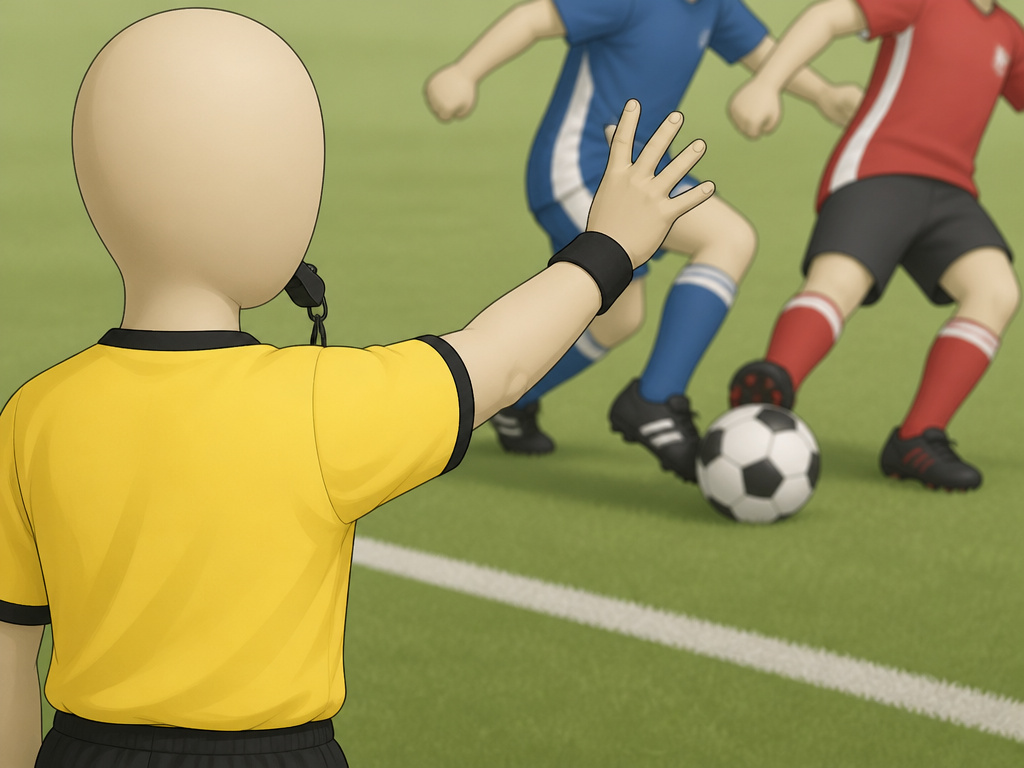
You will make mistakes. Everyone does. Your primary goal is facilitating a safe, fair, and fun match that ends with the same number of healthy players as it started.
Positioning is your best tool to achieve that. A deep understanding of strategic movement patterns for officials is built with experience, but start by simply trying to keep the play between you and your nearest touchline.
When the game is over, your job isn’t.
How Much Do Youth Soccer Referees Get Paid
Payment for refereeing youth matches is not standardized and varies by league and location. Your local governing body or league assignor will have the specific fee structure. Typically, fees are set per match and can differ based on the age group of the players. You should receive clear information on payment rates and the process for receiving fees, such as direct payment from the league or via the clubs, before you accept any assignments. Always confirm the payment details when you register for a league or accept your first game.
Finding a Mentor as a New Referee
Starting out as a referee is easier with guidance. Many leagues and referee associations run formal mentorship programs where an experienced official will observe your games and offer advice. If a formal program isn’t available, don’t hesitate to ask your league assignor or local referee administrator to connect you with a seasoned referee. You can also learn a great deal by asking to shadow a senior referee for a game or by simply introducing yourself to other officials at the field. Their practical insights on game management and local league nuances are invaluable.
Online Referee Training Courses
Most certification processes now include mandatory online learning modules. These courses, provided by the governing body like The FA or AYSO, cover the Laws of the Game and often include youth-specific adaptations. You’ll typically progress through interactive lessons and pass online quizzes to demonstrate your understanding. This digital foundation is crucial before you attend any in-person field training sessions. Completing these modules is a required step to get certified and be eligible to receive game assignments from your league.
Frequently Asked Questions
What’s the easiest age group to referee?
The complexity of offside and more nuanced fouls hasn’t been introduced yet.
How do I handle a coach who constantly disputes every call?
Use the protocol: private warning, public warning, ask to leave. This establishes a collaborative tone. During the game, a brief, calm explanation of a call can often preempt an argument. “Coach, I saw it as a fair shoulder charge from the side. I’ll keep an eye on it.” You’re not debating; you’re informing.
Do I need to be fit to referee youth football?
Yes, but the required fitness scales with the age group. For young children, you need enough mobility to stay near the play. For older youth matches, the pace increases significantly. Most certification bodies require you to pass a referee fitness test that involves repeated sprints and endurance runs. It’s designed to ensure you can keep up with play to make accurate calls.
Can I referee my own child’s game?
Most leagues prohibit this due to the obvious conflict of interest. It puts you in an impossible position and undermines your authority. The standard policy is that you should not officiate any match involving a team from your immediate family’s club. Always declare any potential conflict to your assignor.
What’s the biggest difference between youth and adult refereeing?
The philosophy. In adult football, the law is the law. In youth football, the Spirit of the Law guides you. The AYSO mantra is “Safe, Fair, Fun.” Your decisions should prioritize player safety, then fairness, then the flow and enjoyment of the game. This means sometimes ignoring a technical infringement to allow play to continue, especially with very young players.
The Bottom Line
Your first season will feel like a blur. You’ll overthink simple calls and miss obvious ones. That’s normal. The referees who improve are the ones who focus on the three pillars after each match: Was it safe? Was it fair? Did the kids have fun?
If you can answer yes to those, the technical mistakes are fixable with time and mentorship. The hardest skill is managing a heated sideline with a calm word, or explaining a handball to a tearful eight-year-old without crushing their spirit. That’s the job. The whistle is just the tool you use to do it.
