
Second Yellow Card Rule in Football Explained
This post contains affiliate links. As an Amazon Associate, we earn from qualifying purchases.
The second yellow card rule in football explained: a player cautioned twice in the same match is sent off, and the team plays on a player short. The sending-off is automatic; any ban afterwards depends on the competition. Substitutes and team officials face the same sanction.
That last clause about the competition is where the second yellow card rule in football explained confusion starts. The red card looks identical everywhere, but the ban attached to it comes from whoever runs the tournament: the FA, FIFA, or a state high school association. Sources disagree on several of those numbers, so each one stays separate below, with the name of whoever holds it.
What follows: what Law 12 says, the edge cases (advantage, sin bins, a referee who lost count), ban lengths by competition, the World Cup resets, appeals, and one player who got booked on purpose.
Key Takeaways
- A second caution in one match is an automatic sending-off for players, substitutes and team officials.
- The sent-off player must leave the vicinity of the field, so the side plays one player short (sin-bin football is the exception).
- The FA’s player guide, as relayed to me, puts a second-yellow dismissal at a one-match ban, and each repeat in a season adds a match.
- Season-long yellow totals are a separate system: Premier League bans start at 5 yellows by the 19th league match.
- The sources don’t confirm whether the two yellows behind a red also count toward a season total, so check your own competition’s rules.
Second Yellow Card Rule in Football Explained: What Law 12 Says
The IFAB Law 12 rulebook on fouls and misconduct lists “receiving a second caution in the same match” as a sending-off offence. The same wording covers substitutes, substituted players and team officials. No separate foul is needed. Two bookings are enough.
A second caution in the same match is a sending-off offence under IFAB Law 12. The offence applies to players, substitutes, substituted players and team officials alike. Where two separate cautionable offences occur, even in close proximity, the referee issues two cautions. The sent-off person must leave the vicinity of the field of play and the technical area.
The two cautions can arrive seconds apart. Law 12’s own example is a player who enters the field without permission and then commits a reckless tackle. That’s two offences, so it’s two cards.
Timing matters too. The referee’s disciplinary authority runs from entering the field for the pre-match inspection until leaving it after the match, penalty shoot-out included. A booking can land at any point in that window.
Coaches and staff aren’t exempt. When an offence from the technical area can’t be traced to one person, the senior team coach present takes the sanction.
I like how blunt the law is here. It never asks whether the second booking felt harsh, only whether it happened. Fair? That’s a pub argument, not a rules one.
Which Fouls Earn the First Yellow Before the Second One Lands?
A centre-back clips a winger on the halfway line to stop a counter. Booking one. Later, a tug on a shirt in midfield, and the referee’s hand heads for the pocket again.
Referees decide what gets you a yellow card from Law 12’s list of cautionable offences. For players, that list includes:
- Dissent by word or action
- Delaying the restart, such as kicking the ball away or taking a free kick from the wrong position to force a retake
- Unsporting behaviour, which covers simulation (feigning injury or pretending to be fouled), a reckless direct free kick offence, and any foul that stops a promising attack
- Persistent offences, with no set number of fouls that makes them “persistent”
- Entering, re-entering or deliberately leaving the field without permission
- Failing to respect the required distance on restarts
Celebrations count too. Law 12 requires a caution, even if the goal is disallowed, for removing the shirt, covering the head with it, or climbing a perimeter fence.
I’d call the tactical foul a legitimate skill, and the law sets its price: a caution for stopping a promising attack. The skill is knowing whether it’s your first card or your second.
A booked player who keeps arguing is one gesture from a yellow card for dissent. That’s a fast road from first yellow to second.
Common mistake: Arguing the first booking. Dissent by word or action is a cautionable offence, so the protest over card one can become card two on the spot.
Yellow Card vs Red Card: Where the Second Yellow Fits
A second yellow is a red card reached by a different road. Law 12 says the yellow card communicates a caution and the red card communicates a sending-off. Only a player, substitute, substituted player or team official can be shown either.
| Card | What triggers it | Result |
|---|---|---|
| Yellow | Dissent, delaying a restart, unsporting behaviour | Caution; player stays on |
| Second yellow | Two cautions in the same match | Sent off |
| Straight red | Serious foul play, violent conduct, biting or spitting | Sent off |
| Straight red | Denying an obvious goal-scoring opportunity (DOGSO) with a free-kick offence | Sent off |
Plenty of fans think a red needs a worse foul than a yellow. Two small ones will do. The yellow card vs red card gap is about the route, not the colour at the end.
What gets you a red card is its own list, running from violent conduct to using offensive, insulting or abusive language.
The colour shown changes the calendar. At the 2006 World Cup, Luis Figo head-butted Mark van Bommel and got only a yellow. Van Bommel called it a clear red. Figo played the next match, the quarter-final against England.
For straight reds, ban length depends on the offence and the competition. The sources I checked give no single figure that holds everywhere, so I won’t quote one.
What Happens in the Minute After a Second Yellow Card?
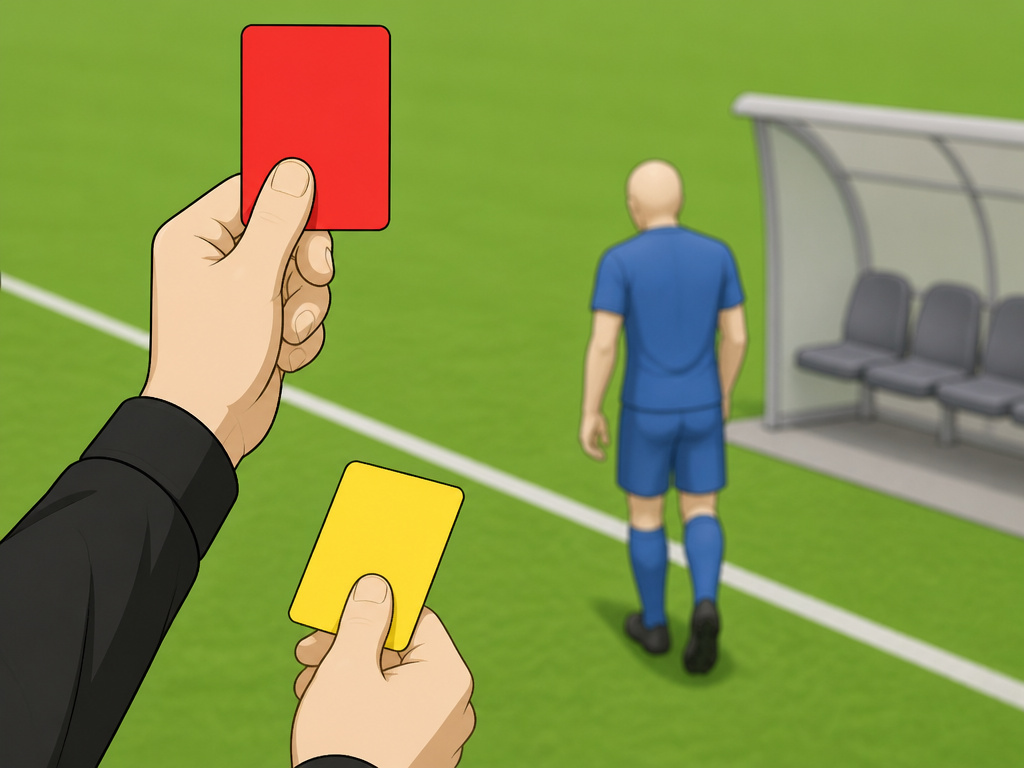
Five things happen in this order, and each has a cost if it’s skipped:
- Play stops, unless advantage applies. When the referee allows play to continue, the card has to be shown at the next stoppage, once the ball is out of play. Skip that and a player who earned a sending-off keeps playing.
- The second yellow, then the red. Show only the yellow and the player stays on, as Australia’s Ray Richards did in 1974: booked a second time in the 83rd minute against Chile, he played on for four more minutes before the referee was told the red had been forgotten.
- The player leaves the vicinity of the field and the technical area. Law 12 requires it, so the dugout is off limits too.
- The team plays one player short. No replacement comes on in normal football.
- The competition takes over. Its rules, not Law 12, set the ban. Skip that check and you end up quoting the wrong number.
The ground goes quiet for a heartbeat when the referee’s hand goes back to the pocket a second time. Then the whistling starts.
Several times I’ve watched a side reduced to ten men defend better in the spell right after the red card. The focus tightens, nobody takes a risk, and every player calls the shape out loud. It’s like a kitchen that loses a cook mid-service: suddenly everyone shouts their orders. I now look for it after any early red.
Funny how a smaller team can look tidier, isn’t it?
Do Two Yellow Cards Always Mean a One-Match Ban?
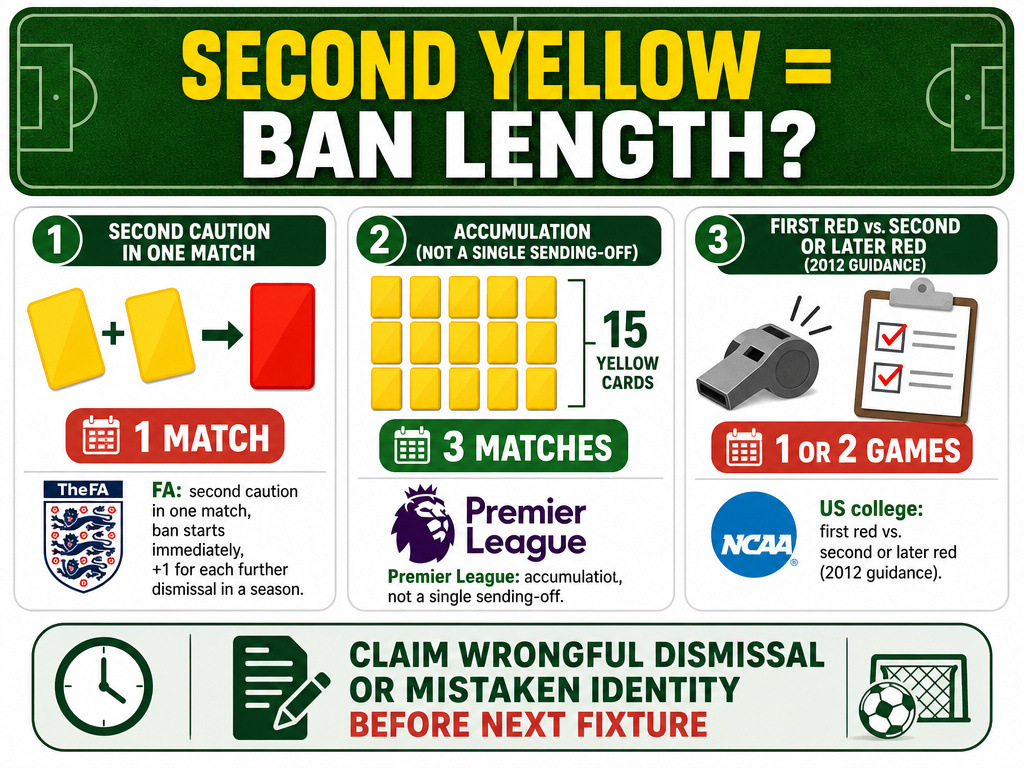
The answer is competition-specific, and no single number covers every league.
The one-match ban in the FA’s guide
As relayed to me, the FA’s 2026-27 player guide says a second caution in the same match brings a one-match suspension. It starts immediately unless the club claims wrongful dismissal or mistaken identity. Each further dismissal in the same season adds one match.
That passage didn’t come through when I opened the PDF, so read it yourself before quoting me.
American college soccer words it differently. A 2012 NISOA Q&A (NISOA is the US college referee association) said a second yellow in one game is a red, with a one-game suspension for a first red and two games for a second or later. That answer is from 2012 and may be out of date.
Is a three-match ban possible?
The number three does appear in the Premier League, but through accumulation: 15 cautions by the last day of the season brings a three-match ban. The FA summary also adds a match for each further dismissal in a season. On these sources, a single second-yellow sending-off is not a three-match ban.
If a ban length is quoted without a competition name attached, treat the number as a rumour until the rulebook confirms it.
Can a club appeal a second yellow?
The FA guide, as relayed, names two grounds: wrongful dismissal and mistaken identity. The sources I found give no success rates, so I won’t guess at one. Since the ban starts immediately unless the claim is made, the club has to move before the next fixture.
How Yellow Card Accumulation Works Across a Season
Five yellows by the 19th league match is the Premier League’s first line. Here are the FA’s thresholds, plus Indiana’s for comparison.
| Competition | Cautions and cut-off | Ban |
|---|---|---|
| Premier League | 5 by the 19th league match | 1 match |
| Premier League | 10 by the 32nd league match | 2 matches |
| Premier League | 15 by the last day of the season | 3 matches |
| EFL Leagues | 10 by the 37th league match | 2 matches |
| Indiana high schools | 5 in a season | Next scheduled game |
League yellows trigger a league ban. At 20, a Regulatory Commission decides the sanction. Cup yellows are counted separately, so a cup ban applies to that cup.
The mechanics of yellow card accumulation are the same idea everywhere: a running total hits a line. The IHSAA yellow card accumulation program adds a two-game suspension at 10 yellows and a three-game one at 15. It also counts a red card, with rule 4-3 not in effect, as two yellows. North Carolina’s NCHSAA likewise counts a red disqualification that isn’t an ejection as two yellows.
The FA, by contrast, treats a second-yellow dismissal as its own one-match ban.
The part nobody mentions: The sources don’t confirm whether the two yellows behind a second-yellow red also count toward a Premier League season total. UEFA runs its own system, and I couldn’t open its regulations, so I won’t quote its thresholds. Ask your league before you do the arithmetic.
Why the 2026 World Cup Wiped Single Yellows Twice
Wiping yellows sounds generous, but the real driver is squad availability. The FIFA Council confirmed that “single yellow cards in the final competition will be cancelled after the group stage and then again after the quarterfinals,” as reported by Al Jazeera and AP on 29 April 2026.
The reason is the 48-team format, which adds a round-of-32 knockout stage. At the previous World Cup, a player shown a yellow in two different games served a one-game ban. Single yellows were cancelled only after the quarter-finals.
The second amnesty applies to players with one yellow from the three previous knockout rounds whose teams reached the semi-finals. Other competitions reset on their own schedules:
- 2026 World Cup: after the group stage and again after the quarter-finals
- NCHSAA (North Carolina): zero once playoffs begin; 3 yellows in the playoffs means a next-game suspension and 5 means out for the rest of the playoffs
- IHSAA (Indiana): zero at the start of the District tournament and again at State; 3 yellows is a one-game suspension
- The FA: each cup competition is counted separately
I won’t repeat a tournament rule I can only find on one site. After being burned by a great story that didn’t hold up, a second source is my minimum.
One travel blog, Wego, claims a player whose second yellow comes in the quarter-final still serves that ban in the semi-final. Its logic is that the reset clears single cautions but not a suspension already triggered. It sounds plausible. I found no second source, so treat it as unconfirmed.
Advantage, Sin Bins and the Referee Who Lost Count
Advantage delays a second yellow without cancelling it. A few other situations bend the usual script:
- Advantage: Law 12 says advantage shouldn’t be applied for a second cautionable offence unless there’s a clear chance to score. The referee sends the player off when the ball is next out of play. If the player touches the ball or challenges an opponent first, play stops, the player goes off, and an indirect free kick restarts the game (unless a more serious offence was committed).
- Sin bins: optional, and only in youth, veterans, disability and grassroots football, with approval from the national FA, confederation or FIFA. A second caution means a second temporary dismissal, after which the player takes no further part. The team can replace the player if it still has substitutes left.
- Unfinished sin bins: the remaining time carries over to the second half, and into extra time.
In a sin-bin match, the referee shows the yellow and then points with both arms to the temporary dismissal area, usually the technical area.
Now the human error. Stuttgart, 22 June 2006: Croatia and Australia drew 2-2, and referee Graham Poll booked Josip Simunic three times before the red. The Josip Simunic three yellow cards incident is the famous case. Poll said he’d written the second booking under Australia’s number 3, Craig Moore.
The fallout was real. Poll and his assistants did not progress to the second stage, and Poll retired from international tournaments. (Counting to two gets harder with 22 players and a notebook.)
An ordinary one by comparison: Khalid Boulahrouz was sent off in the 63rd minute of Netherlands v Portugal for a second yellow.
Can a Player Get Booked on Purpose?
Players try it, and governing bodies punish it. Sergio Ramos was booked in the 89th minute against Ajax for a foul on Kasper Dolberg. UEFA then gave him a two-match ban for “clearly receiving a yellow card on purpose,” as the Ramos deliberate booking UEFA ban report puts it. The ban includes the automatic one-match suspension.
Ramos told reporters, “I would lie if I told you that I did not force the card.” He also said the foul came during a dangerous counter-attack and he had no choice. UEFA ruled it deliberate anyway.
Strictly, that case was accumulation, not a second yellow in one match, but the logic carries over. Indiana’s high school rules also add a match ban for anyone found guilty of getting deliberately cautioned.
A foul to stop a counter is a tactical choice. Collecting a card to dodge a game is gaming the calendar. The sanctions show which one the rule-makers will tolerate.
What does “booked” mean in football?
“Booked” is the everyday word for a caution. The referee shows a yellow card and writes the player’s details in a notebook, which becomes the working record of who has been cautioned. That record matters because a second caution in the same match is a sending-off offence.
Mistakes in the notebook can cause real confusion. At the 2006 World Cup, referee Graham Poll booked Josip Šimunić three times in Croatia against Australia. He said he wrote the second booking under the number of Australia’s Craig Moore, so his own record did not show what Šimunić had already received.
Two separate cautionable offences should bring two cautions, even when they happen close together. A booking can also be delayed. If the referee plays advantage, the caution is issued when the ball next goes out of play. A delayed booking still counts, and players should treat it as already on their record.
Why do referees use yellow and red cards?
Cards exist to make a decision obvious to everyone at the ground. A raised card tells the player, both benches and the crowd what has happened, whatever language they speak and however far away they are standing. A spoken warning can be missed or misunderstood. A bright card held in the air is hard to ignore.
The value of a clear signal shows up when things go wrong. In the 1974 World Cup, Australia’s Ray Richards was shown a second yellow in the 83rd minute against Chile but played on for four minutes before the referee was told he had forgotten the red card. A visible, agreed signal gives referees, officials and players a shared check on what has been decided.
For anyone reading a match report or watching live, the colours work as a simple code. Yellow means a caution, and red means the player must leave. A second yellow leads to the same result as a straight red.
Frequently Asked Questions
What happens if you get a second yellow card?
The referee shows a red card and sends you off. You must leave the vicinity of the field and the technical area, and your team plays one player short. The length of any ban depends on the competition.
Is 2 yellow cards a 3 match ban?
Not on the sources here. The FA guide, as relayed, gives a second-yellow dismissal a one-match suspension. Three-match bans in the Premier League come from accumulating 15 cautions.
Can you appeal a second yellow card in football?
The FA guide, as relayed, names two grounds: wrongful dismissal and mistaken identity. The ban starts immediately unless the club makes the claim. No success rates turned up in the sources.
Can a substitute or coach get a second yellow card?
Yes. A second caution in the same match is a sending-off offence for team officials, substitutes and substituted players. If an offence from the technical area can’t be traced to one person, the senior team coach present takes the sanction.
Do yellow cards carry into a tournament’s knockout stage?
It depends on the tournament. At the 2026 World Cup, single yellows were cancelled after the group stage and again after the quarter-finals. Indiana high schools reset at the District tournament and again at State.
The Bottom Line
The second yellow card rule in football is the easy part. Two cautions, one red, one player short. The hard part is the ban, because that comes from the competition, not from Law 12.
Your first step this week: open your own competition’s disciplinary rules and find two lines, the one on second-yellow dismissals and the one on accumulation. They’re different lines, and fans mix them up constantly.
One honest limit: I can’t tell you whether the two yellows behind a red count toward a Premier League or UEFA season total. If that matters to your team, ask the league.
And my stubborn view stays put. The tactical foul is a skill, referees should punish it consistently, and the second yellow is where the price finally comes due.
