
History of Football: From Medieval Streets to Modern Game
This post contains affiliate links. As an Amazon Associate, we earn from qualifying purchases.
The history of football is not a single story but a messy split. Modern association football (soccer) and rugby football both evolved from violent medieval street games in Britain, were shaped by different 19th-century school rules, and formally divorced in 1863 with the founding of the Football Association—which almost collapsed within four years. The game spread globally through clubs, international matches, and, controversially, the banning of women from professional grounds in 1921.
That split in 1863 is the hinge everything turns on. Before it, “football” was a catch-all term for any game involving a ball and feet. After it, you had two roads: one that banned handling and hacking, and one that kept them. The real story isn’t about a single inventor, but about which set of problems—crowd control, school discipline, or commercial appeal—each set of rules was trying to solve.
What follows is the chain of problems and solutions: how medieval authorities tried to ban a riotous street game, how Victorian schools tried to codify it for their yards, and how a meeting in a London pub accidentally created two of the world’s biggest sports. We’ll trace the evidence from a death in Cornwall in 1302 to the first international match in 1872, and look at the parts most timelines skip.
Key Takeaways
- The earliest unambiguous record of football in England is from Cornwall in 1302, where a man named Andrew de Ros died after being tripped and knocked unconscious while playing, and the game was frequently banned for causing riots and disorder.
- The modern game formed from a split in 1863 when the Football Association banned hacking (kicking shins) and carrying the ball, leading Blackheath and others to leave and form rugby.
- Just four years after its founding, the FA was nearly dissolved in 1867 with only ten member clubs, playing “second fiddle to rugby football” for its first 15 years.
- The first recognised international match (Scotland vs England, 1872) was a 0–0 draw, and the first recorded women’s match was held in England on 23 March 1895.
- Early rule variations mattered: Sheffield’s offside rule in the 1860s was more lenient than London’s, actively encouraging a different, more passing-focused style of play.
The Medieval Game: Violence, Bans, and Shrove Tuesday
Forget organised sport. The earliest football was a chaotic, often violent, communal event more akin to a moving street brawl than a game. According to one source, the earliest unambiguous reference in England comes from a coroner’s roll in Cornwall in 1302, where a man named Andrew de Ros died after being tripped and knocked unconscious while playing. Other sources cite an earlier description from William fitz Stephen (c. 1174), though it is debated whether that refers to football or a form of handball. The authorities weren’t worried about sport; they were worried about public order.
In April 1314, with King Edward II needing peace at home while fighting Robert the Bruce, the Lord Mayor of London issued a proclamation. It banned “hustling over large footballs” in the city’s fields because of the “great noise” and the “many evils” that might arise. This wasn’t a one-off. Football was repeatedly linked to violence, sometimes fatal. In 1321, a player died after accidentally running onto a sheathed knife. In 1373, eight men were charged in London for using a football match as cover for an assault, gathering with swords and knives under the colour of play.
Where this goes sideways: Assuming medieval football had fixed rules or pitches. It was a sprawling, often annual tradition tied to holidays like Shrove Tuesday, with goals sometimes miles apart and whole towns participating. The 1911 Encyclopædia Britannica notes its festival nature, and a match at Derby was recorded as being played every Shrove Tuesday since A.D. 217.
The game was deeply woven into the calendar, particularly on Shrove Tuesday. This tradition turned football into a spectator event and a flashpoint. A match at Pontefract on Shrove Tuesday 1477 ended in a fatal stabbing. Centuries later, authorities in London, Manchester, and elsewhere would still ban it from streets, fearing broken windows and riots. This wasn’t a game to be refined, but a public nuisance to be controlled—the first major problem the history of football had to solve.
Codification: Public Schools and the Search for Rules
If the medieval problem was chaos, the Victorian solution was discipline. From the late 18th century, football was revived and tamed within Britain’s public schools. Each school developed its own version to suit its grounds and ethos, creating a patchwork of rules that would eventually force a choice.
Eton and Harrow favoured a “dribbling game” that largely forbade handling the ball. Rugby School, famously, allowed it. Their written rules from 1845 formalised carrying the ball, setting them on a distinct path. Other schools like Winchester had their own variants. This created confusion when boys from different schools went up to university and wanted to play together.
The first major attempt to create a common code came from Cambridge University. Students there, tired of the confusion, drafted the Cambridge University Rules in 1848. This was a pivotal attempt to blend the various school games into one “dribbling” code. No copy of this original survives, but its spirit was clear: to create a compromise that could be played by all.
| School/Institution | Key Rule Feature (c. 1840s) | Lasting Influence |
|---|---|---|
| Rugby School | Carrying the ball permitted | Foundation of Rugby Football |
| Eton College | Handling forbidden (dribbling) | Foundation of Association Football |
| Harrow School | Dribbling game | Supported the non-handling code |
| Cambridge University | First compromise rules (1848) | Direct precursor to FA Laws |
This era transformed football from a popular street custom into a structured, if fragmented, gentleman’s pastime. The stage was set for a clash between the two broad philosophies: the handling game and the dribbling game.
The Great Split: Founding the FA and the Birth of Two Sports
By the 1860s, the need for a single national set of rules was a hot topic in the sporting press. The call was answered on 26 October 1863, when representatives from eleven London clubs and schools met at the Freemason’s Tavern. Their goal was to form a Football Association and establish a universal code.
The meeting adopted the Cambridge Rules of 1863 as its base. The critical, divisive decisions were embodied in two laws: one forbidding hacking (kicking an opponent’s shins), and another forbidding running with the ball or throwing it. For the representatives from Blackheath and other clubs who favoured the Rugby-style game, this was a deal-breaker. They argued removing hacking would “do away with all the courage and pluck from the game.” By December, they had withdrawn.
The FA’s original goal of uniting all football clubs under one code of rules was a complete failure. Just four years after its formation, around 1867, the FA was considered a failure. And for the first decade and a half of its existence, it played second fiddle to rugby football. – Tony Collins, “How Football Began”
This schism created the two branches of modern football: Association Football (soccer) and Rugby Football. The FA’s early years were shaky. In 1867, the FA’s membership numbered just ten clubs. In 1868, chronicler Charles Alcock noted only 30 clubs used FA rules, compared to 45 using Rugby School rules. The Football Association was, in its first decade, a marginal concern.
Early Clubs, Rules, and the Spread of the Game
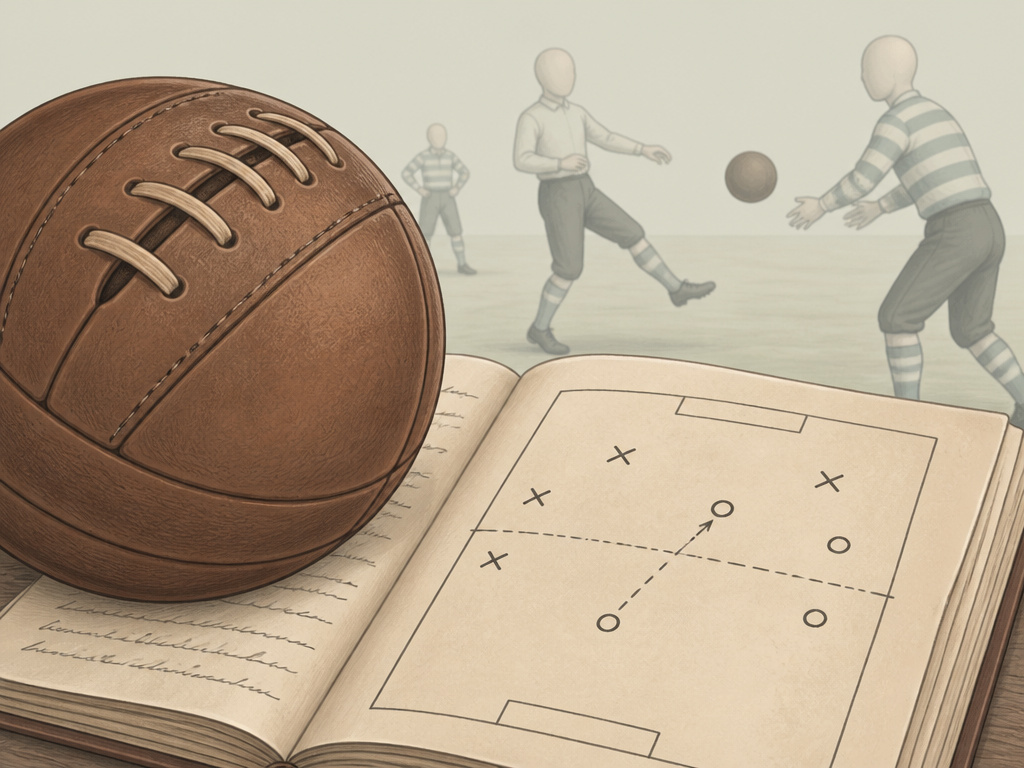
While the FA struggled in London, the game was being shaped elsewhere by clubs playing their own variations. The Sheffield Football Club, founded in 1857, is recognized as one of the world’s oldest. In London, the Barnes Club was founded in 1862. These clubs were crucial testing grounds for rules and styles.
One of the most significant early variations was the offside rule. In the 1860s, the Sheffield Association played with a more lenient offside law than the FA in London. A player was only offside if they were in front of the ball and all three opposing players were behind them. This Sheffield rule, as academic research has pointed out, actively encouraged more passing and combination play than the stricter London code, which required three defenders between the attacker and the goal.
Where sources disagree: Conventional history credits Scotland with the development of passing. However, academic research points to primary source evidence showing passing was practiced and reported in Sheffield in the 1860s, prior to its noted refinement in Scotland, and claims that passing began in Scotland are ‘not correct’.
Blackburn Olympic’s victory in the 1883 FA Cup final is cited as the first exhibition of a systematic passing game in London. Their win is cited as “the first English team to give an exhibition of a systematic passing game in London,” marking a tactical shift from pure dribbling. This evolution of team play is a key part of the broader history of football tactics.
| Club/Region | Founded | Key Contribution |
|---|---|---|
| Sheffield FC | 1857 | One of the oldest clubs; played under local rules with a lenient offside law that encouraged passing. |
| Barnes Club | 1862 | Early metropolitan club playing the dribbling game prior to the FA’s formation. |
| Blackburn Olympic | 1878 | Their 1883 FA Cup win showcased the first systematic passing game seen in London. |
These regional differences highlight that the origins of football were not monolithic. The game was evolving in multiple places at once, responding to local preferences and rule sets.
Going Global: Internationals, Women’s Football, and the Americas
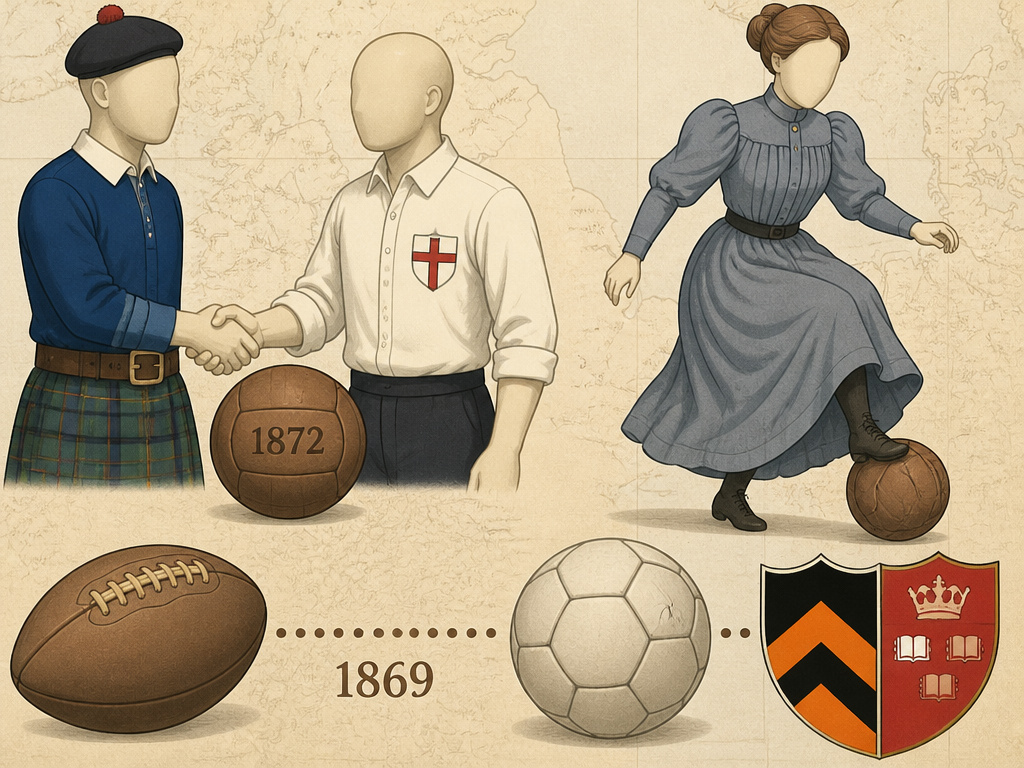
The FA’s fortunes began to change as the game organized and spread. The catalyst was the international match. Charles Alcock, now FA secretary, devised the idea. The first match recognized by FIFA took place on 30 November 1872 between Scotland and England. It ended in a 0–0 draw. The second Scotland vs England game on 8 March 1873 ended 4–2 in favour of England.
The women’s game emerged early too. The first recorded women’s football match was held in England on 23 March 1895. However, in 1921, the FA banned women from playing on its member clubs’ grounds. The fight for recognition is a major thread in the history of women’s football.
Across the Atlantic, a different evolution was underway. The first U.S. Match inspired by FA rules was between Princeton and Rutgers in 1869. It featured teams of twenty players each. However, American colleges quickly adapted these soccer-oriented rules, adding elements like the scrimmage and downs, and by the mid-1870s had diverged to create the distinct sport of American football. This parallel development shows how the same root could grow into completely different games, much like football’s separate development in South America or Africa.
The need to govern this global spread led to the founding of the Fédération Internationale de Football Association (FIFA) in 1904, which would later oversee the premier global tournament, the World Cup.
The Rules That Shaped the Modern Game
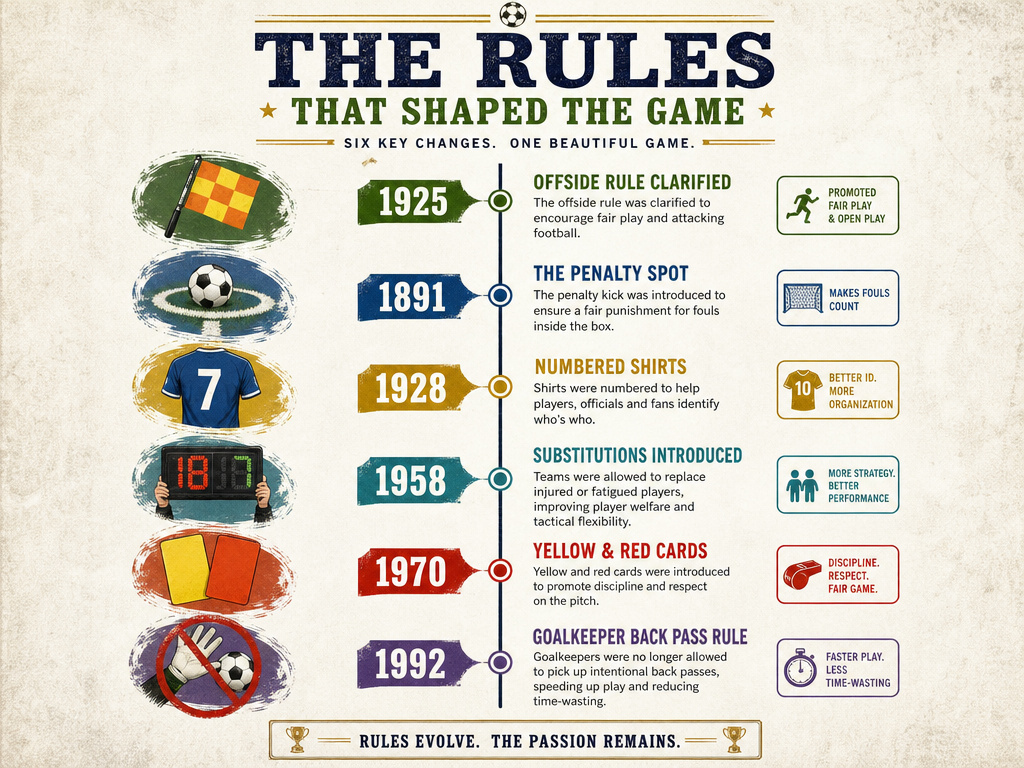
The history of football is, in large part, a history of its laws. The original 1863 FA rules are barely recognizable today. The most impactful changes were often reactions to tactical problems or safety concerns.
The offside rule has been the most frequently tweaked. The original FA law was strict, borrowed from the 1863 Cambridge Rules. The major liberalizing change came in 1925, reducing the number of defenders required between attacker and goal from three to two. This one change is credited with unleashing a flood of goals and forcing a total tactical rethink, directly leading to the development of the modern W-M formation. You can trace every major defensive innovation back to a tweak in the offside rule.
Other key introductions include:
- Penalty kicks (1891): Introduced to punish fouls within 12 yards of goal, removing the incentive for deliberate handball or professional fouls.
- Numbered shirts (1928): First used in a league match between Arsenal and Chelsea, aiding identification for players, referees, and fans.
- Substitutions (1958): Initially not allowed; the first World Cup to permit them was 1970.
- Red and yellow cards (1970): Introduced at the 1970 World Cup for clarity after disciplinary confusion in 1966.
- Back-pass rule (1992): Goalkeepers banned from handling deliberate passes from teammates, aimed at reducing time-wasting and encouraging attacking play.
Each change solved a problem, but also created new ones for managers and players to solve, driving the tactical development in football forward.
Frequently Asked Questions
When and where did football originate?
There is no single origin point. Various cultures played ball games with their feet for centuries. However, the direct history of the modern codes of association football and rugby football begins with medieval “folk football” games in the British Isles. The earliest unambiguous written reference to a game called football in England dates from Cornwall in 1302.
What’s the difference between soccer and rugby?
Both sports evolved from the same medieval games and 19th-century school football. The definitive split occurred in 1863 when the newly formed Football Association (FA) wrote laws that banned carrying the ball with the hands and hacking (kicking opponents’ shins). Clubs that wanted to keep these elements, like Blackheath, left the FA and their game evolved into Rugby Football.
What was the first football club in the world?
While several early clubs formed in the mid-19th century, Sheffield Football Club, founded in England in 1857, is recognized by FIFA and the FA as the world’s oldest existing football club playing association football.
When was the first international football match?
The first international match recognized by FIFA was between Scotland and England, played on 30 November 1872 at Hamilton Crescent in Glasgow. The match ended in a 0–0 draw.
When did the Football Association (FA) form?
The Football Association was founded on 26 October 1863 at a meeting at the Freemason’s Tavern in London, attended by representatives from eleven clubs and schools. Its initial goal was to establish a single, unified code of rules.
Before You Go
The history of football isn’t a straight line from ancient China to the Premier League. It’s a series of forks in the road, most importantly the one in a London pub in 1863. Every rule, from the offside law to the back-pass, is a scar from an old problem—too much violence, too few goals, too much time-wasting.
If you take one thing, let it be this: the game was shaped by its constraints. Heavy, muddy pitches favoured physical power. The 1925 offside change forced tactical genius. The next time you watch a match, the history of football tactics is right there in the spacing of the back four and the timing of the press. The past isn’t a separate story. It’s the reason the game looks the way it does right now.
