
How the Primeira Liga Works: Format, Promotion, and Europe
This post contains affiliate links. As an Amazon Associate, we earn from qualifying purchases.
The Primeira Liga is Portugal’s top professional football division, contested by 18 clubs who play each other twice (home and away) for a total of 34 matches. A win earns 3 points, a draw 1 point, and a loss 0. The bottom two clubs are relegated automatically, while the 16th-placed team enters a two-legged playoff against a second-tier club for the final spot.
That 34-game schedule creates a tight, familiar rhythm, but the league’s identity is shaped by rules most big European divisions don’t have. The tie-breaker that looks at head-to-head results before overall goal difference changes how teams approach a draw. The playoff that can send a third club down adds a layer of drama the pure table doesn’t show. This is a key part of how the Primeira Liga works.
What follows is a walk through the mechanics, from the points on the board to the paperwork clubs must file. You’ll see how the calendar is drawn to account for flights to Atlantic islands, why a B team can finish third but never go up, and where the money and European places flow.
Key Takeaways
- The league uses a double round-robin format, 18 teams play 34 matches each, a shorter season than England’s or Spain’s top flights.
- Tie-breakers favor head-to-head record first, not overall goal difference, making every direct clash between rivals a potential title or relegation decider.
- The promotion/relegation playoff is a two-legged tie between the 16th-placed Primeira Liga club and the 3rd-placed eligible club from Liga Portugal 2, with no away goals rule.
- B teams are ineligible for promotion from the second tier; if one finishes in a promotion spot, the place passes to the next eligible club.
- For European qualification, the Taça de Portugal (cup) winner gets a Europa League place, while the Taça da Liga (League Cup) offers no European spot.
The Core Format: 18 Clubs, 34 Matches, 3 Points
The structure is clean and symmetrical. According to the Liga Portugal 2026/27 competition regulations, the Primeira Liga is a league of 18 clubs, a fundamental part of how the Primeira Liga works. Each club faces every other club twice, once at home and once away. Do the math: 17 opponents x 2 matches = 34 matches per season.
The points system is the global standard: 3 for a win, 1 for a draw, 0 for a defeat. This hasn’t always been the case. The league switched from a 2-points-for-a-win system in the 1995–96 season, a change that subtly incentivized chasing victories over settling for draws. Every point matters more when the season is only 34 games long, a key detail in how the Primeira Liga works; a single dropped point at home in October can be the gap in May.
The Primeira Liga (Liga Portugal 1) is a points-based competition contested by 18 clubs. Each club plays the others twice (home and away) in two symmetrical rounds, for a total of 34 matches. A win is awarded 3 points, a draw 1 point, and a defeat 0 points.
This format is shorter than the 38-game marathons in the Premier League or La Liga. That compactness intensifies everything. A bad run of four or five games can plunge a mid-table side into a relegation scrap, while a strong start can establish a title challenge. There’s less room for error, less time to recover. The pressure is more consistent.
When the Table Lies: The Tie-Breaking Cascade
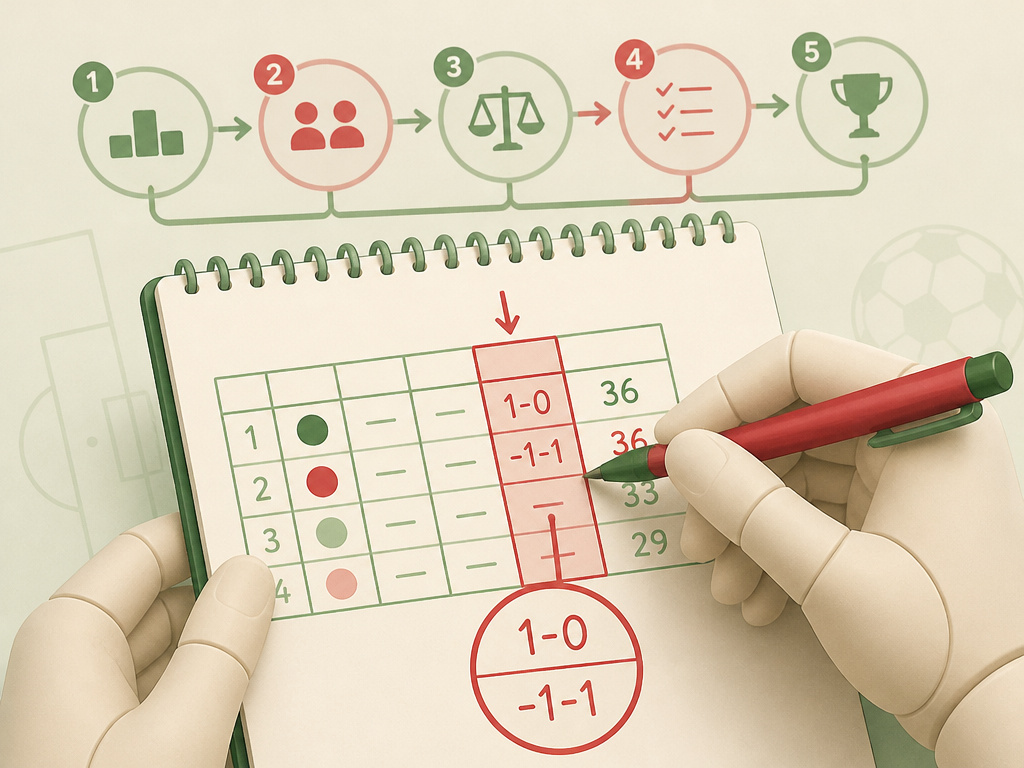
You finish level on points with a rival. In England, goal difference usually settles it. In Portugal, the first question is: what happened when you played each other?
The league’s tie-breaking procedure, detailed in Article 18.1 of the regulations, is a strict, five-step cascade:
- Points earned in head-to-head matches between the tied clubs.
- Goal difference in those head-to-head matches.
- Overall goal difference across the entire season.
- Total wins in the competition.
- Total goals scored in the competition.
This rule changes strategies. A 0-0 draw away to your direct competitor isn’t just a point; it’s a potential tie-breaker advantage denied. A 3-1 home win isn’t just three points, it’s a +2 swing in a secondary metric that could be decisive. It makes the two league meetings between contenders a mini-competition within the season.
If two clubs remain deadlocked after all five criteria, a vanishingly rare event, the regulations order a single match at a neutral venue to decide the ranking. No drawing of lots. The league demands a winner on the pitch, even if it takes a one-off playoff in a silent stadium. It’s a blunt solution that underscores how much every detail in the regular season matters.
This system is a key part of understanding any league table. The order you see isn’t just points and goals; it’s the result of this specific, ordered logic.
Going Up and Going Down: Promotion, Relegation, and the Playoff
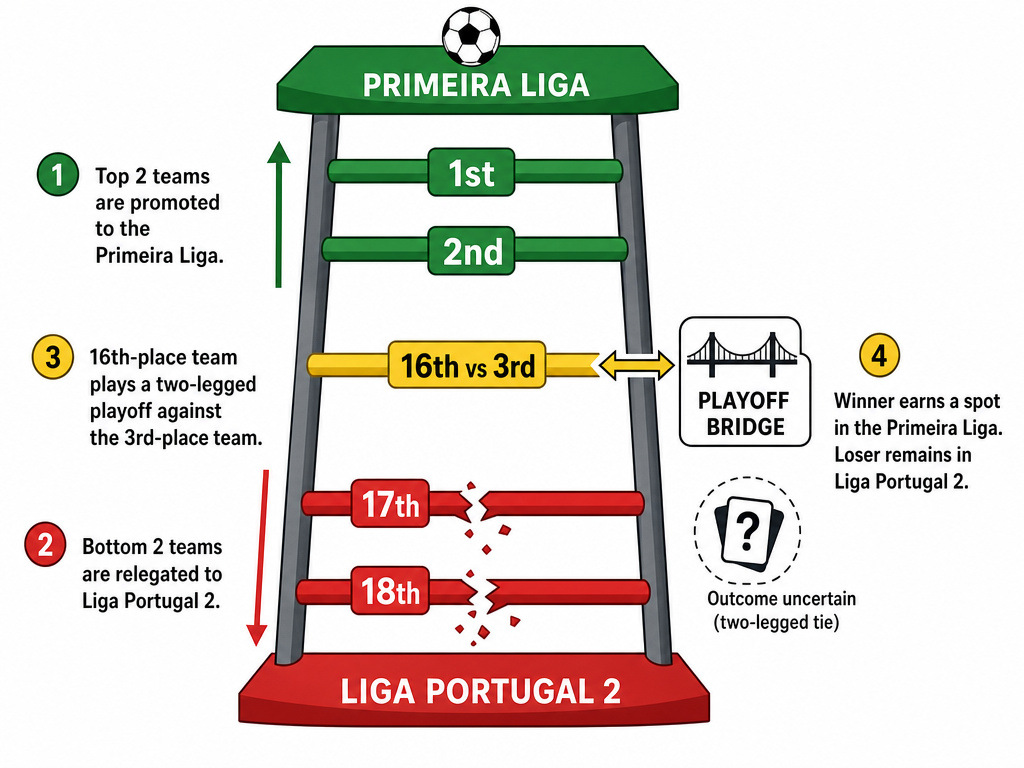
The bottom of the table is where the league’s drama often feels most acute. The system is designed so that up to three clubs can change divisions in a single season.
The rules are clear: the 17th and 18th placed clubs are relegated directly to Liga Portugal 2. That’s the easy part. The tension surrounds 16th place.
The 16th-placed Primeira Liga club enters a two-legged promotion/relegation playoff against the 3rd-placed eligible club from Liga Portugal 2. The order of legs is determined by draw. If the aggregate score is level after the second leg, extra time and penalties follow.
This isn’t a friendly. It’s a survival fight. The top two teams from the second tier are promoted automatically. The third-place team gets this shot. But there’s a famous Portuguese quirk: B teams are ineligible for promotion. If a B team like Benfica B or Porto B finishes third, the playoff chance slides down to the next fully independent club in the Liga Portugal 2 table. The purpose is clear, to keep the professional pyramid distinct from the academy structure.
The playoff itself is a pure, two-legged tie. There’s no away goals rule. The order of home and away legs is decided by draw, so the top-flight club has no guaranteed home advantage in the decisive second leg. If it’s level after 180 minutes, they play extra time and, if needed, penalties. The stakes are pure survival, with no trophy or medal for winning, just the right to stay in or enter the Primeira Liga. It’s a brutal, high-stakes finale that embodies the high-wire act of life outside the top few places.
This is a specific form of the wider promotion and relegation system that defines football pyramids worldwide, but with its own unique, nerve-shredding twist.
| Position | Primeira Liga Fate | Liga Portugal 2 Fate |
|---|---|---|
| 1st – 15th | Stay in Primeira Liga | – |
| 16th | Enter playoff vs. Liga Portugal 2 3rd place | 3rd place (eligible) enters playoff |
| 17th & 18th | Relegated directly | 1st & 2nd (eligible) promoted directly |
The Road to Europe: How League Position Pays
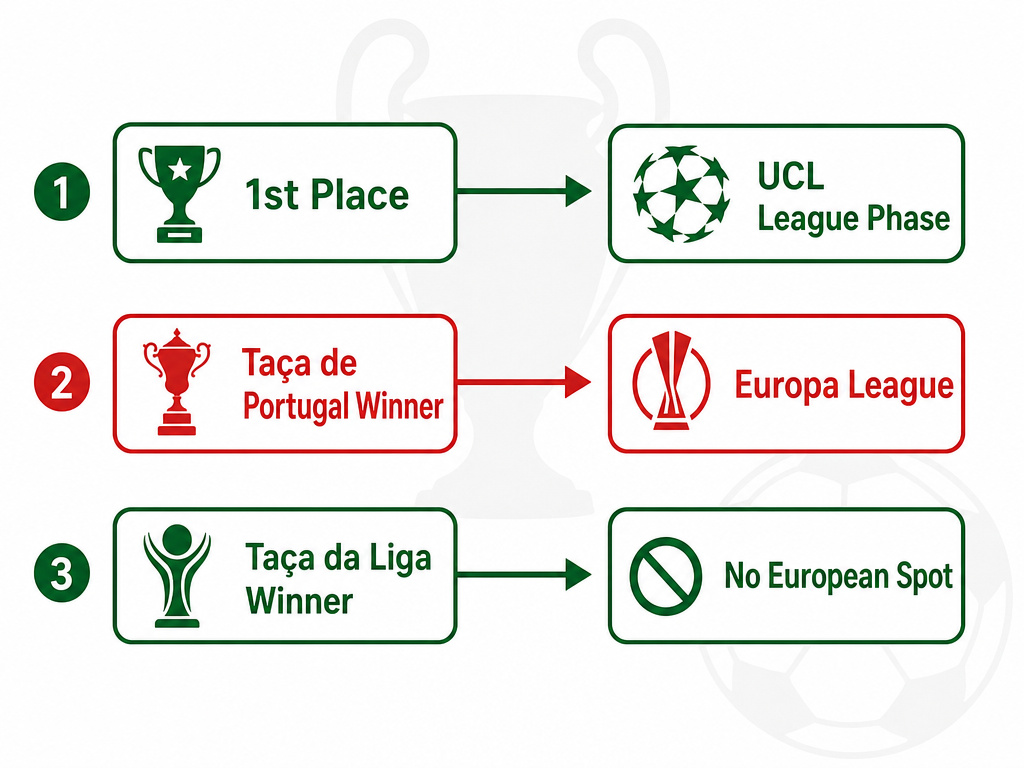
For clubs, the real prize beyond the trophy is often the financial windfall of European football. Qualification spots are dictated by Portugal’s standing in UEFA’s country coefficient, which can shift yearly, but the general hierarchy is stable.
The champion enters the UEFA Champions League phase directly, a huge financial and sporting boost.
One place doesn’t come from the league table at all: the winner of the Taça de Portugal earns a Europa League spot. The other domestic cup, the Taça da Liga, offers no European qualification.
This system creates multiple races within the season. Understanding this is key to grasping the Champions League ecosystem and how a nation’s clubs feed into it.
Behind the Scenes: Schedules, Paperwork, and Money
The matchday experience rests on a foundation of logistics and administration most fans never see. The fixture calendar has unique constraints. Neighboring clubs (e.g., Benfica and Sporting in Lisbon) cannot all be at home on the same matchday. The draw also prevents the same team from having two straight away matches in the Atlantic islands. These are travel realities most European leagues don’t face.
The bureaucracy for clubs is relentless. By July 11 before the season, they must submit kit and advertising information to Liga Portugal. Physical kit samples must be delivered for approval at least 15 days before their first league match. Financial transparency is enforced: clubs must submit detailed salary information for all players and coaches (using ‘Modelo Y’) by October 15, with an updated version due by March 15.
Even stadiums are regularly inspected. The first check is paid for by Liga Portugal; any subsequent inspections requested by the club cost €153.00 plus VAT. These processes, while dry, are the gears that keep the competitive machine running fairly and professionally.
A League Defined by Its Middle and Its Past
That dominance is a defining characteristic, but it can overshadow the league’s real health, which is often found in its middle.
The 2023-24 season saw an average attendance of 12,115 fans per game in the top flight. That’s a league with a passionate, engaged core support.
When you compare it to other major leagues, the Primeira Liga’s shorter season and unique rules give it a distinct flavor.
How Sponsorship and League Naming Works
Clubs must submit all details regarding their kits and advertising materials to the league by a specific deadline each season, well before the first official match is played, to ensure everything is properly homologated.
Frequently Asked Questions
How many teams are in the Primeira Liga?
The Primeira Liga has 18 teams. Each team plays the other 17 twice (home and away) for a total of 34 matches per season.
What is the tie-breaker if teams finish on the same points?
The first tie-breaker is the head-to-head record between the tied teams (points, then goal difference in those games). Only after that does overall goal difference for the whole season come into play.
How does promotion and relegation work?
The bottom two teams (17th and 18th) are relegated automatically to Liga Portugal 2. The 16th-placed team enters a two-legged playoff against the 3rd-placed eligible team from the second division for the final spot.
Can B teams like Benfica B get promoted to the Primeira Liga?
No. B teams are ineligible for promotion from Liga Portugal 2, regardless of their final position. If a B team finishes in a promotion or playoff place, that spot goes to the next highest-placed independent club.
Where can I find the official rules?
The definitive source is the Regulamento das Competições published by Liga Portugal. An English-language summary can be found on the Wikipedia entry on Primeira Liga, and the complete regulations are available in Portuguese on the Portuguese Wikipedia Primeira Liga page and Liga Portugal’s own website.
The Bottom Line
Watch the Primeira Liga for more than the Big Three. Watch the 16th-placed team in May, playing a second-division side with their entire financial future in the balance over two legs. The league’s soul is in that pressure, in the head-to-head rules that make every derby a potential mathematical pivot, and in the logistical puzzle of scheduling trips to Madeira.
It’s a competition that operates with a clear, sometimes brutal, internal logic. The rules are specific, the consequences are immediate, and the stories that emerge, of survival, of narrow failure, of tactical innovation born from necessity, are what make it a compelling chapter in European football, season after season.
