
How the EFL Cup Works: Knockout Format and European Ticket
This post contains affiliate links. As an Amazon Associate, we earn from qualifying purchases.
The EFL Cup is a knockout competition for all 92 Premier League and English Football League clubs. It runs from August to February, featuring single-leg ties until the two-legged semi-finals, and ends with a final at Wembley. The winner qualifies for European football, though sources disagree on the specific competition: the Premier League states it is the third-qualifying round of the UEFA Europa League, while other guides state it is the UEFA Conference League.
That European place is the real stake, the tangible reward that transforms a midweek cup run from a distraction into a career-defining campaign for players and managers. Understanding how the EFL Cup works clarifies why the big clubs, despite often rotating squads early on, still field strong enough sides to progress.
What follows is a breakdown of the competition’s mechanics: who enters when, how the draw works, the specific rules that change as you move through the rounds, and the history behind a trophy that has been both overlooked and fiercely contested.
Key Takeaways
- The competition involves all 92 clubs from the Premier League and the three EFL divisions (Championship, League One, League Two).
- Matches from round one to the quarter-finals are single-leg ties with no extra time; drawn games go straight to penalties.
- The two-legged semi-finals are the only stage with an aggregate score and the potential for extra time.
- The winner qualifies for European football, though sources disagree on the specific competition and entry round: the Premier League states it is the third-qualifying round of the UEFA Europa League, while other guides state it is the UEFA Conference League (with some specifying the play-off round).
- Disciplinary proceedings are on a fast track, with clubs having just 3 days to respond to allegations relating to matches in Round One and/or Round Two.
The Knockout Format, Round by Round
Forget a league phase or group stages. The EFL Cup is pure, sudden-death knockout football from the very first match in August. This is its defining characteristic and the source of its unique drama.
The official EFL rules frame it as running over “5 rounds, semi-finals and final,” though public guides often count seven stages. That discrepancy comes from whether you count the semi-finals and final as part of the “rounds” or as separate showpiece events. The journey for most clubs, however, follows a clear path.
The competition shall consist of 5 rounds, semi-finals and final. The Management Committee may order such preliminary round(s) as they consider necessary. In rounds one, two, three, four and five, matches shall be played on the ground of the first Club drawn. EFL Carabao Cup Rules
Round One kicks off in early August, before the league season is fully underway. All 72 EFL clubs enter here, split into Northern and Southern sections to limit travel for early-season fixtures. The draw is unseeded, meaning a League Two side can be drawn at home against a Championship giant. For the 2025/26 season, a preliminary round was added for four specific clubs, the two promoted from the National League and the two lowest-finishing League Two sides from the prior season, before the main first round draw.
Round Two sees the entry of the Premier League clubs not involved in European competition. This is where the giant-killing stories often begin, as top-flight teams, sometimes with shuffled lineups, travel to lower-league grounds.
Round Three is when the eight clubs qualified for UEFA competitions enter. This exemption, written into the rules, acknowledges their congested fixture list. From this point, the geographical split ends, and the draw becomes completely open.
Round Four and the Quarter-Finals continue the single-leg format. The key operational detail here, often missed, is the absence of extra time. If a match is level after 90 minutes, it proceeds directly to a penalty shootout. This rule, designed to avoid additional fatigue, adds a thrilling layer of instant pressure.
The Semi-Finals shift the entire dynamic. They are played over two legs, home and away. If the aggregate score is level after the second leg, then extra time and penalties are used. This two-game tactical battle is a unique test, different from the one-off drama of the earlier rounds.
Finally, the Final is a single match at Wembley Stadium, typically held on a Sunday in late February. The Management Committee has the authority to set it for a Sunday, and they routinely do. If necessary, extra time and penalties decide the winner here.
Entry, Exemptions and the Draw Process
Who plays when isn’t random. It’s a structured system designed to balance the workload for clubs across different levels, a core part of understanding how the EFL Cup works and how the English football pyramid functions. The draw itself is a simple yet consequential event.
All 92 clubs from the top four tiers are involved. The 72 EFL clubs start in round one. The Premier League clubs not involved in European competition enter in round two. The Premier League clubs qualifying for UEFA club competitions, up to a maximum of eight, are exempt until round three.
Where this goes sideways: Assuming all Premier League clubs enter at the same time. The exemption for European sides is a fixed rule, and it directly shapes the strength of teams in rounds two and three.
The draw mechanics are straightforward but have subtle strategic implications. For round one, the competition is split into Northern and Southern sections. This isn’t just about fan travel; it’s a practical measure to keep costs down for lower-league clubs in the early stages. The draws for these rounds are usually conducted live, often with club legends pulling the balls.
From round three onwards, it’s one open pot. There’s no seeding based on league position. This is the true magic of the cup format, it can produce a heavyweight clash between two title contenders in September, or it can hand a League One side a dream home draw against a rotated giant. The timing of the draw, usually shortly after the previous round concludes, keeps the narrative momentum building throughout the season. For more on the mechanics behind these moments, see our guide on how football seeding and draws work.
Prize and Prestige: The European Ticket
Lifting the trophy at Wembley is the immediate glory, but the real prize is the European qualification that comes with it. This is where a key factual disagreement exists between primary sources.
The Premier League’s official guide states the winner qualifies for the “third-qualifying round of next season’s UEFA Europa League.” However, the consensus from the Wikipedia entry on the EFL Cup and other football guides is that the reward is now a place in the UEFA Conference League, Europe’s third-tier competition, with entry at the play-off round.
| Source | European Competition | Entry Round |
|---|---|---|
| PremierLeague.com | UEFA Europa League | Third Qualifying Round |
| Wikipedia / Guide to Football | UEFA Conference League | Play-off Round |
This discrepancy in understanding how the EFL Cup works likely stems from outdated information on one side. Since the 2020/21 season, the EFL Cup winner’s slot has been allocated to the Conference League. It’s a significant incentive, offering clubs like Leicester City or West Ham, or even a Championship side on a miracle run, a direct path into continental football.
If the winner has already qualified for Europe via their Premier League finish, the Conference League place trickles down to the highest-ranked Premier League side not already qualified. This pass-down rule determines which club receives the European spot.
Rules and peculiarities
Beyond the basic format, the EFL Cup has its own set of specific regulations that govern everything from disciplinary timelines to what happens if a club can’t fulfil a fixture. These aren’t just fine print; they directly impact how clubs approach the competition.
The disciplinary process is on a punishingly fast clock. For allegations relating to matches in Round One and/or Round Two, a club must provide its response to the alleged breach within 3 days of notification by the League. For later rounds, it’s 5 normal working days. Any hearing of an alleged breach by the Disciplinary Commission should take place no later than 7 days prior to the beginning of the next Round. This expedited system is designed to resolve issues before the competition progresses.
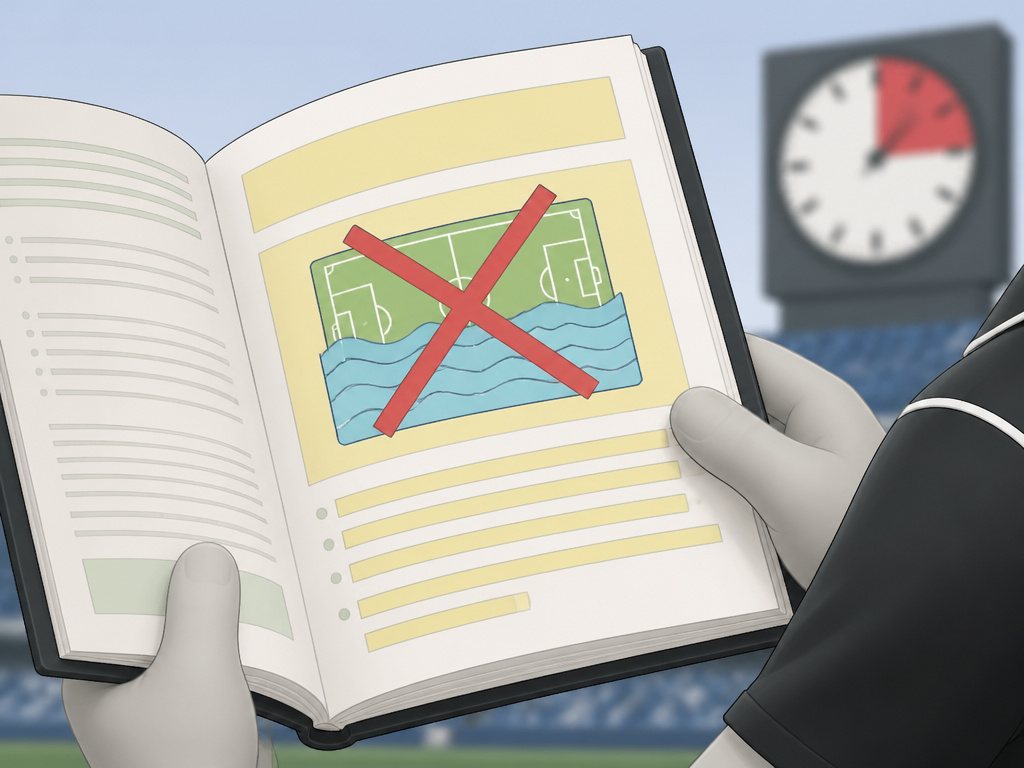
Common mistake: Thinking a waterlogged pitch automatically means a replay. If a match cannot be rearranged before the next round is due to start, and the EFL deems one club at fault for the abandonment, the offending club forfeits. Their opponent gets a bye.
The rules also cover minute details. Each club’s trainers’ bench must have a minimum of fourteen seats. No matches are permitted on artificial surfaces. Even the trophy itself has a custody rule: the winning club must return the cup at least one month prior to the Final Tie in the following year.
Broadcast coverage is now complete. From the 2025/26 season, every single Carabao Cup match is broadcast live in the UK on Sky Sports or their streaming service, Sky Sports+.
History and Record Holders
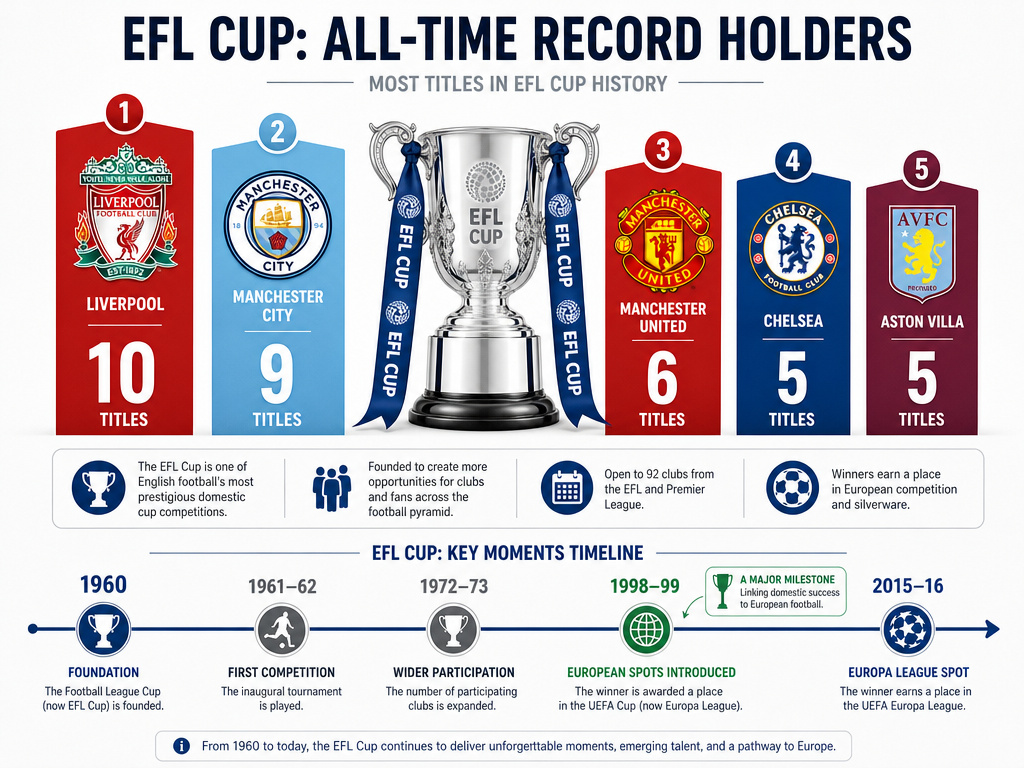
The competition was founded in 1960, a creation of the Football League to generate additional revenue and fixture content. It had a rocky start, with several major clubs refusing to participate in its early years. Its prestige grew when a European qualification place was attached, first for the Inter-Cities Fairs Cup, then the UEFA Cup (now Europa League), and now the Conference League.
The most successful club is Liverpool with 10 titles. Their wins span decades. Close behind is Manchester City with 9 titles. Other multiple winners include Manchester United (6) and Chelsea (5).
| Club | Titles | |———-|————| | Liverpool | 10 | | Manchester City | 9 | | Manchester United | 6 | | Chelsea | 5 | | Aston Villa | 5 |
The list of 24 different winners includes memorable underdog stories. Sources disagree on the current champions: Wikipedia states Manchester City are the current champions, while Guide to Football lists Newcastle United as the 2024-25 winner and Manchester City as the 2026 winner.
EFL Cup vs. FA Cup: The Key Differences
It’s the most natural comparison to make. Both are knockout cups for English clubs, but their philosophies and structures are distinct. Understanding these differences clarifies the unique role each competition plays.
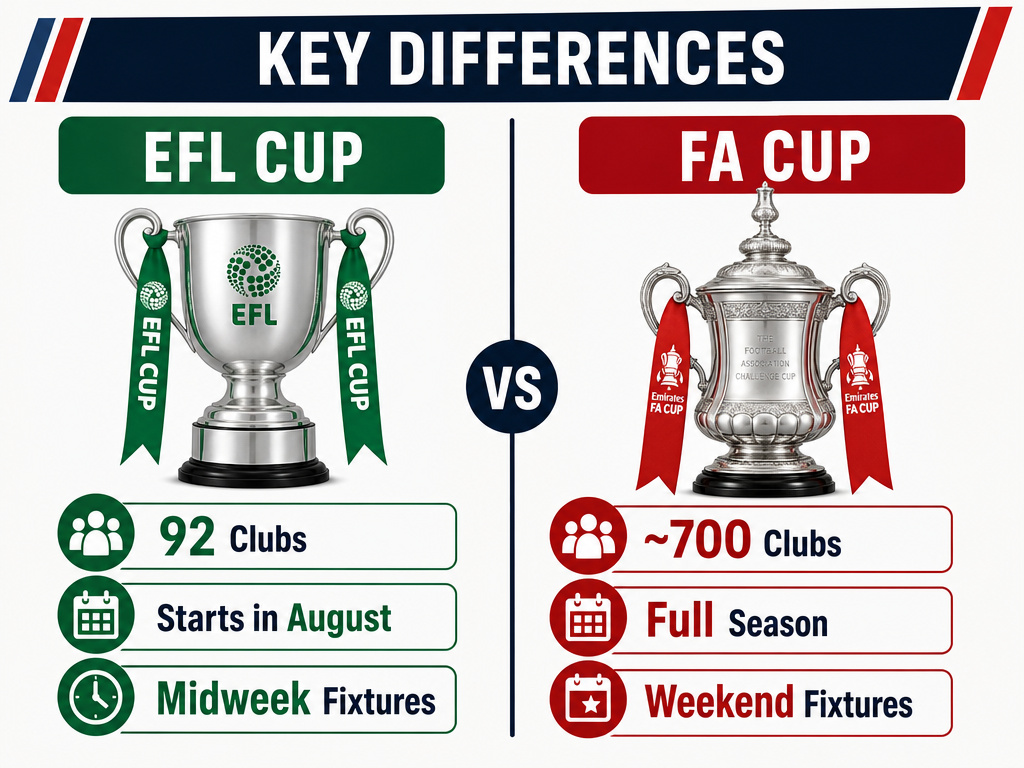
The FA Cup is the older, more prestigious competition, open to around 700 clubs from the Premier League down to the depths of the non-league system. Its magic is rooted in the possibility of very small clubs reaching later rounds and drawing a giant. The EFL Cup, by contrast, is exclusively for the 92 professional clubs of the top four divisions. Its giant-killings are therefore between professional sides, often separated by just one or two divisions.
The scheduling is different. The FA Cup runs for the full season, concluding with a final at Wembley. The EFL Cup is condensed, starting in August and finishing in February. Its midweek slots mean it rarely clashes with weekend league fixtures, whereas FA Cup weekends often see the Premier League take a pause.
Finally, the rewards differ. The FA Cup winner qualifies for the Europa League. Sources disagree on the European competition for the EFL Cup winner: the Premier League states it is the UEFA Europa League, while other guides state it is the UEFA Conference League. To learn more about the older competition, see our explainer on the FA Cup format and history.
How common are giant-killings in the EFL Cup?
The EFL Cup’s structure actively creates conditions for upsets. With all 92 clubs from the top four divisions involved, early rounds frequently see lower-league sides drawn at home against elite opponents. The rules state that in rounds one through five, matches are played on the ground of the first club drawn, giving smaller clubs a significant home advantage. Also, these early rounds are single matches that go straight to penalties if level after 90 minutes, removing the safety net of a replay for bigger clubs. This format, combined with the intense atmosphere of a packed lower-league ground on a midweek night, has produced some of the competition’s most memorable moments where part-time or lower-division teams have defeated top-flight giants.
Why do big clubs rotate their squads in the EFL Cup?
Squad rotation is a standard strategy for clubs with European commitments. Teams qualifying for UEFA competitions are exempt from the EFL Cup until the third round, but once they enter, the schedule becomes congested. Matches are played midweek, usually on Tuesdays and Wednesdays, sandwiched between Premier League weekends. This forces managers to balance priorities. The competition offers a valuable route to European football, but the domestic league and other cups often take precedence. Consequently, managers use these matches to give playing time to squad players, fringe stars, and promising academy graduates. This approach tests squad depth and can lead to unpredictable results, especially in away ties against motivated lower-division opponents.
Frequently Asked Questions
Is the EFL Cup semi-final two legs?
Yes. The semi-finals are the only stage played over two legs, home and away. All rounds before that are single matches. If the aggregate score is level after the second leg, extra time and then penalties are used.
What’s the difference between the FA Cup and the EFL Cup?
The main differences are the teams involved and the scheduling. The FA Cup includes hundreds of non-league clubs and runs the full season. The EFL Cup is only for the 92 Premier League and EFL clubs and finishes in February. The FA Cup winner goes to the Europa League; the EFL Cup winner goes to the Conference League.
How does the Carabao Cup draw work?
For rounds one and two, the 72 EFL clubs (and later the non-European Premier League sides) are split into Northern and Southern sections for the draw. From round three onwards, it’s a single open draw with no seeding or geographical split. The first club drawn plays at home.
Who qualifies for the EFL Cup?
All 92 clubs from the Premier League, Championship, League One, and League Two qualify automatically. EFL clubs start in round one. Premier League clubs not in Europe start in round two. Premier League clubs in European competitions get a bye to round three.
Do EFL Cup games have extra time?
Only in the semi-final second leg (if aggregate is level) and in the final. In all rounds from one to the quarter-finals, if the match is drawn after 90 minutes, it goes straight to a penalty shootout with no extra time.
The Bottom Line
The EFL Cup’s value is often debated. For top-six clubs chasing the Premier League and Champions League, it can be a platform for squad players. For everyone else, it’s a direct shot at silverware and a life-changing European adventure.
The format is brutally efficient: straight knockout, minimal replays, and a finish before the season’s run-in. That condensed timeline creates its own pressure and narrative. Whether you call it the League Cup, the Carabao Cup, or the EFL Cup, its role is clear. It’s a competition where a club’s depth is tested in August, where a cup run can define a manager’s tenure, and where one Sunday at Wembley can rewrite a club’s history.
