
How the UEFA Europa League Works: The /27 Format Explained
This post contains affiliate links. As an Amazon Associate, we earn from qualifying purchases.
The UEFA Europa League works as a two-stage club competition featuring a 36-team league phase followed by a knockout phase. For the 2026/27 season, 36 teams compete in a single league table, each playing 8 matches. The top 8 advance directly to the round of 16, teams ranked 9th to 24th enter knockout play-offs, and the bottom 12 are eliminated. The winner qualifies for the following season’s UEFA Champions League.
That 8-match league slate is the biggest change from the old group stage. It means every team plays a different set of opponents, decided by a complex draw based on club coefficients. This is a key part of how the UEFA Europa League works.
What follows is a walk through the entire machine: how 36 teams get there, the maths behind the league phase draw, the path through the knockouts, and what’s really at stake beyond the trophy, which is a core part of how the UEFA Europa League works.
Key Takeaways
- The 36-team league phase replaces the old group stage, with each club playing just 8 matches (4 home, 4 away).
- Teams ranked 1st–8th skip a round, advancing straight to the last 16. Teams 9th–24th face a two-legged play-off to join them.
- Qualification is a web of domestic league finishes, cup wins, and drop-downs from the UEFA Champions League.
- The league phase draw uses club coefficients to sort teams into four pots, deciding each club’s unique 8-game fixture list.
- Winning the Europa League grants a spot in next season’s Champions League and a match in the UEFA Super Cup.
The League Phase: A 36-Team Table
Forget the old groups of four. Since the 2024 reforms, the Europa League starts with a single league of 36 teams. It looks like a domestic league table, but the fixture list is nothing like one.
Each team plays only 8 matches. They get four at home and four away. But the UEFA administration can change that if needed.
The 36 clubs are divided into four pots of nine based on club coefficients. Each team is drawn against two opponents from each of the four pots and plays one opponent from each pot at home, and the other away.
That’s the engine of the new format. Your club’s coefficient, a five-season performance score, places it in Pot 1, 2, 3, or 4. The draw then gives you two teams from each pot. You’ll host one from each pot and travel to the other. The result is a unique schedule for every club. You could be a Pot 4 team facing two giants from Pot 1, or a Pot 1 team with a relatively kinder draw.
Points are standard: three for a win, one for a draw.
The final matchday is played simultaneously on a Thursday at 21:00 CET, to keep the drama honest and prevent teams playing for a specific result, a rule central to how the UEFA Europa League works.
How Teams Qualify for the League Phase
Getting one of those 36 spots is a puzzle with pieces from all over Europe. The picture for 2026/27 looks like this.
Most teams arrive through their domestic performance. The exact number of spots each country gets is dictated by the UEFA coefficients. Higher-ranked nations like England, Spain, and Germany get more entries.
For the 2026/27 season, the access list is built from several streams. According to UEFA’s official guide, this breaks down as:
- 13 teams qualify directly for the league phase from their domestic competitions.
- The UEFA Conference League title holder from the previous season gets a direct spot.
- 12 spots are filled via the Europa League’s own qualifying rounds, which start in early July.
- 11 spots go to teams that are eliminated from the UEFA Champions League third qualifying round and play-offs.
That last stream is crucial. It means a team that just misses out on the Champions League group stage gets a second chance in the Europa League. The path between the two competitions is a constant flow.
| Qualification Route | Number of Teams (2026/27) | Notes |
|---|---|---|
| Direct Domestic Qualification | 13 | Based on league position/cup wins in top nations. |
| UEFA Conference League Holder | 1 | Previous season’s champion enters directly. |
| Europa League Qualifying | 12 | Winners from three qualifying rounds and a play-off round. |
| UEFA Champions League Drop-downs | 11 | Losers from UCL third qualifying round & play-offs. |
Watch for a discrepancy in the official wording: one UEFA guide states twelve teams qualified directly for the league phase, with one slot also reserved for the UEFA Conference League title holders, while another UEFA guide states thirteen teams have qualified directly for the league phase.
The Intricate Path of Europa League Qualifying
For teams that don’t get a direct ticket, the summer is a gauntlet. The qualifying phase is a straight knockout, played over two legs (home and away). The team with the higher aggregate score after both matches progresses.
The calendar is tight:
- First qualifying round: 9 & 16 July 2026
- Second qualifying round: 23 & 30 July 2026
- Third qualifying round: 6 & 13 August 2026
- Play-off round: 20 & 27 August 2026
The league phase draw is held on 28 August 2026, right after the play-off round concludes. This is where the 36 teams are split into their coefficient pots.
There’s a critical edge case here. If a qualifying tie isn’t finished by the time of a draw, UEFA uses the higher club coefficient of the two teams involved to represent the winner for seeding purposes. It’s a necessary fiction to keep the administrative wheels turning.
Another rule bends for practicality: while ties are two-legged, Article 15.02 of the regulations states the “UEFA administration may decide that a tie be played in one leg, if circumstances so require.” Think of a major weather event or a political crisis, the format has a pressure-release valve built in.
From League to Knockout: The Play-off Path
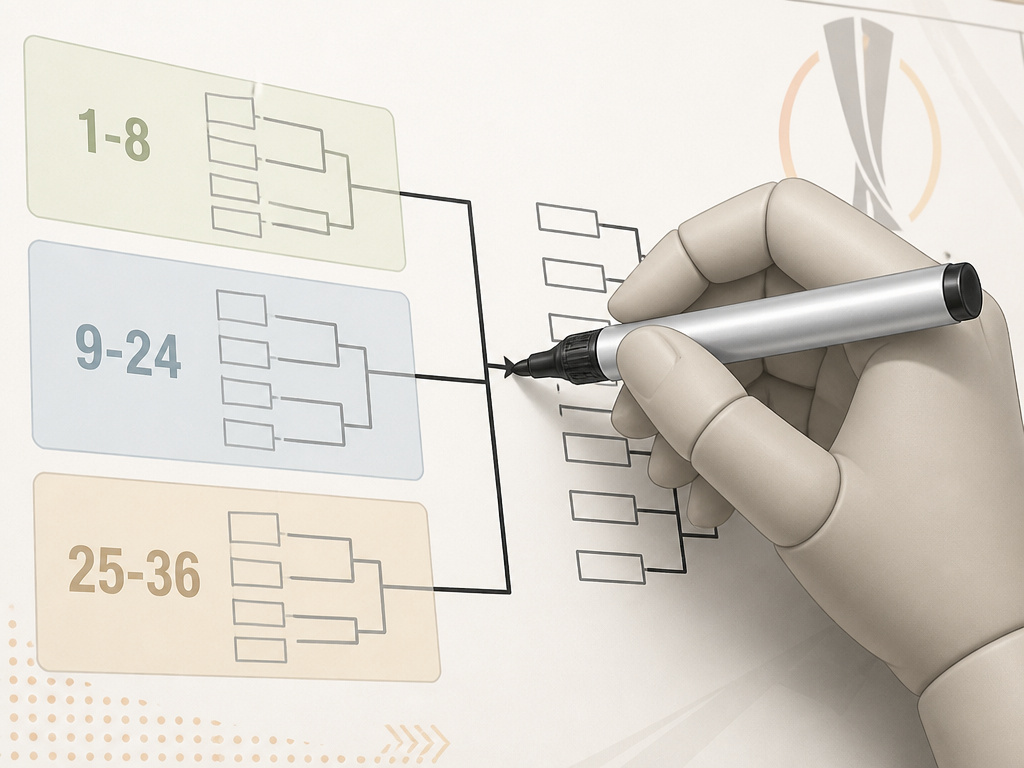
After the 8-match league phase, the table splits the 36 teams into three distinct groups. This is where the stakes crystallise.
- Positions 1 to 8: These teams are through. They bypass the next round entirely and advance directly to the round of 16. They get a breather while the next group fights it out.
- Positions 9 to 24: This is the play-off zone. These 16 teams are paired off for a two-legged knockout tie. The 8 winners advance to the round of 16 to face the top 8.
- Positions 25 to 36: The journey ends here. These 12 teams are eliminated from European competition for the season.
The knockout phase draw is not a free-for-all. The bracket is predetermined. Teams ranked 1 to 4 after the league phase are seeded for the quarter-finals, meaning they are scheduled to play the second leg at home. That advantage is sticky, if a seeded team gets knocked out in the round of 16, the team that beat them takes over their seeded position in the bracket.
The final is a one-off match at a neutral venue. For 2026/27, that’s Stadion Frankfurt in Frankfurt, Germany, on 26 May 2027. The team drawn on the silver side of the bracket is listed as the “home” team for administrative purposes, like choosing the dressing room.
Prizes, Coefficients, and the Bigger Picture
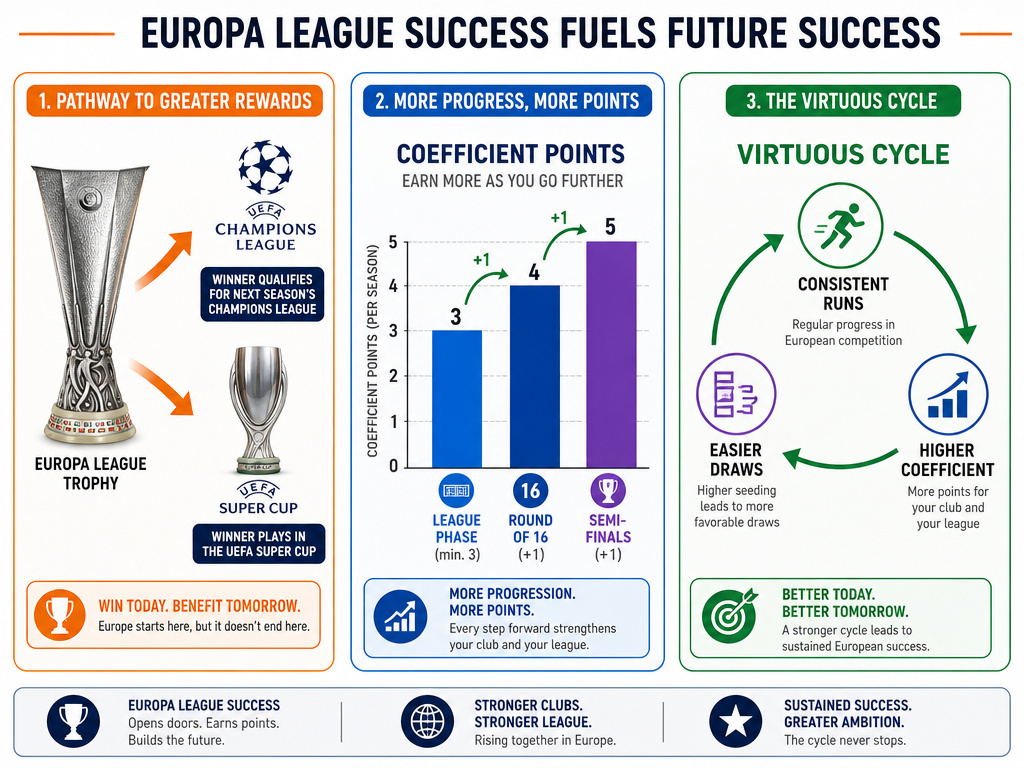
Lifting the 15kg trophy is the obvious goal. But the rewards for a deep Europa League run are multi-layered.
The Sporting Prizes:
- UEFA Champions League Qualification: The winner earns a place in the league phase of the following season’s Champions League, provided they haven’t already qualified through their domestic league.
- UEFA Super Cup: The winner faces the Champions League holder in the season-opening Super Cup.
- Prestige: It’s a major European trophy, the second-tier continental honour.
The Financial & Strategic Prize: Coefficient Points.
This is the quiet, long-term game. A club’s coefficient determines its seeding in future draws, influencing its chances of progress. Points are earned for results and progression.
Clubs are guaranteed a minimum of three points in the league phase for coefficient calculation, even if they earn fewer.
So, a team that has a disastrous league phase and gets zero points still gets credited with 3.000 coefficient points. Beyond that, points are awarded based on final league position (1st place gets 6.000, descending to 24th place getting 0.250). Then, for each knockout round reached from the round of 16 onwards, a club gets one extra coefficient point.
This system massively rewards consistency. A team that makes the semi-finals every year will build a formidable coefficient, making future draws easier and creating a virtuous cycle. It’s why a club might prioritise a Europa League run over a middling domestic league finish.
How the Europa League Fits in UEFA’s Ecosystem
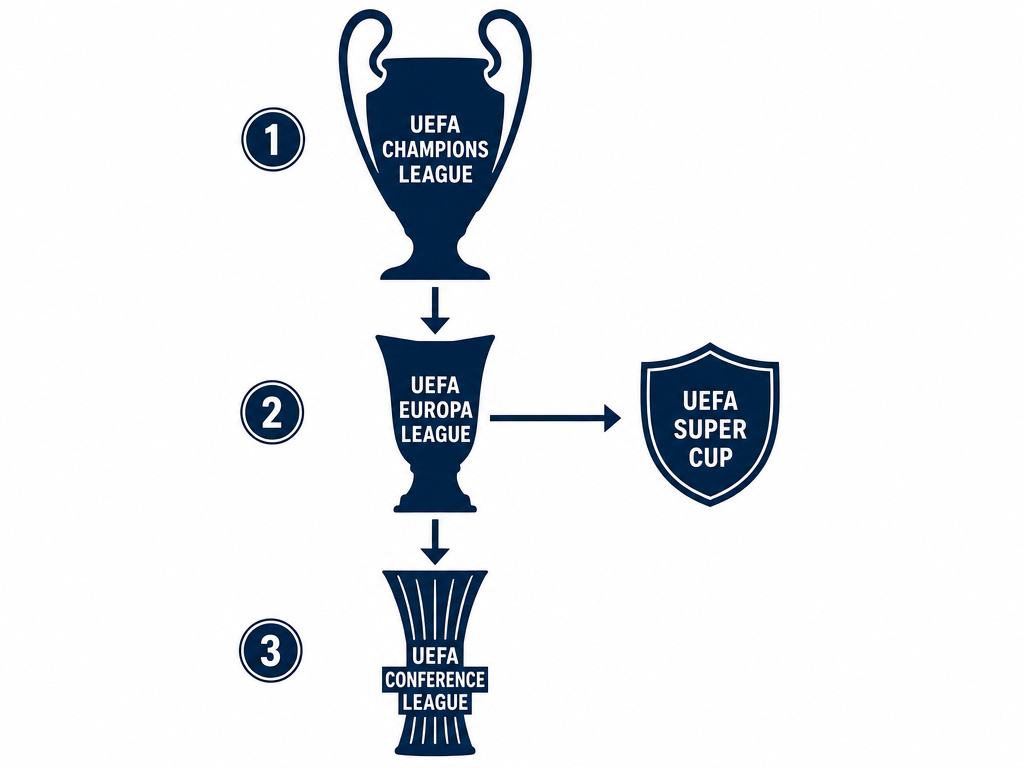
It doesn’t exist in a vacuum. The Europa League is the middle child in UEFA’s three-club competition structure.
At the top is the UEFA Champions League, the most prestigious and lucrative. Below the Europa League is the UEFA Conference League, UEFA’s third-tier competition. Teams flow between them. Losers from the Champions League’s early qualifying rounds drop into the Europa League qualifiers.
The winner of each competition also meets the following season in a hierarchy of showpiece events. The Champions League and Europa League winners contest the UEFA Super Cup.
This interconnected system, governed by the complex UEFA coefficients ranking, is designed to keep more teams in meaningful European football for longer. The criticism is that it protects big clubs. The defence is that it creates more competitive matches across the continent.
Historical context and name changes (UEFA Cup to Europa League)
The competition has a long history, with the 2026/27 season marking its 56th edition. It has been known as the UEFA Europa League for 18 of those seasons, following a significant rebranding. This name change reflected a modernized format and identity for Europe’s secondary club competition. While the core purpose of providing a prestigious continental stage for clubs remains, the evolution in name and structure aligns with UEFA’s broader tournament developments. The competition continues to build on its legacy as the successor to the UEFA Cup.
Qualifying round dates and results
Qualifying for the competition begins in the summer. For the 2026/27 season, the first qualifying round matches were played on specific dates in July. The process continues through subsequent rounds in July and August, with each tie typically played over two legs, home and away. The results from these rounds determine which teams advance to fill the available spots in the league phase. The final play-off round concludes just before the league phase draw, setting the stage for the main tournament. You can find the specific results for each round on official UEFA platforms.
Number of teams and participating nations
The league phase features a set number of teams competing in a single league table. These clubs come from many different nations across Europe. The allocation of places to each country is determined by UEFA coefficients, which rank national associations based on the performance of their clubs in European competitions. Higher-ranked nations typically receive more entries. Teams reach the league phase through various routes, including direct qualification based on domestic league finishes, winning the UEFA Conference League, progressing through the Europa League’s own qualifying rounds, or entering after being eliminated from the UEFA Champions League qualifying process.
Frequently Asked Questions
What’s the difference between the Champions League and the Europa League?
The Champions League is UEFA’s top-tier competition for the champions and top teams from Europe’s strongest leagues. The Europa League is the second-tier, featuring teams that finished lower in their domestic leagues or won their domestic cups. The Champions League is more prestigious and has significantly higher prize money.
How many games does a team play to win the Europa League?
Team entering in the qualifying rounds could play multiple matches in qualifying, 8 in the league phase, and up to 5 in the knockout stages. A team that enters directly into the league phase would need to play 8 league matches plus the knockout matches to win the trophy.
What is the format of the 2026-27 Europa League?
The 2026/27 format features a 36-team league phase where each club plays 8 matches. The top 8 advance to the round of 16. Teams placed 9th-24th enter a knockout play-off round. The knockout phase then proceeds through the round of 16, quarter-finals, and semi-finals to a one-match final in Frankfurt.
How are teams selected for the UEFA Europa League?
Teams qualify primarily through their domestic league position (e.g., 5th/6th place in England) or by winning their domestic cup. Additional spots are filled by losers from the UEFA Champions League qualifying rounds and the previous winner of the UEFA Conference League. The exact number of spots per country is determined by UEFA coefficient rankings.
The Bottom Line
The new UEFA Europa League format is built for volume and continuity. More teams, more matches, and a league system designed to minimise dead rubbers. The real test is whether that league phase creates compelling narratives or just a bloated schedule before the real drama of the knockouts.
For a club, the calculus is clear. A deep run is worth more than ever, in prize money, in prestige, and in the crucial currency of coefficient points that shape your future. For a fan, it means your team is likely to play more European games against a wider variety of opponents. Just don’t expect a simple home-and-away against the same three teams anymore. The draw is more complex, and every team’s path is unique.
The old two-legged knockout ties from the start, like the classic European Cup, had a brutal, win-or-go-home purity. This modern system trades some of that white-knuckle drama for stability and more football. Whether that’s a good trade depends on what you watch for.
