
How to Defend Corners in Football: Setup and Drills
This post contains affiliate links. As an Amazon Associate, we earn from qualifying purchases.
To defend corners in football, assign clear roles, protect the near post and edge, win the first contact, and clear high, far, and wide. Use a zonal, man-marking, or hybrid setup, then practice the second phase and the counter-attack. At FIFA World Cup Qatar 2022, 19% of goals excluding own-goals and penalties came from set pieces.
That structure matters because a corner is a rare chance with high consequence. FIFA Training Centre recorded 1 in 35 corners producing a goal at Qatar 2022, while Coaching American Soccer notes some studies put the chance as low as 2 percent. The gap in those numbers is why setup, communication, and clearances need drilling, not shouting.
What follows: three marking systems, the goalkeeper’s job, edge protection, second-phase habits, and a simple youth-friendly version.
Key Takeaways
- FIFA says teams used zonal marking in 60% of defensive corners at Club World Cup 2025.
- FIFA says when teams had no players designated to protect the edge of the penalty area, 57% of corners entered a second phase at Club World Cup 2025.
- Coaching American Soccer says clear the ball high, far, and wide.
- FIFA says the keeper must be the penalty-area coach.
- FIFA gives zonal the lowest first-phase xG (expected goals) at 0.09 per attempt.
How to Defend Corners in Football: Pick One Setup
Pick one structure before the whistle. Then give every player a job that doesn’t change when the ball moves.
A corner defense plan assigns each defender one of three jobs: a zone, an opponent, or the edge. Zonal setups use four or more players focused on ball trajectory; player-to-player setups use a maximum of three zonal players; hybrid setups mix zones, markers, and edge players. Clearances should leave the danger area, and the second phase needs a named outlet.
A plan beats panic. You hear the keeper’s first call before the ball is struck; if it’s late, defenders collide. That sound is a useful test. If the call comes after the run-up, the plan is too vague.
- Choose one setup: zonal, player-to-player, or hybrid. Skipping this creates mixed messages, and two defenders will chase the same attacker.
- Name the edge defender. The edge is the area just outside the penalty box. Without an edge player, FIFA Club World Cup 2025 data says 57% of corners entered a second phase.
- Decide the clearance rule: high, far, and wide. A short clearance keeps the ball in the danger zone and invites a second phase.
- Put one outlet player ready to counter. Coaching American Soccer says the opponent brings players forward, so the fast break needs a planned escape route.
First contact means the defending team wins the first touch or header. Winning the first contact denies an immediate attempt at goal. FIFA says teams stick to a preferred setup, then change one role for a specific routine.
For a beginner-friendly version, start with team defending and make sure everyone knows the corner kick rules.
You’ll need reps. A first session is messy. Coaching American Soccer says top-level success comes after years of practice.
Corner defense is like seasoning a stew: a little timing at the right moment lifts the whole shape, but constant shouting burns it out.
Which Corner Defense Setup Wins the First Contact?
FIFA Training Centre says teams used zonal marking in 60% of defensive corners at FIFA Club World Cup 2025. It’s the biggest shift from Qatar 2022, when zonal appeared in 31% of defending corners. At FIFA World Cup 2022, player marking was used in 38% of defensive corners and hybrid in 28%; at FIFA Club World Cup 2025, those figures were 14% and 24% respectively.
At FIFA Club World Cup 2025, 18 of the 32 teams used zonal structures, five used player marking, five used hybrid, and four varied approaches.
The FIFA Club World Cup 2025 set-play analysis gives those numbers.
| Setup | FIFA definition | FCWC25 first-contact success | Best for |
|---|---|---|---|
| Zonal | Four or more players cover space | 65% | Teams with strong communicators and reliable headers |
| Player-to-player | Maximum three zonal players; most defenders mark opponents | 62% | Teams with fast trackers and clear marks |
| Hybrid | Mixes zones, markers, and edge players | 57% | Teams that want space cover plus a marker on a key threat |
Zonal marking keeps defenders in front and central areas. FIFA says that loaded presence limits first-phase attempts. FIFA’s numbers use xG, or expected goals per shot. The average xG per attempt was 0.09 for zonal, 0.12 for player marking, and 0.19 for hybrid.
At FIFA Club World Cup 2025, attempts at goal in the first phase against zonal marking were generated 10.2m from goal on average; against player marking they were 2m closer, and against hybrid they were 0.6m closer.
The sources don’t agree on the best system. FIFA’s Qatar 2022 analysis says the numbers don’t prove one system is better by itself. FIFA’s Club World Cup 2025 analysis says zonal was most used and had a defensive first-contact success rate of 65%, compared to 62% for player marking and 57% for hybrid.
Total Football Analysis says hybrid is the current common method. Coaching American Soccer says mixed zone and man marking has the lowest chance of giving up goals from corners.
No source gives a single best system. Anyone who claims one system always wins is selling something.
Which setup fits your team?
The zonal vs man marking debate turns on players and opponent runs.
The zonal case
At FIFA Club World Cup 2025, teams used five or six zonal players to defend against one third (235 of 621) of all corners taken. At FIFA Club World Cup 2025, defending teams conceded the highest proportion of attempts at goal (29%) in the first phase against teams that used seven or eight zonal players. That tells me the middle ground matters: enough bodies to protect space, not so many that the edge is open.
Zonal setups reduce reliance on one-on-one duels. Zone defenders move away from the goal to get the ball.
At FIFA World Cup 2022, USA (with 5 zonal markers) had an 84% first contact rate from corners, and Germany (with 6) won 75% of first balls.
At FIFA World Cup 2022, nine of the 32 teams (28%) used just two zonal defenders at corners.
The player-marking case
FIFA’s Qatar 2022 sample found three of six teams that conceded the fewest attempts from corners used player-to-player setups: Uruguay, Spain, and England. The logic is simple. Each marker owns a runner. Man markers must know their runner, track closely, and win the ball. If the marker loses focus, the runner gets a free chance.
The hybrid case
Hybrid setups mix zones, markers, and edge players. At FIFA Club World Cup 2025, hybrid marking had a defensive first-contact success rate of 57% and produced an average xG per attempt at goal in the first phase of 0.19. That is the weakest number in the set. Still, a hybrid shape works when one player guards a short corner and another protects the edge.
FIFA says the coach chooses based on players.
For a youth team, zonal is the starting pick. For a senior team with strong communicators, a hybrid shape gives the best blend. For a team with fast trackers, player marking wins. Simple. Repeat it.
Where Should Players Stand at Posts, Zones, and the Edge?
Three spots need names: the front post (the post closest to the taker), the back post, and the penalty-area edge (the area just outside the box). FIFA says fewer teams stationed players on the posts at Qatar 2022, while Coaching American Soccer’s basic zone still places one player at each post. That disagreement matters for youth coaches, because post duties are easy to teach, but they can create a flat defense.
The FIFA defending corners analysis says teams stick to one setup, then change one role.
| Problem | Likely cause | Fix |
|---|---|---|
| Attacker gets a free header | No edge defender | Put one player at the penalty-area edge |
| Front post is overrun | Front-post defender is too deep | Move the front-post player to attack the ball |
| Second phase starts too fast | Clearance is short and central | Clear high, far, and wide |
| Defenders collide | Late goalkeeper call | Keeper calls before the run-up |
- Front post: attack the ball, not the shirt. FIFA says traditional front-post roles were more reactionary, while zonal players try to prevent first contacts in threatening areas.
- Back post: cover the space behind the keeper. If the keeper claims, the back-post player still needs to clear a loose ball.
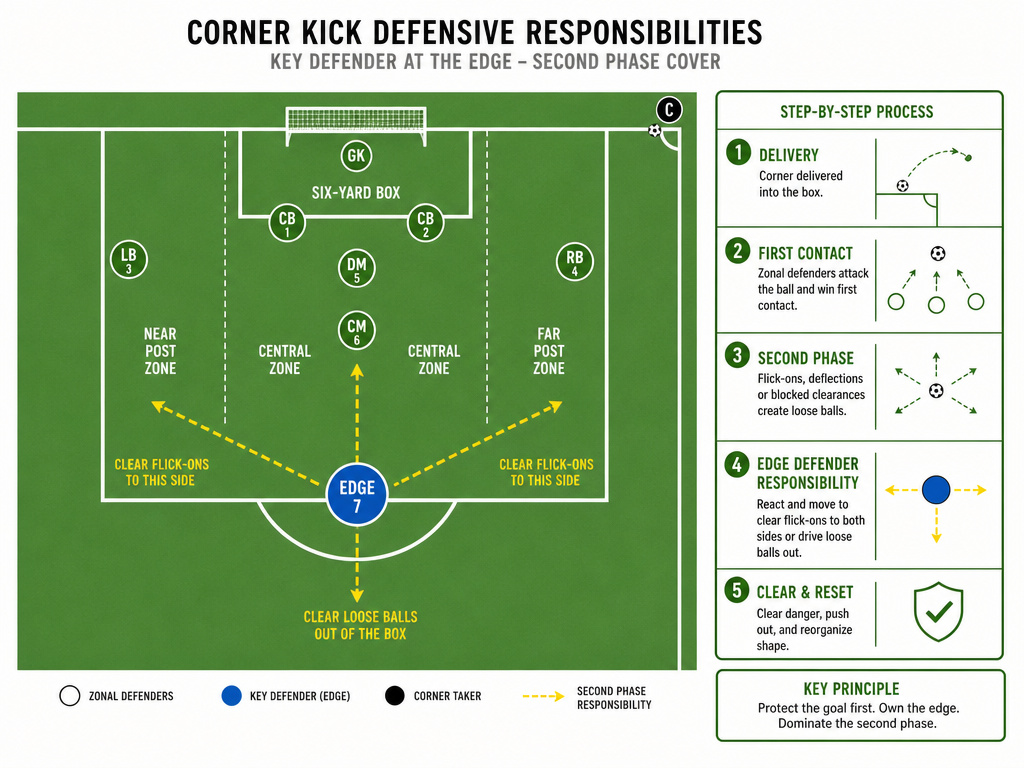
- Edge defender: protect the area between the box and the halfway line. At FIFA Club World Cup 2025, when teams had no players designated to protect the edge of the penalty area, 57% of corners entered a second phase; with one edge player, the figure was 40%.
- Outlet player: stay ready to receive a clearance. Coaching American Soccer suggests an outlet about halfway up the sideline in the defensive half.
The near post needs a defender who attacks the ball early. Good body shape lets that defender turn with the delivery. Keep defensive compactness without crowding the keeper.
Coaching American Soccer’s mixed layout puts two post players and three on the six-yard line, with the rest marking man-to-man. One defender covers the kicker. Coaching American Soccer says to put the team’s best headers on the six-yard line.
Skip tall target men as the sole answer. The three six-yard defenders need timing and calls.
A clean clearance leaves the boot with a flat thud and travels high and wide. A high, wide clearance removes immediate pressure and gives defenders time to reset.
Don’t put a slow central defender on the edge if the opponent loves second balls. Within two corners, the ball drops to a shooter.
Don’t clear short and central. On the next play, the ball stays in the danger zone and invites a second phase.
Easy to miss: Leaving no player at the penalty-area edge. FIFA FCWC25 data says 57% of corners entered a second phase with no edge defender, compared with 40% with one.
The Goalkeeper Is the Penalty-Area Coach
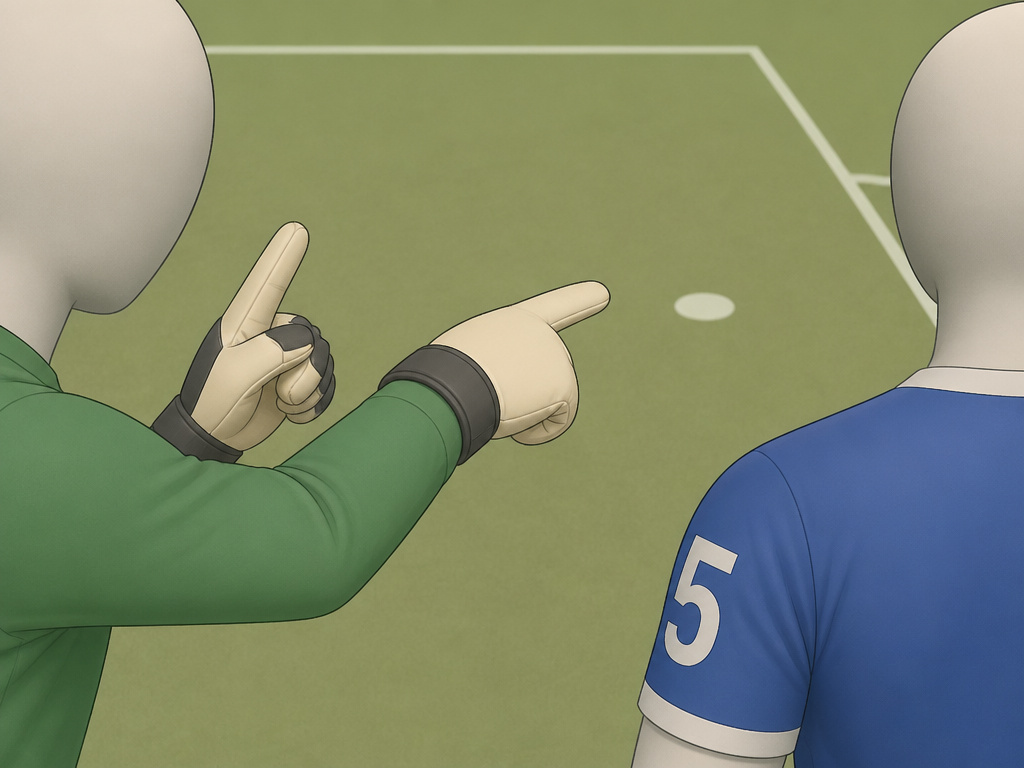
FIFA Training Centre says the goalkeeper must be the coach in the penalty area for set plays. The keeper’s starting position stays consistent across setups. The delivery type changes it: inswinger or outswinger. An inswinger bends toward the goal; an outswinger bends away.
FIFA says first contacts by goalkeepers in hybrid marking strategies have decreased by 4% compared to 2023, while the goalkeeper’s first contacts in zonal setups have risen by 2% from 2023.
If an attacker stands close to the keeper, some goalkeepers prefer to handle that duel, while others want a defender to handle the attacker. Coaching American Soccer says if the goalkeeper calls for a specific defender to mark the attacker near them, it is usually the player on the back post.
Coaching American Soccer says defenders must clear a path if the keeper calls. If the keeper doesn’t call, defenders follow the plan.
FIFA says the goalkeeper coach and head coach should collaborate when training to defend corners. They should consider the keeper’s strengths and what the keeper likes.
I want a keeper who calls early and owns the first six yards. A silent keeper turns a corner into a guessing game.
Coaching American Soccer says an attacker near the keeper must play the ball and must not block the keeper.
A keeper who can command your box makes the plan work.
Read the Opponent Before You Judge the System
I once counted a back three at kickoff and read the wrong story. The shape changed during the phases, and counting at kickoff told me the wrong thing. I now read shape during phases instead. For corners, that means watching how opponents flood a zone, use blockers, or play short.
At FIFA World Cup 2022, 83% of teams from the AFC and the OFC tended to favour a man-to-man setup. Five of their six teams deployed three zonal defenders or fewer.
Coaching American Soccer says attackers can flood a zone, and late decisions create gaps. Coach winning headers with timing, not just height.
Short corners
In FIFA’s Qatar 2022 example, the front-post player and the nearest edge player move out to press a short pass. That keeps the delivery angle narrow. A short corner is a chance to reset the defense.
Second phase
FIFA says teams should train for the second or later phases. The first phase is only the start. The edge defender is the key. The edge defender protects the space where flick-ons and loose balls fall.
At FIFA Club World Cup 2025, when the defending team had one player positioned to protect the edge, 40% of corners entered a second phase; with no edge player, the figure was 57%.
Counter-attack
Coaching American Soccer says defenders must move forward quickly to catch attackers offside after the keeper gathers. FIFA notes more teams are defending corners with all ten outfielders back in their defensive third. Argentina used all ten outfielders back and still launched counters, while Al Hilal and Real Madrid turned corners into attacks. Real Madrid used Vinicius Junior on the edge of the box.
- Six-yard box only: defenders clear the zone, no edge player. This teaches attackers to attack space, and it shows why the edge matters.
- One edge defender: add a player at the penalty-area edge. Compare the second-phase count in practice.
- Short-corner press: front-post and edge players step out on the pass. The rest hold the zones.
- Outlet game: after a clearance, the outlet player receives and turns upfield. Coaching American Soccer says this creates the fast break.
- Live corners: send in all types, then add full opposition. Keep oral communication loud.
I rate set-piece coaches for the movement they rehearse. I sketch TacticalPad layouts before a corner drill; check availability. For practice, use a Fox 40 Classic whistle; see it on Amazon. For live corners, use a Puma Ultra Play football; current reviews on Amazon.
For youth teams, keep it small: two zones, one edge defender, and one outlet.
The real test of how to defend corners in football is the second phase.
How to Start a Counter-Attack from a Defended Corner
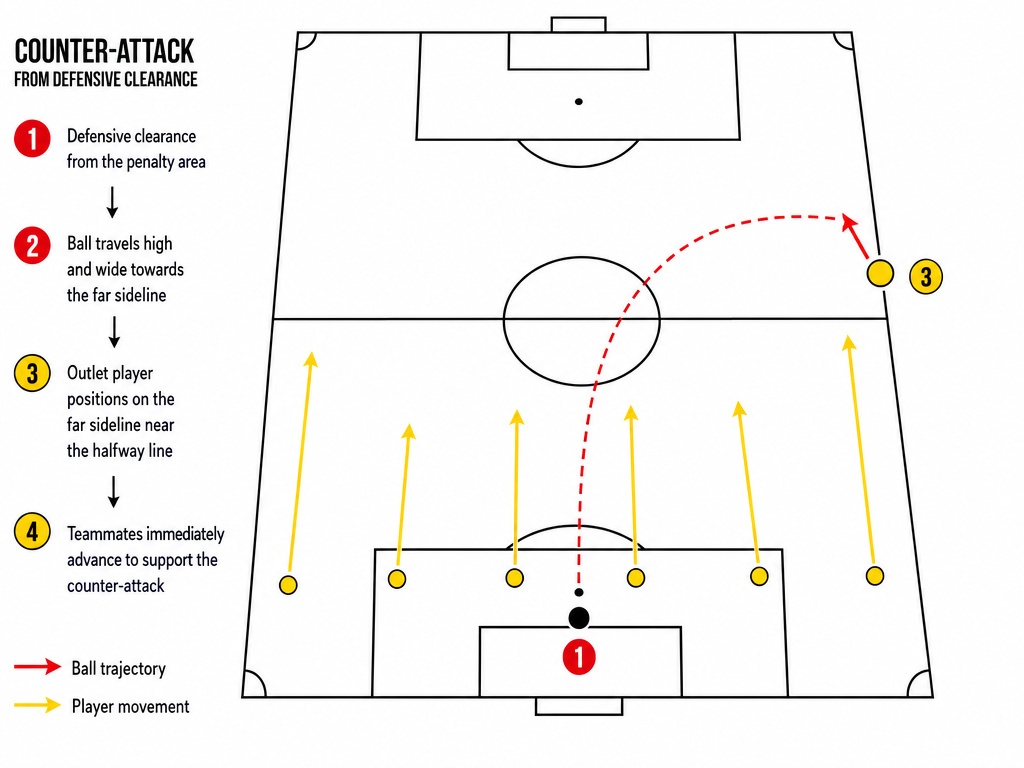
A provision needs to be made for how to transition into attack after winning the ball. The clearance is the starting point; the ball should generally be cleared as high, far, and wide upfield as possible. This move serves two purposes: it relieves immediate pressure and can launch a fast break. Teams often station an outlet player approximately halfway up the far or near sideline, in the defensive half of the field, to act as a target for this clearance. Simultaneously, defenders must immediately move forward as soon as possible to take advantage of placing attackers in an offside position and to support the counter-attack.
Frequently Asked Questions
How do you defend against corners?
Pick one setup, name the edge defender, and practice clearances. FIFA says teams used zonal marking in 60% of defensive corners and won 65% of first contacts at Club World Cup 2025. For a first plan, use zonal markers in the goal area and one edge player.
Where should defense be during a corner kick?
Defenders need to cover the goal area, the near and far posts, the edge, and an outlet. Coaching American Soccer’s basic zone puts the keeper six yards out, post-to-post, with one player at each post. FIFA says fewer teams stationed players on the posts at Qatar 2022.
What are some effective tactics for corner kicks?
Use a clear setup, protect the edge, and train the second phase. FIFA’s Club World Cup 2025 data shows one edge player reduced second-phase corners from 57% to 40%. A named outlet also gives the team a counter-attack route.
Should the goalkeeper come out on corners?
The keeper’s starting position depends on an inswinger or outswinger, FIFA says. If the delivery enters the goal area, FIFA’s U-20 analysis says keepers act early. The keeper must also organize the penalty area.
Is zonal or man marking better for corners?
FIFA’s Qatar 2022 analysis says the numbers don’t prove one system is better by itself. FIFA’s Club World Cup 2025 data says zonal had the best first-contact success at 65%. Choose the setup your players repeat.
Before You Go
If your team can’t win first contact in three practice corners, simplify to zonal and add one edge defender. That’s the first fix.
This week, drill one setup with a named edge defender and a named outlet.
If your keeper can’t claim high balls, don’t leave the keeper alone. Put a front-post defender in the path and let the keeper organize. That’s how to defend corners in football in practice, not just on paper.
Back to the pitch. The plan works when every player knows the call before the ball’s struck.
