
Speed Agility Ladders for Football Pros and Cons
This post contains affiliate links. As an Amazon Associate, we earn from qualifying purchases.
Speed agility ladders for football offer a tool for warm-up coordination and basic footwork rhythm, but they are a poor method for developing genuine sprint speed or match-ready agility. The research is mixed on measurable athletic gains, and the drills lack the acceleration, deceleration, and unpredictable decision-making that define football movement. For real improvement, prioritize strength training, sprint practice, and reactive cone drills.
The gap between ladder skill and match agility is where the conversation gets interesting, especially when considering speed agility ladders for football pros and cons. Ladders train your feet to move in a pre-set pattern on the ground. Football asks your brain to read a defender, your body to brake from a sprint, and your feet to push off at a new angle, all in under a second. One is a memorized dance. The other is a reactive, physical contest.
What follows is a breakdown of the research, the mechanical reasons ladders fall short, and where, if at all, they fit into an honest training plan when you compare a speed agility ladders for football pros and cons. We will look at what studies say about speed, why coaches who swear by them might be seeing a different kind of improvement, and the specific drills that actually transfer to the pitch.
Key Takeaways
- Ladder drills train closed-skill footwork, not the open-skill, reactive agility needed in a match where you must perceive, decide, and move.
- Scientific findings on speed improvements show disagreement: the 2020 PMC (NIH) study on youth players showed no significant benefit, while the 2024 Journal of Social Education study on elite adults noted gains in 10m sprint time compared to cone drills.
- The tool’s best use is as a 5-minute warm-up for foot rhythm and coordination, especially for younger players; spending more session time on it offers diminishing returns.
- For true speed and agility development, focus on lower-body strength training (squats, deadlifts), maximal-velocity sprinting, and reactive cone drills that include deceleration.
- Improvement on the ladder itself is real, but it’s skill-specific, you get better at the ladder, not necessarily at changing direction against an opponent.
What the Science Actually Shows on Sprint Speed and Agility
The research on agility ladders doesn’t give a single, clean answer on the speed agility ladders for football pros and cons. It gives two, and they disagree based on the athletes studied.
A 2020 PMC peer-reviewed study on agility ladders looked at youth soccer players with about five years of training experience. These players added a 6-week, 18-session agility ladder program to their normal training. The result? No significant improvement in 10m or 20m sprint times, dribbling speed, or agility tests compared to the control group that just trained as usual. The 2020 PMC (NIH) study notes that while maximum intensity is essential for speed adaptation, agility ladder drills require a learning period, meaning the training stimulus is variable and often submaximal.
A 2020 randomised controlled trial found that a six-week agility ladder program added to normal training produced no meaningful improvement in sprint times, change-of-direction, or dribbling performance in youth footballers.
This study found that agility ladder drills did lead to greater improvements in 10m sprint speed and reaction time compared to cone drills. However, the cone drill group showed superior gains in the Illinois Agility Test and vertical jump power.
So, does the ladder improve sprint speed? For experienced youth players in one study, no. For elite adults in another, yes, but cones were better for agility and power. This tells us the athlete’s level and what you’re measuring matter enormously.
| Study (Year) | Subjects | Duration | Key Finding on Ladders | Superior Method for Agility/Power |
|---|---|---|---|---|
| PMC/NIH (2020) | Youth players (U-13) | 6 weeks | No significant improvement in 10m/20m sprint vs. Control group. | Control group (normal training) |
| Journal of Social Education (2024) | Elite male players (18-25) | 6 weeks | Greater improvement in 10m sprint speed vs. Cone drills. | Cone drills |
The takeaway highlights where sources disagree: the 2020 PMC study found no significant sprint benefit for youth players, while the 2024 Journal of Social Education study found ladder drills led to greater 10m sprint improvement than cone drills for elite adults. Opinions on their overall value and recommended use also vary among sources.
The Core Problem: Closed Skills vs. Open Agility
As noted by commentators like Aaron Chew and Elite Champions Coaching, in ladder drills the pattern is set, the direction is typically forward, the speed is constant, and the player’s head is often down, watching their feet. Now watch a winger beat a fullback. The trigger is the defender’s weight shifting. The movement is a explosive stop, a cut, and a re-acceleration at a new angle. The head is up, reading the game.
This is the fundamental mismatch. Ladder drills are a closed skill. The environment is predictable, and the movement pattern is pre-planned. Football agility is an open skill. It’s perceptual and reactive. You must read a cue, a bad touch, a defender’s hips, a teammate’s call, brake hard, change direction, and explode again.
A ladder cannot train this. Commentary from sources like Aaron Chew and Elite Champions Coaching states that ladder drills run in one plane with almost no acceleration or deceleration. Your foot contacts are light and quick, deliberately not pushing off too hard, or you’ll overshoot the next square. Compare that to a top-speed stride, which, as 1st and Goal Athletics notes, puts a multiple of the athlete’s body weight through one leg in around a tenth of a second. The physical demands are opposites.
This is why players can get visibly better at ladder drills week-to-week but see no transfer to their 5-10-5 shuttle run time. They’ve gotten skilled at the ladder task, not at the physical qualities of braking and re-accelerating. It’s like getting great at typing on a keyboard and expecting it to improve your handwriting.
Where Ladders Can Fit (And Where They Absolutely Don’t)
I am not here to tell you to throw your ladder away. I am here to tell you to put it in the right drawer. Its value is specific, modest, and time-bound.
Sources like Elite Champions Coaching and 1st and Goal Athletics recommend using the ladder briefly as a warm-up and coordination tool for juniors, and sparingly for seniors for pre-activation or return-to-training. However, other sources like Aaron Chew argue ladder drills have extremely little transfer to sport performance, and the Journal of Social Education Study (2024) suggests they can be integrated for full enhancement.
The mistake nobody mentions: Spending 20 minutes of a 90-minute session on ladder work and calling it agility training. The opportunity cost is everything you didn’t do in those 20 minutes: maximal sprints, strength work, or reactive agility training.
The ladder is not speed training. It is not a fix for a slow cut. It does not build the eccentric strength needed to decelerate. If your speed training block consists of ladder patterns without a stopwatch in sight, you are buying coordination work at speed-development prices.
Here is the honest breakdown of where it sits in a hierarchy of tools for football athleticism:
- For Warm-Up & Coordination (Good): Ladders, dynamic stretching, light ball work.
- For Speed & Power (Essential): Maximal effort sprints, plyometric exercises (hurdle hops, box jumps), Olympic lift variations.
- For Sport-Specific Agility (Essential): Reactive cone drills with coach cues, small-sided games, 1v1 chase drills.
Your ladder lives in the first category, and only for a brief visit. The real work happens in the second and third.
What to Do Instead: Drills That Actually Transfer
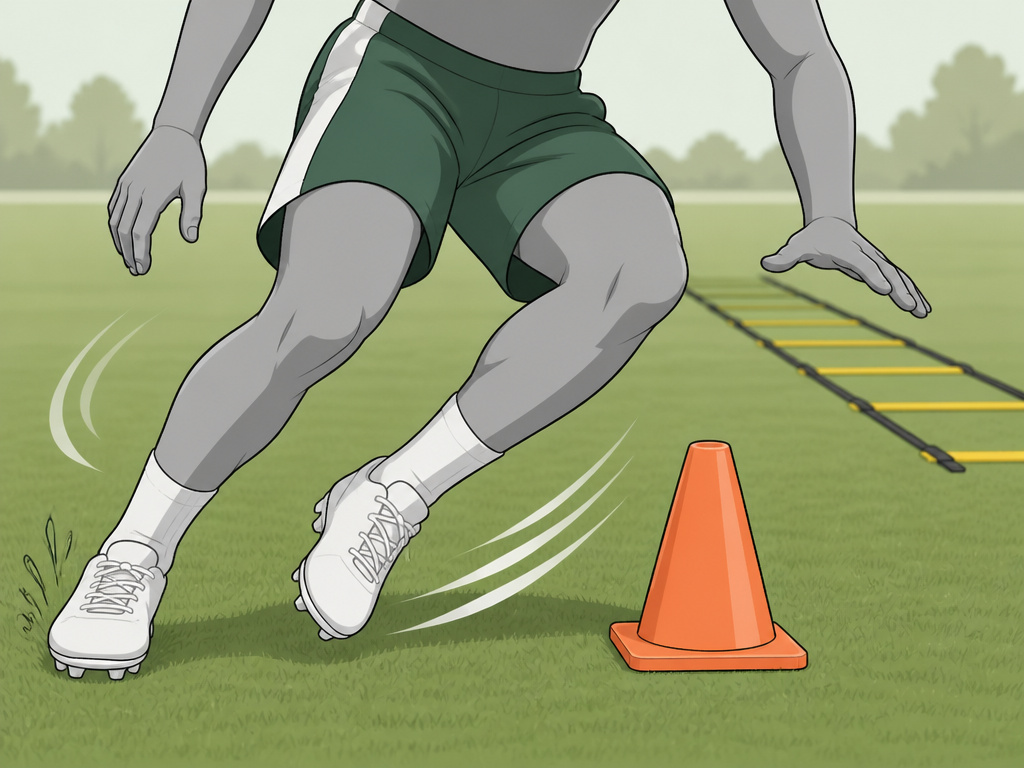
So if the ladder is mostly a warm-up actor, what should take center stage in your training? The answer focuses on force production, high-velocity movement, and reactive decision-making.
First, build the engine. Lower-body strength is the base. Heavy squat and deadlift variations (think 85%+ of your 1-rep max) develop lower-body strength, which is critical for the concentric power to accelerate and the eccentric strength to brake. This isn’t just gym talk; developing lower-body strength is widely recognized as a foundation for speed and agility. You cannot be fast if you are weak.
Second, practice the skill of speed. You won’t run faster if you don’t practice running fast. This means full-effort sprint drills over 10-30 meters, with full recovery between reps. Do this early in your session when you’re fresh. Technique matters here, focus on improving acceleration mechanics and a powerful arm drive.
Third, train true change of direction. This is where cones vastly outperform ladders. Set up a simple Y-drill: sprint to a central cone, then react to a coach’s call to cut left or right. This trains the perception-decision-action chain. Other effective options include the 5-10-5 pro agility shuttle and zig-zag runs with sharp cuts.
| Quality to Develop | Sample Drill | Why It Beats a Ladder |
|---|---|---|
| Maximal Acceleration | 20m sprints from a standing start | Trains high ground reaction forces and specific joint angles for pushing. |
| Deceleration & Re-Acceleration | 5-10-5 Pro Agility Shuttle | Forces a hard stop and explosive restart from different stances. |
| Reactive Agility | Cone drill with visual/verbal cue | Trains open-skill perception and decision-making under time pressure. |
| Elastic Power | Hurdle hops (double & single leg) | Develops joint stiffness and the “bounce” needed for rapid foot contacts. |
Integrate these elements. A simple session framework could be: warm-up (which may include 2 minutes of light ladder footwork), maximal sprints, strength or plyometric work, then finish with reactive cone drills or a small-sided game. That sequence attacks the actual physical and perceptual demands of the sport.
How to Use a Ladder Honestly (If You Use It At All)
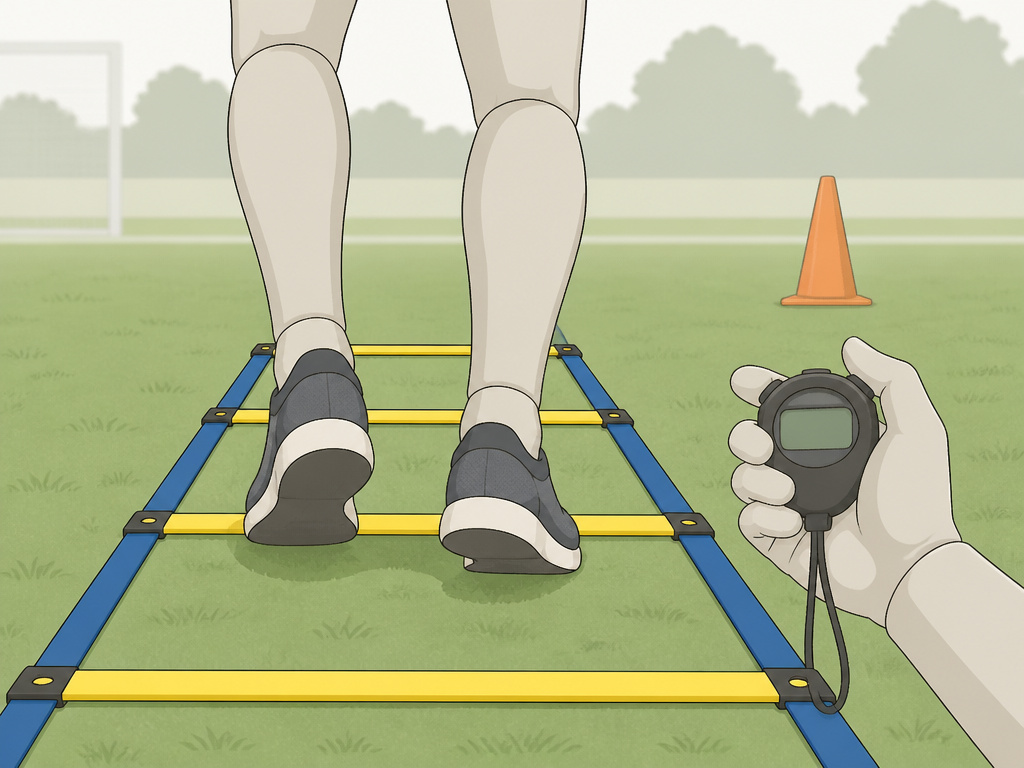
Be practical. You might have a ladder. Your coach might use one. Here is how to engage with it without wasting your training capital.
For Coaches:
- Slot it early. Use it in the first 5-7 minutes of a session for pulse-raising and coordination.
- Keep it simple. Two or three basic patterns (in-in-out, lateral shuffles) are plenty. Complexity is not the goal.
- Never sell it as speed work. Be explicit with players: “This is for warm-up and foot feel. Our speed work comes next.”
- Transition quickly. The moment the ladder is packed away, move to higher-value activities like the drills listed above.
For Players/Parents:
- Audit the session. If the “agility block” is 25 minutes of ladder patterns, ask what physical quality is being developed. There’s a good chance it’s just pattern memorization.
- Measure what matters. Your benchmarks should be a 20m sprint time, a shuttle run time, and your vertical jump. If you’re spending hours on ladder work but these numbers are stagnant, you have your answer.
- Advocate for better tools. Suggest incorporating more cone-based reactive drills or essential equipment like mini-hurdles for plyometrics.
The ladder’s utility shrinks as player age and experience grow. For a beginner, it can be a fun introduction to movement patterns; Football Mastery suggests they can be introduced as early as age 6-7. For a competitive academy player, it’s a vestigial part of the warm-up. For a senior professional, it’s largely absent. Match its role to the stage of the athlete in front of you.
Sample Agility Ladder Drills and How to Use Them
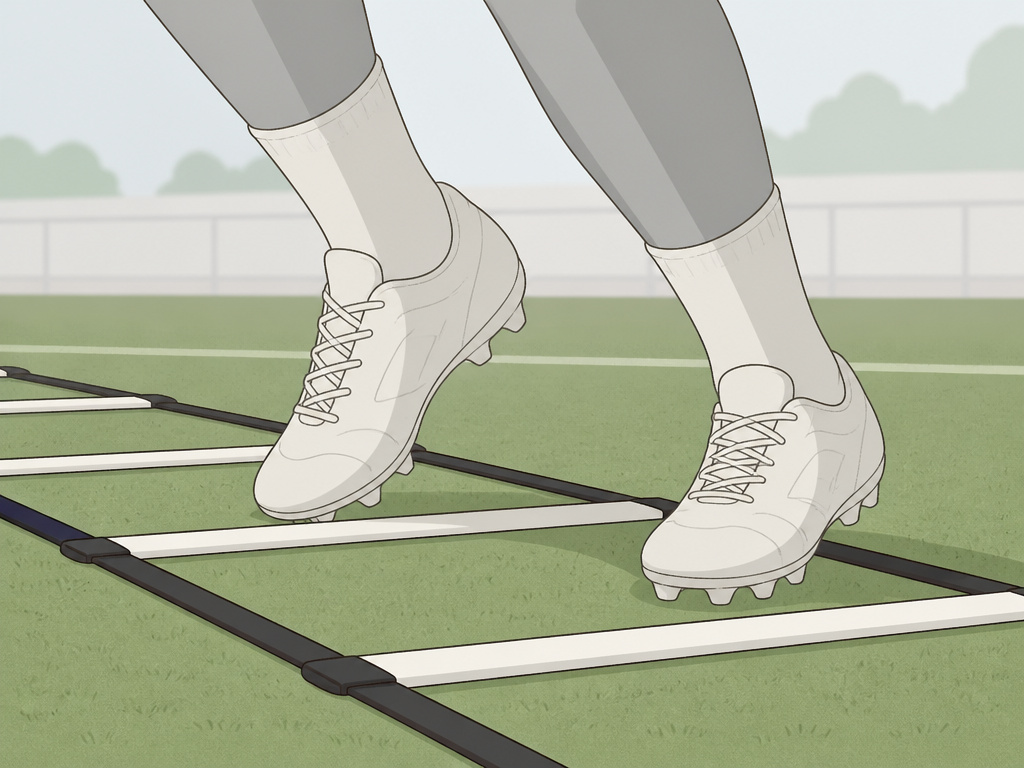
As described by sources like Aaron Chew, common agility ladder drills involve performing predetermined footwork patterns at a constant speed in the same direction. To use them, focus on light, quick foot contacts and maintaining rhythm. However, view these drills strictly as a warm-up or coordination tool. Spend only a few minutes at the start of a session to wake up the feet and ankles before moving to more demanding work. Never sell ladder drills as speed or agility training for the pitch, as they lack the acceleration, deceleration, and reactive elements of match play. Their primary value is in low-load neuromuscular activation.
Frequently Asked Questions
Do agility ladders make you faster?
Sources disagree on whether agility ladders improve sprint speed. The 2020 PMC (NIH) study on youth players showed no significant improvement, while the 2024 Journal of Social Education study on elite adults found they led to greater 10m sprint gains than cone drills. Other sources, like Aaron Chew, argue dedicated sprint training and strength work are more direct methods.
What are the downsides of using agility ladders?
The primary downside is poor transfer to sport performance. Ladders train pre-planned footwork in a straight line, neglecting the acceleration, deceleration, and multi-directional changes of football. They can promote a head-down posture and create a false sense of accomplishment as players improve at the specific ladder skill, not at general athletic qualities.
Are ladder drills good for football?
They have a very limited, specific role. As a brief warm-up tool for coordination and rhythm, especially for younger players, they can be fine. As a primary method for developing match-winning speed or agility, they are ineffective. Football-specific agility is reactive and forceful, which is better trained with cone drills and strength plyometric exercises.
What is better than an agility ladder for football?
Cone drills are superior for training change-of-direction ability and reactive agility. For developing raw speed, nothing replaces maximal-effort sprinting. For the power underpinning both, lower-body strength training (squats, deadlifts) and plyometric exercises for football like box jumps are essential. A combination of these methods will yield far better results.
The Bottom Line
The ladder is a tool of modest means. It can grease the wheels at the start of a session, but it is not the engine. The research landscape is messy, showing everything from no benefit to narrow gains, but the mechanical argument is clear: football is played with the head up, with hard stops and explosive starts, against unpredictable opponents. The ladder trains none of that.
If you choose to use one, be brutally honest about its job. Give it five minutes for foot contacts and rhythm, then move on to the work that actually builds athletes: lifting heavy, sprinting fast, and practicing cuts on a call. Your football agility ladder drills should be a short prelude, not the main act. The beautiful game is chaotic and powerful. Train for that chaos, not for the quiet, predictable squares of a ladder.
