
How to Improve Acceleration for Football: Step-by-Step
This post contains affiliate links. As an Amazon Associate, we earn from qualifying purchases.
To improve acceleration for football, you must train three distinct elements: maximizing horizontal force production, developing explosive power, and practicing sprint-specific technique. A 7-week combined sprint training intervention, mixing maximal and assisted sprints, improved 0-20m times in junior Australian football players, proving focused work on how to improve acceleration for football pays off faster than you think.
That “first three steps” speed comes from how hard you can push into the ground, not just how fast you can move your legs, which is the core of how to improve acceleration for football. The best training targets your ability to generate force horizontally, not vertically, and builds the power to repeat those bursts with limited recovery.
What follows is a complete plan, broken into the three pillars you need to master. The biomechanics explain why each drill works, a step-by-step weekly protocol you can follow, and the recovery strategies that turn training into results. By the end, you’ll have a clear path to a quicker first step and a bigger impact on the pitch.
Key Takeaways
- Acceleration, not top speed, is the greater predictor of success in team sports, per the National Strength and Conditioning Association (NSCA).
- Build your horizontal force with resisted sled sprints and your explosive power with targeted plyometric exercises.
- Assisted sprint methods, like elastic pulling cords, are a cost-effective way to improve acceleration, with studies showing benefits over 4-week and 5-week protocols.
- Football acceleration is often assessed at short distances, with tests like the AFL combine measuring splits at 5-meter and 10-meter intervals.
- Follow a 7-week, in-season protocol with 2 sessions per week for measurable gains, as demonstrated in junior football research.
The Biomechanics of Acceleration
Rewind the tape. In football, that explosive first step is about applying a massive amount of force into the ground, horizontally, rather than moving your legs quickly. Watch any striker burst past a defender: their torso leans forward, their foot strikes behind their center of mass, and they drive forward, not up.
The key mechanical variables for sprint assessment are theoretical maximal force (F0), theoretical maximal velocity (v0), and theoretical maximal power (Pmax). Acceleration is dominated by the ability to produce high levels of F0 in the first few strides.
That means your weight room “max” matters, but only if you can express that strength rapidly. A study in the Strength & Conditioning Journal puts it bluntly: “acceleration rather than maximal velocity is likely a greater predictor of success” in team sports. Your training must reflect that. Chasing a faster 40-yard dash time by just running more often misses the point, you’re training for a different race.
The part nobody mentions: If your sprint form has you bouncing up and down, you’re wasting energy. The visual cue for good acceleration is a low, forward-leaning torso and a powerful, piston-like arm drive. You should feel like you’re pushing the world behind you, not jumping over it.
Acceleration vs. Maximal Velocity: Why Your Focus Matters
Is 22 mph fast for a football player? Absolutely. But how many times in a match do you actually hit that speed? Almost never. The game is won and lost in bursts of 5, 10, maybe 20 meters. That’s the acceleration zone.
The Australian Football League (AFL) draft combine uses a standardized 20-meter sprint test, with splits measured at 5-meter and 10-meter intervals. They don’t care about your 40m time; they care about your 0-5m and 0-10m times. That’s the football distance. Your training should mirror this.
| Training Focus | Primary Goal | Typical Distance | Football Application |
|---|---|---|---|
| Acceleration | Maximize horizontal force (F0) | 0-20 meters | Beating a defender to a loose ball, closing down an opponent. |
| Maximal Velocity | Achieve highest possible speed (v0) | 20+ meters | Chasing a long through ball over the top. |
| Repeated Sprint Ability | Maintain acceleration after fatigue | Multiple 10-30m efforts | Making overlapping runs in the 70th minute. |
While a 2021 systematic review in Sports Medicine noted training can improve medium-to-long distance sprint performance, the NSCA’s stance on how to improve acceleration for football is that it is likely a greater predictor of success in team sports. So, if your session is just 100m repeats, you’re leaving critical speed on the table.
The 3-Pillar Acceleration Plan
Improving acceleration requires a combination of strength, power, and skill. Think of it like a kitchen brigade, the strength work is the prep, the power exercises are the cooking, and the sprint technique is the plating. All three have to be right for the dish to work.
Pillar 1: Strength Training for Horizontal Force
Forget just adding kilos to the bar. The goal is to increase the force you can apply backwards and downwards during the first step. Exercises that build this quality have a longer range of motion and emphasize the triple extension of the ankle, knee, and hip.
- Front Squats & Bulgarian Split Squats: These build the raw leg strength and single-leg stability needed to propel your body forward. A split squat directly mimics the staggered stance of a sprint start.
- Hip Thrusts: This is the engine room. Powerful glutes are essential for horizontal drive. You’ll feel these the next time you explode from a standing start.
- Romanian Deadlifts (RDLs): Acceleration puts enormous strain on the hamstrings. RDLs build the eccentric strength that keeps those muscles healthy when you’re decelerating and re-accelerating all game.
The risk of skipping single-leg work is a strength imbalance. That’s how you pull a hamstring the first time you have to push off your weak side at full tilt.
Pillar 2: Power Development (Plyometrics)
Strength is the fuel tank; power is the horsepower. Power training teaches your nervous system to fire muscles rapidly. You can’t improve acceleration without it.
I once tried to add plyometrics to the end of a brutal leg day. Big mistake. The power just wasn’t there, the jumps felt heavy, and I spent the next two days walking like I’d been on a horse. Now I do plyos fresh, at the start of a session or on a separate day entirely.
Here is a sample progression. Start with Level 1 and master the landing before moving on.
- Level 1 – Foundational: Box Jumps (focus on soft, quiet landings), Skipping A-Skips.
- Level 2 – Horizontal Focus: Broad Jumps, Single-Leg Hops (for distance).
- Level 3 – High-Intensity: Depth Drops (drop off a box and immediately jump forward), Bounding.
Where this goes sideways: Doing plyometrics on a hard concrete surface without proper landing mechanics. The repeated impact jars your joints and the repeated impact jars your joints and increases injury risk. Use a gym floor, grass, or turf.
Pillar 3: Sprint-Specific Skill Work
This is where you apply your new strength and power. Skill work breaks down the complex sprint action into drills that ingrain efficient technique.
- Falling Starts: Stand tall, lean forward until you’re about to fall, then drive into a sprint for 10m. This teaches you to use gravity and get your foot strike behind you.
- Wall Drills: Place hands on a wall at a 45-degree angle and practice driving your knees with a forward lean. Listen for the sound, a quick, rhythmic “tap-tap-tap” of your feet, not a slow, heavy “thud-thud-thud.”
- Resisted Sled Sprints: The gold standard. Load a sled with a weight that provides meaningful resistance without drastically altering your sprint technique. The resistance forces you to lean forward and push hard. When you unload the sled, you’ll feel lightning fast.
Step-by-Step: The 7-Week Acceleration Protocol
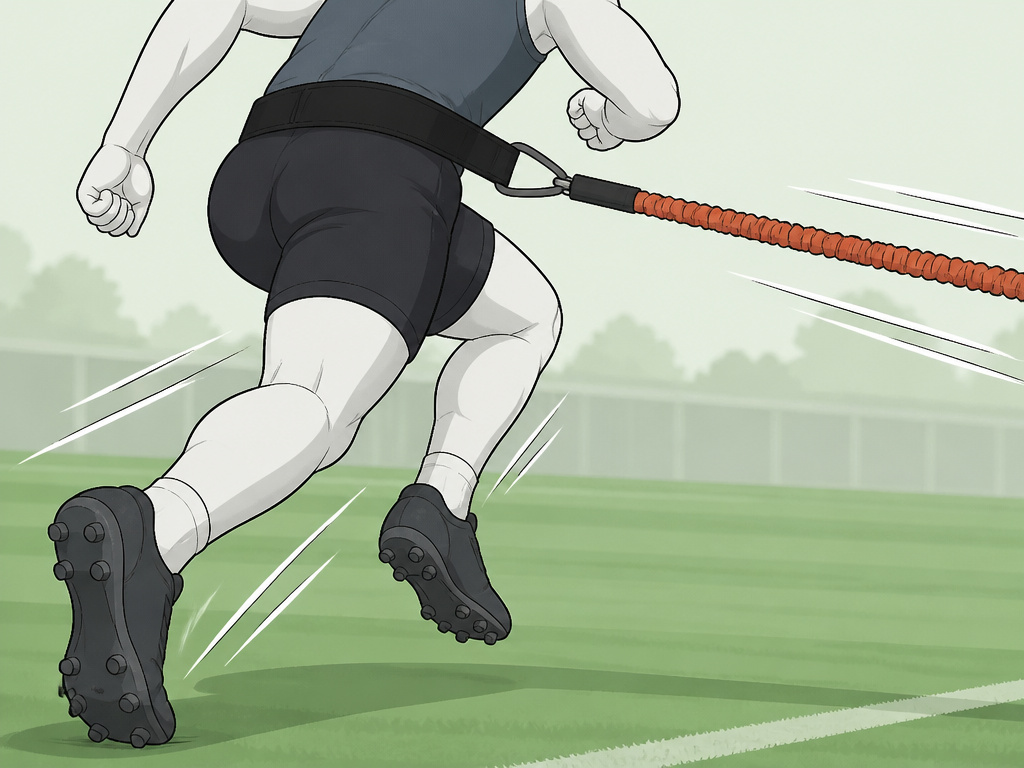
A research-tested plan exists. A study published in PeerJ took junior Australian football players and put them through a 7-week in-season training intervention. The group that used combined sprint training (CST), mixing maximal sprints with assisted sprints, saw significant improvements in their force-velocity profile and 0-20m sprint time.
Here’s how you can adapt that protocol. The original required 10-12 sessions (2 per week) with ≥70% attendance.
Week 1-2: Foundation
- Session A (Monday): Maximal Sprints. 2 sets of 4x20m sprints. Full recovery (3-4 mins) between reps.
- Session B (Thursday): Resisted Sled Sprints. 3 sets of 3x10m with moderate weight. Focus on perfect form.
Week 3-5: Intensification
- Session A: Maximal Sprints + Plyometrics. 3x30m sprints, then 4×5 Broad Jumps.
- Session B: Assisted Sprints. Use an elastic cord or find a slight decline. 4x20m with elastic pulling cords, focusing on exceeding your normal stride frequency.
Week 6-7: Integration & Testing
- Session A: Mixed Sprints. 1x20m resisted sled, 1x20m assisted, 2x20m maximal. This teaches your body to apply force under different conditions.
- Session B: Time Trial. After a proper dynamic warm-up, test your 0-20m time. Compare it to your Week 1 baseline.
The study’s participants were junior male Australian football players with an average age of 14.4 ± 0.3 years. If you’re younger, be conservative with volume. The rule is to never add more than one new variable per week, don’t increase weight, distance, and volume all at once.
Assisted Sprint Training: The Secret Weapon
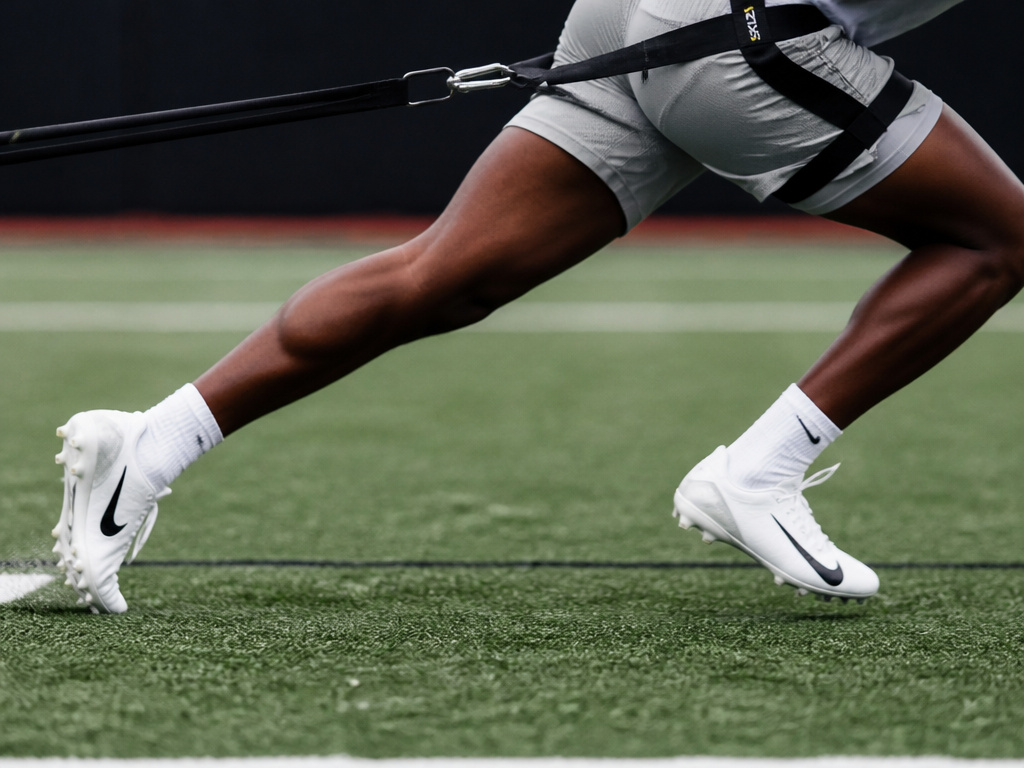
Assisted sprinting sounds like cheating, but it’s a brilliant way to train your nervous system to move your limbs faster than it thinks is possible. By using an external aid to pull you forward, you experience higher stride frequencies and longer flight times.
Previous research using elastic pulling cords across a 4-week period reported increased acceleration performance specifically in the first 5-yards (4.6 m). A 5-week protocol showed significant improvements in running velocity and stride frequency.
The methods are varied:
- Elastic Pulling Cords: The most accessible and cost-effective. A partner pulls you gently from the front as you sprint.
- Downhill Running: A very slight slope (1-3% grade) reduces gravity’s resistance.
- High-Tech Devices: The 1080 Sprint™ or MuscleLab DynaSpeed™ are portable robotic resistance devices used in pro settings.
The key is that the assistance should help you move faster, not just make you feel lighter. If you’re over-assisted, your form breaks down. You want a feeling of controlled, rapid turnover.
Injury Prevention and Safe Progressions
High-force acceleration training is demanding. The muscles, tendons, and joints need time to adapt. Jumping into a high-volume plyometric or sled program after a break is the single fastest way to get hurt.
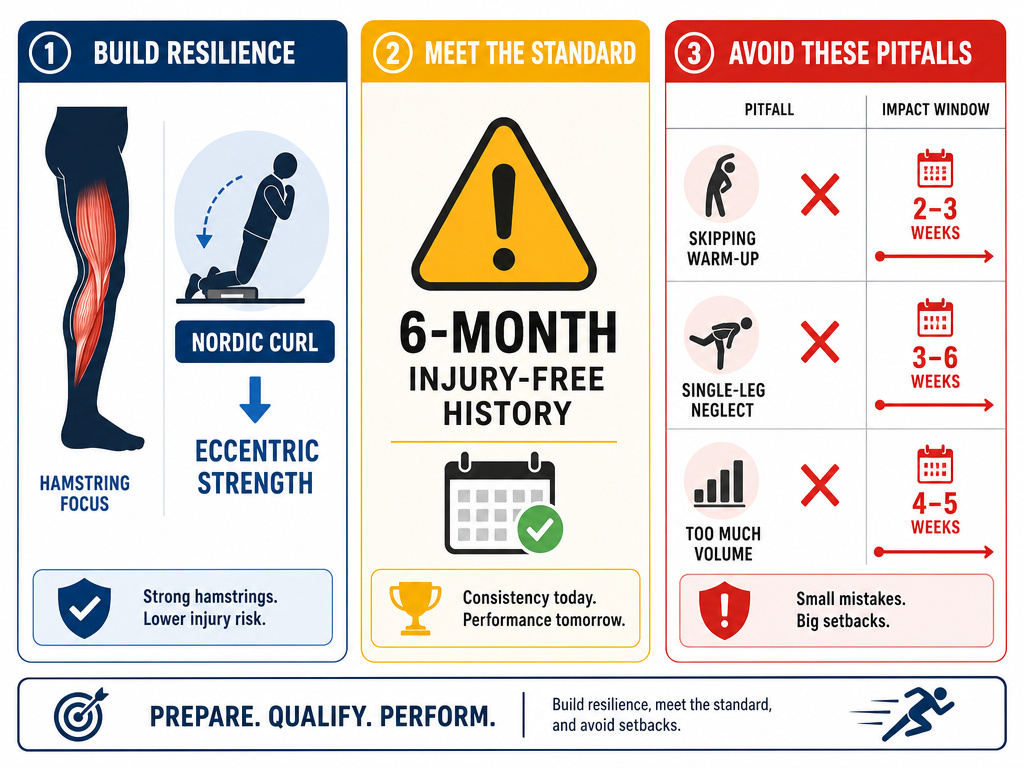
Before you start: Rule number one is a full six-month history free of musculoskeletal injuries that would prevent maximal effort sprints, per the sprint force-velocity characteristics study on junior athletes. If you’re coming back from a hamstring issue, that timeline resets.
Build your eccentric hamstring strength with Nordic curls. Start with a slow, controlled lowering phase, even if you need bands for assistance. This prepares the muscle for the brutal deceleration forces of the game.
| Common Mistake | Specific Consequence | Timeline to Injury |
|---|---|---|
| Skipping the warm-up | “Cold” muscles lack elasticity | Increased risk of strain within the first 2-3 high-intensity efforts |
| Neglecting single-leg strength | Compensation patterns and overload on the dominant leg | Imbalance-related pain (knee, hip) often appears 3-6 weeks into a new program |
| Too much volume, too soon | Systemic fatigue that masks poor technique | Overuse injuries (shin splints, tendonitis) typically flare up in Week 4-5 |
Listen to your body. A little muscle soreness is fine. Sharp joint pain, or pain that persists after your warm-up, is a hard stop.
Nutrition and Recovery for Speed Development
You can have the perfect plan, but if you’re fueling with crisps and sleeping five hours a night, you won’t get faster. Adaptation happens when you’re resting, not training.
Protein intake is crucial for repairing the muscle micro-tears caused by powerful contractions. Aim to consume a protein-rich meal or shake after your sprint session to aid muscle repair.
Carbohydrates are not the enemy. They replenish the glycogen stores in your muscles that fuel those repeated high-intensity efforts. Carbohydrates help replenish glycogen stores that fuel repeated high-intensity efforts.
Sleep is the ultimate performance enhancer. Sleep is crucial for recovery and adaptation after demanding training. Skimping on sleep is like doing the training but throwing away the results.
Agility and Change of Direction Drills
Agility drills train your body to apply force in new directions without losing speed. Since acceleration is a key predictor in team sports, your ability to explode out of a cut is critical. These drills should mimic game situations, forcing you to decelerate and re-accelerate from various angles. Work on sharp, controlled changes where you push off powerfully with the outside foot. Consistent practice over a training block, like the seven-week interventions studied, builds the specific strength and coordination needed to separate from defenders.
Fast-Twitch Muscle Fiber Development
Developing fast-twitch fibers is about training for high rates of force production. This means moving with intent and speed in the gym and on the field. Focus on exercises and sprints that require maximal effort against resistance or with assistance, like using elastic cords or running downhill. These methods train your neuromuscular system to fire more rapidly and powerfully. To see results, commit to multiple sessions per week over several weeks, ensuring you are free from injury to train at the required intensity.
Frequently Asked Questions
Is 20 too late for football?
No. While peak physical potential for speed may be earlier, acceleration is highly trainable through strength and power development at any age. Technical improvement and football IQ can more than compensate.
How fast does Messi accelerate?
While specific metrics are private, analysis suggests his first 5-10 meter acceleration is elite, driven by a low center of gravity, incredible agility, and rapid leg turnover rather than pure brute force.
Should I train with or without the ball?
Both. Early in your acceleration training block, focus on pure technique without the ball to build the motor pattern. As you near the season, integrate ball work, dribbling at pace, receiving and exploding away, to make the skill game-specific.
How to gain 20 pounds for football?
This is a separate goal from acceleration. Gaining quality mass requires a dedicated caloric surplus paired with heavy strength training. Gaining fat will slow you down. Focus on acceleration first, then a controlled mass-gain phase in the off-season.
The Bottom Line
Your acceleration plan comes down to one test: can you apply more horizontal force in your first three steps than the defender across from you? Everything else is commentary.
The research gives you a clear template: a 7-week block of combined maximal and assisted sprinting, built on a foundation of horizontal strength and explosive power. Stick to the distances that matter, 0 to 20 meters, and measure your splits.
The players who look fastest are often the ones who win the first step, not necessarily those with the highest top speed. That’s a skill you can learn, and this is your blueprint. Start your next session with falling starts and wall drills. In seven weeks, that first step will be someone else’s problem.
