
How to Shoot a Football Accurately: What the Data Says
This post contains affiliate links. As an Amazon Associate, we earn from qualifying purchases.
*To shoot a football accurately, you must master three body mechanics: a level plant foot pointed at your target, a locked ankle striking the ball’s center, and a full follow-through.* Peer-reviewed research shows the inside kick (side of the foot) yields significantly higher accuracy than the instep (laces) kick, though it sacrifices some power. Effective practice means repeating these mechanics from game-realistic distances, such as starting at the 7.3 to 9.1 metre range recommended by Nike UK, then pushing to 16 yards, under instructions that prioritize placement over power.
That gap between “hit it hard” and “place it right” is where most players lose goals. You can have perfect form, but if your brain is screaming “power!” while your foot tries to finesse, the shot sails over. The mechanics are simple; the real challenge is learning how to shoot a football accurately. The mental shift to prioritize the corner of the net over the back of it is what separates a hopeful shot from a finished chance.
What follows breaks down that shift. We’ll cover the essential body checklist, settle the ‘laces vs. Inside’ debate with actual numbers, and outline a practice plan that turns static repetition into game-ready accuracy.
Key Takeaways
- Sources disagree on the best part of the foot for shooting accuracy: Nike UK recommends using the laces for a goal shot, while Upper 90 Football and a peer-reviewed study (Doewes) recommend using the inside/side of the foot for accuracy.
- Your plant foot decides everything. Place it level with the ball and point your toes directly at the corner of the goal you’re aiming for.
- Lock your ankle at the moment of contact. A firm foot is a predictable foot; a wobbly ankle sprays the ball.
- To improve, practice with your team a couple of times per week and play weekend matches for 12-14 weeks, as Nike’s coaching guide outlines.
- When instructed to prioritize accuracy, ball velocity drops. This is a documented trade-off, accept less power to gain more precision.
The 3-Step Accuracy Checklist (Body Mechanics)
Forget power for a minute. Accuracy is a checklist, and you can’t skip a step. Get these three things right every single time, and your shots start finding corners.
First, your plant foot. It’s not just standing there. It’s your aiming sight and your balance point. The Upper 90 Football guide is blunt: place it level with the ball and point your toes toward your target. If you want the bottom left corner, your left foot’s toes are pointing at that spot. This isn’t a suggestion, it sets your hips and shoulders to open toward that exact line. Place it too far behind the ball, and you’ll lean back and sky it. Too far in front, and you’ll stub your shot into the ground.
Technical Snippet: For maximum shooting accuracy, the plant foot must be level with the ball at the moment of contact, with the toes oriented toward the intended target. This alignment determines hip and shoulder orientation, which directly controls the initial direction of the shot. A misplaced plant foot is the primary cause of shots that miss the frame entirely, regardless of foot contact.
Second, the strike. This is where the advice gets noisy. Do you use your laces or the inside of your foot? Here’s what the sources actually say:
- Nike UK: For a goal shot, kick so the laces at the top of your shoe hit the middle of the ball.
- Upper 90 Football: When trying to shoot with accuracy, using the side of your foot is going to be the way to go.
- Peer-Reviewed Study (Doewes): There was a significant difference in shooting accuracy using inside and instep kick… Accurate shooting movement is achieved using inside kicks.
The data settles the argument. In a controlled test from 16 yards, players were significantly more accurate using the inside kick. The “laces for power, inside for accuracy” rule isn’t just a coaching cliché; it’s biomechanics. The larger, flatter surface area of your foot’s arch makes for a more predictable, controlled collision.
| Kick Type | Best For | Contact Point | Key Biomechanical Difference |
|---|---|---|---|
| Inside Kick | Accuracy, placement, short passes | Flat surface along the arch of the foot | Lower backswing/frontswing knee angle, more controlled body tilt |
| Instep (Laces) Kick | Power, distance, driven shots | Top of the foot, over the laces | Larger knee angle range for greater leg whip, more torso lean |
Third, follow through. Don’t just hit the ball and stop. Your shooting leg should continue smoothly toward your target. Think of it as pointing your foot where you want the ball to go after you’ve made contact. A full follow-through maintains control and ensures you’ve transferred your momentum correctly. A stunted follow-through often means you’ve pulled out of the kick, which kills both power and accuracy.
Laces vs. Inside: Which One Actually Hits the Target?
You see the pros blast it top-corner with their laces all the time. So why does the data say to use the inside of your foot? It comes down to what you’re optimizing for.
The Doewes study didn’t just record goals; it used high-speed cameras (1000 frames per second) to measure everything. Players shot at one-meter circular targets from 16 yards. The result? The inside kick group was significantly more accurate. The reason is in the angles: inside kicks use a more controlled, compact leg swing. There’s less that can go wrong.
A laces shot, or instep kick, is a physics problem. You’re trying to whip your leg like a trebuchet to generate maximum force. That requires a bigger backswing, a faster snap, and perfect timing. There are more moving parts, literally. Your knee angle is wider, your shoulder tilt is more pronounced. It’s a high-reward, high-risk technique. For a powerful shot, it’s unmatched. For picking a spot under pressure, it’s overkill.
The inside kick simplifies the equation. You’re using a bigger sweet spot. You don’t need as much leg swing, so your body stays more balanced and upright. This is why your first touch and accurate passing often use the same surface, it’s the tool for control. When you’re one-on-one and need to slot it past the keeper, control beats horsepower every time.
Where this goes sideways: Choosing laces because it feels more powerful when you need to score. The ball might travel faster, but it’s also more likely to miss the frame entirely. In the final third, the effective power of a shot is zero if it’s not on target.
Your 12-Week Accuracy Blueprint
Knowing the technique is one thing. Making it automatic is another. You can’t just whack balls at a vacant goal and call it practice. You need a plan that pressures your technique the way a game does.
Nike’s guide gives us a framework: practice with your team a couple times a week and play a weekend game for 12 to 14 weeks. That’s your skeleton. Here’s how to put meat on those bones.
Start with the wall drill they describe. Place two cones about 3 to 4 metres apart against a wall. Start with the ball 7.3 to 9.1 metres away from the wall. Your only goal is to hit the wall between the cones, using your inside foot. Don’t try to smash it. Focus on your checklist: plant foot pointed at the center, ankle locked, follow through. The wall doesn’t lie. A bad strike comes back at a bad angle.
Have a friend lightly close you down as you receive a pass and shoot. Or, set up a rebounder net so the ball comes back at you at an unpredictable angle, forcing a first-time finish. This bridges the gap between static technique and game speed.
| Phase | Focus | Sample Drill | Key Metric |
|---|---|---|---|
| Weeks 1-4 (Foundation) | Technique Isolation | Wall-pass shooting from 8m | 8/10 shots hit target zone between cones |
| Weeks 5-8 (Integration) | First Touch & Shoot | Pass from partner, controlled touch, shot | Clean first touch sets up shot without extra adjustment |
| Weeks 9-12 (Application) | Game Scenario & Pressure | 1v1 against friend, shooting under fatigue | Score percentage when defender is present |
The Doewes study used 16 yards (about 14.6 meters) to test how to shoot a football accurately. That’s a serious distance for a placed shot. Can you still pick the bottom corner from there with your inside foot? This is where you learn the real trade-off between power and precision.
The Speed-Accuracy Trade-Off (It’s Not In Your Head)
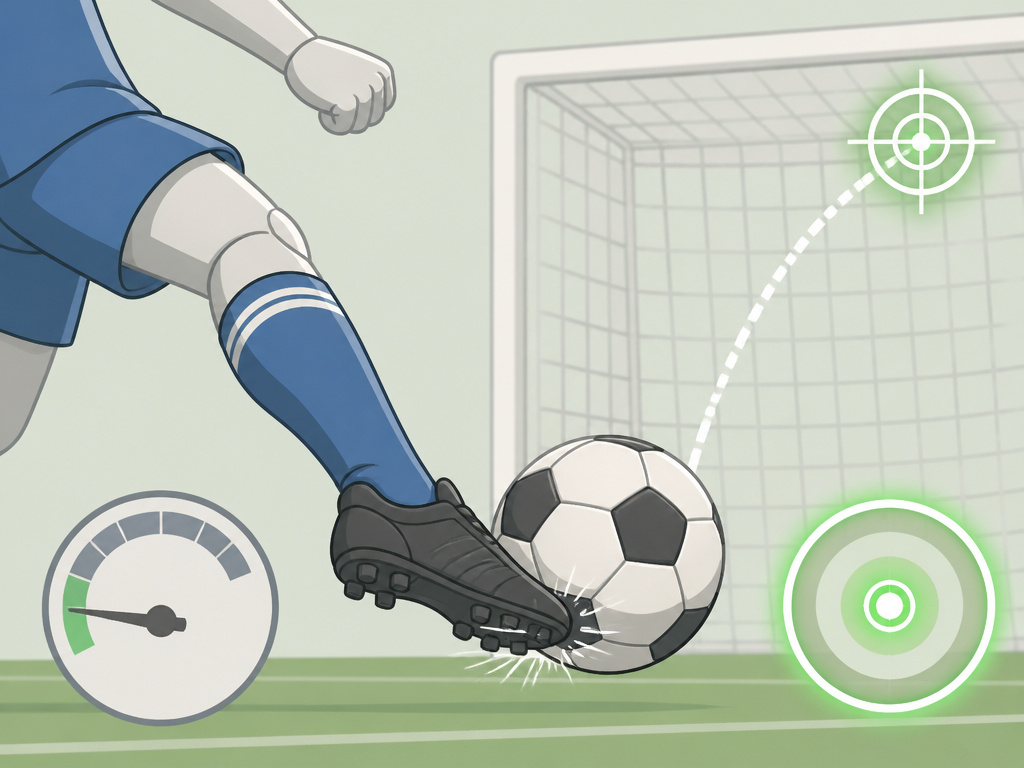
You’ve felt it when learning how to shoot a football accurately. The moment you consciously try to place the ball into a specific spot, your shot seems to lose its sting. That’s not a flaw in your technique, it’s a fundamental law of human movement, and it’s been measured in a lab.
A study by van den Tillaar and Fuglstad had players take penalties under different instructions: prioritize speed, prioritize accuracy, or try to do both. The finding was clear. When the main aim was accuracy, accuracy went up, and ball velocity went down. The players’ bodies literally changed how they moved. They used a lower backswing, less knee extension, and slower pelvis rotation. Their brains were choosing control over force.
What most people get wrong: Trying to add power and precision to the same shot. Your body can’t optimize for both at once. You must pick a priority. Inside the 18-yard box, your priority should almost always be accuracy. Let the power come from clean technique, not raw force.
This is the core mental skill. You have to commit to the placement. Trust that a ball rolled firmly into the side netting is more effective than a rocket blasted two feet over the bar. This is especially true for a penalty kick, where the pressure magnifies every doubt. Your run-up, your plant foot, your strike, they all change when you’re trying to be too careful and too strong simultaneously. Pick a corner and pass it in.
How to shoot while dribbling or on the move
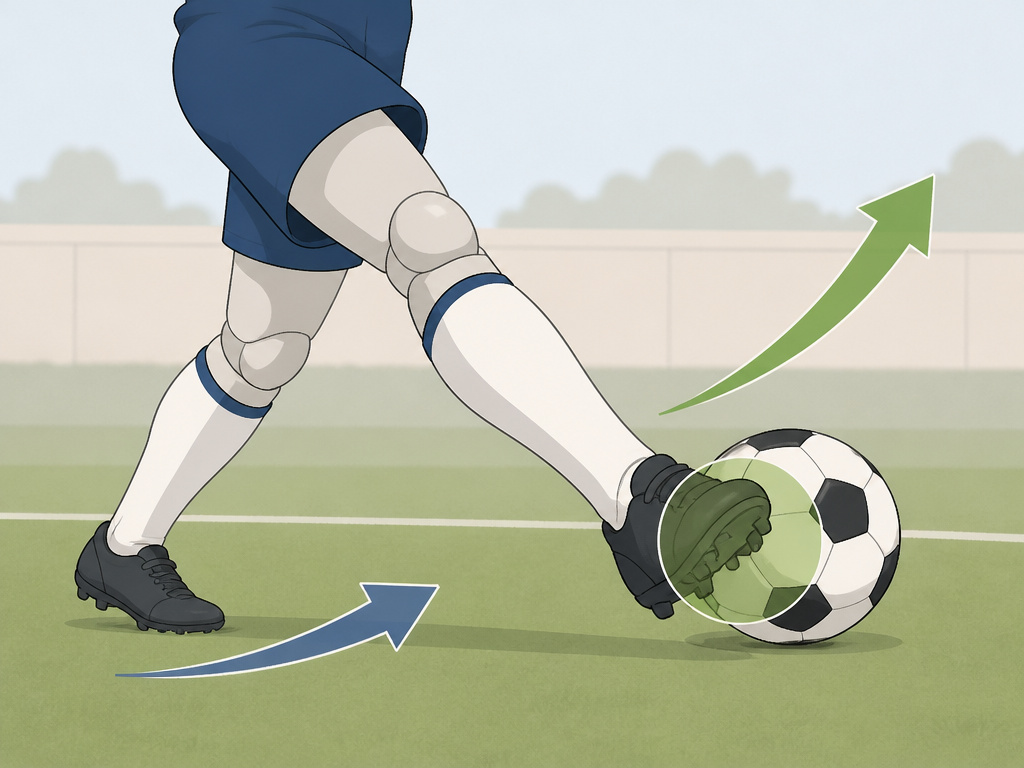
Shooting on the move requires you to integrate your run-up into the strike. Always step towards the ball with pace to generate a cleaner and more accurate strike. Let your shooting leg swing back as you approach the ball to ensure your shot has momentum. Your final plant foot should be level with the football and pointed toward your target. Keep your eye on the ball as you take your shot to maintain control. For accuracy in these dynamic situations, using the side of your foot is often recommended. Lock your ankle and make contact with the center of the ball, then follow through fully to direct your shot.
How to observe the goalkeeper’s position before shooting
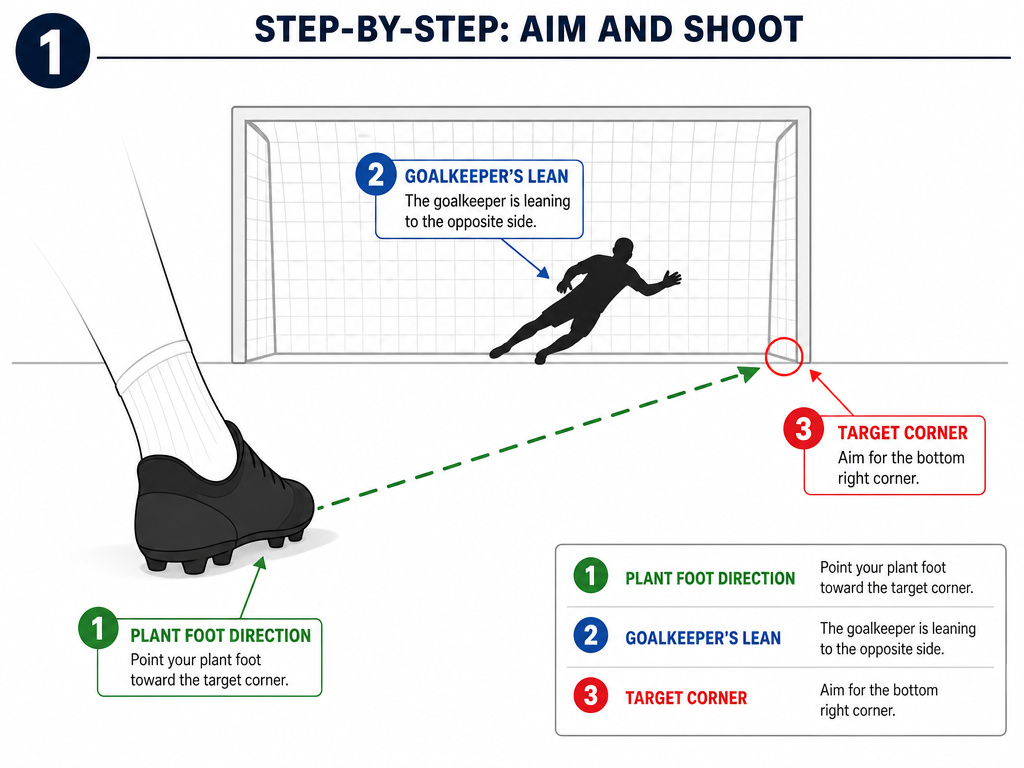
A quick glance at the goalkeeper just before you shoot can decide where to place your shot. Shooting at the bottom left or bottom right corners of the goal is one of the most effective ways to score, especially if the goalkeeper is off their line or leaning. Your plant foot should be pointed towards the specific corner you are aiming for. When your main aim is accuracy, studies show that accuracy increases, though the ball velocity may be reduced. Kicking accuracy is also higher when kicking to the contralateral side of your body relative to the goalkeeper’s position. Choose your spot, commit to it, and keep your body position aligned to that target.
Frequently Asked Questions
How do you properly shoot a football?
You properly shoot a football by executing a consistent pre-shot routine: a confident approach, a plant foot placed level with the ball and pointed at your target, a locked ankle making solid contact with the ball’s center using the appropriate surface (inside for accuracy, laces for power), and a full follow-through toward your target.
How to get a more powerful shot in football?
To get a more powerful shot, you need to generate power through leg speed and technique, not just muscle. This means using a longer run-up, a full backswing, striking the ball with your laces, and following through completely. Core and leg strength training off the pitch supports this, but the technique is what transfers that strength to the ball.
How to increase your shooting accuracy?
Increase your shooting accuracy by dedicating practice time to placement, not power. Use finishing drills that emphasize hitting specific targets from realistic game distances. Focus intensely on your plant foot alignment and using the inside of your foot. Record yourself to check for consistency, and practice under mild fatigue to simulate game conditions.
What’s the best way to practice shooting alone?
The best solo practice uses a wall or a rebounder training net. Set up targets (cones, chalk marks) and practice striking the ball cleanly to hit them from various angles and distances. Mix in first-time shots from rebounds to simulate passes. Consistency in your technique matters more than the number of shots taken.
Is it better to aim high or low when shooting?
Aiming low is generally more effective, especially against a goalkeeper who is set. Shots aimed at the bottom corners are harder to reach and often lead to rebounds. The Upper 90 Football guide specifically recommends the bottom corners as the most effective targets. High shots have a smaller margin for error and are easier for a keeper to tip over.
Before You Go
Here’s the part most people miss: accuracy isn’t a talent you’re born with. It’s a decision you make, shot after shot, in training. You have to choose the boring, repeatable inside-foot pass into the corner over the satisfying laces blast.
So your job this week is simple. Go to the pitch, find a wall, and put down two cones. Your only goal is to hit the wall between the cones, using the inside of your foot. Don’t count the ones that miss. Just focus on the checklist, plant, lock, follow. Do that twice before you play your next match.
The power will come later, once the accuracy is automatic. But a powerful shot that misses is just a loud mistake. A quiet, accurate shot is a goal.
