
How to Shoot a Football With Power: Step-by-Step
This post contains affiliate links. As an Amazon Associate, we earn from qualifying purchases.
*To shoot a football with power, follow a six-step mechanical sequence: approach at an angle (sources suggest 30 to 45 degrees), plant your non-kicking foot beside the ball (sources suggest 6-8 inches or a foot’s width), take a full backswing, strike the center of the ball with your laces while locking your ankle, and follow through completely.* The power comes from your quadriceps and hip muscles driving your leg in a straight plane, not from wild strength.
Most guides tell you to just lean forward and kick hard. They skip the part about what your body is actually doing. The difference between a shot that stings the keeper’s palms and one he catches is a set of boring, specific adjustments to your run-up, your plant foot, and the rigidity of your ankle at the moment of contact. A true guide on how to shoot a football with power must cover these details.
What follows is the breakdown of those six steps, where the sources disagree (and why it matters), and the one practice habit that makes the technique automatic under pressure.
Key Takeaways
- Power is a mechanical transfer, not brute strength. Locking your ankle turns your foot into a solid object that transfers more energy into the ball.
- Your plant foot decides everything. Place it beside the ball, pointing at your target, to keep your body over the strike and prevent the ball from ballooning. Sources differ on the exact distance, suggesting roughly 6-8 inches or a foot’s width.
- Generate force from your hips and quadriceps, not just your lower leg. The dramatic contraction of these muscles creates the overwhelming majority of the power.
- Practice at a controlled, sub-maximal effort. Swinging at 100% often wrecks your form; a smooth, technical strike can yield a harder, straighter ball. One source (footbolno) recommends striking at about 80% of your maximum effort.
- Power and accuracy are a trade-off. Decide before you shoot whether the situation calls for a laces-driven blast or a placed side-foot finish.
The Six Steps of a Powerful Shot
The perfect power shot is a chain of six motions, where each link has to be solid for the next one to work, and this chain is the essence of how to shoot a football with power. Break one, and the whole shot falls apart.
Step 1: The Angled Approach
Come at the ball from a slight angle. Coaching American Soccer recommends up to 30 degrees for long passes, while footbolno suggests 30 to 45 degrees for shooting. This disagreement is a clue.
A straight-on run-up locks your hips. An angled approach lets them open and rotate through the strike, and that hip rotation is where a surprising amount of your whip-like power comes from.
A 30-degree angle is more controlled, ideal for a driven pass or a shot where placement is still key. A 45-degree angle opens your body more, allowing for a fuller hip rotation and a more powerful swing, but it demands better timing. Start at 30 degrees. Two or three purposeful steps are plenty. A long, dramatic run-up mostly makes your timing harder.
Step 2: Planting the Deciding Foot
This is the step everyone gets wrong, and it’s why shots sail over the bar. Your non-kicking foot, the plant foot, must land beside the ball, not behind it. But how far beside it?
The sources don’t fully agree. Coaching American Soccer says about 6-8 inches away. Footbolno says about a foot’s width to the side. Vizari simply says next to the ball. The common thread is beside, not behind.
| Plant Foot Position | Result |
|---|---|
| Beside the ball | Keeps your instep perpendicular, body over the ball, and results in a low, driven shot. |
| Behind the ball | Puts your instep on an upswing, tilts your body back, and sends the ball high. |
Place it wrong and you disconnect your body mass from the strike. The fix is simple: film yourself from the side. If your shots are ballooning, your foot is almost certainly landing behind the ball.
Step 3: The Loaded Backswing
Bring your kicking leg back with a bent knee, a real backswing. Your heel should come up towards your backside. This isn’t just for show; it’s creating the potential energy you’re about to unleash.
Simultaneously, swing your opposite arm out for balance. Try to strike a ball hard with both arms pinned to your sides. It feels awkward because it is. The arm swing is a natural counterbalance that keeps your torso stable.
Step 4 & 5: Contact and the Rigid Ankle
Now the two steps that happen in a split second: striking the right spot with a rigid foot.
Contact Point: Sources disagree on the ideal point of contact for a powerful shot. Coaching American Soccer, Nike, and Avec Sport advise striking the center of the ball for power. For a driven, low shot, footbolno advises striking slightly above the centre, while Vizari says center or slightly below. The nuance is in the desired trajectory. Sources offer different advice on how to shoot a football with power: striking the center is for maximum power, while striking slightly above (footbolno) or center/slightly below (Vizari) are suggested for controlling the ball’s flight. For a pure power shot, start with the center.
The Laces: Your contact surface is the hard, bony top of your foot where your laces sit. Not your toes. Point your toes down towards the ground to present this flat surface.
The Ankle Lock: This is the invisible but critical detail. Tense your ankle so your foot is rigid at the moment of impact. A floppy ankle acts like a shock absorber, wasting the energy you just built up. As Nike puts it, locking your ankle and pointing your toes down helps maximise power. It turns your foot from a bag of bones into a firm lever.
Step 6: The Non-Negotiable Follow-Through
Your leg swing must not stop at the ball. Follow through completely, letting the momentum carry you forward.
A shot that decelerates into contact is a weak shot. The follow-through is proof you committed your full mass through the ball. It’s the difference between a punch and a push.
Where Does the Power Actually Come From?
You’re not just kicking with your leg. You’re firing a kinetic chain.
The dramatic and explosive contraction of the quadriceps and the muscles surrounding the hip joint creates the overwhelming majority of the power of the instep drive. The adductor and abductor muscles contract equally to keep the leg swing in one straight plane.
Think of it like a whip. The handle is your hip, the whip itself is your thigh and lower leg. The crack is your foot hitting the ball. If your hip doesn’t initiate the movement, you’re just flicking the tip of the whip. That’s why swinging from just the knee feels weak. The leg must travel in a straight line toward the target. Any medial or lateral drift, where your knee swings in or out, leaks power and causes wayward shots. This is often a balance issue stemming from incorrect plant foot placement.
Power vs. Accuracy: The Tactical Slider
Most coaching points ignore this: you cannot maximise both power and accuracy on the same shot. They exist on a slider.
Coaching American Soccer states it plainly: “Power should never supersede accuracy.” Meanwhile, other sources, like Nike, frame power as a primary goal for scoring. The choice is tactical.
| Situation | Priority | Technique | Reason |
|---|---|---|---|
| Long range, keeper off line | Power | Laces drive, full follow-through | Give the goalkeeper no time to react. |
| One-on-one, inside the box | Accuracy | Side-foot (inside of foot) placement | Pass the ball into the corner past the advancing keeper. |
| Tight angle, aiming for far post | Power + Placement | Laces strike across the ball | Needs pace to reach the far corner, but requires direction. |
The skill is reading the game and deciding before you shoot. Are you blasting it or placing it? The worst shots come from players who change their mind mid-swing. This is why first-time finishing is such a valuable skill, it commits you to a decision.
The 3 Most Common Power-Killing Mistakes
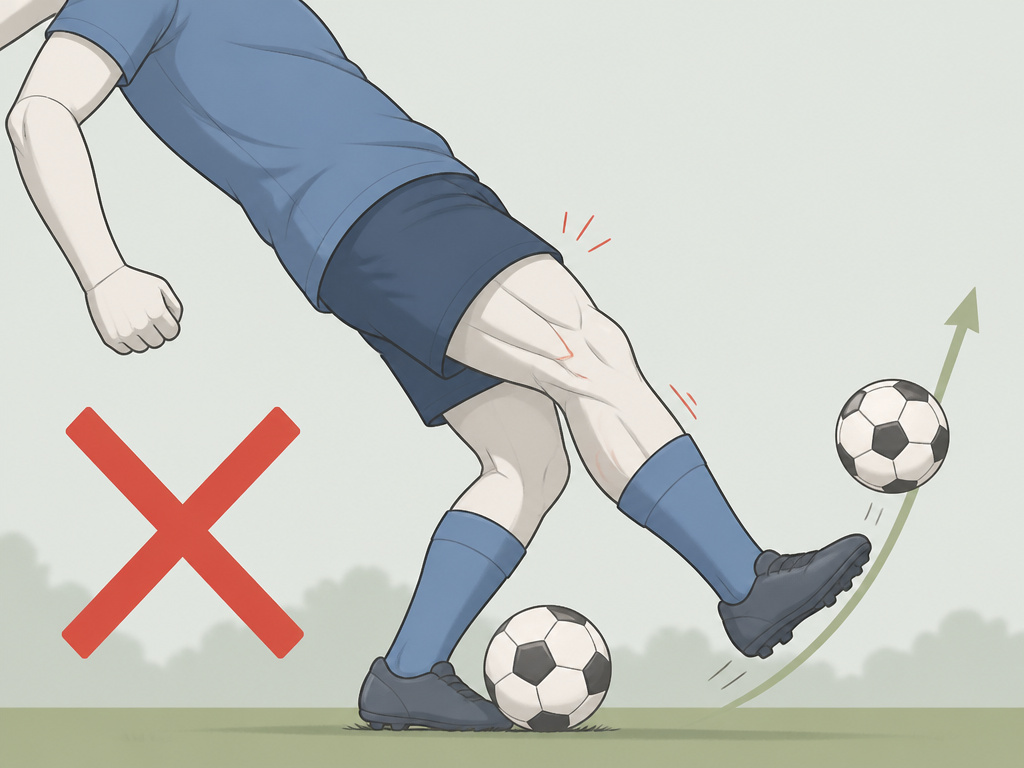
These errors are the reasons your shot feels weak.
- Leaning Back. Your body should be over the ball, chest slightly forward. Lean back and you disconnect your mass from the strike, sending the ball high and robbing it of pace. Every time you sky a shot over the bar, check your lean.
- A ‘Walking’ Commitment Step. When striking a moving ball, your final step before planting needs to be a larger, airborne step. A timid, walking step won’t give you the space or time for a large backswing, and your plant foot will often end up in the wrong place.
- Swinging at 100% Effort. It sounds wrong, but it’s true. Footbolno recommends striking at about 80% of your maximum effort. When you try to “kill” the ball, you tense your entire body, disrupt the kinetic chain, and often miss the sweet spot. A smooth, technical swing at 80% yields a cleaner, harder strike.
Drills to Build Powerful Habits
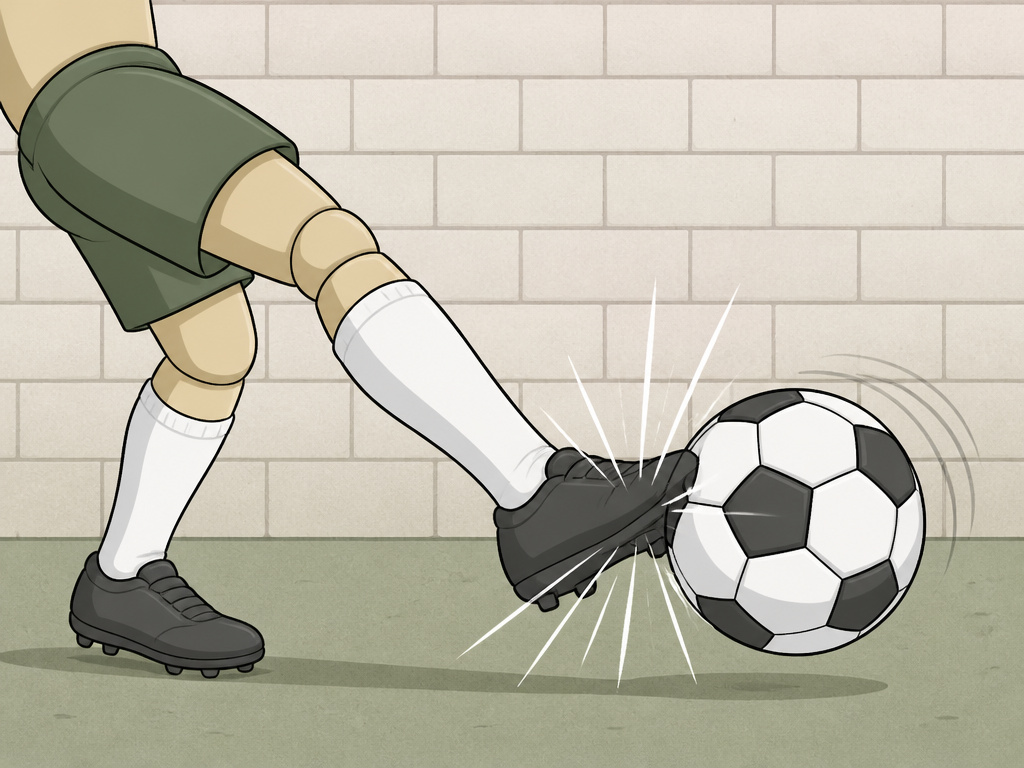
You can’t just think about technique. You have to drill it until it’s automatic. Static shooting from the penalty spot has limited value.
- Wall Work: Stand at a short distance from a wall, such as 10 to 15 yards as one source suggests. Strike a stationary ball, focusing only on your plant foot and ankle lock. Ignore where it goes. Do fifty repetitions. It’s boring, and it works.
- One-Touch Finishing: Have a partner roll or pass the ball to you. Strike it first-time while it’s moving. This punishes sloppy plant-foot placement immediately and builds the techniques for first-time finishing you need in games.
- Angle Shots: Set up wide of the posts at a close range, such as 8 to 12 yards out as one source suggests. Shooting from an angle forces you to think about body shape and contact point, not just raw power. It turns power into a targeted skill.
For structured routines, our guide on effective football finishing drills offers progressive exercises. Remember, power is supported by strength, but it’s built by technique. Targeted strength training and plyometric exercises build the athletic base, but they can’t fix a broken swing.
Generating power from thigh/leg swing, not just calf
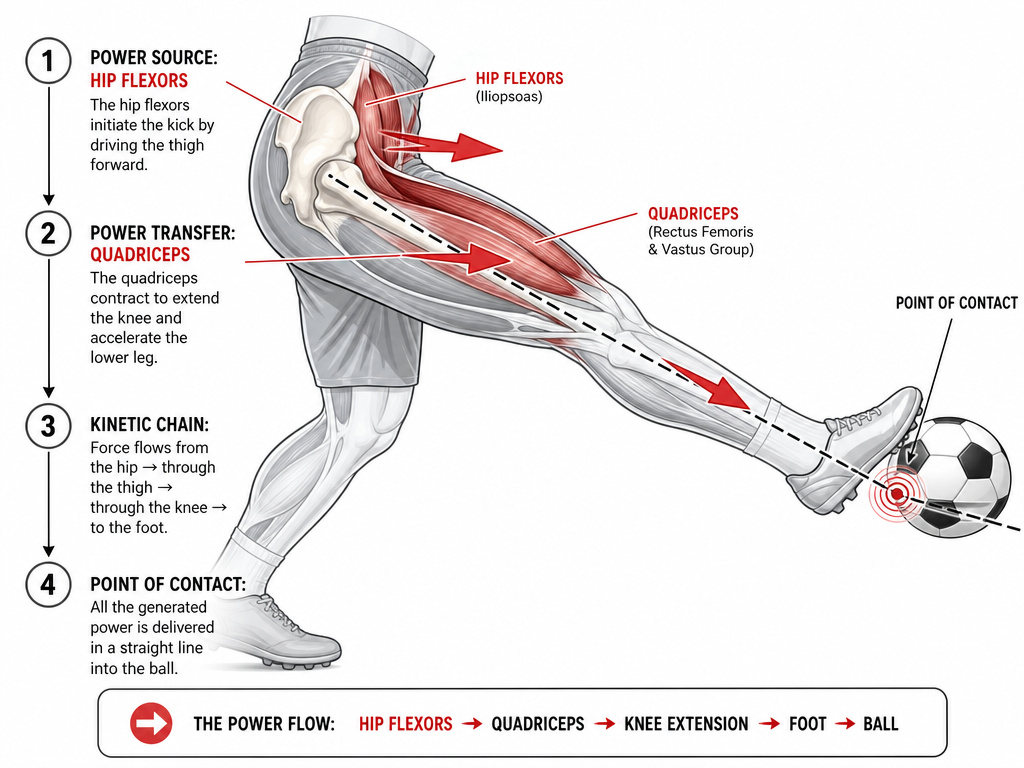
Real power comes from your thigh and hip, not just a flick of the ankle. The dramatic and explosive contraction of the quadriceps and the muscles surrounding the hip joint creates the overwhelming majority of the power. Your leg motion must stay in one straight plane, with no drift to the side, to channel all that force directly into the ball. Use a large backswing and follow through fully to maximize this effect. Contact should occur at maximum lower-leg extension and upper-leg transition, ensuring your entire leg is working together as a single, powerful lever.
Keeping head down and eyes on the ball
Keeping your head down and eyes on the ball is fundamental for clean contact. This focus ensures you strike the intended point on the ball, whether that’s the center for maximum power or another point as suggested by various sources for controlling trajectory. Leaning slightly forward as you make contact helps keep the ball low, according to sources like Avec Sport and Vizari. Sources disagree on body lean for a powerful shot, with some advocating a forward lean and others suggesting leaning backward can add elevation. If your head comes up too early, your body tends to lean back, causing you to sky the shot. A stable head position throughout the swing supports the straight-back and straight-forward nature of the overall leg motion needed for a powerful strike.
Frequently Asked Questions
Do I need strong legs to shoot with power?
Less than you think. Technique beats raw strength at most levels. That’s why a technically proficient professional can strike a ball harder than a much bigger, stronger amateur. Strength helps at the margins, but a correct laces technique is the foundation.
Why do all my shots go over the bar?
Two usual culprits: your plant foot is landing behind the ball, or you’re leaning back at the moment of contact. Both tilt your body backwards, causing your foot to get under the ball and lift it. Film yourself from the side once, and it will be obvious.
Should I point my toes down for power?
Yes, but understand why. Pointing your toes down helps lock your ankle, presenting the hard surface of your laces to the ball. However, as Coaching American Soccer notes, for a low drive, the critical factor is your plant foot position. The toe-down cue is a means to an end, a rigid foot, not the sole secret.
How long until I see improvement?
You can understand the mechanics today. You can consciously fix your plant foot and ankle lock within a few training sessions and feel an immediate difference. Making it automatic under the pressure of a game takes months of consistent repetition. That’s the point of drills.
What’s the difference between a power shot and a volley?
The principles of a rigid ankle and full follow-through are similar, but a volley is struck with the ball in the air, requiring impeccable timing and adjustment. The swing is often shorter and sharper. Mastering the basic power shot is a prerequisite for learning how to volley a football effectively.
The Bottom Line
Power is something you build by doing six specific things in the right order. Start with the angle of your run, commit with a solid plant foot, and finish with a rigid ankle swinging through the ball.
Forget about trying to hit the ball as hard as you can. Focus on hitting it right. The pace will follow. The real challenge is trusting the steps when a defender is closing you down and the goal looks small. That only comes from the repetitive, boring work against a wall, where you’re not scoring, just building the one muscle that matters: memory.
