
How to Become a Professional Footballer: Step-by-Step
This post contains affiliate links. As an Amazon Associate, we earn from qualifying purchases.
Becoming a professional footballer requires navigating a defined but narrow pathway where success hinges on hitting specific age milestones, accumulating thousands of training hours, and securing a formal contract. The global player base is approximately 265 million, but only 0.04% reach professional leagues. The journey typically starts with informal play at age 4–6, progresses through organized training and academy entry by 9–12, and aims for a senior debut at 17–19, all while amassing 4,500–6,000 hours of football-specific practice.
Most guides list the obvious steps. They miss the actual mechanics, the contractual deadlines, the registration rules that bind you to a club for years after you leave, and the academic data on what separates the 0.04% from the rest. This focuses on the calendar, the paperwork, and the type of practice that shows up in the research. A true guide on how to become a professional footballer must cover these details.
What follows breaks down the pathway using primary sources: FIFA’s regulations, a professional club’s youth handbook, and a 2026 systematic review of elite player development. This section explains the age benchmarks, the scholarship and professional contract windows, the mental and perceptual skills the data highlights, and the concrete alternatives if the academy door closes.
Key Takeaways
- The 0.04% professional conversion rate from a 265-million-player base means the pathway is a filter, not a funnel, plan for education alongside football.
- In the UK, a club must offer a two-year scholarship by 31st December of your under-16 season; you have 28 days to respond, making this your first major contractual decision.
- Research indicates elite players don’t just train more; they perceive training as more challenging and develop superior pattern-recognition skills, which are trainable mental attributes.
- FIFA’s 30-month registration hold means if you leave a club, your registration stays with that association for over two years, complicating immediate moves to another professional side.
- A significant number of professionals come from non-academy routes like non-league or college football, proving the pathway has late-entry points if you develop the right attributes.
The Professional Pathway Timeline (Ages 4-22)
The journey isn’t a mystery. A 2026 systematic review in Frontiers in Psychology synthesized multiple studies to map the typical age milestones for male professional footballers, providing a scientific backbone for the how to become a professional footballer question. Think of it as a broad schedule, not a strict rulebook. Some hit marks earlier, some later, but the sequence is remarkably consistent.
The data shows a clear progression from casual play to structured investment. You start kicking a ball around at 4–6 years old. Organized, coach-led training usually begins between 6–7 years, with your first formal competition following at 7–9 years. This early phase is dominated by what researchers call “deliberate play”, informal, fun-focused football.
The first major institutional step is academy entry, typically between 9–12 years. This is where the environment shifts. The same Frontiers in Psychology systematic review notes that successful trajectories see informal play give way to intensive, coach-led practice throughout adolescence. Training hours ramp up significantly during these years.
Male professional footballers generally accrue 4,500–6,000 hours of football-specific activities before attaining professional status. This accumulation is not steady; training durations during adolescence are markedly higher than during childhood.
The later milestones are about breakthroughs. A senior professional debut usually happens at 17–19 years. National team call-ups follow, with youth national selection at 14–16 years and senior national team selection at 18–22 years. The research also notes that higher-level players often, but not always, reach these milestones at younger ages than their lower-level counterparts.
| Developmental Milestone | Typical Age Range | What Changes |
|---|---|---|
| Football Initiation | 4–6 years | First contact with the ball; informal, playful exposure. |
| Start of Organized Training | 6–7 years | Introduction to coach-led sessions; basic technical focus. |
| First Formal Competition | 7–9 years | Entry into league or cup matches; understanding of rules and teamwork. |
| Academy Entry | 9–12 years | Entry into a structured youth system; training becomes more frequent and systematic. |
| Senior Professional Debut | 17–19 years | First appearance for a club’s first team; transition from youth to adult football. |
| Youth National Team Selection | 14–16 years | Recognition at country level for age-group teams. |
| Senior National Team Selection | 18–22 years | The pinnacle of representation; playing for the full national side. |
This timeline is a map, not a prison sentence. Plenty of players deviate from it. But it shows the scale of the undertaking. It’s a decade-and-a-half commitment that starts in primary school.
The UK Academy Ladder: Scholarships and Pro Contracts
The academy system is the most visible path. In England, it’s a formalized structure with clear rules. Grimsby Town FC’s Youth Development Handbook gives us a transparent look at the critical deadlines that govern a young player’s life. Miss these, and the path gets much harder.
The first big date is 31st December. If a club wants to keep an academy player beyond their under-16 season, they must offer a two-year scholarship (an apprenticeship) on or before this date in the player’s under-16 season. This is a formal offer that kicks off a 28-day decision window for the player and their family. Saying yes means committing to the club’s Professional Development Phase for two years, where football and education are combined.
Where this goes sideways: Letting the 28-day scholarship decision window pass without a clear plan. The offer expires, and you’re suddenly a free agent in a market where most spots are already filled for the next season.
After the scholarship begins, the next target is a professional contract. The club may offer this to commence from age 17 at any time from 1st November following the start of the under-16 year. This is the dream ticket, a paid, written agreement that meets FIFA’s definition of a professional. According to FIFA’s Regulations on the Status and Transfer of Players, a player is considered professional if they have a written contract with a club and are paid more for his footballing activity than the expenses he effectively incurs.
The handbook also highlights a subtle pivot point. Education is compulsory during the two-year scholarship. But after age 18, it notes education opportunities “may continue” but are “not compulsory.” This is a potential cliff edge for personal development if football doesn’t work out.
What “Professional” Actually Means (It’s About the Paperwork)
We throw the word “professional” around loosely. In football, it has a specific, contractual meaning defined by FIFA, the global governing body. Understanding this definition is crucial because it changes your rights, your status, and your options.
Per the FIFA Regulations on the Status and Transfer of Players, a player is considered professional if they have a written contract with a club and are paid more for their footballing activity than their expenses. Everyone else is an amateur. This distinction affects everything from transfer rules to dispute resolution.
One of the most important, and often overlooked, rules is the registration hold. Upon contract expiry or when football activity terminates, a player remains registered with their last club’s national association for 30 months. This period starts from the date of their last official match for that club.
For example, imagine you are released from an academy at 18. You aren’t just a free agent. Your registration is lodged with the Football Association for another two and a half years. This can complicate a move to another professional club, as they may need to secure an international transfer certificate (ITC) or navigate compensation claims. It’s a rule designed to protect club investment in youth development, but it’s a bureaucratic reality every aspiring pro must understand.
This is why the advice to “just get a football agent” early is simplistic. A good agent understands these regulations and can navigate the scouting process and subsequent contract negotiations within this framework. Their job isn’t just to find you a club; it’s to manage your legal and administrative status through these transitions.
The Training Reality: Hours, Structure, and Mindset
Talent is the entry fee. What you do with it is the entire game. The systematic review provides hard data on what elite training actually looks like. It involves different hours, approached with a different mindset.
The research indicates a specific accumulation of football-specific practice hours before reaching the professional level. The research on how to become a professional footballer indicates male professionals accumulate 4,500–6,000 hours before reaching the professional level. The structure of those hours is telling. In childhood, play dominates. In adolescence, coach-led practice takes over. Elite players don’t just endure this shift; they engage with it differently.
Elite players reported markedly higher perceptions of effort and challenge during training activities. They aren’t just working harder; they are consciously engaging with the difficulty, which likely deepens the learning effect.
Furthermore, they demonstrate superior decision-making accuracy and pattern-recognition skills compared to non-elite athletes. This is a cognitive skill honed through specific types of practice. The review notes that higher-skilled players accumulated more practice involving decision-making demands, not just repetitive drills.
This is where modern tools like Hudl come in. It’s not for posting highlights. It’s for self-analysis, reviewing your own game to spot decision-making patterns, timing, and positioning. The elite mindset uses every available resource to convert raw practice into intelligent practice.
Your football fitness regimen must support this. It’s not about being the fastest in a sprint. It’s about maintaining technical clarity and decision-making speed in the 85th minute. Sport-specific conditioning replicates the stop-start, high-intensity nature of the game, ensuring your body doesn’t betray your brain when you’re tired.
When the Academy Door Closes: The Non-League and College Route
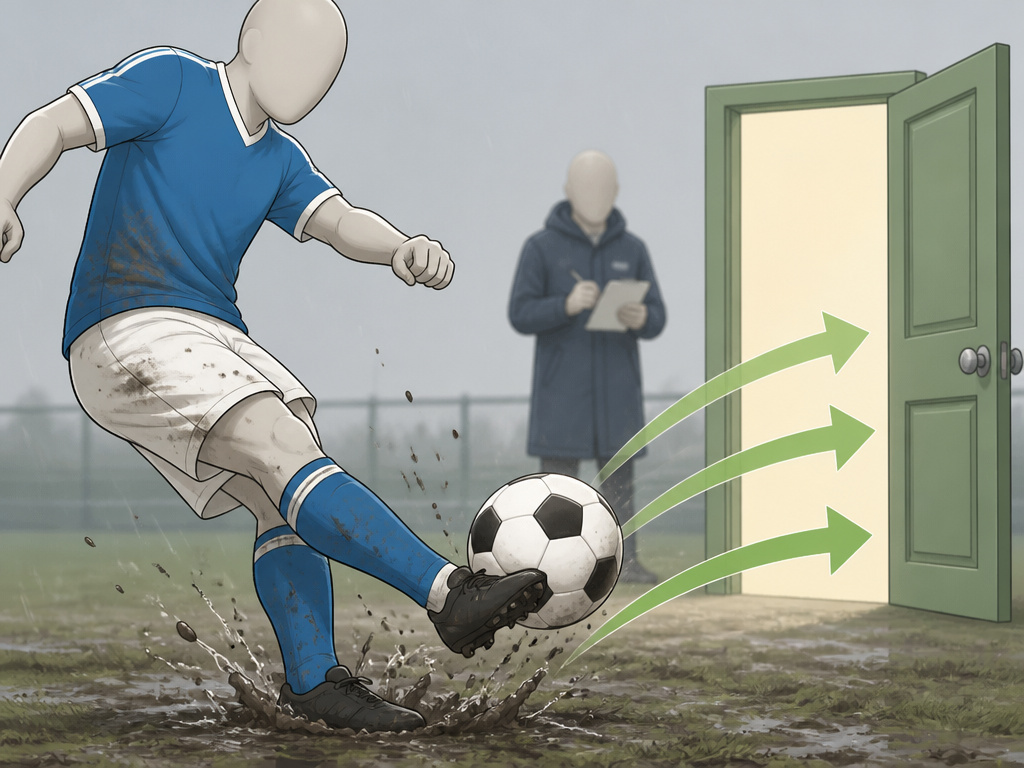
The academy pathway is linear and well-marked. It is also the one that closes for the vast majority. The 0.04% statistic is a brutal truth. But the pathway isn’t a single road ending at a cliff; it’s a river with multiple tributaries.
A significant number of professional footballers did not come through traditional academies. It is entirely possible to be picked up from non-league, college, or later development. Most guides underplay. Jamie Vardy’s journey from Stocksbridge Park Steels to Premier League champion is the famous example, but he is not a solitary miracle.
Common mistake: Believing that academy release at 16 or 18 is the end of the story. For many late developers, it’s the beginning of a more realistic, pressure-off journey where they can play men’s football and be scouted on performance, not potential.
The semi-professional football ladder exists for this reason. Semi-professional football leagues are filled with players who were in academies. The standard is physical and direct, and it’s a proving ground. Scouts from Football League clubs regularly watch these games looking for players who have matured physically and mentally after release.
Another route is the college or university system, which can offer a blend of competition and education. This offers a blend of high-level competition and continued education. The schedule allows for development without the all-or-nothing pressure of an academy. Success in non-academy routes can still lead to a professional contract.
The key is to reframe “failure” as a “redirect.” An academy release is often a timing issue, a club’s need versus your development curve. The goal shifts from climbing a pre-set ladder to making your own path visible through consistent performance in adult football.
The Indispensable Skills: Beyond the 40-Yard Pass

Technical ability gets you in the door. What keeps you in the building is everything else. The research points to psychological and perceptual factors that separate levels.
We’ve already touched on the perception of challenge. Elite players rate their training as more effortful and challenging. This suggests a mindset of engagement, not just compliance. They are active participants in their improvement, seeking out the difficult aspects of a drill rather than just getting through it.
The review also confirms elite players have better pattern recognition and decision-making speed. This is the advanced decision-making and pattern-recognition ability the research highlights. It’s the ability to read a developing attack one pass before it happens, to know where a teammate will be without looking. This can be trained through video analysis and small-sided games that force constant decisions.
Then there’s multi-sport participation. Most elite players engaged broadly in multiple sports during childhood, particularly invasion games like basketball or rugby, before specializing. This early diversification builds general athleticism, spatial awareness, and reduces burnout. It suggests a broader athletic foundation before specializing in football.
Finally, resilience is essential. You will be rejected. You will be benched. You will have a bad game. The system is designed to test this. The players who make it aren’t necessarily the most talented at 14; they are the ones who learn from setbacks without being defined by them. This mental toughness is what allows a player to succeed at football trials after a previous rejection or to thrive in the semi-pro pathway while aiming higher.
Physical fitness and diet requirements

Elite players consistently report higher perceptions of effort and challenge during their training. This indicates the physical demands are intense and sustained. While the fact sheet does not list specific fitness tests or dietary plans, the general trajectory shows that training durations increase markedly during adolescence compared to childhood. To meet these demands, a professional approach to conditioning and nutrition is required. Practical guidance involves building a regimen that supports high-intensity, repeated efforts and promotes recovery, aligning your physical preparation with the escalating training load typical of a professional pathway.
Frequently Asked Questions
What is the best age to start football to become a professional?
The data shows most professionals start between 4 and 6 years old with informal play. However, “best” is misleading. Starting early allows for more accumulated hours, but the quality and structure of those hours matter more. Many professionals who started later compensated with intense, focused practice. The key is starting a structured, quality training regimen by early adolescence.
Is it too late to start at 14 or 16?
No, but the pathway changes. At 14, players following a non-traditional pathway may have a different profile of accumulated practice compared to long-term academy peers. You would need to accelerate skill acquisition and seek alternative routes like advanced local clubs or specialized training centers. At 16, the focus shifts to the non-league or college pathway, using men’s football as your development platform. The age limit for a debut is less important than your rate of improvement and physical readiness.
How do I get scouted?
Scouts look for players who solve problems on the pitch. To get scouted, you need to be visible. Perform consistently well for your team, whether academy, non-league, or college. Ensuring you are visible and performing consistently at a high competitive level is key to attracting scouting attention. Most importantly, ensure you are playing at the highest competitive level you can; scouts go where the competition is.
Do I need an agent as a youth player?
Not initially. Focus on performance. An agent becomes useful when you have tangible interest from clubs and need to negotiate a scholarship or professional contract. A good football agent provides legal and career guidance, but they cannot create talent where it doesn’t exist. An agent becomes useful when you have tangible interest from clubs and need to negotiate a scholarship or professional contract.
What are the odds of actually making it?
The numbers are stark. With a global base of ~265 million players and a 0.04% conversion rate, the odds are extremely low. This isn’t to discourage, but to insist on planning. Pursue education with equal seriousness. A dual focus ensures you have options and can often relieve the performance pressure that hinders young players.
Before You Go
The pathway to professional football is a blend of calendar deadlines, deliberate practice, and relentless mindset. It starts with a ball and a dream around age five, but it’s secured by understanding FIFA’s Article 2, hitting the scholarship offer deadline of 31st December, and logging thousands of hours where you seek out the challenge, not just the comfort.
The academy system is the clearest route, but the non-league and college pathways are legitimate, proven alternatives for late developers. The research is clear: the players who make it train with more cognitive engagement and perceptual sharpness. They see the game faster.
So, have the dream. But build it on the facts: the 0.04% statistic, the 30-month registration hold, the 4,500–6,000 hours. Watch your own games on Hudl with a critical eye. Treat education as your backup contract. And if an academy door closes, remember that the non-league stands are full of scouts looking for the player you can still become. The game always needs problem-solvers. Go be one.
