
How Old Is Too Old to Become a Professional Footballer?
This post contains affiliate links. As an Amazon Associate, we earn from qualifying purchases.
Professional footballers are signed at an average age of 24.95 in Europe’s top leagues, with players aged 24 making up the single biggest recruitment group at 10.6%. The real barrier isn’t a calendar age but a combination of physical development, competitive exposure, and league-specific recruitment policies. While starting in an academy before age 12 makes a player 12.43 times more likely to get a pro contract, outliers like Jamie Vardy prove pathways exist well into a player’s 20s.
That average age of nearly 25 is the central fact most inspirational articles miss. It means clubs are buying finished players, not just betting on teenagers. The gap between that number and the common belief that you must be scouted at 12 explains the whole tension in the question of how old is too old to become a professional footballer.
What follows is a breakdown of the actual data from league reports and academic studies, the positional and league biases that change the math, and the practical, unglamorous steps an older player can actually take to answer the how old is too old to become a professional footballer question. We’ll separate motivation from mechanics.
Key Takeaways
- The average recruitment age for players in Europe’s top five leagues is 24.95 years, with 24-year-olds being the most commonly signed age group.
- A player’s position changes the timeline; goalkeepers have a significantly longer average career (12.4 years) than outfield players (11.6 years).
- German Bundesliga clubs recruit the youngest (avg. 24.38 years), while Spanish La Liga clubs sign the oldest (avg. 25.67 years).
- Starting in an academy before age 12 makes a player 12.43 times more likely to gain a professional contract than those starting at 13/14.
- For a realistic pathway after 22, focus on lower-league or semi-professional football where recruitment ages are higher and physical peaks are judged differently.
The Hard Data on Recruitment Age
Forget the highlight reels of teenage wonderkids. The business of building a squad happens with players who have already proven they can handle the professional grind.
The CIES Football Observatory tracks this precisely. Their analysis shows the average age at which players currently in big-five league squads were recruited is 24.95 years. The single most common age to be signed is 24, accounting for 10.6% of all recruits. Clubs want relatively young footballers, but ones with solid experience.
The average recruitment age of players currently present in the squads of big-5 league teams is 24.95 years of age. This average varies considerably between leagues: from 24.38 in the German Bundesliga to 25.67 years of age in the Spanish Liga.
This isn’t a uniform rule. League philosophy dictates strategy. Bundesliga clubs recruit the fewest players aged 30 or over (8.3%) and the most aged 21 or younger (17.6%). They build. La Liga teams do the opposite, signing the highest percentage of players aged 30+ (16.1%) and the lowest percentage of under-21s (12.6%). They buy proven quality.
| League | Average Recruitment Age | % of Signings Aged 21 or Younger | % of Signings Aged 30 or Older |
|---|---|---|---|
| Bundesliga (GER) | 24.38 years | 17.6% | 8.3% |
| Premier League (ENG) | 24.79 years | 14.7% | 10.6% |
| Serie A (ITA) | 24.89 years | 16.6% | 11.8% |
| Ligue 1 (FRA) | 25.01 years | 15.8% | 12.0% |
| La Liga (ESP) | 25.67 years | 12.6% | 16.1% |
So, is 25 too old? For a Bundesliga club’s typical signing, maybe. For a La Liga side, you’re just entering the prime demographic. The first step in any realistic plan is understanding which market might value your profile. For more on this, see our guide to the path to becoming a pro.
The Youth Academy Advantage (And Its Limits)
The data on early specialisation is brutally clear, but its interpretation has a twist.
A study of an English academy by Mills et al. Found that starting before the under-12 age group was a “key indicator” of obtaining a professional contract. Players recruited that early were 12.43 times more likely to gain a contract than those recruited at U13/U14, and 3.16 times more likely than those at U15/U16. 87% of the players who signed pro contracts came from that early-starter group. The system is designed to identify and mould talent over a decade.
This is the commodity narrative: you must be in an academy by 12. But another longitudinal study, referenced in broader research, found that 68% of successful academy graduates were recruited at age 12 or older, suggesting later recruitment does not preclude success. This contrasts with the Academy Study (Mills et al.) which found starting before age 12 is a key indicator and makes a player 12.43x more likely to get a pro contract.
The real mechanism isn’t just about skill. It’s about biological maturation and the relative age effect. A PLOS One relative age effect study notes that primary selection in top academies happens before age 10, where a few months’ age difference grants significant physical advantage. Early-maturing kids dominate youth stages. However, a Semantic Scholar biological maturation study that tracked academy players found all those who later reached top-five European leagues were in the late-maturing group. The system often filters for early physical prowess, but long-term elite success frequently correlates with later development.
Where this goes sideways: Assuming an academy trial at 14 is your last chance. The data shows two paths: the early-identifier path and the late-bloomer path that the system is worse at spotting but still produces top professionals.
If you missed the early academy window, your task changes, especially when you compare a how old is too old to become a professional footballer timeline. You’re not following the standard pathways. For context on how the system works, read about football academy pathways. You need to compress a decade of competitive understanding into a few years and find a league or level that judges you on your current output, not your projected potential.
Physical Realities and the Aging Curve
Your body’s timeline is fixed. The game at the professional level is a series of sprints, jumps, and sharp turns, repeated for 90 minutes twice a week.
A career length study by Jones et al. Gives us the numbers. At 5 years into their top-level career, EPL players have a 40% probability of still playing at that level. By 10 years, that drops to 18%. The window at the very top is short.
The curve is even steeper in lower leagues. The average career length in League Two is 6.2 years, and players there have a less than 2% chance of still playing at their highest level after a decade. The physical grind without the top-level medical and recovery support takes its toll faster.
This means an aspiring 28-year-old isn’t just competing against 22-year-olds. They’re competing against a biological clock that gives them a shorter projected career return for any club that signs them. Your training must now do two things at once: raise your technical/tactical level to professional standard and make the most of the athletic prime you have left.
Three non-negotiable focuses for an older beginner:
- Football-specific endurance. Not just running miles, but replicating the high-intensity interval pattern of a match. The feel is a specific burn in the lungs around the 70th minute that you must be able to play through.
- Strength and injury resilience. Your ligaments and muscles need to handle forces they’re not used to. Strength training is not for bulk; it’s for durability.
- Recovery as a skill. Sleep, nutrition, and mobility work aren’t optional extras. They are the foundation that allows you to train hard again tomorrow.
The Goalkeeper Exception
The calculus changes completely if you’re between the posts. The same career length study found goalkeepers have a significantly longer average career (12.4 years) than outfield players (11.6 years). Their game relies more on positioning, decision-making, and handling—skills that mature with experience and decline later physically.
Stories like Luca Toni making his pro debut at 25 are rare for strikers. For goalkeepers, later breakthroughs are less mythological. If you’re an older aspirant with goalkeeping instincts, your potential timeline is more forgiving. The scouting process for keepers also values game intelligence and command, attributes that can be showcased effectively in semi-professional football or even strong amateur leagues. Learn more about the scouting process and semi-professional football.
The Practical Pathway After 22

So you’re past the academy age. The “how” becomes brutally pragmatic. Inspiration is useless without a map.
First, reset your destination. The Premier League is not the goal. The goal is a contract. That means targeting leagues and clubs where the average recruitment age is higher and the physical demands, while still intense, allow for a different kind of player. Look at the lower divisions in England, leagues in Scandinavia, Eastern Europe, or Asia. Their semi-pro level is a fully professional environment and a legitimate destination. For a deeper explanation, see our article on semi-professional football.
Common mistake: Sending highlight tapes to Premier League academies. A 24-year-old is not an academy project. Target first-team managers at clubs in the National League or League Two, where players in their mid-20s are regularly signed.
Your “tryout” is your current season. You need to be playing at the highest level you can access, right now. That means:
- Joining the best semi-pro or amateur team in your region. Don’t wait for a scout. Get game footage.
- Treating every match as an audition. Consistency over six months is more convincing than one flashy game.
- Creating a professional-grade highlight reel. Not just goals. Show your first touch under pressure, your defensive positioning, your work rate in the 90th minute.
Networking is not schmoozing. It’s information gathering. Talk to coaches, former players, anyone connected to the levels you’re targeting. Understand what those clubs actually need. A BMC Sports Science cohort study on female players highlighted that higher match exposure before 18 lowered career attrition risk later. The principle translates: you need competitive minutes to prove you can handle the environment. Go and get them.
The Mental Hurdle: Handling the “Too Old” Label

The toughest opponent won’t be a faster winger. It will be the voice in your head—and the glances from others—that questions the entire endeavour.
This is where the standard “believe in yourself” advice fails. You need a specific cognitive strategy. Anchor your identity to your daily process, not to the distant outcome of “becoming a pro.” Your job today is to complete the training session, to analyse your last match, to eat the right meal. The goal is a byproduct of a thousand tiny jobs done well.
You must also manage external doubt. When a coach at a trial sees your date of birth, their perception shifts. You have about ten minutes of a small-sided game to redefine that perception with your decision-making and communication. Show you see the game faster. Your physical attributes are a given; your football brain is your argument.
I learned to watch the 70th minute of any match for fitness and discipline. That’s when shape holds or falls apart. As an older player, your composure in that fatigued period is your strongest selling point. If you’re still organising, still making the simple pass, you’re demonstrating a professional mentality.
Finally, have an exit ramp. The probability of continuing at the top level drops sharply after 30. This isn’t pessimism; it’s planning. Use the pursuit to build transferable skills—discipline, teamwork, performance under pressure. Explore alternative football careers in coaching, analysis, or sports media. For ideas, see our guide to football career paths besides playing. The journey has value even if the final destination changes.
Why skill development matters more than fame for older players
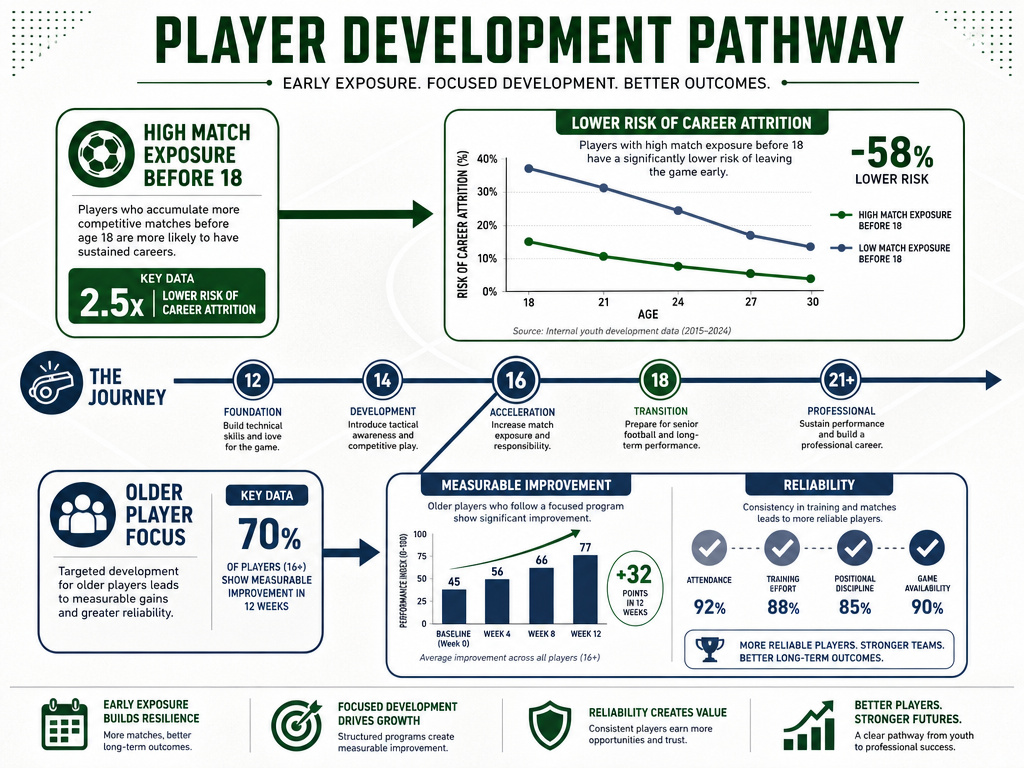
The statistics make a clear case for prioritizing development. Research indicates that higher match exposure before age 18 is associated with a lower risk of career attrition later on, underscoring that foundational skill and experience are critical long-term assets. For an older player, the focus must shift entirely to measurable improvement and reliability. Studies of academy systems show that primary selection for top pathways occurs very early, but for those who start later, the goal is to close the technical and tactical gap. This means dedicated, focused training on core competencies that make a player valuable to a team, rather than chasing high-profile trials or contracts. A player’s value is built on consistent performance, a quality that scouts at all levels are tasked with finding.
Frequently Asked Questions
Is 30 too late to become a professional footballer?
For a debut in a top-five European league, yes, it is realistically too late. The data shows recruitment drops sharply at that age. However, “professional football” includes hundreds of leagues worldwide. A debut in a lower-division or semi-professional league at 30 is improbable but not impossible, especially for goalkeepers. The focus would shift entirely to immediate, proven ability.
Who is the oldest footballer to go pro?
While many players have long careers, debuts at an extremely late age are folklore. The more relevant examples are players like Jamie Vardy, who signed his first professional contract at 25 with Halifax Town after playing non-league football, or Ian Wright, who signed for Crystal Palace at 21. These stories emphasise the non-league to professional pipeline, not a first kick-about at 40.
Does starting late mean I should play a specific position?
It can help. Goalkeepers and central defenders often have longer career arcs because their roles rely more on anticipation, positioning, and leadership than pure explosive speed. A late starter might find more opportunity developing the game intelligence for these positions rather than trying to out-sprint wingers who have been training since childhood.
How can I get scouted if I’m older?
You move from “scouted” to “recruited.” Scouts hunt for future potential in youth games. At an older age, you need to be seen by a manager or chief scout who needs a player for their first team now. This means performing consistently in a visible, adult competitive league and making your availability and performance data known directly to clubs.
Before You Go
The number that matters isn’t your age. It’s the average recruitment age of 24.95. If you’re under that, you’re within the statistical norm for a signing. If you’re over it, you’re an outlier, and outliers need a different plan.
That plan has three parts: target the right level (lower leagues, specific countries), compress your development with ultra-focused training, and build your case with undeniable current performance. The pathway for a 28-year-old doesn’t run through an academy entry system designed for 12-year-olds. For context on that system, read about how to join a football academy. It runs through the men’s first team of a club that needs a player who can contribute next Saturday.
To be blunt. The odds are long. But the door isn’t locked by a birthday. It’s weighted by physics, economics, and a club’s need. Your job is to make your specific skills so necessary that pushing that door open becomes the obvious choice.
