
Number 10 Role in Football: The Playmaker, Explained
This post contains affiliate links. As an Amazon Associate, we earn from qualifying purchases.
The number 10 in football is a creative attacking midfielder, typically playing just behind the striker in ‘the hole’ to orchestrate a team’s attacks. The traditional role had minimal defensive duties, but modern playmakers like Kevin De Bruyne now combine vision and passing with significant physical output and pressing, adapting the classic archetype to contemporary tactical demands.
That distinction between the historical luxury and the modern necessity of the number 10 role in football is what coaches argue about. It’s the gap between a highlight reel and a full match-watch.
What follows breaks down that evolution: the tactical origin of the shirt number, the quantifiable physical and technical demands modern data reveals, and why the role is both more difficult and more varied than the simple ‘magician’ label suggests.
Key Takeaways
- The traditional number 10 shirt was assigned to the inside-left forward at the 1950 World Cup, cementing its status as the playmaker’s number.
- Modern data shows central midfielders, a category that includes modern number 10s, cover more total and high-speed distance than forwards, debunking the myth of a purely luxury player.
- A player’s technical performance (like dribbles and medium/long passes) is heavily influenced by their positional role, explaining 27–44% of the variance, while short passes depend more on individual skill.
- The 4-2-3-1 formation demands significantly more decelerations from all players compared to a 4-4-2, directly impacting the physical load on an attacking midfielder.
- True mastery now requires hybrid skills: the classic vision and creativity, plus the athleticism to press and the tactical intelligence to operate as a false nine, wide playmaker, or deep-lying midfielder.
The Shirt and the System: A Brief History
In football, a position is usually a set of tasks, and a shirt number is only a label. But when the two combine over decades, they create a myth. The tradition of numbered shirts in international football began at the 1950 World Cup, with players numbered 1 to 11 based on their position. The number 10 was assigned to the inside-left forward, the creative playmaker.
That wasn’t a random draw. It was the space where a clever player could turn and face the defence. That geographical fact stuck to the number long after formations evolved. The shirt, and the number 10 role in football it represented, became a story: Pelé, Maradona, Platini. It promised creativity, the unpredictable moment, the player who made the team watchable.
The part nobody mentions: The South American reverence for the enganche (the hook) and the European appreciation for the trequartista (three-quarters attacker) meant the number 10 developed slightly different cultural meanings on each continent, even as the on-pitch job description converged.
But systems change. A player who just stood there, waiting, became a passenger out of possession. The story of the number 10 in the last 30 years is the story of that player learning to move, to work, to defend. The shirt’s magic is now earned through sweat as much as silk.
What Does a Number 10 Actually Do?
Forget the highlight reel. A playmaker’s job is connective. In possession, they are the team’s central switchboard, receiving the ball from defenders and deep midfielders and choosing the right pass to break lines. They operate between the opposition’s midfield and defensive lines, “in the hole”, which requires constant scanning and subtle movement to lose a marker.
Out of possession, the role has transformed. Some sources describe the classic archetype as having ‘minimal’ defensive responsibility, a luxury that left the team vulnerable, while modern data shows central midfielders (encompassing many modern No. 10s) cover significant distance and perform defensive work.
The tools for the number 10 role in football haven’t changed much: vision to see passing lanes before they open, close control to operate in tight spaces, and the passing range to execute. What’s changed is the engine required to get into those positions throughout a match. You can’t orchestrate if you’re too gassed to take a touch.
The Classic Number 10 vs. The Modern Playmaker
This is where the nostalgia bumps into the data. Is the classic, free-roaming number 10 extinct? The answer depends on what you measure.
On the other, contemporary match analysis paints a different picture. A systematic scoping review of 178 studies found that central and external midfielders cover greater total and high-speed distance than forwards. Midfielders also presented higher mean heart rate values (as a percentage of maximal heart rate) than all other playing positions.
| Aspect | Classic Number 10 | Modern Playmaker |
|---|---|---|
| Primary Focus | Creation in final third | Creation + ball progression |
| Defensive Duty | Minimal, often a “libero” in attack | Integral part of team press/block |
| Modern Example | Juan Román Riquelme | Kevin De Bruyne |
The shirt is still coveted, as discussed in a recent Athletic article on No. 10 shirt, but the player wearing it now does the work of a number 8 and a number 7 as well.
Physical and Technical Demands: What the Numbers Say
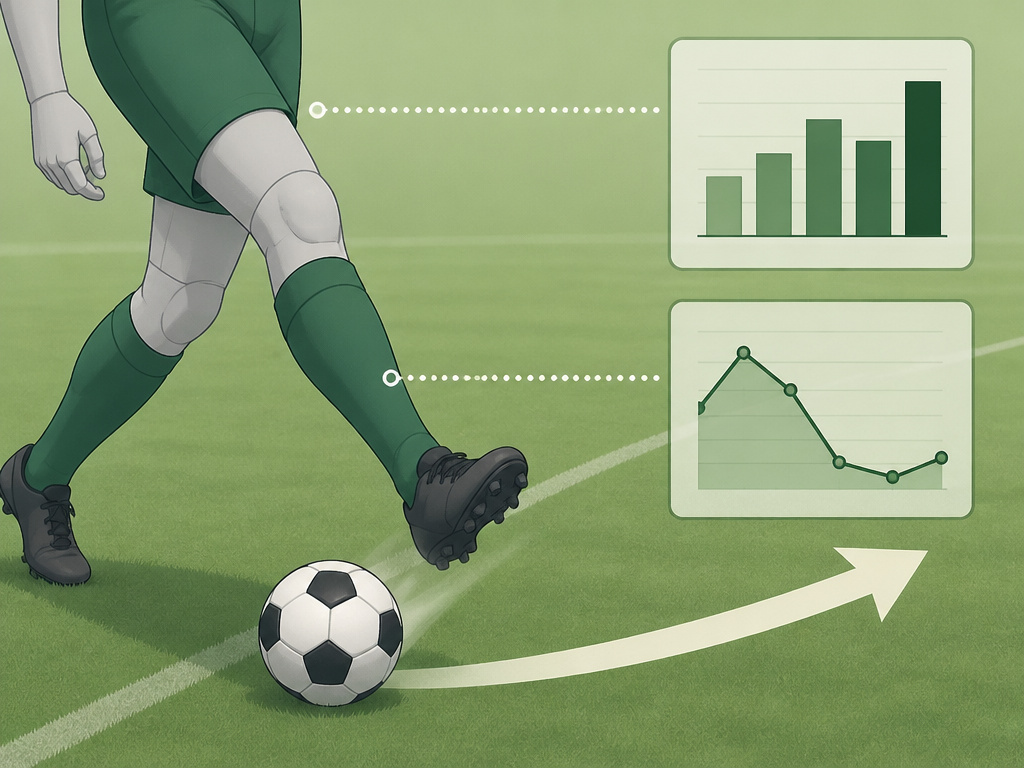
A study on an elite team found that the 4-2-3-1 formation demanded significantly more decelerations in the 2–4 m·s² range for all players.
A systematic scoping review found that sprint distance was higher in external midfielders versus all other positions. Central midfielders, the category encompassing most number 10s, perform more passes than external midfielders and forwards.
A 2022 PMC study on positional role vs individuality dug into the technical side. It found that a player’s positional role could explain 27–44% of the variance in dribbles, medium passes, and long passes. For short passes and ball possessions, however, the role only explained 3–6% of the variance. The takeaway? The basics of keeping the ball are down to individual skill, but the type of creative, penetrative actions we associate with a number 10 are heavily shaped by where the coach tells you to stand.
What Makes a Good Number 10? Key Skills and Attributes
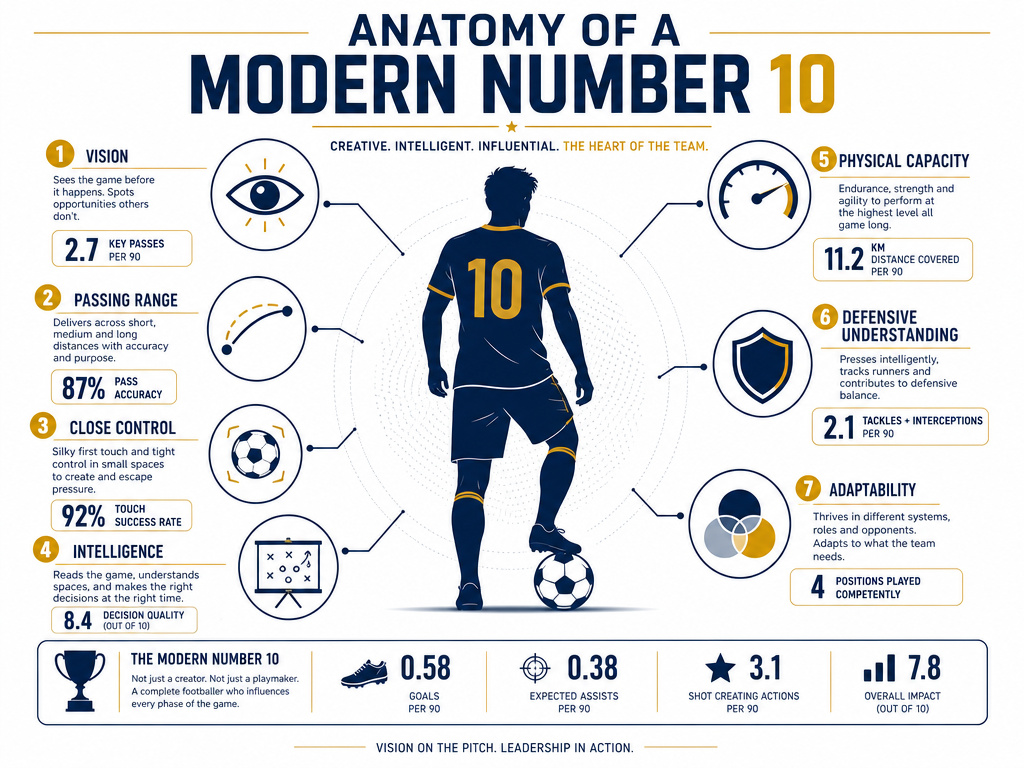
If you’re building a playmaker, either as a coach or in your own game, the checklist has expanded. The non-negotiables remain.
- Vision and Scanning: The ability to receive the ball on the half-turn, with a picture of the options already formed. This isn’t magic; it’s a habit built from thousands of repetitions and film study.
- Passing Range: It requires the weight and timing of a 10-yard pass into a striker’s feet, not only the Hollywood ball. The attacking midfielder is judged on assists, but the best ones are judged on possession.
- Close Control and Dribbling: The first touch must kill the ball dead in traffic. Dribbling is less about beating three men and more about shifting the ball two yards to open a passing lane.
- Tactical Intelligence: Understanding when to drop deep to help build-up (like a second striker might) and when to push forward to become a goal threat. Knowing the difference between a false nine and a target man, and how to play off each.
The modern additions are just as critical:
- Physical Capacity: As the data shows, you need to be able to run. High-intensity output is essential. A player who fades after 70 minutes is a liability.
- Defensive Understanding: Knowing your pressing triggers, your cover shadows, and how to delay counter-attacks. This isn’t about tackles won; it’s about positioning that forces the opponent into a mistake.
- Adaptability: The best modern playmakers can play in multiple roles. Is the game stretched? Play as a traditional 10. Is it blocked? Drift wide like an inside forward or drop next to the defensive midfielder to dictate from deep.
The one skill that bridges both eras is mental resilience. The number 10 shirt carries a weight of expectation. Every misplaced pass is a groan. That pressure is a unique part of the job description.
Variations and Evolution: The Number 10 Isn’t One Role Anymore
The beauty, and the confusion, of modern football is the blurring of lines. The number 10 is now a family of related roles, all carrying the same creative mandate but starting from different points on the pitch.
- The False 10 / Deep-Lying Forward: Think Lionel Messi at Barcelona under Guardiola, or Thomas Müller. They start high but drop deep, dragging centre-backs out of position and creating chaos. This role merges the false nine with traditional playmaking.
- The Wide Playmaker: A player like Bernardo Silva or a younger David Silva. They nominally start on the wing but constantly drift inside into the half-spaces to receive the ball, overloading the central areas and creating from wide-central zones.
- The Box-to-Box Playmaker: The Jude Bellingham model. They have the license and the engine to influence the game in both penalty areas, arriving late as a goal threat while still being the primary creative outlet.
- The Regista (Deep-Lying Playmaker): Andrea Pirlo is the classic example. While traditionally a number 6 or 8, they wear the creative mantle, dictating tempo from in front of the defence. Modern examples like Toni Kroos show how this deep-lying role can be the team’s true number 10 in everything but the shirt number.
This evolution is a direct response to increased defensive organisation. Coaches have fragmented the classic number 10’s duties and spread them across two or three players to make teams less predictable. The history of football tactics is a story of these kinds of adaptations.
Historical origin and evolution of squad numbers
The tradition of numbered shirts in international football began at the 1950 World Cup, with players numbered 1 to 11 based on their position. In that system, the number 10 was assigned to the inside-left forward, the creative playmaker. This fixed numbering created a direct link between a digit and a specific on-field role. Over time, as squad sizes grew and players began to keep their numbers for entire seasons, the system evolved. Numbers drifted from their strict positional origins, becoming more associated with individual players and their legacy, though the iconic status of numbers like 10 remained deeply rooted in that original assignment.
Positional number system across different formations
While the classic 1-11 system was designed for a 2-3-5 formation, modern shapes reinterpret these numbers. In a 4-4-2, the number 10 might be a second striker. In a 4-2-3-1, it typically belongs to the central attacking midfielder operating behind the lone forward. A 4-3-3 often has no dedicated ’10’, distributing creative duties among three midfielders or inside-drifting wingers. The physical and technical demands shift with the shape. For instance, a central midfielder in a 4-2-3-1 may cover significant high-speed distance and perform more passes than a forward, showing how the same number can imply different workloads based on the team’s structure.
General explanation of football position numbers
Football position numbers originated as a simple way to identify player roles on the field, from goalkeeper (1) to striker (11). These numbers correspond to general zones of responsibility and typical playing styles. For example, central midfielders and defenders are generally involved in more passing sequences, while external midfielders cover greater sprint distances. A player’s positional role is a key factor in their technical output, influencing everything from short passes to dribblings. While modern squad numbers are often personal, the traditional system provides a foundational language for understanding a player’s primary function and expected contributions within the team’s tactical plan.
Frequently Asked Questions
What position is number 10 in football?
The number 10 is traditionally an attacking midfielder or playmaker, operating in the central space behind the main striker, often called “the hole.” While modern shirt numbers are not strictly tied to positions, the number 10 retains this strong association with creativity and attack.
Is the classic number 10 role outdated?
The pure classic number 10, with zero defensive duties, is largely outdated at the elite level due to the high physical and tactical demands of modern pressing systems. However, the core creative function of the role is more alive than ever, distributed across various hybrid positions like the false nine, wide playmaker, or box-to-box midfielder.
What’s the difference between a number 10 and a number 8?
Number 10 is primarily an attacker and creator, focused on the final third. A number 8 is a central midfielder with more balanced responsibilities, contributing significantly to both defence and attack, often covering more ground. In modern systems, the roles can blur, with many number 8s (like Jude Bellingham) taking on number 10-like creative duties.
Who are the best number 10s in football history?
Historical legends include Pelé, Diego Maradona, Michel Platini, and Zinedine Zidane. In the modern era, Lionel Messi (though he evolved beyond it), Kevin De Bruyne, and Luka Modrić are considered the pinnacle of the role’s contemporary evolution.
Can a winger or striker wear the number 10?
Absolutely. Shirt numbers are now largely personal choices. Wingers like Eden Hazard or strikers like Harry Kane have worn the number 10, symbolizing their status as the team’s primary attacking focus rather than a strict adherence to the old positional system.
Before You Go
The conversation about the number 10 always circles back to a single tension: artistry versus efficiency. The history of the role is a slow victory for efficiency, but artistry keeps finding a way.
The data from that systematic scoping review on playing position is the final word for any coach: your playmaker must be an athlete. But the intangible, the vision, the weight of pass, the calm in the chaos, that’s what separates a midfielder from a legendary number 10. The shirt is about how you make people feel when you do it.
So the next time you watch a match, don’t just look for the player with the number 10 on their back. Look for the player doing the job: the one constantly finding the space between the lines, taking the ball on the turn, and playing the pass before the assist. They’re the real number 10, no matter what number they wear. And that, more than any historical system, is what defines the role today.
