
Attacking Midfielder Role in Football: What Is Their Job?
This post contains affiliate links. As an Amazon Associate, we earn from qualifying purchases.
An attacking midfielder is a creative fulcrum positioned between the midfield and the forward line. Their primary job is to receive the ball in the space “between the lines” of the opposition, turn, and create goal-scoring chances with passes or shots. In the modern game, many systems demand they also press, defend, and contribute significantly without the ball, evolving far beyond the classic “luxury” number 10, though sources disagree on the universality of this defensive requirement.
That evolution from a pure creator to a hybrid athlete changes everything about who can play the attacking midfielder role in football, how they train, and which teams can afford them. The romantic image of a player who floats around, only creating, has been replaced by a reality of specific, measurable demands.
What follows is a breakdown of what the attacking midfielder role in football actually entails now: the specific skills it demands, the specialized variants like the shadow striker, the physical data that proves the workload, and the hard tactical decisions a modern attacking midfielder must make in every game.
Key Takeaways
- The core job is to operate between the lines, creating chances via passes like through balls or scoring from distance.
- Many modern systems demand pressing and defensive work, making the pure, stationary creator rarer at the top level, though sources disagree on the extent to which defensive work is a universal requirement for all attacking midfielders.
- A Premier League study found players performed the equivalent of 726 ± 203 turns per match, highlighting the agility and balance required.
- The role has specialist variants, like the goal-scoring Shadow Striker or the roaming Trequartista, each suited to different team needs.
- Success depends less on a single skill and more on linking technical ability with high-intensity physical output.
What Does an Attacking Midfielder Do?
At its simplest, the attacking midfielder role in football is the link. They receive passes from deeper midfielders in the pocket of space between the opposition’s defensive and midfield lines, turn, and face the goal. From there, their job splits.
First, they are creators. They look to play the decisive pass, a through ball splitting the centre-backs, a slipped pass into a winger’s run, or a cross from an inside position. According to the Guide to Football, this requires vision to see passes others don’t, close control to receive under pressure, and awareness to know where everyone is before the ball arrives.
Second, they are scorers. When a passing lane is blocked, they become a direct threat, shooting from the edge of the area or arriving late into the box to finish a move. This dual threat, passing and shooting, is what separates them from a pure striker or a deeper-lying midfielder.
Before you start: Misunderstanding this role as purely offensive is the fastest way to misuse a player. The modern attacking midfielder must also press triggers, block passing lanes, and maintain compact defensive distances. Ignoring these duties leaves a gaping hole in your team’s defensive shape.
Their movement is constant. They drop deep to collect the ball, drift wide into the half-spaces to combine with a full-back, or push beyond the striker to create an overload. This isn’t random wandering; it’s a calculated search for space where they can receive the ball facing forward, which is the single most valuable position on the pitch.
The Essential Toolkit: Skills Backed by Data
Listing “good passing” as a required skill is true but useless. The why-layer matters. Why is short passing so critical? Because the space they operate in is congested; a misplaced five-yard pass turns possession over in the most dangerous area of the pitch.
A multivariate analysis study published on Exa.ai identified the most relevant attributes for a central attacking midfielder through statistical analysis. The Principal Component Analysis (PCA) pinpointed short passing, long passing, vision, composure, and ball control as the key qualities.
This is a data-driven profile, not a coach’s opinion. The study’s Canonical Correlation Analysis (CCA) further suggested that attributes like dribbling, agility, and composure significantly influence on-pitch performance metrics like crossing and finishing.
Let’s translate those stats into what you see on the pitch:
- Vision and Composure allow a player like Kevin De Bruyne to lift his head amid three charging defenders and dink a 40-yard pass onto a winger’s foot.
- Ball Control and Close Control let a player like Bernardo Silva receive a fizzed pass with his back to goal, spin his marker with one touch, and suddenly be driving at a retreating backline.
- Short and Long Passing are the tools. The former keeps possession ticking in tight areas; the latter changes the point of attack and breaks defensive lines in an instant.
The physical side is just as specific. It’s not about marathon stamina but repeatable explosive actions. The Bench View Soccer notes the need for agility, balance, and short-burst acceleration to evade markers. Stamina is about recovering quickly between those high-intensity efforts, sprinting to press, then jogging back into shape, over and over.
| Skill Category | Specific Attribute | Why It Matters for an AM |
|---|---|---|
| Technical | First Touch, Ball Control | Receiving under pressure in crowded space is non-negotiable. |
| Cognitive | Vision, Awareness, Composure | Decision-making speed dictates the speed of the entire attack. |
| Physical | Agility, Short-Burst Acceleration, Balance | Needed to turn quickly and exploit tiny pockets of space. |
| Tactical | Positioning, Pressing Intelligence | Knowing when to drop or push to unbalance the opponent’s structure. |
Specialist Roles: From Playmaker to Runner
Not all attacking midfielders are the same. Over time, different football cultures have created specialized variants to solve specific tactical problems. Calling someone a “number 10” today is almost meaningless without specifying which type.
The Advanced Playmaker is the classic creator, most associated with the 4-2-3-1 formation. They operate as the central hub in that “3,” looking to receive between the lines and play the final pass. They have some defensive duties, but creating is their primary function.
The Trequartista is a more romantic, roaming version of the playmaker. Originating in Italy, the name means “three-quarters,” referring to the attacking zone they occupy. They have even more freedom to drift and significantly fewer defensive responsibilities. A team must be structured to carry this luxury.
The Enganche (Argentine for “hook”) is a fixed creative pivot. The team’s entire attacking structure is built to funnel the ball to this stationary player, who then turns and distributes. It’s an old-fashioned role that’s rare in modern high-pressing football, as it essentially plays with ten outfield players defensively.
Then you have the runners, whose main contribution isn’t a pass.
The Shadow Striker is a goal-scorer. They start in the number 10 position but their key movements are runs beyond the striker into the box. Think of a player like Thomas Müller, whose genius is less about a perfect through ball and more about arriving in the penalty area at the perfect moment. This role blurs the line with the second striker role.
The False Ten is a newer, more disruptive concept. This player starts in the number 10 zone but deliberately moves away from it, dropping deep like a false nine or pulling wide. The goal is to drag a marker out of position and create chaos for others to exploit. It’s a role built for movement rather than stationery creation.
Where this goes sideways: Picking a Trequartista for a high-pressing team. The freedom is a trade-off. If the rest of the midfield can’t cover the defensive gap, the team’s press is broken before it starts, and you’ll concede through the center within twenty minutes.
Choosing the right variant comes down to one question: do you need a creator or a runner? Is your team built to give one player the ball and let them orchestrate, or is your creativity spread out, requiring a midfielder who attacks space and finishes moves?
The Modern Attacking Midfielder is a Runner and a Fighter
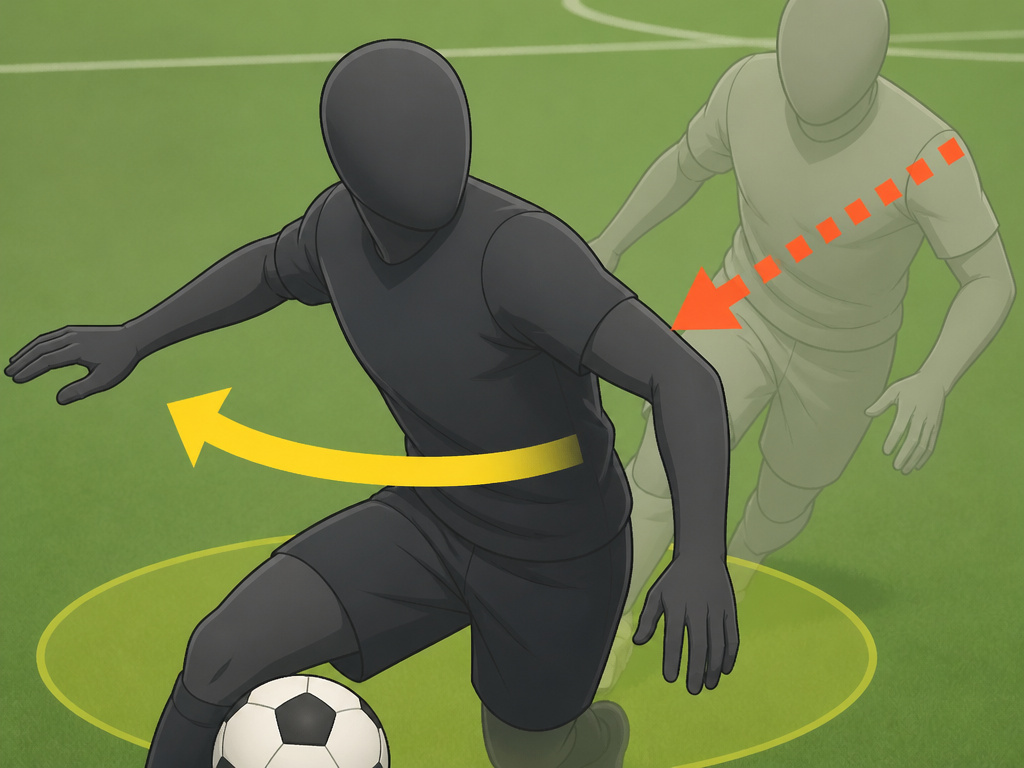
The historical debate is settled. The Tactalyse E-book states it plainly: the modern number 10 “must balance artistry and work rate and is no longer a luxury player who avoids defensive duties.” This is the single biggest shift in the role over the last 15 years.
High-pressing systems dominate elite football. Every player must contribute to the defensive phase. For an attacking midfielder, this means understanding pressing triggers, a bad touch by an opponent centre-back, a backwards pass, and leading the charge to win the ball high up the pitch. Out of possession, they are responsible for blocking direct passes into the opposition’s holding midfielder and maintaining a compact distance to their own midfield line.
This physical demand is quantified. A Premier League time-motion analysis study published on PMC provides hard numbers. It found players performed the equivalent of 726 ± 203 turns during a match, with 609 ± 193 of those being turns of 0° to 90°.
The same study noted players spent 40.6 ± 10.0% of match time in “Purposeful Movement,” a measure of active play. You can’t coach this into a player who doesn’t have the engine for it.
| Tactical System | Primary AM Duty | Secondary AM Duty | Physical Emphasis |
|---|---|---|---|
| Possession-Based | Receive between lines, break low block | Quick counter-press after loss | Agile turns, short acceleration |
| Counter-Attacking | Carry ball forward, shoot from distance | Secure initial clearance | Long-distance sprint speed |
| High-Pressing | Trigger press, win ball high | Maintain compact defensive block | High-intensity repeat efforts |
So what does this mean for a player? It means training can’t just be rondos and shooting practice. Conditioning must mimic the game: short, sharp drills with quick turns, followed by a recovery period, then another explosive action. It’s a specific athletic profile, as specialized as a winger’s speed or a striker’s leap.
Common Mistakes and How to Correct Them
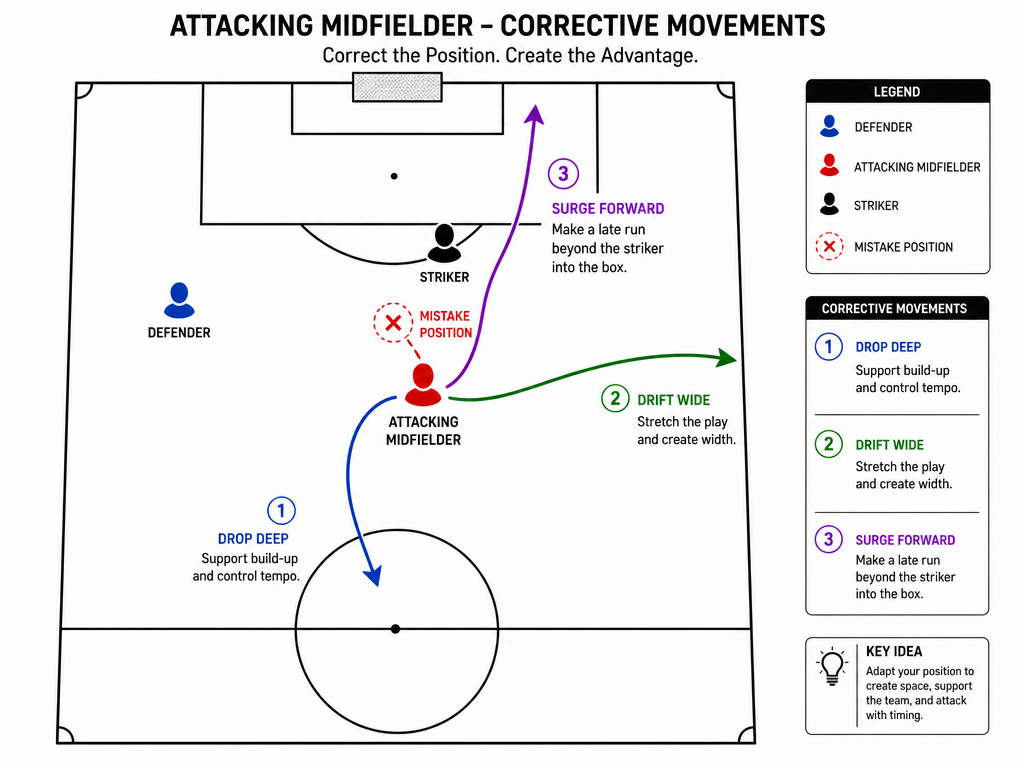
Watching youth or amateur football, you see the same errors crop up. They’re understandable, the role is glorified as pure creativity, but they kill a team’s structure.
Mistake 1: Staying Static. The young player who gets the “number 10” shirt and plants themselves straight behind the striker, waiting for the ball. They become easy to mark. The fix is constant movement: drop deep to drag a centre-back out, drift wide to link with the winger, or make a late run so the holding midfielder has to track you.
Mistake 2: Always Going for the Hollywood Pass. The desire to play the perfect through ball every time leads to constant turnovers. The fix is understanding possession value. A simple five-yard pass to a nearby mezzala might be the move that actually breaks down the defence two passes later. Composure is knowing when to be safe.
Mistake 3: Neglecting the Defensive Shift. This is the most costly error. When the team loses the ball, the attacking midfielder who trots back creates a massive gap between the lines. The fix is a mentality shift: see defending as the first step in creating your next chance. Winning the ball high up is the best assist you’ll ever give.
A reader who had only followed football for a season once sent me a brilliantly simple breakdown of how a back three moves. It surprised me. I’d been writing for years assuming newer fans only wanted to know about famous players and goals. It taught me that the tactical curiosity is there from the start, people want to know how the game works, not just who won. The attacking midfielder’s role is a perfect entry point for that understanding.
How to Train and Develop for the Role
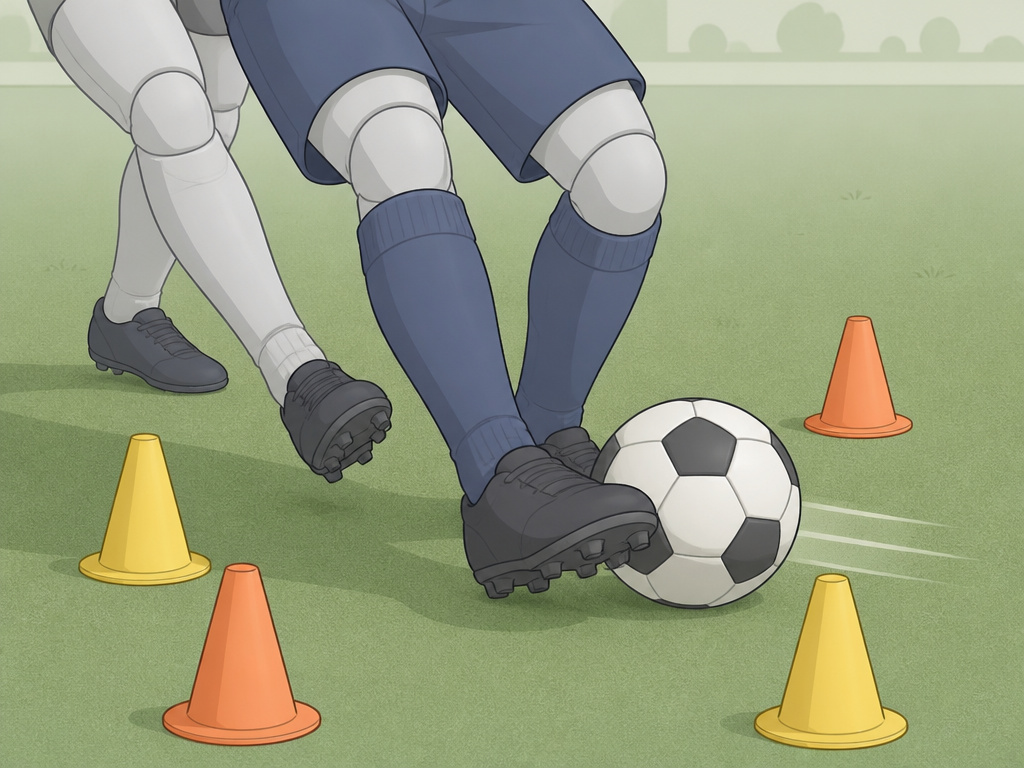
Development starts with acknowledging the twin pillars: technique and tactical brain. You can’t have one without the other.
For technique, focus becomes everything. Don’t just practice passing; practice receiving a ball with a defender at your back, taking a touch to spin, and then passing. Use drills that force you to play with one or two touches in a tight grid. Shooting practice should be on the turn or from a lay-off, not a stationary ball.
For the tactical brain, watch games with a specific focus. Follow one attacking midfielder for the full 90 minutes. Note where they move when their team has the ball, and more importantly, where they go when they lose it. This kind of focused film study is worth more than any generic tutorial.
Physical conditioning should mirror the PMC study on Premier League physical demands. Build workouts around change-of-direction drills, not long runs. Agility ladders, cone drills for sharp turns, and interval training that mimics the stop-start nature of a match are key.
The part nobody mentions: The mental load. An attacking midfielder is constantly making decisions, dribble or pass? Shoot or cross? Press or hold position? This decision fatigue is real. Training under fatigue, when you’re tired in the last 20 minutes of a session, is when you build the mental stamina to make the right call.
Finally, play different roles. Spend some time in the defensive midfielder role to understand the protection you need behind you. Play as a winger to appreciate the runs you should be seeing. The best attacking midfielders understand the entire pitch, not just their own zone.
Who are the most famous attacking midfielders?
While the fact sheet does not list specific player names, it provides a clear framework for identifying the archetypes. Historically, the pure number 10 was a creator first and a goalscorer second, operating as a stationary creative pivot with minimal defensive duties. In the modern game, this pure role is rarer, as players are now expected to balance artistry with work rate, contributing to pressing and defensive shape. Current top players in this position exemplify the key attributes highlighted by analysis: short and long passing, vision, composure, ball control, and the agility to turn quickly under pressure. They operate as the creative fulcrum in formations like the 4-2-3-1, but must also excel in crucial game situations like link-up play and receiving under pressure to progress the ball.
Frequently Asked Questions
What is the difference between an attacking midfielder and a central midfielder?
Central midfielder, including one in the box-to-box midfielder role, typically operates in deeper areas with a balance of defensive and attacking duties. An attacking midfielder is positioned higher, primarily in the final third, with a focus on creation and scoring. Their defensive work is more about pressing than tackling.
Is the classic number 10 role dead?
No, but it has evolved. The pure, stationary creator with no defensive duties is incredibly rare at the elite level. However, the creative function of the number 10 is alive in players who now blend that artistry with high work rate, often playing slightly deeper as an advanced playmaker with defensive responsibilities.
What is the best formation for an attacking midfielder?
The 4-2-3-1 formation is the most natural home, providing a dedicated “10” slot behind the striker. Some versions of 4-3-3 also accommodate one by pushing a central midfielder higher, though the creative duties are often shared more with the wingers in that system.
Can a team play without an attacking midfielder?
Absolutely. Many top teams redistribute the creative duties among other positions, using inverted wingers, advanced players in the mezzala role, or a creative deep-lying playmaker role. This approach can make a team less predictable and more solid defensively.
What is the most important skill for an attacking midfielder?
If forced to pick one, it’s vision, the ability to see and execute a pass that others don’t. However, vision is useless without the close control to receive the ball in tight spaces and the composure to pick the pass under pressure. It’s the combination that matters.
The Bottom Line
The modern attacking midfielder is defined by a problem-solving function. They are the player who connects the midfield to the attack, either by carving the final pass or by making the decisive run. The data is clear: this requires a hybrid athlete, capable of sublime technical skill packaged inside a relentless, high-intensity engine.
The romantic, untouchable number 10 belongs to history. Today’s version is a pressing trigger, a chance creator, and a goal threat rolled into one. For any player aspiring to the role, the path is twofold: hone the technical gifts until they’re automatic, and then build the physical and tactical capacity to apply them under the greatest pressure, for ninety minutes, every week. The teams that find players who can do both are the ones that break down defenses.
