
Full Back Role in Football: Data-Driven Demands Explained
This post contains affiliate links. As an Amazon Associate, we earn from qualifying purchases.
In football, the full back is a wide defender whose primary role is to prevent attacks down the flanks and support their own team’s forward play. The modern interpretation demands they cover extreme distances, up to 11,410 meters in UEFA Champions League matches, while also contributing significantly to the attack with crosses and overlaps, making them one of the most physically demanding positions on the pitch.
That number, 11,410 meters, isn’t a ceiling. It’s the upper limit observed in the UEFA Champions League, which is higher than the 10,650 to 10,814 meters they average in top domestic leagues, a range that can also be seen in the demands of the full back role in football.
This guide explains the full back role in football using the numbers that actually define it. We’ll look at the raw physical output required, the specific technical actions they perform, and, most importantly, how a manager’s tactical choice of formation can double or halve a full-back’s job description overnight. The label “full-back” doesn’t describe one job; it describes a dozen, depending on the shape of the team behind them.
Key Takeaways
- Full-backs in the UEFA Champions League cover up to 11,410 meters per match, a significant jump from domestic league averages.
- Their most common high-intensity run is 6–10 meters, a key difference from other positions who typically sprint 1–5 meters.
- Playing in a back-three system (e.g., 3-4-3) demands the highest total and sprint distances from full-backs, while a 4-4-2 asks for the least.
- During periods of extreme pressure, a study found full-backs pass shorter and safer, exhibiting lower long-pass volume and shorter forward pass length, which contradicts the common view that they become more offensive when the game speeds up.
- A study of Spain’s top division found full-backs exceed their worst-case physical scenarios significantly more often than centre-backs, midfielders, and attacking midfielders.
The Raw Numbers: Total Distance Covered
We begin with the most quoted stat: how far they run. The commodity take about the full back role in football is “full-backs run a lot.” The real picture has layers.
In top European domestic leagues, the mean distance for a full-back falls between 10,650 m and 10,814 m per match. Step up to the UEFA Europa League, and that average climbs to 11,063 m. In the UEFA Champions League, it pushes to 11,410 m. This tiered increase, outlined in an analysis of full-back match performance, shows how competition intensity directly translates into physical demand for wide defenders.
The mean distance covered by full-backs is between 10,650 m and 10,814 m in top national European leagues, 11,063 m in the UEFA Europa League, and up to 11,410 m in the UEFA Champions League. This data consolidates findings from multiple peer-reviewed studies tracking elite match performance.
The other critical distance is sprinting. Using a threshold of >23 km/h, full-backs may cover up to 402 meters of pure sprint distance during a match. That’s not just end-to-end gallops. It’s a series of explosive, short bursts to close down a winger, overlap their own teammate, or recover position. You feel those the next day in the hamstrings, not the lungs.
The part nobody mentions: Those averages hide the “worst-case scenario.” Research from Spain’s First Division monitored how often players exceeded 85% of their most demanding 1-minute period. Full-backs hit that red-line threshold significantly more often than centre-backs, midfielders, and attacking midfielders. Their job isn’t about steady output; it’s about surviving repeated, extreme peaks.
Not All Sprints Are Equal: The 6–10 Meter Rule
Here’s where the data gets interesting. If you ask most fans what a high-intensity run looks like, they picture a winger blazing down the touchline for 30 meters. For a full-back, the work is more repetitive and grinding.
A key study published in PLOS One broke down the most common distance covered in high-intensity runs (≥19.8 km/h) by position. For central defenders, central midfielders, wide midfielders, and forwards, the answer was 1–5 meters. For full-backs, it was 6–10 meters.
| Playing Position | Most Common High-Intensity Run Distance (≥19.8 km/h) |
|---|---|
| Central Back | 1–5 m |
| Central Midfielder | 1–5 m |
| Wide Midfielder | 1–5 m |
| Forward | 1–5 m |
| Full-Back | 6–10 m |
That 6–10 meter band is the sweet spot for the actions that define their game: quickly closing down a receiver, accelerating to support an overlap, or shuffling to stay goal-side of a dribbler. It’s a specific, repeatable, and exhausting demand that separates their fitness profile from other positions. This insight comes from a detailed position-specific player load study of a professional club.
Furthermore, full-backs perform significantly more turns (>90°) than central defenders. Every time they adjust their body orientation to track a run, change direction to support play, or pivot to switch the point of attack, it adds a hidden load that raw distance doesn’t capture.
The Technical Job Description: Touches, Passes, and Duels
Running is only half the story. What do they do with the ball? The technical profile of a full-back is defined by volume, accuracy, and context.
On average, a full-back will have between 41 and 59 touches of the ball per match. Their passing accuracy is high, ranging from 78% to 81% successful. They also win 54% to 56% of their one-on-one defensive duels. These figures, drawn from the same consolidated research, paint a picture of a reliable, efficient player in possession.
However, the number of passes they make is heavily influenced by team formation. Earlier research by Carling (2011) noted the mean number of passes for a full-back was 53 in a 4-4-2, 54 in a 4-3-3, and 50 in a 4-2-3-1. The differences weren’t massive, but the trend suggests their involvement is a tactical lever a coach can pull.
Where this goes sideways: Assuming a full-back’s main job is to cross. In Spain’s top division, full-backs were found to execute the highest number of passes and crosses in the attacking third compared to other leagues. But they also performed the lowest number of passes in midfield and defensive zones. Their technical role is hyper-specialised by league and tactic, not universal.
During the most intense periods of a match, their technical role shifts. A 2026 study in Frontiers in Physiology found that during “extremely demanding passages” of play, full-backs exhibited lower long-pass volume and shorter forward pass length. Under the greatest physical stress, their instinct isn’t to be a playmaker; it’s to be a safe, short outlet to relieve pressure. This directly contradicts the common view that they become more offensive when the game speeds up.
Tactical Shape Dictates Everything
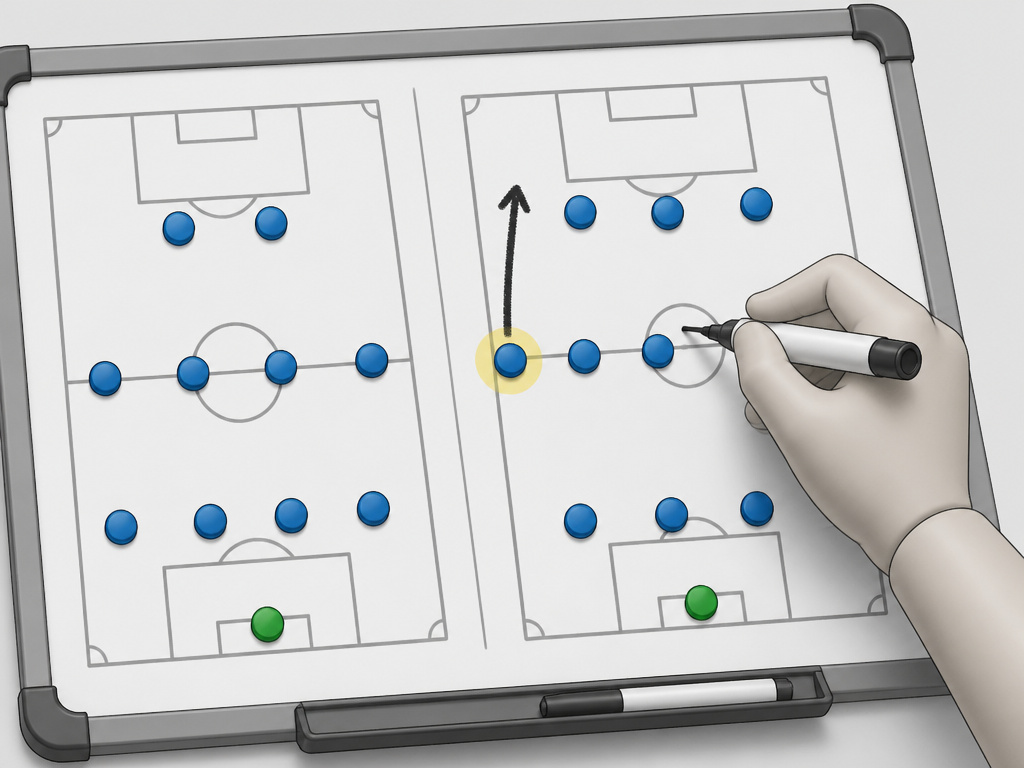
This is the single biggest factor that most overviews miss: a full-back’s physical and technical output is not fixed. It is almost entirely dictated by the formation their team uses. You cannot understand the role without understanding the shape behind it.
Research from the German Bundesliga provides the clearest evidence. It found that the degree to which formation affects performance is position-dependent, and full-backs are among the most sensitive. Their physical output varies wildly.
| Formation | Full-Back Physical Demand | Primary Reason |
|---|---|---|
| 3-4-3 / 3-5-2 | Highest total, high-intensity, and sprint distances | Less defensive cover from a back-three allows/requires wing-backs to attack more. |
| 4-4-2 / 4-5-1 | Lowest running outputs | More structured, flat defensive block requires less adventurous wing play. |
| 4-2-3-1 / 4-3-3 | Moderate to high demands | Balanced system that asks for both defensive solidity and attacking width. |
In a back-three system, the outside centre-backs provide cover, freeing the wing-backs, essentially advanced full-backs, to focus on offensive duties. This leads to their greatest sprinting distances. Conversely, in a 4-4-2, the wide midfielder shares the flank responsibility, and the full-back’s primary duty is to hold a defensive line, resulting in their lowest running outputs.
The effect sizes in the Bundesliga study ranged from 0.13 to 1.27, which in sports science terms means the differences weren’t just noticeable; they were large. Choosing a back three over a back four isn’t just a tactical preference; it’s a different job description for the players on the flanks.
Specific Physical Demands: Acceleration and Deceleration
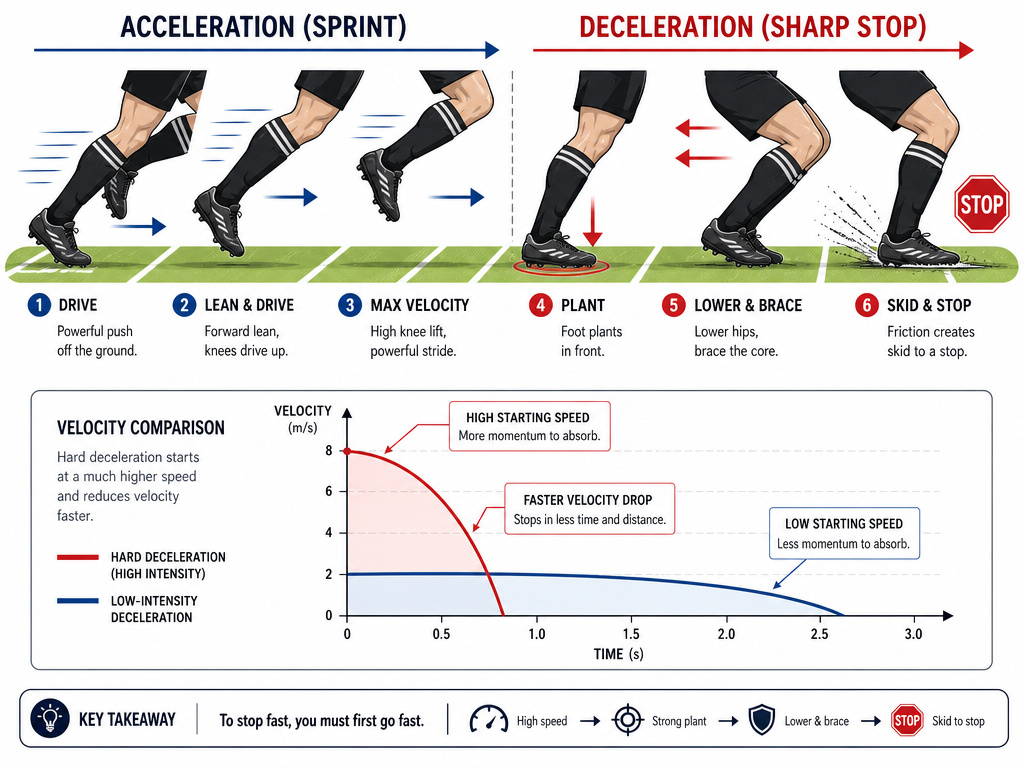
Modern tracking data looks beyond total distance to the explosive actions that cause fatigue. For full-backs, this means a lot of hard stops and fast starts.
A study of a professional LaLiga 123 team dug into acceleration and deceleration profiles. It found that full-backs performed high-intensity decelerations at a significantly higher starting velocity (V₀) than they did for low-intensity decelerations. The difference was 3.9 ± 0.4 km/h. What does that mean practically?
It means when a full-back decelerates hard, they’re doing it from a near-sprint. They’re not just jogging to a stop; they’re sprinting to close a gap, then slamming the brakes to avoid overrunning the opponent or the ball. This specific acceleration profiles by position research highlights a unique and punishing aspect of their game.
It’s a different kind of fatigue, one that punishes the muscles and joints as much as the cardiovascular system.
This demand for explosive change is also why principles like defensive cover and compactness are so vital.
Evolution and Modern Variations
The full-back role has evolved from a purely defensive figure to a multifaceted tactical weapon. This has given rise to specific sub-types, each with a slightly different emphasis.
- The Traditional Full-Back: Prioritises defensive solidity. Their starting position is deeper, overlaps are selective, and their primary focus is on winning a defensive duel. They are common in a 4-4-2 or systems that value a flat back four.
- The Wing-Back: Essentially a winger in a defensive starting position. Used predominantly in back-three systems (3-4-3, 3-5-2), their defensive responsibilities are lighter due to the back-three cover, allowing them to be a primary attacking outlet. You can read more about the wing-back role in our dedicated guide.
- The Inverted Full-Back: A modern twist where the full-back, often on the side of the team’s dominant midfielder, moves into central midfield areas during possession. This creates numerical overloads in the centre and allows midfielders to push higher. We explore the nuances of the inverted full-back separately.
The choice between these types isn’t just about the player’s skills; it’s a core tactical decision that shapes the team’s entire approach to build-up play and chance creation.
Key Skills and Attributes Needed
Based on the data, a modern full-back requires a distinct blend of physical and technical qualities.
- Elite Repeated-Sprint Ability. They must produce those 6–10 meter high-intensity runs dozens of times a game, with short recoveries.
- Strong Acceleration and Deceleration Force. The power to change speed rapidly is essential, as the LaLiga deceleration study proves.
- Situational Defensive Intelligence. Knowing when to engage and when to jockey, guided by the team’s defensive concepts of cover and balance, is more valuable than pure tackling aggression.
- High-Pressure Passing Competence. The ability to play accurate, forward-thinking passes under intense opposition pressure, especially during those “extremely demanding passages” identified in research.
- Tactical Flexibility. They must understand and execute different roles, holding a line, overlapping, inverting, sometimes within the same game, depending on the phase of play and the team’s shape.
A player strong in only one or two of these areas will be exposed. The modern role demands the complete package.
Frequently Asked Questions
What’s the difference between a full-back and a wing-back?
Full-back is typically part of a back-four defensive line, with balanced defensive and attacking duties. A wing-back plays in a system with three central defenders (a back-three), which provides more defensive cover, allowing them to focus predominantly on attacking as a wide forward. Their physical data shows they cover significantly more high-intensity distance.
Do full-backs need to be good at crossing?
Crossing is a valuable skill, but the data suggests it’s not the universal priority. Technical output varies by league and tactic. In Spain, crossing volume is high. During periods of extreme match pressure, research shows full-backs actually attempt fewer long passes and crosses, opting for safer, shorter distribution. The essential skill is effective passing under pressure.
Which formation is most demanding for a full-back?
Studies from the German Bundesliga show that a back-three system (like 3-4-3 or 3-5-2) is the most physically demanding for full-backs (or wing-backs), requiring the greatest total and sprint distances. The least demanding running outputs are found in traditional 4-4-2 and 4-5-1 formations.
How important is one-on-one defending for a full-back?
Extremely important, but the context matters. Data shows full-backs win between 54% and 56% of their defensive duels. However, the best defenders use positioning and support, employing cover and balance, to avoid isolated situations. Pure one-on-one defending is a last resort, not a primary tactic.
Why are full-backs so important in modern football?
Their positioning on the flanks makes them key to both defensive solidity and attacking width. Data proves they are among the most physically taxed players, covering immense ground and performing more high-intensity actions than most. Tactically, they are versatile pieces that allow managers to shift between systems without substituting, making them invaluable for in-game adaptations.
Before You Go
The biggest mistake is still seeing a full-back as just a defender who sometimes runs forward. The data from UEFA, LaLiga, and the Bundesliga paints a different picture: they are endurance athletes with a specific technical brief, whose entire workload is dictated by the numbers on a tactics board.
If you take one thing, let it be the 6–10 meter rule. It’s the fingerprint of the position, a short, sharp, repeating demand that separates their contribution from a winger’s or a central midfielder’s.
