
Role of the Fourth Official in Football: What They Do
This post contains affiliate links. As an Amazon Associate, we earn from qualifying purchases.
The role of the fourth official in football is to back up the referee from the touchline: running substitutions, checking equipment, handling replacement balls, showing the minimum added time and reporting bad behaviour in the technical areas. Under IFAB Law 6, competition rules decide whether the fourth official or the senior assistant referee replaces an injured referee.
That clause about competition rules matters more than it looks. The Laws hand the biggest moment of a fourth official’s day to each league’s own rulebook. In the Premier League, that has meant the fourth official taking the whistle, sometimes mid-match and sometimes at half-time.
What follows: the duties by phase of the match, the bench rows that ended in bans, the injured-referee cases from 2016 and 2025, and the 2026/27 changes that let competitions put body cameras on fourth officials.
Key Takeaways
- The added-time board shows a minimum, set by the referee, so a half can run longer than the number that goes up.
- Law 6 leaves the injured-referee question open. Competition rules decide whether the fourth official or the senior assistant referee steps in.
- A reserve assistant referee, where one is appointed, can replace the fourth official too.
- Dissent at the fourth official still counts as dissent. Players get a yellow card for protesting at any match official.
- From 2026/27, competitions can let fourth officials wear body cameras, as long as the organiser supplies them and controls the footage.
What Does the Fourth Official Actually Do Before, During and After a Match?
The fourth official’s job splits into three phases, and only the middle one gets TV time. The added-time board is the duty fans argue about most, so start there.
The added-time board shows the shortest stoppage the referee plans to allow. Law 6 tasks the fourth official with indicating the “minimum amount of additional time” the referee intends to play at the end of each half, including extra time. The referee sets the figure and can play longer. At Brentford v Liverpool in October 2025, three minutes went up and nearly five were played.
That word “minimum” in the role of the fourth official in football saves a lot of shouting. I’ve sat next to plenty of fans checking their watches the second the board’s digits flip over. The board is a floor. If a team wastes time inside the added time, the referee simply plays on.
Before Kick-Off
Pre-match work in the role of the fourth official in football is quiet and dull, which is the point. The fourth official checks both technical areas, sets up the replacement balls and sits in on the referee’s briefing. That briefing is where the crew agrees who covers what if someone gets hurt.
During Play
Once the game starts, the fourth official runs substitutions, checks player equipment and manages the board. They also control entry for medical staff and stretcher bearers once the referee waves them on. And they keep records: goals, cautions, sendings-off and every change.
After the Final Whistle
The tunnel is still part of the job. The fourth official watches players and staff leave, acts as a witness to anything that kicks off, and helps with the match report. Some of the nastiest moments in the job’s history happened after the referee’s last whistle, as you’ll see below.
| Phase | Main duties | Who it helps |
|---|---|---|
| Before kick-off | Technical area checks, replacement balls, briefing | Referee and both benches |
| During play | Subs, equipment, added-time board, medics | Referee, players, medical staff |
| Half-time and tunnel | Supervise players and staff walking off | The whole referee team |
| After the whistle | Report incidents, act as witness | Referee and the competition |
The Substitution Routine Behind Every Raised Board
A winger jogs toward the halfway line while his replacement bounces on his toes. Before the board even goes up, the fourth official is crouched by the sub, looking at boots and shin pads.
A mate of mine used to call football dull. He started coming to weekend matches with me, and about two months in he was spotting offside traps before I did. That’s how fast curiosity grows once someone knows where to look. The substitution routine is one of the best places to look, because it follows the same order every time.
- Check the substitute’s equipment. Skip this and a player can come on with the wrong kit or jewellery, and the referee has to stop play later to fix it.
- Show the numbers on the board. A wrong number sends the wrong player trudging off, and the confusion eats time nobody gets back.
- Write down the time and the players. Without a record, nobody can settle a later row over how many changes a team used.
- Wait for the player to leave and the referee to signal. A substitute who runs on early is entering without permission, which hands the referee a caution to deal with.
Replacement balls sit in the same corner of the job. When a ball goes into the stand or bursts, the fourth official makes sure the spare that comes on is one the referee already approved. (In my Sunday-league days the replacement ball was whatever the nearest dad could find in his boot.)
The full order of play for changes, including how many a team can make, lives in the football substitution rules. The fourth official just makes sure each one happens cleanly.
Why Does the Fourth Official Stand Between the Two Technical Areas?
In the 2002-03 season, two of the best-known managers in England were sent to the stands after a fourth official called the referee over. That’s the honest answer to the positioning question. The fourth official stands between the benches so they can hear what each one says.
The 2002-03 Season That Put Managers on Notice
The Reading Referees’ Association covered it in a column at the time. In that year’s law revision, the IFAB only reworded the fourth-official text and added no new duties. The FA, though, highlighted one existing duty: informing the referee of irresponsible behaviour by anyone in the technical area.
Sir Alex Ferguson and Harry Redknapp both went to the stands after being reported. Ferguson said the referee should apologise to him for getting the original decision wrong. Ron Atkinson, by then a TV pundit, asked “What’s wrong with a little bit of Anglo-Saxon”, his phrase for swearing. The column’s writer answered him well: it sounds fine until you’re the one it’s aimed at.
I’d rather see a fourth official call the referee over in the 30th minute than watch a manager stew until the 90th. Every bench row I’ve seen boil over had a quieter, earlier moment where a word from the touchline would have cooled it.
Wenger, Anthony Taylor and the Tunnel
Arsenal beat Burnley 2-1 on 22 January 2017, and the result was the least memorable thing about it. Arsene Wenger was sent off late on after protesting a Burnley penalty. He then stayed in the tunnel and pushed fourth official Anthony Taylor.
The FA said Wenger used abusive or insulting words towards the fourth official. It said staying in the tunnel after his dismissal and making physical contact amounted to improper conduct. He admitted the charge. Wenger’s touchline ban as Arsenal manager ran four matches and came with a fine. Goal reported that the games were the FA Cup tie at Southampton plus league matches against Watford, Chelsea and Hull City.
The timing is a little messy in the record. The FA’s statement places the abusive words “in or around the 92nd minute”. Goal reports the disputed penalty as a 93rd-minute award. Both can be true. I’d still quote the FA’s own wording if you’re settling a pub argument.
What gets reported from the technical area now has firmer rules behind it:
- Swearing or abuse aimed at any match official.
- Team officials leaving the technical area to protest.
- Physical contact of any kind. Wenger proved how far that goes.
- If nobody can identify the offender, the 2019 IFAB AGM agreed that the senior team official gets the card, which is usually the main coach.
Common mistake: Assuming a player can say what they like to the fourth official or an assistant. Law 6 is clear that protesting at any match official earns a yellow card, and the caution comes straight away.
Who Replaces an Injured Referee? Law 6 vs the Premier League
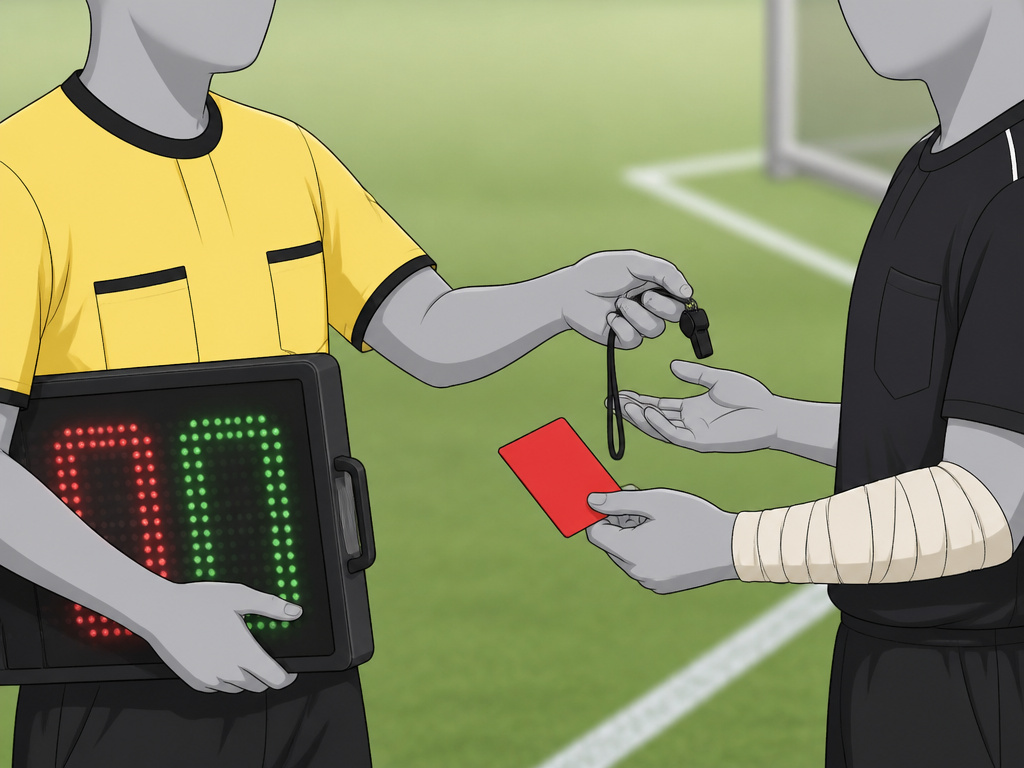
Simon Hooper was booed off the pitch at half-time at Brentford on 25 October 2025. When the second half finally started, some fans booed the man who came out with the whistle too. They hadn’t noticed it was a different referee.
Hooper had been injured in the first half. At half-time he swapped places with fourth official Tim Robinson, and Hooper took over as fourth official. The restart came later than the usual 15-minute break while both men got ready. About 15 minutes into the second half, Robinson gave a penalty for Virgil van Dijk’s foul on Dango Ouattara after a VAR review.
That’s the Premier League way. It isn’t the only way. Law 6 says competition rules must state clearly who takes over, and whether that’s the fourth official or the senior assistant referee. The table below shows where the Law and the match reports line up, and where they don’t.
| Situation | What happened or what’s allowed | Source |
|---|---|---|
| Referee can’t continue (the Law) | Competition picks fourth official or senior assistant | IFAB Law 6 |
| Referee injured, Premier League 2025 | Fourth official Robinson took over at half-time | Sports Illustrated |
| Fourth official can’t continue (the Law) | Reserve assistant referee can step in | IFAB Law 6 |
| Fourth official collapses, 2016 | Spectating non-league referee drafted in | Fox News |
Mid-match swaps hurt more. SuperSport reported that referee David Webb couldn’t continue after treatment for a head injury on his Premier League debut. After a 12-minute delay, fourth official Sam Barrott replaced him. A half-time swap at least hides some of the wait inside the break.
The strangest case went the other way. On 1 March 2016, fourth official Kevin Friend collapsed near the end of the first half at Bournemouth v Southampton and hit his face on a dugout. With no spare official in place, non-league referee Dean Treleaven, who was watching from the crowd, became the new fourth official. The second half started five minutes late.
Easy to miss: If the competition appoints a reserve assistant referee, that official can cover an injured assistant or the fourth official. The “fourth official always steps up” story only holds when the competition rules say so.
The swaps also shuffle the assistant referees in some competitions, since a senior assistant might move to the middle instead. Check the competition’s handbook before assuming anything.
The Zidane Final and the Limits of the Fourth Official’s View
The most famous fourth-official moment of all comes with an awkward detail. Writing for ESPN, Gabriele Marcotti points out that nobody except Gianluigi Buffon saw Zinedine Zidane’s headbutt live. That includes referee Horacio Elizondo and fourth official Luis Medina Cantalejo.
The Zidane Materazzi World Cup final incident in 2006 ended with Zidane sent off. How the information reached Elizondo has been argued over for years, and I’m not going to pretend the record is settled. What’s clear is the job description: the fourth official reports misconduct the referee missed.
That duty used to carry a lot of weight. A caution shown to the wrong player, or a red-card offence behind the referee’s back, needed a human eye on the touchline. Today the VAR officials cover much of that ground. Mistaken identity is one of the categories VAR can review.
David Elleray told the 2019 IFAB AGM that VAR stepped in about once every 3 matches, under a “minimum interference – maximum benefit” approach. My view? VAR earns its keep on factual calls like identity and goal-line questions. It struggles when asked to judge how hard a tackle was. The fourth official still sees things no camera catches, like what a coach shouts with his back to the lens.
If the referee cautions the wrong player, the clock is against everyone. Spot it, say it, and get it fixed before play restarts.
Fourth Official vs VAR vs Assistant Referees: Who Decides What?
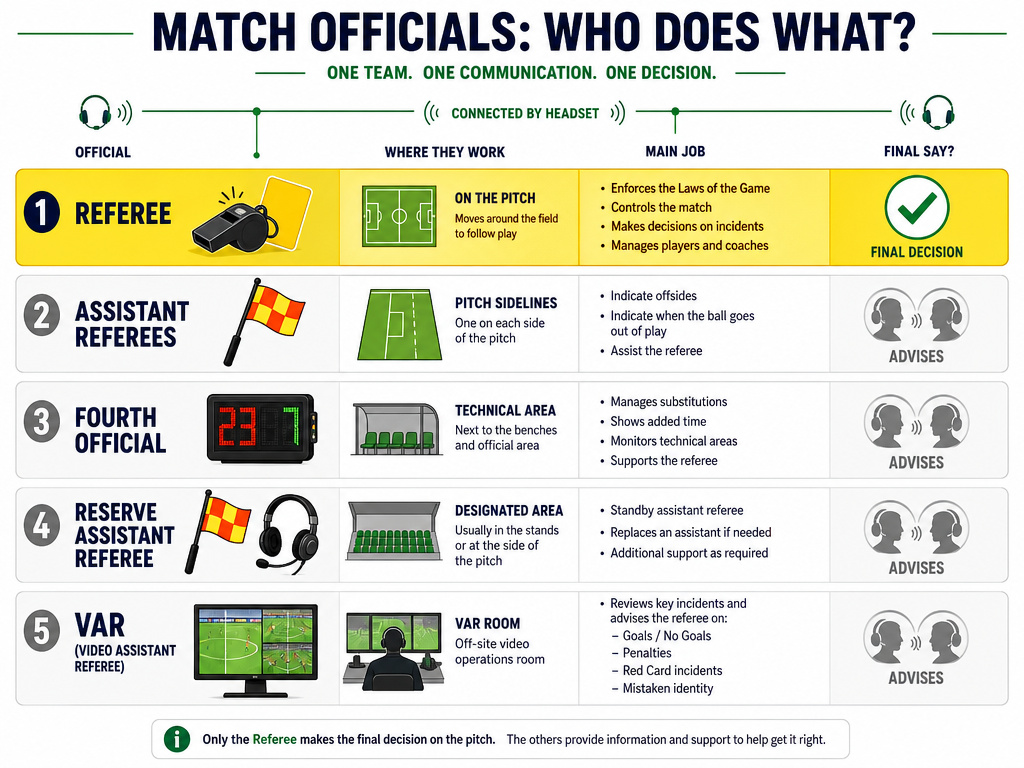
The referee decides. Everyone else advises.
That one line answers the question new fans ask most: can the fourth official overrule or dismiss the referee? No. The fourth official informs, the assistants signal, and the VAR recommends a review. The referee’s call stands until the referee changes it.
| Official | Where they work | Main job | Final say? |
|---|---|---|---|
| Referee | Centre of the pitch | Runs the match | Yes |
| Assistant referees | Touchlines | Offside, ball out of play | No, they signal |
| Fourth official | Between technical areas | Subs, board, benches, standby | No, they inform |
| Reserve assistant referee | Touchline area | Covers an assistant or fourth official | No, they assist |
| VAR | Video room | Five review categories in 2026/27 | No, they recommend |
The VAR row changed recently. In 2026/27 the IFAB added a clearly incorrect second caution to the reviewable red-card incidents, taking the categories from four to five. The fourth official’s list of duties didn’t change.
All of this runs over the headsets used by match officials, so the crew talks constantly. Think of it as joinery. A table holds because the pieces fit together, and no single carved leg gets the credit. The reserve assistant referee sits in that structure too, and the IFAB’s Law 6 FAQ confirms the referee can ask them for advice on an incident they saw more clearly.
From 1995 to Body Cameras: How the Job Has Grown
The Reading Referees’ Association dates the fourth official’s first appearance in the Laws of the Game to 1995. The column’s writer had never held the role, because it didn’t exist during his senior refereeing days. He compared it to being a substitute, waiting for a colleague’s bad day.
The milestones in the sources look like this:
- 1995: the fourth official first appears in the Laws.
- 2003: the IFAB rewords the fourth-official text without adding duties, and the FA leans on the technical-area reporting duty.
- 2019: the 133rd IFAB AGM backs yellow and red cards for team officials after a trial it called successful.
- 28 February 2026: the 140th AGM meets in Hensol, Wales. Trials on Football Video Support, offside and cooling-off periods at lower levels carry on.
- July 2026: the 2026/27 Laws take effect, and the IFAB app carries them from 1 July.
The 2026/27 package has the most direct effect on the fourth official in years. Under the IFAB changes to the Laws of the Game 2026/27, competitions can let referees, assistants and fourth officials use body cameras. The organiser has to supply the cameras and keep full control of the footage. Cameras can carry microphones, but talk with the VAR can’t be broadcast. Authorities can use the sound and footage for disciplinary cases.
Picture what that means for the next Wenger-style tunnel row. The footage exists, and the disciplinary panel can watch it. That’s an option, though, and plenty of competitions won’t take it up.
The Irish FA also flagged a change worth knowing. If a match official or an outside agent interferes with play, the game restarts with a dropped ball where the interference happened. Fourth officials stand close to the action, so that one matters.
You can read the current text of Law 6 on the IFAB Laws of the Game page for the other match officials.
How Do You Become a Fourth Official?
Ever wondered who those men and women in the kit by the halfway line actually are? They’re referees. Nobody trains specifically as a fourth official; it’s an appointment given to qualified referees, and at the top level it rotates among the same group who referee and run the line.
So the path starts where every referee’s does. Your national association runs the courses, and the steps to become a referee are the same whether you end up in the middle or by the benches.
On pay, I’ll be straight with you: none of the sources here publish fees, and they vary by country and level. I’m also thinner on how associations outside Europe handle appointments, so check your own association’s guidance.
One thing I like from the 2019 AGM minutes. The IFAB said cards for team officials helped referees at every level, including young referees dealing with “difficult” adult coaches. Anyone who has refereed a youth game with a shouting parent coach will know exactly what they meant.
Frequently Asked Questions
What are five duties of a fourth official in football?
They run the substitution process, check player and substitute equipment, look after the replacement balls, and show the minimum added time the referee wants. They also tell the referee about irresponsible behaviour in the technical areas. On top of that, they stand by to replace an injured official if the competition rules say so.
How much do 4th officials get paid?
There’s no single figure. Fees are set by the competition or national association and depend on the level of football. The sources behind this guide don’t publish any rates, so your own association is the place to ask.
Can the fourth official dismiss the referee?
No. The fourth official can only inform the referee of what they saw. The referee makes every final decision, including any card shown after a fourth official’s report.
When was the fourth official introduced?
The Reading Referees’ Association records the fourth official first appearing in the Laws of the Game in 1995. The duties have been reworded and added to since, with the 2026/27 body-camera option the newest change.
Is the added-time number on the board exact?
The board shows a minimum. The referee decides how much time to add and can play beyond the figure, which is why a half sometimes runs a minute or two past what went up.
Before You Go
Here’s a first step for your next match, live or on TV. Spend one substitution watching only the fourth official. Watch the equipment check, the board, and the note they write down. You’ll see the whole routine in under a minute.
One honest limit on all of this. The injured-referee rules depend on the competition, so what you saw at Brentford in 2025 won’t match every league. Check the competition’s own handbook before you call anything a mistake.
And if body cameras catch on, the fourth official’s word in a tunnel row might soon carry footage behind it.
Would Wenger have stayed in that tunnel if he’d known a camera was running?
