
Drop Ball Rule in Football Explained: The 4-Metre Gap
This post contains affiliate links. As an Amazon Associate, we earn from qualifying purchases.
Here’s the drop ball rule in football explained: when play stops and no other restart fits, the referee drops the ball for one player. In the penalty area it goes to the defending goalkeeper; elsewhere, to the team that had or would have won possession. It’s live on touching the ground, and no goal counts until two players touch it.
That phrase “would have won possession” is the newest part of the drop ball rule in football explained here. IFAB approved it as a clarification at its 140th AGM on 28 February 2026, so older guides still describe the previous wording. US high school games under NFHS rules run on a different version again.
What follows: who gets the ball and where, the bounce-and-redrop procedure, the two-player scoring rule, what happens when the ball hits the referee, and three real matches where a drop ball went wrong.
Key Takeaways
- Under IFAB, opponents stay 4 m (4.5 yds) away until the ball touches the ground. After that, anyone can play it.
- The player who receives the drop gets unlimited touches, but can’t score until another player has touched the ball.
- In the penalty area the drop goes to the defending goalkeeper, who doesn’t have to play it and is allowed to pick it up once it has landed.
- A ball that hits the referee and then leaves the field is restarted as normal: throw-in, goal kick or corner, never a drop.
- US high school games follow NFHS Rule 9-2-3, which gives the ball to the team that last possessed it.
What Is a Dropped Ball, and When Does the Referee Use One?
IFAB Law 8 treats the dropped ball as the restart for stoppages that no free kick, throw-in or goal can settle. It’s the referee’s reset button.
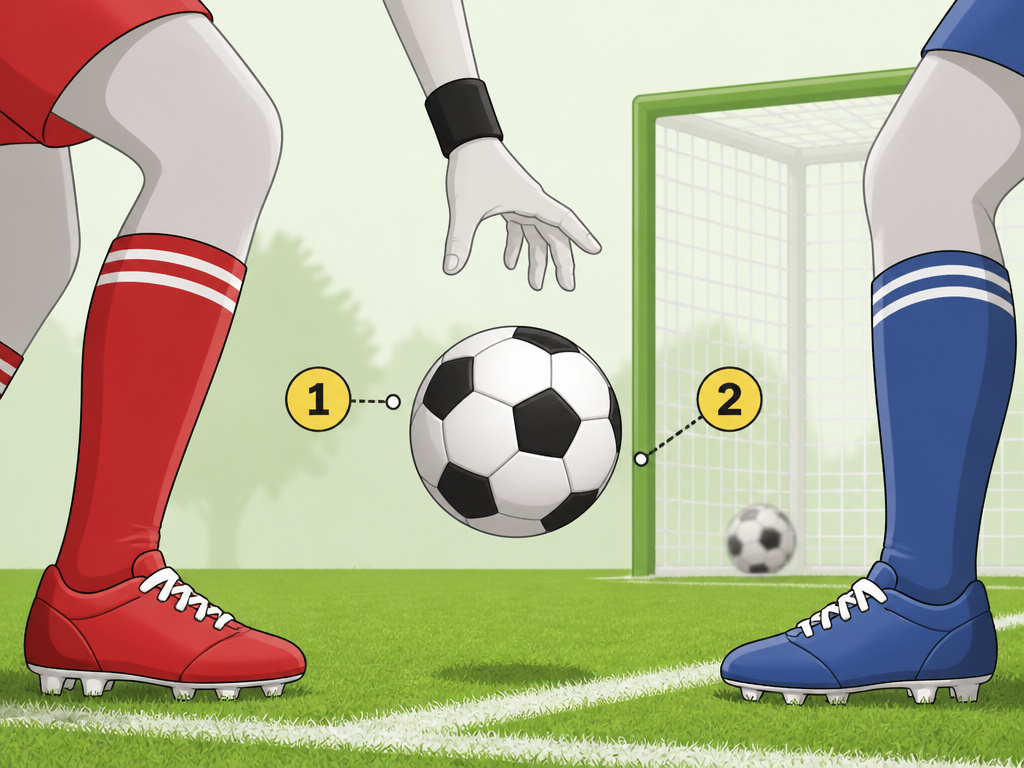
A dropped ball is the restart used when the referee stops play and no free kick, ball out of play, or goal decides the restart. Under IFAB Law 8, the referee drops the ball for one player, all other players stay at least 4 m (4.5 yds) away, and the ball is in play once it touches the ground.
It sits inside Law 8 of the Laws of the Game, next to the kick-off. The IFAB FAQs list a surprising range of triggers:
- A serious injury with no offence behind it.
- The ball bursting, which means the referee swaps it and then drops the new one.
- An outside agent getting involved. A ball boy catching a ball that’s still on the field counts, and so does a spectator’s bottle thrown at a player running with the ball.
- An accidental whistle.
- The ball touching a match official, staying on the field, and changing the game (more on that below).
- Off-field offences with no valid free kick, such as a substitute striking a team-mate outside the field.
The accidental whistle is my favourite. A stray blast mid-attack and every player stops dead, the ball trickling on through the sudden quiet while twenty-odd heads turn toward the referee.
Honestly, the off-field cases are the ones that baffle grassroots players most. The IFAB’s Law 8 on the start and restart of play explains why: a free kick only goes for an offence against an opponent or a match official. Hit a photographer or a ball boy and the referee can send you off, but the restart is still a drop.
Who Gets the Ball, and Where Is It Dropped?
On 2 March 2024, referee Paul Tierney stopped Liverpool v Nottingham Forest for a possible head injury. He dropped the ball to Liverpool’s goalkeeper inside the penalty area. Liverpool scored about 1 min 50 s later.
Dermot Gallagher, on Sky Sports’ Ref Watch, said the drop should have gone to Forest outside the box. He also said VAR couldn’t step in, because the goal didn’t come directly from the restart. Wrong team, wrong spot, and the goal stood.
That’s the cost of getting this bit wrong. Two questions decide every drop: which team, and which spot.
Where this goes sideways: Using the old “last touched” wording as the default. Since IFAB’s 2026 clarification, the last touch only decides the restart when the referee can’t tell who would have kept or won the ball.
Inside the penalty area
If the ball was inside the penalty area when play stopped, IFAB says the referee drops it for the defending team’s goalkeeper. It doesn’t matter which side had it. A ball that bursts in the goal area goes to the keeper too, because the goal area sits inside the penalty area.
The keeper doesn’t have to play it, either. The IFAB FAQ covers a keeper who leaves the ball for a team-mate who’d stayed 4 m away. Play on.
Outside the penalty area
Out here, the ball goes to one player of the team that “has, or would have, retained or gained possession.” That includes possession from a restart. IFAB’s own example: a ball boy catches a ball that’s rolling out for a throw-in, so the drop goes to the team that would have taken it.
Position follows a simple rule. The ball is dropped where it was when play stopped, unless it hit a match official or an outside agent. Then it’s dropped at the point of contact.
The dating of this change trips some coaches up. A grassroots referee video I came across labels it a 25/26 change. Years ago I passed on a football story with a too-tidy punchline that turned out to be embellished, and since then I check anything neat twice. IFAB’s 140th AGM announcement dates the clarification to 28 February 2026, for use at the 2026 World Cup. Go with the lawmaker.
The 4-Metre Gap and the Redrop: How the Drop Actually Works
Three things happen in order: the referee drops it, it hits the ground, and only then is it anyone’s ball. Each step has its own way of going wrong.
- The referee picks the player and the spot. Get the team wrong and the whole restart is wrong. Liverpool v Forest shows VAR can’t always rescue it.
- Everyone else retreats 4 m (4.5 yds). That includes team-mates of the receiver. A player who closes in and touches the ball before it lands forces a redrop.
- The referee releases the ball. NFHS rules say from waist level. The IFAB text I’m working from doesn’t give a height, so I won’t invent one.
- The ball touches the ground and it’s live. If it bounces and leaves the field without touching anyone, it’s dropped again for the same team.
On a wet winter pitch, that waist-high drop lands with a dull slap and barely bounces. It just sits in the mud, waiting.
A redrop works like a joint that won’t sit flush in the workshop. You don’t hammer it into place. You pull it apart and seat it again.
| What goes wrong | Referee’s decision | Why |
|---|---|---|
| Player touches it before it lands | Drop it again | Not in play until it hits the ground |
| It lands, rolls out untouched | Drop again, same team | No player touched it |
| Receiver dribbles in, no other touch | Goal kick | Two players must touch it |
| Receiver’s back-pass rolls into own goal | Corner kick | Only one player touched it |
| Opponent from 4 m+ nips in after bounce | Play on | Ball was already in play |
What about cards for creeping in early? The Law 8 text on dropped balls lists the redrop as the remedy for an early touch. I haven’t seen it attach a specific caution to that, so I won’t claim one.
I’d coach every grassroots side to treat the bounce as a starting gun. The IFAB FAQ confirms an opponent who stayed beyond 4 m can win the ball once it lands, with no offence. Teams that stroll up to a drop ball are treating a restart as a pause.
Restarts aren’t rest breaks. Ever.
Can You Score Directly From a Drop Ball?
Cabinteely against Cork City, 20 August 2021. A drop ball restarts play, one player touches it, a cross goes in, and the referee gives the goal. The match finished 2-2, and Cork manager Colin Healy said the error cost his side three points.
It shouldn’t have counted. IFAB’s rule is blunt: if a dropped ball enters the goal without touching at least two players, it’s a goal kick (opponents’ goal) or a corner kick (own goal).
Everything around that is generous. The receiver can dribble with no limit on touches, and the ball is fully live.
A goal needs two touches. A short pass to a team-mate who shoots? Goal. A long shot the opposing keeper fumbles in? Also a goal, because the keeper’s touch counts as the second.
Compare that with kick-off rules, which run almost the opposite way. A goal can go straight in from a kick-off, but the kicker can’t touch it twice before someone else does. Confusing the two is how the Cabinteely goal slipped through.
Can the goalkeeper pick up a dropped ball?
Yes, once it has touched the ground inside their own penalty area. The IFAB FAQ describes a keeper picking up the drop and kicking it to a team-mate, and play simply continues. That fits the wider goalkeeper rules: the hands are allowed because the ball is in play.
Easy to miss: A receiver who rolls the drop back to their own keeper, who swings and misses. If it trickles over the line, IFAB awards a corner to the opponents, because only one player touched it.
What Happens When the Ball Hits the Referee?
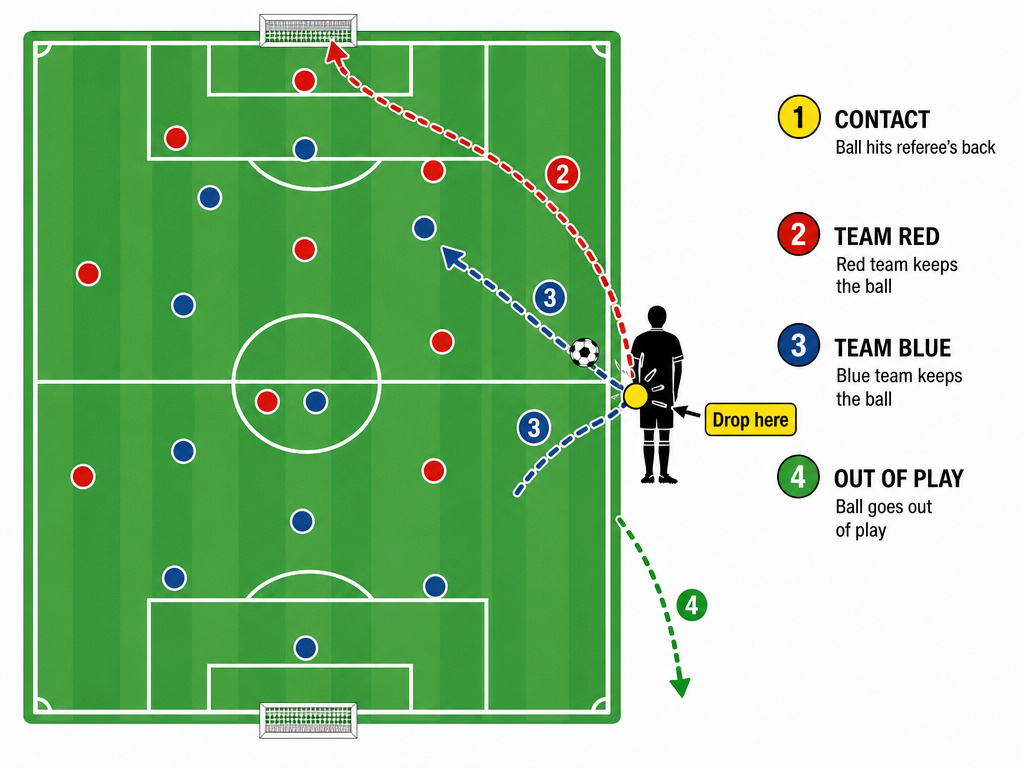
Ever watched a pass clip the referee’s back and wondered why play carries on sometimes and stops other times? Law 9 has the answer. The ball touching a match official is normally just bad luck, and play continues.
It only becomes out of play if the ball stays on the field and then:
- a team starts a promising attack,
- the ball goes directly into the goal, or
- possession changes.
Any of those three means a dropped ball at the point of contact. It goes to the team that would have kept or won the ball if the referee hadn’t been in the way.
My favourite IFAB example has the ball deflecting off an assistant referee standing on the touchline. Team A keeps it and starts an attack. The drop goes to Team B, because the ball would have gone out for their throw. That’s the 2026 wording at its smartest.
Two exceptions matter. If the ball hits the referee and leaves the field, play restarts as if the referee wasn’t there. And if it hits the referee inside the penalty area and goes straight in, the goal is disallowed and the keeper gets the drop.
If the ball hits the referee and goes off, forget the referee. If it stays on and changes the game, ask who would have had it.
The Drop Ball Rule in Football Explained for US High School Games
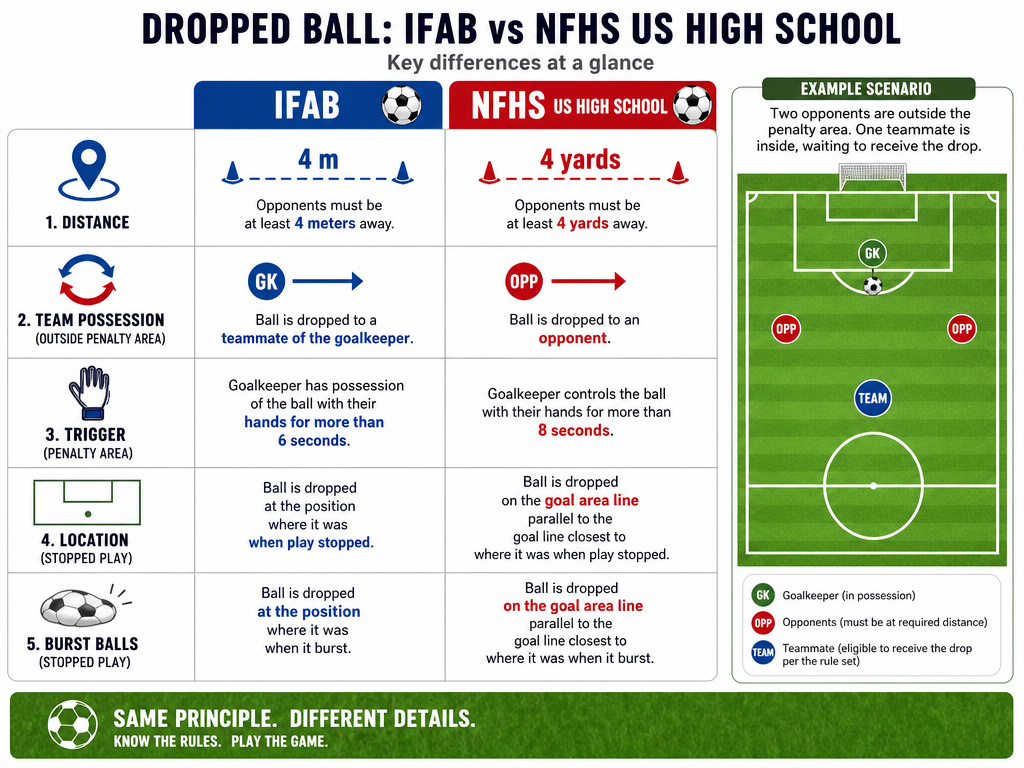
Check your rulebook before you argue. US high school soccer follows NFHS, and on several points it disagrees with IFAB.
Rewind a second. IFAB ended contested drops in 2019, giving the ball to one player from 1 June. That same year, according to the NFHS announcement of soccer rule changes, US high school soccer went the other way and let any number of players contest a drop, keepers included. It reversed course a year later.
The NFHS soccer rules changes 2020-21 adopted the one-player drop and said the change simplified the procedure. The two codes still don’t match, though.
| Point | IFAB Laws of the Game | NFHS (US high school) |
|---|---|---|
| Distance for others | 4 m (4.5 yds) | 4 yards |
| Who gets it outside the box | Team that would have kept or won it | Team that last possessed it |
| Goalkeeper trigger | Ball in penalty area when play stopped | Ball or last touch in penalty area |
| Stopped in the goal area | Keeper, at that spot | Dropped on the goal-area line |
| Burst or deflated ball | Team that would have kept it | Spot where it was last played |
The NFHS version also pushes all opponents outside the penalty area for a keeper’s drop. IFAB only asks for the 4 m gap. Under NFHS, two opponents sending the ball out together means a drop five yards inside the boundary for the team that had it before.
My eye is trained on European football, so on US rules I lean on the NFHS text rather than touchline memory. Trust the document.
As for the old contested scramble, I don’t miss it one bit. A drop that hands the ball back to the right team feels fairer than a shoving match over a ball nobody earned.
The Camera-Cable Goal That Split Opinion at the 2026 World Cup
On 11 July 2026, England beat Norway 2-1 in a World Cup quarter-final. Norway argued a goal kick had clipped an overhead camera cable before England’s equaliser. The referee didn’t stop play.
FIFA said its Connected Ball sensor showed no evidence of contact with the cable. Norway’s coach struggled to argue: “If there’s been no sound or nothing from the chip, what can I say against that?”
Former referee Mark Clattenburg, on Fox, took the opposite line. If the ball touches any outside object, he said, the whistle should go and it should be a drop ball.
Both positions fit Law 8. An outside agent touching the ball means a drop at the point of contact. The real fight was over a fact (did it touch?) and over whether a sensor reading should outrank what the cameras appear to show.
Where do I land? Uneasy, honestly. I’m a notebook-and-eyes watcher, weak on tracking data, so I can’t judge how much a ball chip should be trusted. But every match leaves a clue, and this one says referees will lean on technology for outside-agent calls more often.
Can you get a yellow card for encroaching on a drop ball?
The Law 8 text lists a redrop as the remedy for touching the ball early and does not attach a specific caution to it. Law 8 says the ball is in play once it touches the ground, and everyone other than the player receiving the drop has to keep their distance until then. Creep in early, or play the ball before it lands, and you have broken the restart.
Honestly, most referees start with a word. A player who drifts a little close gets told to back off and the drop is simply done again.
The practical advice is simple. Stand well back, wait for the ball to hit the grass, and only then go for it. A player who stays clear is allowed to play the ball first once it touches the ground, so patience costs you nothing and keeps you out of the notebook.
Frequently Asked Questions
How does drop ball work in football?
The referee stops play, picks one player and drops the ball for them. Everyone else stays 4 m (4.5 yds) away under IFAB until it hits the ground. Once it lands it’s a live ball, and no goal counts until two players have touched it.
What are the new rules for drop balls in football?
IFAB’s 140th AGM in February 2026 clarified that the ball goes to the team that would have retained or gained possession had play not been stopped. The team that last touched it only gets the drop when the referee can’t tell. The change was brought in for the 2026 World Cup.
Can a goalie drop a ball and pick it back up?
On a dropped-ball restart, yes. Once the ball has touched the ground in the keeper’s own penalty area, the keeper can pick it up. The keeper also doesn’t have to play it and can leave it for a team-mate.
What is the stupidest rule in football?
That’s a matter of taste, and the two-player scoring rule gets plenty of votes. It exists so a team handed the ball can’t simply bang it straight in. Cork City fans felt it the other way in 2021, when a goal stood that the rule should have cancelled.
Does an accidental whistle mean a dropped ball?
Yes. The IFAB FAQ says play restarts with a dropped ball after a referee blows the whistle by accident, using the usual rules on who gets it and where.
The Bottom Line
One concession first. Everything above about who gets the ball assumes IFAB football, and a US high school match runs on NFHS Rule 9-2-3 instead. Before your next game, find out which code your league uses. If it’s NFHS, the last team in possession gets the drop, and the goal-area rules change too.
If you remember one thing: under IFAB, the drop goes to whoever would have had the ball, the keeper gets it in the box, and nobody scores until two players have touched it.
The rest is concentration. A drop ball looks like a pause, but the moment it lands it’s as live as any pass.
So here’s one to argue over: should a ball chip get the final word on whether a goal stands?
