
Kick Off Rules in Football: Soccer and NFL Explained
This post contains affiliate links. As an Amazon Associate, we earn from qualifying purchases.
Kick off rules in football say the ball sits still on the centre mark, every player except the kicker stays in their own half, and opponents keep at least 9.15 m (10 yds) away. The ball is live once kicked and clearly moving, in any direction, and a goal can go straight in from it.
That centre-mark ritual is the soccer reading of the phrase, and it’s the one most of this guide follows. American football uses the same word for a completely different play. The NFL has rewritten its version every season since 2024, so that code gets its own sections near the end.
What follows: the Law 8 procedure step by step, who kicks off and when, what each offence costs, the 2016 change that reshaped kick-off tactics, futsal’s smaller numbers, and the NFL’s dynamic kickoff with the safety data both sides still argue over.
Key Takeaways
- The team that chose ends takes the second-half kick-off in 11-a-side. Futsal flips this: the toss winner kicks off the second half.
- A kicker who plays the ball twice gives away an indirect free kick, or a direct one if the second touch is a handball. Most other procedure errors just mean a retake.
- Kick before the referee’s signal and the same team retakes it. Nobody gets a free kick for jumping the whistle.
- The NFL’s 2025 rule moved the touchback to the 35 for kicks reaching the end zone in the air, and Football Zebras’ summary says 2026 lets teams declare an onside kick at any point, though its scorecard wording reads ‘not trailing in score’.
- Whether the dynamic kickoff is safer is still disputed: the league cites a 43% drop in the concussion rate, while a 2025 study calls the concussion effect unclear.
Kick Off Rules in Football: The Law 8 Procedure, Step by Step
Law 8 of the IFAB Laws of the Game covers the start and restart of play, and the kick-off sits at the top of it. The Laws of the Game give it three jobs: starting both halves, starting both halves of extra time, and restarting play after a goal.
Law 8 kick-off procedure: a stationary ball on the centre mark, every player except the kicker inside the team’s own half, and opponents at least 9.15 m (10 yds) from the ball. The ball is in play once kicked and clearly moving. A direct goal against the opponents counts; a direct own goal gives the opponents a corner kick.
That’s the whole thing in a paragraph. The detail lives in the order, so here it is the way a referee runs it, taken from IFAB’s Law 8 text and the FA’s version of the same law.
- The referee tosses the coin. Not a captain, not an assistant referee. IFAB’s own Q&A says a captain or assistant asking to do it gets a flat no.
- The ball goes on the centre mark and stays still. Kick a rolling ball and you’ve broken the procedure, which means the kick-off is retaken.
- Everyone except the kicker gets into their own half, with opponents at least 9.15 m (10 yds) back. Skip this and the referee won’t start play; if a defender creeps in early, the referee can still play advantage.
- The referee gives the signal. Go early and your team retakes the kick-off, so the only thing you’ve won is a ticking-off.
- The kicker kicks, and the ball has to clearly move. Touch it again before anyone else does and the opponents get an indirect free kick.
On a wet Sunday pitch the centre mark is a smudge of white paint in the mud, and the ball keeps rolling off it. Referees wait. A ball drifting an inch isn’t stationary, and the Law doesn’t care how cold everyone is.
The kick-off is one restart among several. Law 8 names the others: free kicks, penalty kicks, the throw-in, the goal kick and the corner kick. Anyone still learning the basic rules lumps them together. Each one has its own distances and its own penalties for getting it wrong.
Who Kicks Off First, and Who Takes the Second Half?
Two captains, one referee, one coin in the centre circle. Whoever calls it right gets a choice, and that choice decides more than the first ten seconds.
Under the FA’s Law 8, the toss winner picks one of two things. Their opponents get the other.
- Pick the end to attack in the first half, and the opponents kick off.
- Pick the kick-off, and the opponents choose ends.
- Second half: the team that chose ends in the first half kicks off. That’s the bit that trips up Sunday-league linesmen, me included on at least one muddy afternoon.
- After any goal, the conceding team kicks off.
Rewind a second, because the history here is messier than the rule. IFAB’s 2022/23 changes added the line that the referee tosses the coin, to match the wording in Law 10. The option to take the kick-off itself as your prize arrived earlier. The Irish Times dated it to around the 2019/20 season, and I’ll be honest: I couldn’t confirm the exact year from IFAB’s own documents.
My take? On a windy day I’d take the ends every time. The kick-off is a few seconds of possession. The wind behind you lasts a whole half.
Easy to miss: Extra time gets a brand-new coin toss. The referee tosses again, the winner chooses ends or kick-off afresh, and nothing from the original toss carries over.
What Happens When the Kick-Off Goes Wrong?
A retake, mostly. Law 8 says any infringement of the procedure means the kick-off is taken again. The exceptions are where it gets interesting, and IFAB’s Q&A answers the odd ones directly.
| What happens | Decision | Where it comes from |
|---|---|---|
| Kicker touches it twice before anyone else | Indirect free kick (direct if handball) | Law 8 |
| Kick taken before the referee’s signal | Retake by the same team | IFAB Law 8 FAQ |
| Defender enters early, ball goes straight in | Advantage played, goal awarded | IFAB Law 8 FAQ |
| Scoring team still off the pitch celebrating | No kick-off until they’re back | IFAB Law 8 FAQ |
| Ball goes directly into the kicker’s own goal | Corner kick to the opponents | Law 8 |
| Any other procedure infringement | Kick-off retaken | Law 8 |
The double touch
This is the one that costs real possession. The kicker scuffs it, the ball barely moves, and instinct says tap it again. That second touch hands the ball over.
Common mistake: Treating a fluffed kick-off as a do-over. Once the ball has clearly moved, it’s in play, and a second touch by the kicker before anyone else plays it is an indirect free kick to the other side.
Offences while the ball is dead
The FA’s Law 8 has a line I wish more players knew. An offence committed while the ball isn’t in play doesn’t change how play restarts.
If the ball hasn’t been kicked yet, the restart stays a kick-off. Cards can come out; the restart doesn’t move.
Don’t confuse any of this with the dropped ball. There, everyone else keeps 4 m (4.5 yds) away, the ball is live when it hits the ground, and a goal only counts once at least two players have touched it. A kick-off has no such limit. The kicker can score straight from the centre mark against the opponents, and that single difference catches out plenty of pub-quiz teams.
The 2016 Backward Kick-Off and the Tactics It Opened Up
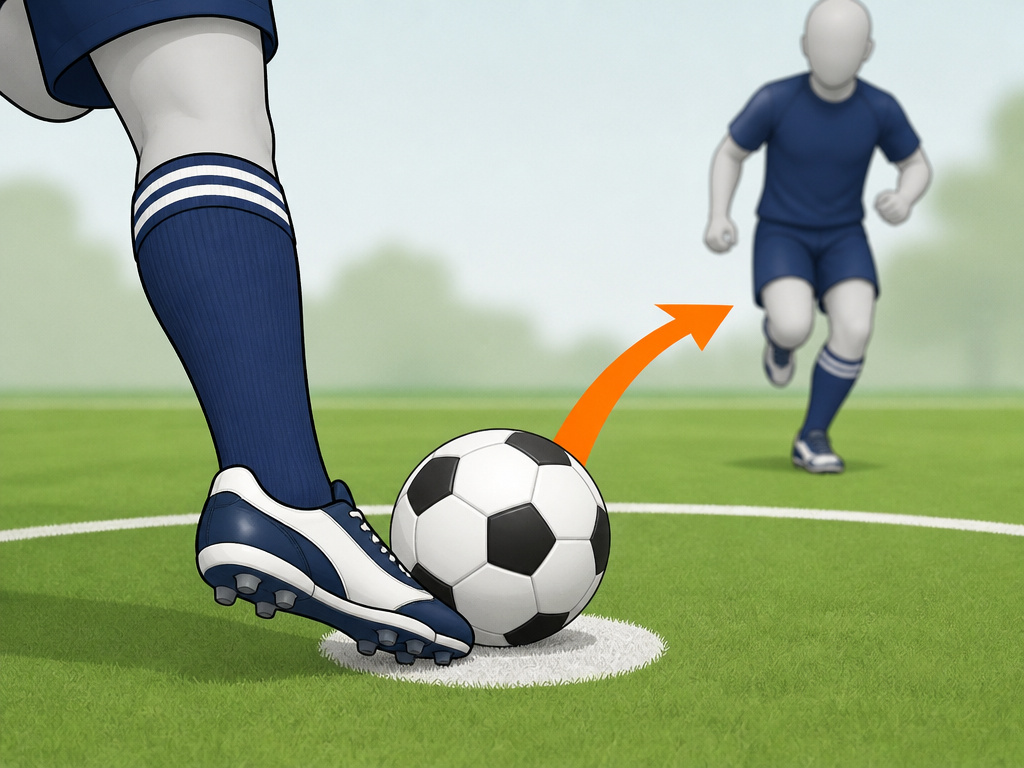
1 June 2016 is the date the ball was first allowed to go backward from a kick-off. Before that, it had to move forward or the kick-off was retaken.
You’ll remember the old shape if you watched football before then. Two players stood over the ball. One nudged it forward a few inches, the other turned and passed it back. It was a legal workaround for a pointless rule, and it took two bodies to do one job.
Now one player can roll it straight back to a midfielder. That freed the second player to run.
What teams do with it now
Three shapes cover most of what you’ll see:
- The pass back and keep it. The safe build-up from the back.
- The long ball, launched from the centre into the channel behind the opposing full-back while runners sprint after it.
- A rehearsed passing move straight through the middle, the kind clubs drill in closed sessions.
A kick-off routine works like joinery. A dovetail only holds when both halves are cut to match, and a long ball only works when the runners, the kicker and the receiver all move on the same beat. One brilliant player with nobody moving off the ball is just a nice piece of wood.
Here’s my confession. I preach quick restarts as football’s most underused weapon, because defences are scrambled in the first few seconds. The kick-off is the one restart where that sermon falls flat. The Law makes every player get back into their own half and wait for the signal, so nobody’s caught out of shape at the start.
The chance comes a beat later. The flat thud of a long ball off a cold boot, a back line still settling into its line, a keeper a few yards off his goal: this is when kick-off goals happen, and Law 8 lets a goal stand straight from the kick against the opponents.
I’d rather watch a youth side pass it back and keep the ball than boot it from the centre to steal a cheap goal. The long ball wins a few games at that age and teaches nobody how to play.
Kick-offs are also the best place to start if you’re teaching someone to watch the game. A mate who’d always called football dull started coming to weekend matches with me, and within about two months he was spotting offside traps before I did. Start him on the kick-off shape. The rest follows.
One caveat for American readers. NISOA, the US college soccer officials’ body, reported in 2016 that NCAA soccer still required the ball to move forward at kick-off. I haven’t been able to verify the current NCAA wording, so check the rulebook your league actually uses.
Futsal and Youth Kick-Offs: Where 9.15 m Shrinks to 3 m
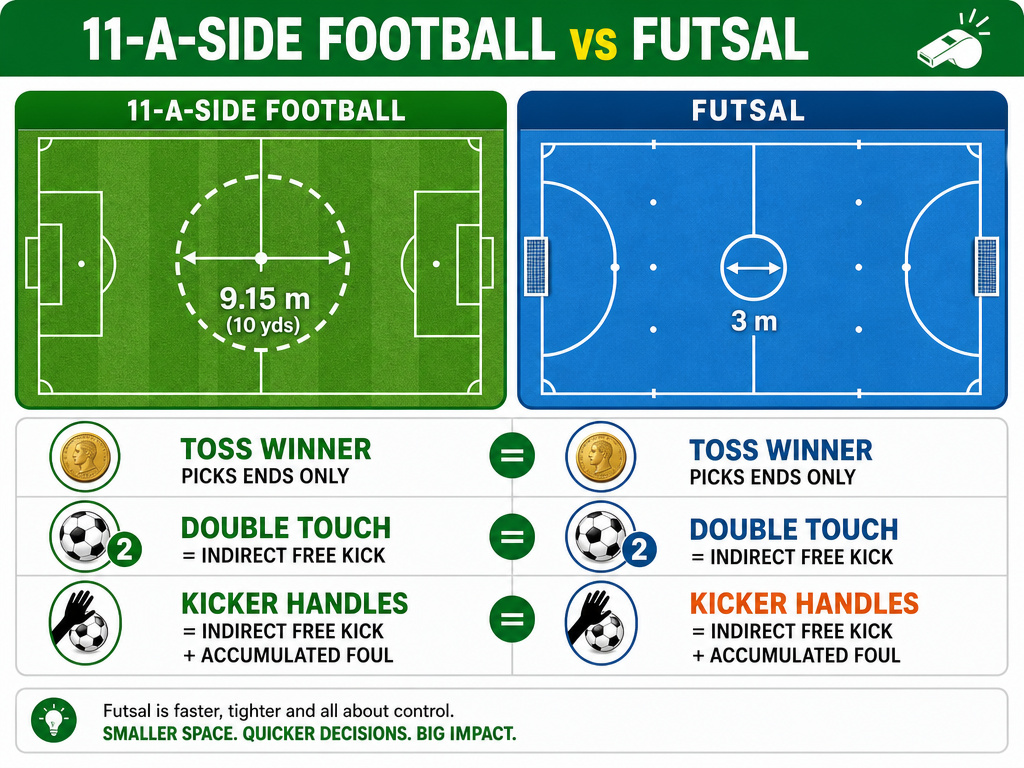
Futsal keeps the shape of Law 8 and changes the numbers, plus one detail most crossover players miss.
Futsal’s version of Law 8
Opponents only need to stand at least 3 m from the ball in futsal, according to the FA’s futsal Law 8. The coin toss works differently too. The winner chooses which goal to attack, the other team kicks off, and the toss winner kicks off the second half.
| Rule | 11-a-side (Law 8) | Futsal (Law 8) |
|---|---|---|
| Opponents’ minimum distance | 9.15 m (10 yds) | 3 m |
| Toss winner’s choice | Ends or the kick-off | Ends only; other team kicks off |
| Second-half kick-off | Team that chose ends | Toss winner |
| Kicker touches it twice | Indirect free kick | Indirect free kick |
| Kicker handles it | Direct free kick | Indirect free kick plus accumulated foul |
The futsal handball line matters more than it looks. An accumulated foul counts toward a team’s running total in the half, so a clumsy kicker’s hand costs more than one free kick.
Other futsal infringements have their own outcomes. If the ball goes directly into the opponents’ goal after one, it’s a goal clearance. If it goes into the kicker’s own goal, it’s a corner kick.
Youth and small-sided games
I’ll be straight with you: I haven’t found a single governing text that sets youth kick-off distances everywhere. Leagues write their own small-sided rules. Ask yours for its handbook before you mark out the centre circle with cones.
What I’d say to youth coaches is simpler. Every kick-off is a chance to practise a pass, a run and a shape. Spend it on that.
The NFL Dynamic Kickoff: Where Everyone Lines Up in 2026
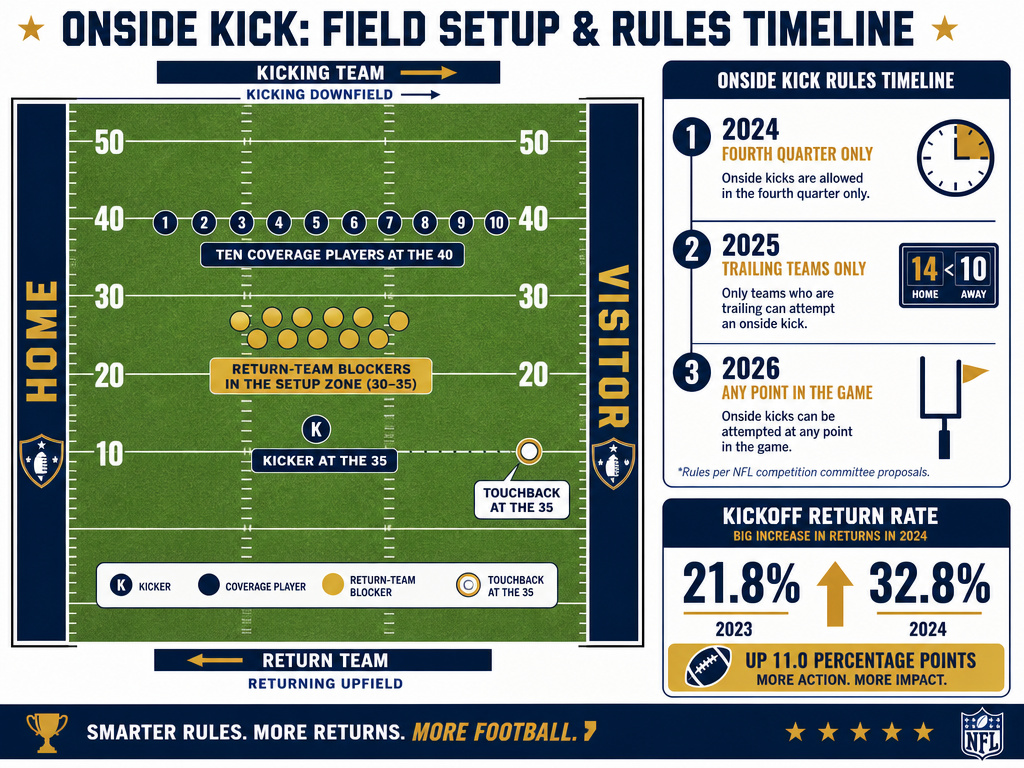
The NFL’s dynamic kickoff arrived in 2024 and became a permanent fixture in 2025. I’m a soccer man first, so I read these yard lines from the rulebook reporting rather than from years on a gridiron. Treat my take on the NFL side as a careful fan’s, not a coach’s.
The alignment
Falcons.com and AP describe the setup like this:
- The kicker lines up at his own 35.
- The other ten coverage players line up at the 40.
- At least nine return-team blockers stand in the setup zone, between the 30 and the 35.
The 2026 owners’ rule changes loosened the receiving side, per Football Zebras. The return team now needs only 5 players (down from 6) with a front foot on the restraining line, and it can use up to 4 floaters. The rulebook also defines a landing zone and penalises short kicks. I couldn’t get primary rulebook text for those exact spots, as the NFL’s own dynamic-kickoff page was down when this was researched, so I won’t quote yard lines I can’t source.
Touchbacks and penalty-moved kicks
In 2025 the touchback for kicks reaching the end zone in the air moved from the 30 to the 35. The AP coverage of kickoff touchback change laid out the competition committee’s thinking: put the ball far enough upfield that kicking it deep stops being the easy choice.
Then 2026 added a narrow case. If a penalty moves the kickoff up to the 50, touchbacks and out-of-bounds kicks are now spotted at the 20, down from the 25. One SI-syndicated piece gave the 35 for this situation. Football Zebras and team sites say the 20, and the 35 looks like a mix-up with the 2025 change.
Onside kicks
This rule has changed three seasons running:
- 2024: onside kicks allowed in the fourth quarter only.
- 2025: allowed for trailing teams only.
- 2026: a team can declare one at any point in the game, according to Football Zebras.
The part nobody mentions: Football Zebras’ own vote scorecard words the 2026 onside rule as allowed for a team “not trailing in score,” which doesn’t match the “any point” summary in the same article. Until the league publishes the final text, I’d watch how officials apply it in the first few weeks.
Any of these changes needed a three-quarters vote, which means 24 owners. Abstentions count as a no.
Why don’t NFL players run on kickoffs?
The answer depends on which season you mean. In 2023, only 21.8% of kickoffs were returned. Teams booted it into the end zone and took the touchback, so the coverage team’s sprint ended in a whistle.
The dynamic kickoff changed the setup. Both units now start from fixed yard lines instead of a full run-down from beside the kicker. The return rate jumped to 32.8% in 2024, per ESPN, with an average return of 27.6 yards.
Did the New Kickoffs Actually Make Football Safer?
The safety case is weaker than the league’s headline number suggests. Every match leaves a clue, and in this case the clues point in two directions.
Start with the college experiment that inspired all of this. In 2016 the Ivy League moved kickoffs to the 40 and touchbacks to the 20. Touchbacks rose from 17.9% to 48%. The JAMA Ivy League kickoff study by Wiebe and colleagues found kickoff concussions fell from 10.93 to 2.04 per 1,000 plays, comparing 2013-15 with 2016-17. Other play types fell from 2.56 to 1.18 over the same years.
A small wrinkle in the units: JAMA counts per 1,000 plays, while the Brown University kickoff concussion findings say per 1,000 kickoffs. The figures match. Only the label differs.
NCAA football had already moved kickoffs from the 30 to the 35 in 2012. In 2018 it went further. A fair catch inside the 25 now counts as a touchback, with the ball placed at the 25.
The NFL went the other way. It wanted more returns, not fewer, and safer ones. That’s where the sources split.
| Question | One source says | Another says |
|---|---|---|
| Concussions after the 2024 change | NFL (Rich McKay): rate fell 43%, totals flat | OJSM 2025 study: net effect unclear |
| Projected 2025 return rate | ESPN: 60-70% | AP: 65-75% |
| 2026 spot after penalty to the 50 | Football Zebras: the 20 | SI-syndicated piece: the 35 |
| Who can onside kick in 2026 | Any team, any point | Scorecard: teams “not trailing in score” |
McKay’s 43% is a rate per play. Because returns rose so sharply, the raw number of kickoff concussions stayed flat. At least one other outlet reported a 60% fall; I couldn’t pin down its source, so I’d weight the committee’s own 43% figure.
The 2025 study in the Orthopaedic Journal of Sports Medicine, by Puga and colleagues, read game books and the next week’s team injury reports for 2022, 2023 and 2024. It found significant rises in overall injuries, plus lower-body and upper-body injuries, in 2024. Concussions were up on 2023 but down on 2022.
So which is it? Honestly, I’m a notebook-and-eyes analyst, not a tracking-data one, and this is exactly where my method runs out. Two seasons of data with a moving rulebook can’t settle it.
Frequently Asked Questions
What are the rules for kicking off in football?
In 11-a-side football, the ball sits still on the centre mark, everyone except the kicker stays in their own half, and opponents stand at least 9.15 m (10 yds) away. The referee signals, and the ball is in play once kicked and clearly moving. The kicker can’t touch it again until another player has.
Can you score directly from a kick-off?
Yes, against the opponents. Law 8 allows a goal straight from the kick-off. If the ball goes directly into the kicker’s own goal, the opponents get a corner kick instead.
Does the ball have to go forward at a kick-off?
Not since 1 June 2016 under IFAB’s Laws, when backward kick-offs became legal. Before that the ball had to move forward. NCAA soccer still required a forward kick-off as of 2016, and the current college wording is worth checking.
Why do NFL players not run on kickoffs?
Before 2024, most kicks ended in touchbacks, with only 21.8% returned in 2023. The dynamic kickoff now starts both units from fixed yard lines, the coverage team at the 40 and blockers between the 30 and 35, rather than a long run-down from the kicker.
What is the new NFL rule on kickoffs?
For 2026, Football Zebras’ summary says teams can declare an onside kick at any point in the game, but its scorecard wording allows it for a team ‘not trailing in score’. If a penalty moves the kickoff to the 50, touchbacks and out-of-bounds kicks go to the 20. The receiving team needs only five players on the restraining line and can use up to four floaters.
The Bottom Line
The kick off rules in football are shorter than most people expect. The soccer version fits in a paragraph, and the edge cases fit in a table.
Here’s your first step for this weekend. At the next kick-off you watch, check three things before the whistle: who won the toss and what they chose, whether every player is back in their own half, and whether the kicker touches it twice. Get those three right and you’ll call the second-half kick-off correctly when the commentator gets it wrong.
One honest limit on all of this. The NFL side is still moving, and the 2026 onside wording and the safety data could shift again before next season. Treat those sections as the state of play today, and read the league’s final text when it lands.
So, on a windy day, would you take the kick-off or the ends?
