
Penalty Kick Rules in Football: Every Offence and Outcome
This post contains affiliate links. As an Amazon Associate, we earn from qualifying purchases.
Penalty kick rules in football require a stationary ball on the penalty mark, a clearly identified kicker, all players except the kicker and goalkeeper at least 9.15 m from the mark, and a goalkeeper with at least part of one foot on, in line with, or behind the goal line when the ball is kicked.
That clause about the goalkeeper’s foot is a rule change from 2019. Before it, both of the goalkeeper’s feet had to stay on the line. Referees and VAR have spent the years since sorting out what one foot off the line really allows.
What follows: when a penalty is awarded, the kick step by step, a plain list of what each player can’t do, a results table for common breaches, and the places where IFAB, high school and college rulebooks disagree.
Key Takeaways
- Encroachment is punished only when it has clear impact on the kick. IFAB and the US high school body (NFHS) use that wording; the Premier League says “material impact”.
- Under IFAB, a goalkeeper’s first offence in a game earns a warning, then a yellow card for any repeat, including on the retake. NFHS adopted a warning first from 2026-27, while NCAA 2016-17 gave a retake with no mandatory caution.
- Stopping after the run-up to fool the keeper costs an indirect free kick and a yellow card, even when the ball goes in.
- After a post or crossbar rebound, the kicker needs another player’s touch before playing the ball again.
- College rules from 2016 treat several of these offences differently, so confirm which rulebook your competition uses.
What Fouls Earn a Penalty, and What Card Comes With Them?
Some readers write in wanting to skip straight to the clever stuff. I send them back here every time, because you can’t judge a penalty without knowing where the foul happened and what it did to the attacker.
A penalty kick is awarded when a defender commits a direct free kick offence inside the defender’s own penalty area while the ball is in play. The penalty area line belongs to the area, so contact on the line counts as inside. Handball, holding, pushing, and reckless tackles all qualify when the offence occurs within those boundaries.
The line rule trips up more arguments than any other. IFAB’s Law 1 says lines belong to the areas they bound, so a reckless tackle with its point of contact on the line is a penalty and a yellow card for the defender.
Where the ball sits doesn’t matter either, as long as it’s in play. IFAB’s own example: a defender starts a fight in the middle of the field and strikes an attacker inside the defender’s penalty area. Penalty kick, and a red card for violent conduct.
The card depends on what the foul did to the attacker:
- Deliberate handball that denies a goal: red card.
- Non-deliberate handball that denies a goal: yellow card.
- A challenge for the ball that denies an obvious chance: yellow card, because the penalty already restores the opportunity.
- Holding or pushing without playing the ball: red card.
Referees call that second category denying an obvious goal-scoring opportunity. If the defender never tried to play the ball, the sanction is a red card. If the defender went for the ball, it drops to yellow.
How Does a Penalty Kick Run, Step by Step?
Six things happen in order, and each has its own price if somebody gets it wrong. I think of it like joinery: every part has to sit exactly where it belongs or the whole piece fails.
- Ball on the mark. The ball sits stationary on the penalty mark, with part of it touching or overhanging the centre of the mark. A ball that overhangs the mark without touching it is still placed correctly, so the referee allows the kick to go ahead.
- Kicker identified. The referee needs to know who is taking it. If a team-mate steps up after the signal, play restarts with an indirect free kick to the defence, goal or no goal, and the player who took it is cautioned.
- Everyone else back. Every player except the kicker and goalkeeper stands at least 9.15 m (10 yds) from the mark, behind it and outside the penalty area. Early entry is only punished when it has impact, which the encroachment section below covers.
- Goalkeeper on the line. Part of one foot must touch, sit in line with, or stay behind the goal line until the ball is kicked. Break that and the kick is retaken whenever the offence changed the outcome.
- Referee signals, kicker runs. Stopping after the run-up is finished to fake out the keeper brings an indirect free kick and a yellow card. If the kicker feints and never touches the ball, the kick is retaken and the kicker is cautioned.
- Ball kicked and clearly moves. Only then is it in play. The ball has to go forward.
That last step explains the feint ruling. A free kick restarts play, but the ball was never in play, so there’s nothing to restart. The referee retakes the kick instead.
Backheels and short passes are legal on IFAB’s Law 14 as long as the ball goes forward and the kicker doesn’t touch it a second time before another player does. A kicker who taps it to a team-mate arriving after the ball is in play can see that team-mate score. The goal stands.
Time is no obstacle at the end of a half. Added time is allowed for the kick. If a goal is scored at the end of the second half, the match ends. No kick-off.
What Each Player Can’t Do: Kicker, Goalkeeper and Everyone Else
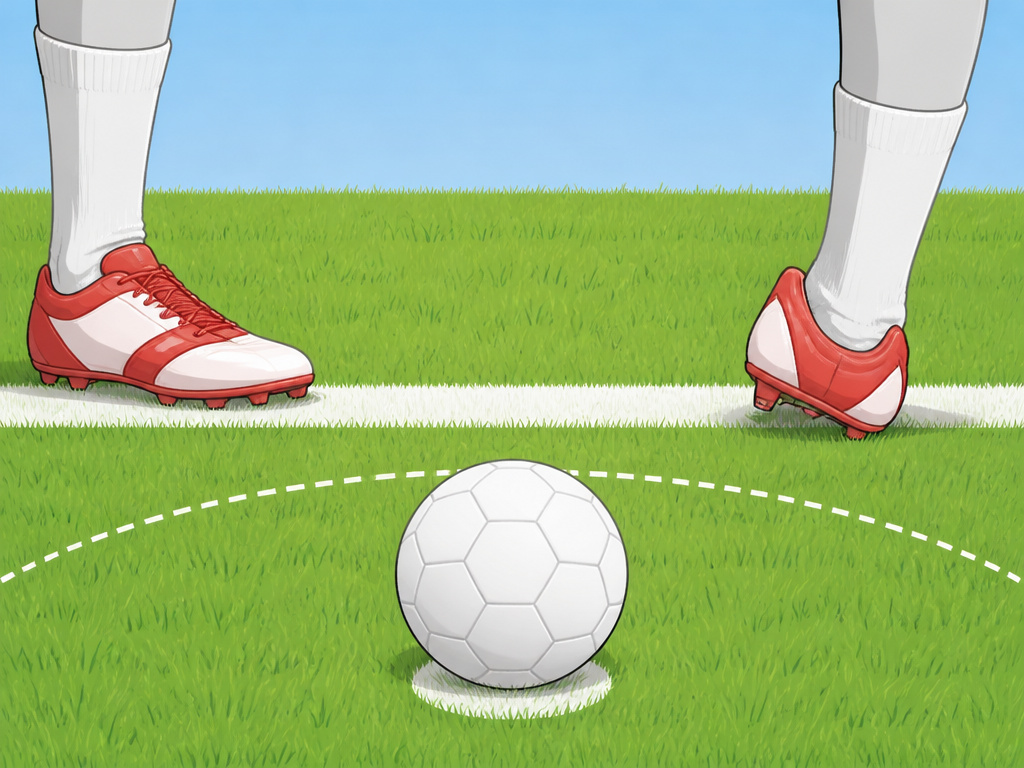
IFAB’s Law 14 gives each role its own short list of banned moves. Here they are in plain language.
The kicker
- Kicking the ball backwards.
- Touching it a second time before another player has, apart from a rebound off the goalkeeper.
- Feinting after the run-up is complete.
- Letting someone else take the kick once the referee has signalled.
Feinting during the run-up is fine. The offence starts once the run-up is finished and the kicker deliberately stops to fool the keeper. Skip that move. A kicker who already carries a yellow card and does it goes off with a second yellow and a red.
The practical side of penalty technique lives inside those limits, so learn the edges before you try anything fancy.
The goalkeeper
- Standing with both feet in front of the line when the ball is kicked.
- Touching the crossbar to rattle the kicker.
- Unfairly distracting the kicker or delaying the kick.
A goalkeeper can move arms, jump and shuffle along the line, provided nothing looks disrespectful or unfair. Picture a keeper bouncing on the chalk with one boot toe curled over the line. Legal. Both boots a stride in front: not.
The punishment for goalkeeper encroachment depends on what the kick did next. If the keeper saves with both feet forward, the kick is retaken. If the ball misses or hits the post, play continues unless the offence clearly impacted the kicker. If the keeper saves and the rebound goes to an attacker who scores, the referee plays advantage, the goal stands and there’s no warning or caution.
The crossbar trick gets a retake and a warning for a first offence. Distracting or delaying earns a yellow.
Everyone else
- Standing inside 9.15 m, in front of the mark, or inside the penalty area.
- Putting a foot on the penalty area line. The line is part of the area, so that counts as encroaching.
- Shouting at the kicker. A defender who does it forces a retake and gets a yellow card for unsporting behaviour.
Easy to miss: A boot resting on the painted line looks harmless from the stands. It’s encroachment. If that attacker then scores off a rebound, the goal comes back and the defence gets an indirect free kick from where the attacker entered the area.
An attacker standing outside the area, inside the field and behind the mark is legal. If that team-mate’s side scores, the goal stands.
The Impact Test Behind Every Encroachment Call
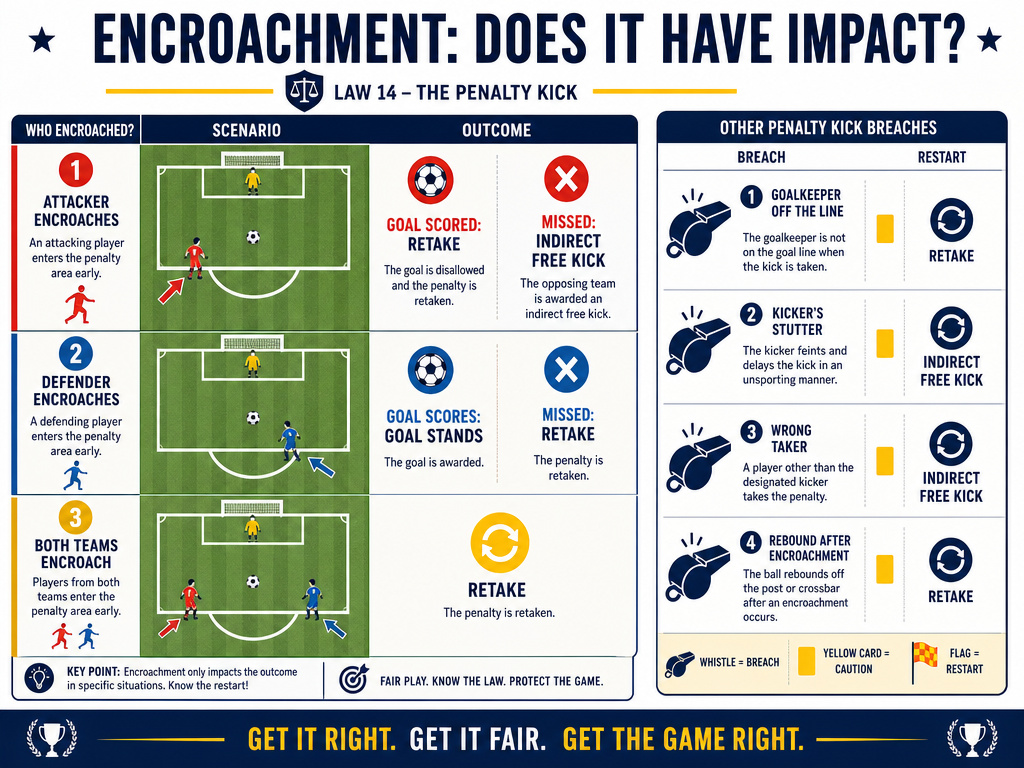
Impact is the word that decides it. IFAB says a kick is retaken after a defender encroaches only if the encroacher clearly impacted the kicker, or played the rebound or challenged and stopped a scoring chance. The NFHS rule release of 16 March 2026 uses the same test: encroachment is penalised only if the offence has a clear impact on the penalty kick.
The Premier League phrases it as “material impact” and says a player encroaches if a foot is on the penalty-area line or the arc when the ball is kicked. Two wordings, one idea. Treat them as the same threshold, but expect referees to argue about where it sits.
The Premier League’s 2024/25 grid shows how it plays out:
- Attacker encroaches with impact: retake if a goal is scored, indirect free kick to the defence if not.
- Defender encroaches with impact: the goal stands if scored, retake if not.
- Both teams encroach with impact: retake.
IFAB’s examples add detail. If an attacker and a defender both encroach and both challenge for the rebound, the kick is retaken. If a team-mate of the kicker enters the arc and the keeper isn’t affected, the goal stands.
Here’s how the common breaches resolve:
| Situation | Restart | Card |
|---|---|---|
| Goalkeeper has both feet in front of the line and saves | Retake | Warning first, then yellow |
| Kicker stops after the run-up, then scores | Indirect free kick to defence | Yellow |
| Wrong player takes the kick | Indirect free kick to defence | Yellow |
| Attacker encroaches, then scores from rebound | Goal disallowed, indirect free kick | None |
| Defender shouts at the kicker | Retake | Yellow |
| Kicker touches a post rebound before anyone else | Indirect free kick to defence | None |
Not every breach ends in a retaken penalty. The table shows why. Feinting and wrong kickers go to the defence as free kicks, while keeper and defender offences usually turn on impact. A retake can also swap the taker, provided the new player is clearly identified.
I tell young kicker the same thing every time: skip the stutter at the end of the run-up. The goal you score gets wiped out, the defence gets the ball, and you walk away with a yellow card. The save you were trying to avoid looks pretty good by comparison.
Where this goes sideways: Assuming a goal always counts once the ball is in the net. An attacker who encroaches, then scores from a rebound, has the goal disallowed. The referee restarts with an indirect free kick, and no card is shown.
Double Touches, Rebounds and the Slip That Decided a Shootout
March 2025, Champions League round of 16, Atletico against Real Madrid, and the tie went to a shootout. Julian Alvarez slipped and touched the ball twice. VAR ruled the goal out, and Atletico lost the shootout.
That incident led to a clarification in June 2025, set out in an IFAB circular effective 1 July 2025. IFAB itself admitted the situation was “not directly covered in Law 14”, so referees had drifted toward penalising the kicker.
The new handling for an accidental double touch:
- Scored: retake.
- Missed in a match: indirect free kick to the defence.
- Missed in a shootout: recorded as a miss.
Here’s the bit people skip: the change only covers accidental touches. A deliberate second touch is still an indirect free kick, or a direct free kick if it’s handball. In a penalty shootout the same slip is simply a miss, since there’s no live ball to restart with.
Sources disagree on what kind of change this was. Football-Espana reported in March 2025 that IFAB’s annual changes for 2025/26 included no alteration to the double-touch rule. The Premier League’s 2025/26 guide lists it as a change for the season. PA and NBC reported a circular letter effective 1 July 2025. My read is a mid-cycle circular, not a Law rewrite from the annual meeting.
Rebounds follow simpler logic. The ball clangs off the crossbar and spins back toward the mark, and every kicker’s instinct is to chase it. Don’t.
If the ball comes back off the goalkeeper, the kicker can play it. If it comes back off the post or crossbar, hands and feet off until another player touches it.
I’ve got form for judging too fast. I once published an analysis after a single viewing, breaking my own three-match rule, and misread a player’s role. The correction taught me that rules only help if you follow them. I treat double-touch calls the same way: one slow-motion replay isn’t the law.
Why the One-Foot Goalkeeper Rule Still Divides Players and Referees
The 2019 IFAB change let goalkeepers keep one foot off the line, where previously both feet had to be on it. Collina said saving a penalty under the old rule was “very difficult”. The goalkeeper line rule now asks for one thing at the moment of the kick: part of one foot touching, in line with, or behind the goal line.
Enforcement was messy at first. The 2019 Women’s World Cup had three penalties retaken after VAR intervention: Scotland v Argentina, France v Nigeria and Italy v Jamaica. In the first, Lee Alexander saved Florencia Bonsegundo’s kick, it was retaken, and Scotland went out in the closing seconds.
The players hated it. Karen Bardsley called it “cruel. And so pedantic.” Hope Solo said that “If a shooter misses, they shouldn’t get a freebie simply because a goalkeeper moved slightly forward.”
Even the Premier League contradicted itself. It said in 2019 it would not use VAR against goalkeepers moving off their line. Its 2020/21 VAR explainer says there are “no tolerance levels”: a save with the keeper’s foot over the line is retaken. I can’t reconcile those two statements, and I won’t pretend to.
There’s also data. The penalty feet positioning rule study in Scientific Reports (Monteiro et al., 2022) measured six goalkeepers (two professional, four amateur, 20 dives). Under the 2019 one-foot rule, they dived further and faster (p < 0.001 for both).
A Brazilian research agency’s press write-up describes lab tests with ten goalkeepers, but the paper reports six, so I’m going with the paper. Six is a small sample. Read it as a signal, not a verdict. (I’m a notebook-and-eyes writer, not a data analyst, which is exactly why I lean on the paper.)
Keepers who care about saving penalties should note that the rule hands them more room, and the study suggests they use it.
Penalty Kick Rules in Football Differ by Competition: IFAB, NFHS and NCAA
The NFHS Soccer Rules Committee approved 13 proposals at its February 9-11 meeting in Indianapolis, including new penalty kick encroachment guidance and major rewrites to Rules 13 and 14. The headline for penalties: encroachment is punished only with clear impact, and a goalkeeper’s first offence now brings a warning instead of a caution.
The NFHS soccer rules interpretations 2026-27 show it in action. A defender’s shout means a retake (Rule 12-3-6). An attacker who encroaches and scores off a crossbar rebound gives the defence an indirect free kick (Rule 14-1-2). Goalkeeper encroachment that clearly impacts the kicker means a retake, with a warning for the first offence and a caution afterwards (Rule 14-1-3).
That puts high school rules very close to IFAB. Before 2026-27, though, NFHS gave the goalkeeper an immediate caution.
| Rulebook | Goalkeeper offence | Illegal feint | Wrong kicker |
|---|---|---|---|
| IFAB Law 14 | Retake if it matters; warning, then yellow | IFK and yellow; retake and yellow if untouched | IFK, yellow |
| NFHS 2026-27 | Retake if clear impact; warning, then caution | Not in my sources | Not in my sources |
| NCAA 2016-17 (NISOA) | Retake, no mandatory caution | Retake, no mandatory caution | Retake |
The college row comes from a 2016 summary by the officials’ association NISOA, covering AR 14.3.1 and R 14.3.3. NCAA also orders a retake for a backwards kick (AR 14.2.e). I found no current NCAA rulebook text, so treat that row as history and check the live book before you argue with a referee. Check your state’s adoption of the NFHS book too.
What about new IFAB rules? I found no confirmed penalty-specific changes in the 2026/27 cycle. One item mentioned a “double touch” rule without detail, so treat it as unverified. The new VAR power to retake a restart after a foul applies to corners and free kicks, and no source I read says it covers penalties.
How does a penalty shoot-out work?
A shoot-out settles a tied match when the competition rules demand a winner. The referee tosses a coin, and the captain who wins it chooses either to kick first or which goal the kicks are taken at. After that, the teams alternate, one kick each, with a different player stepping up every time.
Each side gets a set round of kicks. If the scores are level after that round, it goes to sudden death: both teams take one more kick each, and the shoot-out ends as soon as one team has scored and the other has not.
Only players who were on the pitch when the match finished can take part, which includes anyone who was injured or sent off during the shoot-out build-up only if the competition rules allow it, so check them. A shoot-out can also end early. If one team has scored more than the other could possibly reach with its remaining kicks, the referee stops it there.
The kick itself follows the usual penalty rules, with one wrinkle. An accidental double touch by the kicker is recorded as a miss in a shoot-out, whether or not the ball goes in.
Frequently Asked Questions
What are the new rules for penalty kicks in football?
The latest change from IFAB is the accidental double-touch clarification, effective 1 July 2025. A goal scored after one is retaken, and a miss gives the defence an indirect free kick. For US high school, NFHS now requires clear impact for encroachment and a warning before a goalkeeper’s first caution.
What is not allowed during penalty kicks?
The kicker can’t kick backwards, touch the ball twice or feint after finishing the run-up. The goalkeeper can’t have both feet in front of the line, and everyone else must stay back. A defender who shouts at the kicker forces a retake and gets a yellow card.
Can a penalty taker kick the ball twice?
Not before another player touches it. A rebound off the goalkeeper counts as a touch by another player, so the kicker can play on. After a post or crossbar rebound, the kicker must wait. An accidental double touch that goes in is retaken.
What are the rules for penalty kicks in football?
Defender commits a direct free kick offence in the penalty area. The referee signals, and the ball is in play once it’s kicked and clearly moves. It has to go forward. Backheels and passes are fine, and added time is allowed at the end of a half.
Can the goalkeeper move before a penalty kick?
Yes, along the line. Arms, jumps and shuffling are allowed provided nothing is disrespectful or unfair. The only hard limit is the feet: at least part of one foot must touch, sit in line with, or stay behind the line until the ball is kicked.
The Bottom Line
Penalty kick rules in football look simple until two things go wrong at once. The sources agree on the core procedure and split on the discipline, so the first job is knowing which rulebook your competition uses. This week, find out whether your league follows IFAB or an NFHS-style book.
Then act on that knowledge. If you take penalties, skip the end-of-run-up feint: the goal is erased and the yellow card stays. If you coach, rehearse the rebound rule in training, because a kicker who chases a post rebound hands the defence a free kick.
One caveat on all of this. College guidance I found dates from 2016, so don’t treat that row of the comparison as current. IFAB and NFHS are close now; the older college rule is the outlier.
Would you keep the one-foot rule, or send goalkeepers back to both feet on the line?
